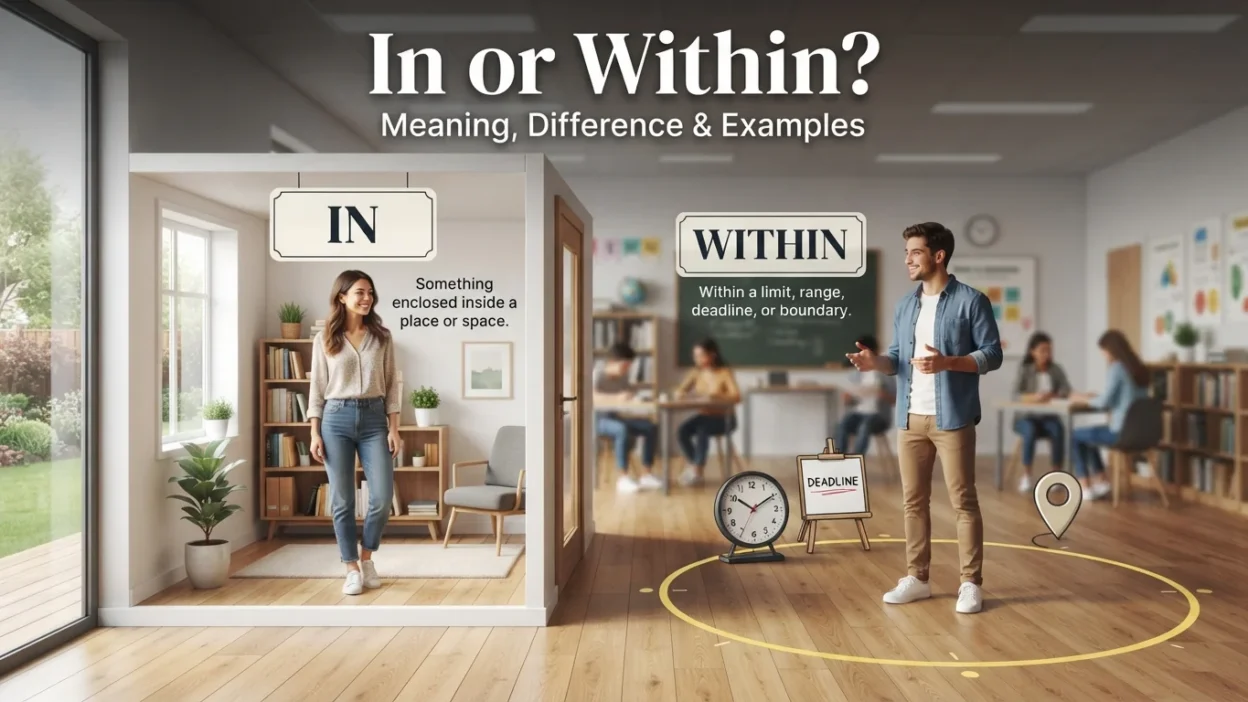
Choosing between in and within can be confusing because both words can describe something happening inside a place, period, or limit. However, they are not always interchangeable. In is the more common and natural choice in everyday English, while within often emphasizes boundaries, limits, or a specific range.
For example, we say, “She will arrive in ten minutes” when talking about the amount of time before something happens. But “Please reply within ten minutes” emphasizes a deadline or time limit. Understanding this small difference can make your English more precise and natural.
In this guide, you will learn when to use in and within, how their meanings differ, and how they work in sentences involving time, place, distance, and limits. The examples are designed to help students, ESL learners, and anyone who wants to use these words correctly.
Quick Answer: In vs Within
In usually means inside something or before a period of time has passed. Within means inside a particular boundary, range, or time limit. For example, “The keys are in the drawer” describes location, while “Please finish it within an hour” emphasizes a deadline or maximum time allowed.
Why Do People Confuse In and Within?
People confuse in and within because both can refer to something being inside a particular space or period.
Consider these sentences:
- The children are in the classroom.
- The children must stay within the classroom.
The first sentence simply describes location. The second emphasizes a boundary or restriction.
The same distinction appears with time:
- I will call you in an hour.
- Please call me back within an hour.
The first sentence usually means the call will happen after approximately one hour. The second means the call should happen at any time before one hour has passed.
What Does “In” Mean?
In is one of the most common prepositions in English. It can indicate location, time, inclusion, or a situation.
“In” for Location
Use in when something is inside an enclosed or defined place.
Examples:
- The milk is in the refrigerator.
- She is in the office.
- There are books in the bag.
- He lives in Canada.
Here, in answers the question “Where?”
“In” for Time
Use in to refer to a period of time or an amount of time before something happens.
Examples:
- The train leaves in ten minutes.
- I will finish the project in two days.
- She graduated in 2020.
- We usually travel in December.
When used with a future period, in often means after that amount of time has passed.
I will see you in three days.
This normally means the meeting will occur three days from now.
What Does “Within” Mean?
Within means inside a particular limit, boundary, range, or period.
It often carries the idea of something happening or existing no later than a specified limit.
“Within” for Time
Use within when you mean at any time before a particular period ends.
Examples:
- Please respond within 24 hours.
- The package should arrive within five days.
- You must submit the form within one week.
- The problem should be resolved within a month.
The important idea is the deadline or maximum period.
“Within” for Boundaries
Within can also refer to physical or abstract boundaries.
Examples:
- Stay within the marked area.
- The hotel is within walking distance.
- The answer is within the report.
- Keep the discussion within reasonable limits.
In vs Within: Comparison Table
| Feature | In | Within |
|---|---|---|
| Basic meaning | Inside or during a period | Inside a boundary or limit |
| Everyday usage | Very common | More formal or specific |
| Time | Often means after a period has passed | Means before the period ends |
| Place | Indicates location | Emphasizes a boundary |
| Deadline | Less direct | Commonly used |
| Example | I will return in an hour. | Return within an hour. |
| Main idea | Location or time | Limit, range, or boundary |
When Should You Use “In” or “Within”?
Use “in” for ordinary location
Use in when you simply want to say that something is inside a place.
The documents are in the drawer.
There is no special emphasis on the drawer’s boundaries.
Use “within” for a boundary
Use within when the idea of a limit is important.
Please remain within the designated area.
The sentence emphasizes the boundary that should not be crossed.
Use “in” for future time
The bus will arrive in ten minutes.
This normally means the bus is expected after about ten minutes.
Use “within” for a deadline
Please arrive within ten minutes.
This means you can arrive now, in five minutes, or close to ten minutes—but not after the ten-minute limit.
In vs Within: 12 Examples
- The children are in the garden.
- Please stay within the garden area.
- I will call you in an hour.
- Please reply within an hour.
- She lives in London.
- The village is within five miles of the city.
- The answer is in the book.
- The information can be found within the first chapter.
- We will finish the work in three days.
- You must finish the work within three days.
- He was in the building.
- Everyone must remain within the building during the drill.
Notice that in often gives a straightforward description, whereas within highlights a limit, range, or boundary.
Common Mistakes With In and Within
Mistake 1: Treating “in an hour” and “within an hour” as identical
They can communicate related ideas, but the focus is different.
- In an hour → after approximately one hour.
- Within an hour → at any point before one hour has passed.
Mistake 2: Using “within” for every location
You do not normally need within simply to say something is inside a place.
Less natural:
The keys are within the drawer.
Natural:
The keys are in the drawer.
Within becomes useful when the boundary itself matters.
Mistake 3: Confusing “within” with “after”
I will finish it within three days.
This does not mean you will definitely finish it after three days. It means the task will be completed before the three-day limit ends.
Mistake 4: Forgetting that “within” can be abstract
Within does not only describe physical spaces.
You can say:
- within the law
- within the budget
- within the limits
- within the organization
- within the specified period
A Simple Memory Trick
Think of in as inside and within as inside a limit.
IN = inside
The phone is in my bag.
WITHIN = inside a boundary or deadline
Please respond within two days.
Another easy trick:
“In” tells you where or when. “Within” tells you the limit.
American vs British English
There is no major difference between American and British English in the basic meanings of in and within.
Both varieties commonly use:
- in the room
- in London
- in five minutes
- within two days
- within the limits
- within walking distance
The choice usually depends on meaning and context rather than regional English.
Similar Words to In and Within
Several words can express related ideas, but their meanings are not exactly the same.
Inside
Inside usually emphasizes physical location.
The children are inside the house.
Into
Into describes movement toward the inside.
She walked into the room.
Compare:
- She is in the room.
- She walked into the room.
During
During refers to something happening at some point in a period.
We met during the summer.
By
By often indicates a deadline.
Please finish the report by Friday.
Compare:
Finish it within three days.
This gives a three-day time limit.
Finish it by Friday.
This gives a specific final date.
Final Verdict: In or Within?
Use in when you are talking about ordinary location, a period, or the amount of time before something happens.
Use within when you want to emphasize a boundary, range, restriction, or deadline.
The difference is especially clear with time:
- I will call you in an hour. → The call is expected after about an hour.
- Call me within an hour. → Call me anytime before the one-hour limit ends.
So, in is the more general and common word, while within is useful when a limit or boundary is important.
Frequently Asked Questions
Is “in an hour” the same as “within an hour”?
No. In an hour generally means after approximately one hour. Within an hour means at any time before one hour has passed.
Can “in” and “within” be used for time?
Yes. Both can be used for time, but they can express different ideas. In often refers to when something will happen, while within emphasizes a time limit or deadline.
Is “within” more formal than “in”?
Often, yes, especially when it is used to express limits, deadlines, or formal conditions. However, within is not exclusively formal and is common in everyday English too.
Is “within the house” correct?
Yes, but it has a different emphasis from in the house. In the house simply describes location. Within the house can emphasize the interior or the boundaries of the house.
Which is correct: “in two days” or “within two days”?
Both can be correct, depending on the intended meaning. In two days generally points to a time after two days. Within two days means any time before the two-day period ends.
Can “within” describe distance?
Yes. For example:
The school is within five miles of my home.
This means the distance does not exceed five miles.
What is the easiest way to remember in vs within?
Remember: in = inside or a point/period of time; within = inside a limit or boundary.
Remember This
- In = inside, during, or after a stated period.
- Within = inside a boundary, range, or time limit.
- In an hour usually points to when something will happen.
- Within an hour gives a maximum time limit.
- Use in for ordinary location.
- Use within when a boundary or restriction matters.
Conclusion
The difference between in and within is mainly about emphasis. In is the everyday choice for describing where something is or when something will happen. It is simple, common, and widely used in both American and British English.
Within adds the idea of a boundary, range, or maximum limit. This is especially important when discussing deadlines, distances, rules, and restrictions. Once you remember that in means “inside” while within often means “inside a limit,” choosing the correct word becomes much easier.

John Tyler is a dream researcher and content writer at SleepCout, sharing insightful articles about coded dreams, dream meanings, symbolism, sleep psychology, and practical guidance to help readers understand their dreams.