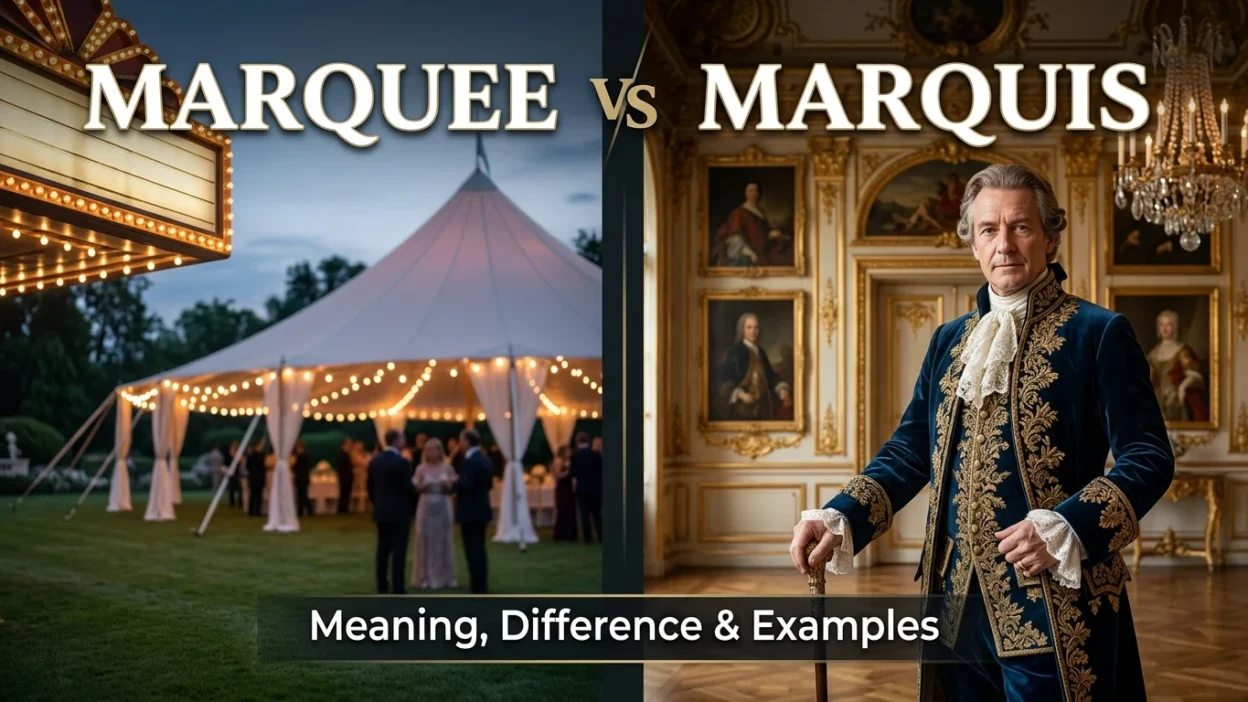
The words marquee and marquis look and sound similar, but they have completely different meanings. Marquee usually refers to a large sign above a theater or building, or a large tent used for events. Marquis is a title of nobility, traditionally ranking below a duke and above an earl or count.
Because both words are pronounced similarly in some varieties of English, it is easy to confuse them when writing. However, their meanings, spellings, and uses are distinct. In this guide, you will learn the difference between marquee vs marquis, when to use each word, and how to remember the correct spelling.
Quick Answer: Marquee vs Marquis
Marquee is a noun meaning a large tent, canopy, or sign, especially a theater sign displaying a movie or show. Marquis is a noun meaning a nobleman of a particular rank. Use marquee for tents and prominent signs; use marquis when talking about a European aristocratic title.
Why Do People Confuse Marquee and Marquis?
People often confuse marquee and marquis because they have similar spellings and pronunciations.
Both words are associated with French, which adds to the confusion. However, they developed different meanings in English.
A simple way to separate them is:
- Marquee → a tent or large sign
- Marquis → a nobleman
The context usually makes the correct word obvious.
What Does “Marquee” Mean?
Marquee is a noun with several related meanings.
1. A large tent or canopy
A marquee can be a large temporary structure used for weddings, parties, receptions, exhibitions, and other events.
Example:
The wedding reception was held in a beautiful white marquee.
In this sense, the word is especially common in British English.
2. A large sign
A marquee can also be a sign placed above the entrance to a theater, cinema, or other entertainment venue.
Example:
The movie title was displayed on the theater marquee.
A marquee may contain the name of a movie, play, performer, or event.
3. A prominent or highly important attraction
In modern English, marquee can also be used figuratively as an adjective meaning highly prominent or important.
Example:
The tournament attracted several marquee players.
Here, marquee player means a particularly famous or important player.
Marquee in a Sentence
- We rented a marquee for the outdoor wedding.
- The theater’s marquee advertised the new film.
- The festival featured several marquee performers.
- The large marquee protected guests from the rain.
What Does “Marquis” Mean?
Marquis is a noun referring to a nobleman with the rank of marquess in certain European systems of nobility.
The feminine form is traditionally marquise.
The word is associated particularly with continental European titles. In British English, the equivalent title is generally spelled marquess.
Example:
The marquis inherited the family estate.
Another example:
The marquis was invited to the royal ceremony.
Marquis in a Sentence
- The marquis owned a large estate.
- The young marquis inherited the title from his father.
- The marquis attended the formal banquet.
- The novel features a mysterious marquis as one of its main characters.
Marquee vs Marquis: Comparison Table
| Word | Meaning | Part of Speech | Common Context | Example |
|---|---|---|---|---|
| Marquee | A large tent or canopy | Noun | Weddings, parties, events | We sat inside the marquee. |
| Marquee | A large entertainment sign | Noun | Theaters, cinemas | The film’s name appeared on the marquee. |
| Marquee | Prominent or famous | Adjective | Sports, entertainment, business | They signed a marquee player. |
| Marquis | A nobleman of a particular rank | Noun | Aristocracy, history, fiction | The marquis owned the estate. |
| Marquess | British form of the noble title | Noun | British aristocracy | The marquess attended Parliament. |
When Should You Use “Marquee”?
Use marquee when you are talking about a large tent, canopy, theater sign, or prominent attraction/person.
Use “marquee” for:
- Wedding tents
- Event tents
- Theater signs
- Cinema signs
- Show advertisements
- Major performers
- Famous athletes
- Important events
- Prominent attractions
Examples:
We decorated the marquee with flowers.
The theater marquee displayed the name of the new movie.
The club signed a marquee player during the summer.
When Should You Use “Marquis”?
Use marquis when you are referring to a nobleman or aristocratic title.
It is most likely to appear in:
- Historical writing
- Literature
- Fiction
- European history
- Discussions of aristocracy
- Formal descriptions of noble titles
Examples:
The marquis invited his guests to dinner.
A marquis traditionally held a high rank among the nobility.
The story follows a young marquis searching for his lost inheritance.
10+ Examples of Marquee and Marquis
Seeing the words in context makes the difference easier to understand.
Examples with “Marquee”
- The guests gathered inside the large marquee.
- The wedding marquee was decorated with lights.
- The cinema marquee displayed the evening’s movie.
- We could see the theater marquee from across the street.
- The festival hired a huge marquee for the performers.
- The team signed a marquee player.
- The concert became the event’s marquee attraction.
Examples with “Marquis”
- The marquis arrived at the palace.
- The marquis inherited the family title.
- The novel’s main character is a wealthy marquis.
- The marquis hosted a formal dinner.
- The young marquis was expected to continue the family tradition.
- Historians discussed the role of the marquis in European politics.
Common Mistakes with Marquee and Marquis
Mistake 1: Using “marquis” for a theater sign
Incorrect:
The movie was advertised on the marquis.
Correct:
The movie was advertised on the marquee.
A theater sign is a marquee, not a marquis.
Mistake 2: Using “marquee” for a nobleman
Incorrect:
The marquee entered the royal palace.
Correct:
The marquis entered the royal palace.
A nobleman is a marquis.
Mistake 3: Confusing “marquis” with “marquess”
If you are specifically discussing British aristocracy, marquess is generally the preferred British spelling for the title.
So you may see:
- marquis → common in French and some other contexts
- marquess → British title
Mistake 4: Assuming similar pronunciation means similar meaning
Words can sound alike or nearly alike without having related meanings.
Marquee and marquis are a good example of this.
Memory Trick: How to Remember Marquee vs Marquis
Try this simple trick:
Marquee = Movie or Marquee Tent
Think of the two M words:
Marquee → Movies / Marquee tent
If you see a big sign outside a cinema, think marquee.
For marquis, think:
Marquis → Monarch’s nobleman
A marquis is a person with a noble title.
You can also remember:
Marquee = thing
Marquis = title/person
Marquee vs Marquis in American and British English
The word marquee is used in both American and British English, but its common applications can differ somewhat.
In American English, marquee is strongly associated with a theater or cinema sign. It can also be used figuratively for something prominent, such as a marquee player or marquee event.
In British English, marquee is commonly used for a large temporary tent used at weddings, parties, and outdoor events. British English also generally uses marquess rather than marquis for the British aristocratic title.
For example:
- American English: The movie is on the theater marquee.
- British English: The wedding guests gathered in the marquee.
- British aristocratic title: The marquess attended the ceremony.
Similar Words You Should Know
Several words are related to marquee or marquis and can cause additional confusion.
Marquess
Marquess is the usual British English form of the aristocratic title corresponding to marquis.
The Marquess of Cambridge attended the event.
Marquise
Marquise can refer to a female holder of the title or the wife of a marquis, depending on the historical context.
It is also used for a type of elongated, pointed diamond shape.
Marquis
Marquis refers to a nobleman holding the corresponding title, especially in French or other continental European contexts.
Canopy
A canopy is a covering or structure that provides shelter or shade.
The guests stood beneath the canopy.
A marquee can function as a large canopy, but the words are not always interchangeable.
Awning
An awning is a covering attached to a building, window, door, or storefront.
We sat under the restaurant’s awning.
An awning is usually smaller and attached to a structure, while a marquee is often a larger temporary structure.
Final Verdict: Marquee or Marquis?
The correct word depends entirely on what you mean.
Use marquee for a large tent, canopy, theater sign, or prominent attraction.
Use marquis for a nobleman or aristocratic title, particularly in European historical contexts.
If you are talking about a movie theater sign, remember marquee. If you are talking about an aristocrat, remember marquis. In British English, the corresponding noble title is generally spelled marquess.
Frequently Asked Questions
Is it “marquee” or “marquis”?
Both words are correct, but they have different meanings. Marquee means a large tent, canopy, theater sign, or prominent attraction. Marquis refers to a nobleman holding a particular aristocratic rank.
What is the difference between marquee and marquis?
The main difference is meaning. A marquee is a physical structure or sign, while a marquis is a person with a noble title.
Is a theater sign called a marquee?
Yes. A large sign above or outside a theater or cinema displaying the name of a movie, show, or performer is called a marquee.
What is a marquee at a wedding?
At a wedding, a marquee is a large temporary tent or covered structure where guests can eat, socialize, and celebrate.
Is marquis a title?
Yes. Marquis is an aristocratic title used in various European traditions. In British English, the corresponding title is generally spelled marquess.
Is “marquess” the same as “marquis”?
They refer to essentially the same rank in different linguistic traditions. Marquess is the standard British English form, while marquis is widely used in French and some other contexts.
How do you remember marquee vs marquis?
Remember marquee = movie sign or event tent, while marquis = nobleman. The phrase “marquee for movies, marquis for a monarch’s nobleman” can help.
Can marquee be used as an adjective?
Yes. In modern English, marquee can describe something especially prominent or important, such as a marquee player, marquee event, or marquee attraction.
Remember This
Marquee = tent, theater sign, or something prominent.
Marquis = nobleman or aristocratic title.
Marquess = the usual British form of the noble title.
The easiest distinction is marquee = thing/event and marquis = person/title.
Conclusion
Although marquee and marquis look and sound similar, they are not interchangeable. Marquee commonly refers to a large event tent or a theater sign, and it can also describe something especially prominent. Marquis, on the other hand, refers to a nobleman with a particular aristocratic rank.
When choosing between them, focus on the meaning rather than the pronunciation. If you are talking about a cinema sign, wedding tent, or major attraction, choose marquee. If you are talking about a nobleman, choose marquis. For British aristocratic titles, remember the spelling marquess.

John Tyler is a dream researcher and content writer at SleepCout, sharing insightful articles about coded dreams, dream meanings, symbolism, sleep psychology, and practical guidance to help readers understand their dreams.