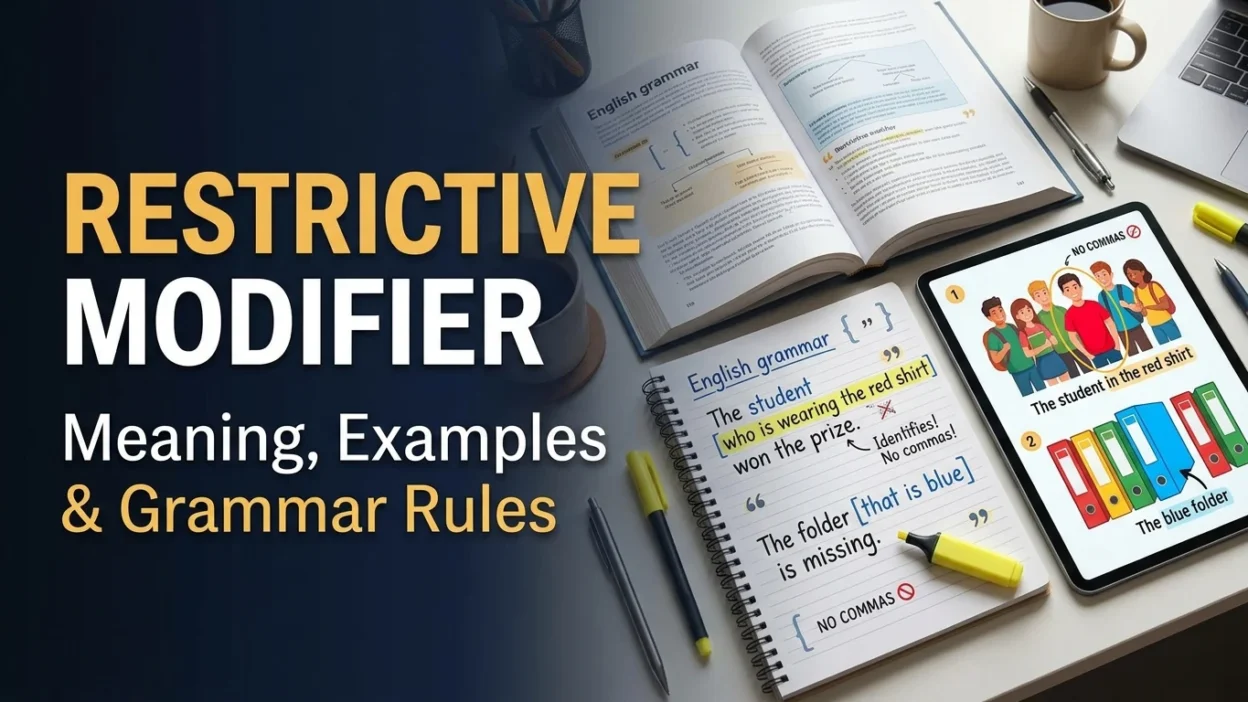
A restrictive modifier is a word, phrase, or clause that identifies or limits the meaning of a noun or pronoun. It provides essential information that helps readers understand exactly which person, place, thing, or idea is being discussed. Without this information, the sentence may become unclear or communicate a different meaning.
For example, consider the sentence “The students who studied passed the exam.” The phrase “who studied” identifies which students passed. It restricts the meaning of “students” because the sentence does not necessarily refer to every student. Restrictive modifiers are common in everyday conversations, academic writing, essays, professional communication, and English grammar exercises.
Understanding restrictive modifiers can help you write clearer sentences and use punctuation correctly. They are especially important when learning the difference between restrictive and nonrestrictive modifiers. Although both types add information, they serve different purposes. This guide explains the meaning of a restrictive modifier, its common forms, practical examples, punctuation rules, and the mistakes you should avoid.
Quick Answer: What Is a Restrictive Modifier?
A restrictive modifier is a word, phrase, or clause that provides essential information about a noun or pronoun. It limits the noun’s meaning by identifying exactly which person or thing is intended. Restrictive modifiers are generally not separated from the rest of a sentence by commas. For example, “The book that I borrowed is interesting.”
Why Do People Confuse Restrictive Modifiers?
People often confuse restrictive modifiers with nonrestrictive modifiers because both provide additional information about nouns. The main difference is whether that information is essential to identifying the noun.
A restrictive modifier narrows the meaning of a noun. A nonrestrictive modifier adds extra information that can usually be removed without changing the main identification.
Consider these examples:
- Restrictive: The employees who arrived early received breakfast.
- Nonrestrictive: The employees, who arrived early, received breakfast.
In the first sentence, the modifier identifies the employees who arrived early. In the second, the commas suggest that the employees being discussed all arrived early.
The difference is not simply punctuation. It is also a difference in meaning.
What Is a Restrictive Modifier?
A restrictive modifier identifies or limits the noun it modifies. The information is necessary to distinguish the intended person or thing from others.
Restrictive modifiers can appear in several grammatical forms, including adjectives, prepositional phrases, and relative clauses.
1. Restrictive Adjectives
An adjective can restrict the meaning of a noun by specifying its type, quality, or identity.
Examples:
- The red car belongs to my sister.
- I prefer fresh vegetables.
- She bought the wooden chair.
The words “red,” “fresh,” and “wooden” help specify which car, vegetables, or chair is intended.
Not every adjective is automatically restrictive. Its function depends on the meaning and context of the sentence.
2. Restrictive Prepositional Phrases
A prepositional phrase can identify a particular person or thing by describing its location, relationship, or other distinguishing feature.
Examples:
- The girl in the blue dress is my cousin.
- The keys on the table belong to Dad.
- We visited the house near the river.
The highlighted phrases help identify which girl, keys, or house the speaker means.
3. Restrictive Relative Clauses
A restrictive relative clause provides essential information about a noun. It often begins with words such as who, that, or which.
Examples:
- The person who called you is waiting outside.
- The phone that I bought yesterday is already broken.
- Students who complete the assignment will receive certificates.
These clauses narrow the meaning of the nouns they modify.
What Is a Nonrestrictive Modifier?
A nonrestrictive modifier adds information about a noun without being essential to identifying it. It commonly appears between commas, although punctuation depends on its grammatical structure.
Examples:
- My brother, who lives in London, is visiting us.
- The Eiffel Tower, which is in Paris, attracts many visitors.
- Sara, a talented musician, performed at the event.
In these examples, the modifiers provide additional details about people or places already identified.
The distinction between restrictive and nonrestrictive modifiers depends on the intended meaning, not merely on the length of the phrase.
Restrictive Modifier vs. Nonrestrictive Modifier
| Feature | Restrictive Modifier | Nonrestrictive Modifier |
|---|---|---|
| Main purpose | Identifies or limits a noun | Adds extra information |
| Importance | Essential to the intended identification | Not essential to identification |
| Typical punctuation | No separating commas | Usually set off by commas |
| Example | The dog that barked ran away. | My dog, which is small, ran away. |
| Meaning | Identifies a particular dog | Adds information about an already identified dog |
| Can it be removed? | Removing it may change the intended meaning | Removing it usually preserves the main identification |
When Should You Use a Restrictive Modifier?
Use a restrictive modifier when readers need the information to understand which noun you mean.
Use It to Identify a Specific Person
Example: The teacher who teaches mathematics is absent today.
The clause “who teaches mathematics” identifies the teacher being discussed.
Use It to Distinguish Between Objects
Example: Please give me the folder on the desk.
The phrase “on the desk” identifies the correct folder.
Use It to Explain Which Group You Mean
Example: People who exercise regularly may improve their fitness.
The clause “who exercise regularly” narrows the statement to a particular group of people.
Use It in Academic and Professional Writing
Restrictive modifiers help writers communicate precise information.
Example: Applicants who meet the eligibility requirements can submit an application.
The modifier identifies which applicants qualify.
12 Examples of Restrictive Modifiers
Here are practical examples showing how restrictive modifiers work in complete sentences.
1. The student who won the competition received a medal. The clause identifies the winning student.
2. I lost the pen that you gave me. The clause identifies the particular pen.
3. The man in the black jacket is our new manager. The phrase identifies the man.
4. She prefers books about history. The phrase identifies the type of books she prefers.
5. The house with the green roof belongs to my uncle. The phrase distinguishes the house from others.
6. Employees who arrive late must report to the supervisor. The clause identifies the employees covered by the rule.
7. I need the documents that contain the final figures. The clause identifies the required documents.
8. The restaurant near the railway station serves excellent food. The phrase identifies a particular restaurant.
9. Children who eat a balanced diet need a variety of nutritious foods. The clause identifies the group being discussed.
10. She returned the shoes that she borrowed. The clause specifies which shoes she returned.
11. The student sitting beside the window asked a question. The phrase identifies the student.
12. We selected the candidate with the most relevant experience. The phrase identifies the chosen candidate.
Common Mistakes When Using Restrictive Modifiers
Even experienced writers sometimes use restrictive modifiers incorrectly. These are the most common mistakes to avoid.
1. Adding Unnecessary Commas
Incorrect for the intended restrictive meaning: The students, who completed the test, left the classroom.
Correct: The students who completed the test left the classroom.
The corrected version identifies which students left. The version with commas suggests that all the students under discussion completed the test.
The original sentence with commas can still be correct if that is the intended meaning.
2. Confusing Essential and Extra Information
Incorrect reasoning: Every phrase that describes a noun is nonrestrictive.
Correct reasoning: A modifier is restrictive when it limits or identifies the noun, regardless of whether it is a word, phrase, or clause.
3. Assuming Every “Which” Clause Is Restrictive
Both restrictive and nonrestrictive clauses can begin with which.
- Restrictive: The book which has a blue cover is mine.
- Nonrestrictive: My book, which has a blue cover, is on the desk.
The first identifies a particular book. The second adds information about an already identified book. In American English, that is often preferred for restrictive clauses, while which is commonly used in nonrestrictive clauses.
4. Removing a Modifier Without Checking the Meaning
A restrictive modifier may be grammatically removable but still change the sentence’s intended meaning.
For example, “The employees who passed the test received bonuses” does not necessarily mean the same thing as “The employees received bonuses.”
Always check whether the modifier narrows the group being discussed.
Memory Trick: How to Remember Restrictive Modifiers
Use this simple rule:
Restrictive = Required to identify.
Ask yourself: “Which person or thing do I mean?”
If the modifier answers that question by narrowing the noun, it is probably restrictive.
For example:
- The house with the red door is ours.
- The student who scored highest received a prize.
The highlighted information identifies the intended house and student.
For a nonrestrictive modifier, think: “Extra information.”
For example: My house, which has a red door, is near the park.
The house has already been identified as “my house.” The clause adds a detail.
Restrictive Modifiers in American vs. British English
The basic grammatical principles of restrictive modifiers are shared by American and British English. In both varieties, restrictive modifiers identify or limit nouns, while nonrestrictive modifiers add supplementary information.
However, some punctuation and word-choice preferences differ.
American English
American English commonly uses that for restrictive relative clauses and which for nonrestrictive clauses.
Examples:
- The laptop that I ordered arrived today.
- My laptop, which I ordered last week, arrived today.
The first clause identifies the laptop. The second adds information about an already identified laptop.
British English
British English also uses restrictive and nonrestrictive clauses, and which is widely accepted in restrictive clauses.
Examples:
- The laptop which I ordered arrived today.
- My laptop, which I ordered last week, arrived today.
The first example is acceptable in British English, although that is also possible.
Important: The distinction between essential and supplementary information matters more than the choice of that or which. Both American and British writers should use punctuation that reflects the intended meaning.
Similar Words and Related Grammar Terms
Understanding related grammar terms can make restrictive modifiers easier to recognize.
Restrictive Clause
A restrictive clause is a clause that identifies or limits a noun.
Example: The woman who owns the shop is friendly.
The clause identifies which woman is meant.
Nonrestrictive Clause
A nonrestrictive clause adds extra information about a noun.
Example: The woman, who owns the shop, is friendly.
The commas indicate that the ownership detail is supplementary to the intended identification.
Modifier
A modifier is a word, phrase, or clause that describes, qualifies, or limits another part of a sentence.
Example: The small dog barked loudly.
The adjective “small” modifies “dog.”
Relative Clause
A relative clause is a clause that gives information about a noun or pronoun, often beginning with who, whom, whose, which, or that.
Example: The movie that we watched was exciting.
A relative clause can be restrictive or nonrestrictive.
Appositive
An appositive is a noun or noun phrase that renames or identifies another noun.
Example: My friend Daniel lives nearby.
An appositive can be restrictive or nonrestrictive depending on its function and the context.
Final Verdict: What Should You Remember About Restrictive Modifiers?
A restrictive modifier is an essential part of a sentence’s intended meaning because it identifies or limits the noun it modifies. It can take the form of an adjective, a prepositional phrase, or a clause.
The most important difference between restrictive and nonrestrictive modifiers is their purpose. Restrictive modifiers narrow the meaning of a noun, while nonrestrictive modifiers add supplementary information. Restrictive modifiers are generally written without separating commas, whereas nonrestrictive modifiers are usually set off by commas.
When deciding whether to use commas, focus on what you want to communicate. Determine whether the information identifies the noun or simply adds another detail. This approach will help you write clearer, more accurate English.
Frequently Asked Questions
1. What is a restrictive modifier in simple words?
A restrictive modifier is a word, phrase, or clause that tells readers exactly which person or thing you mean. For example, in “The boy wearing a red shirt is my brother,” the phrase “wearing a red shirt” identifies the boy.
2. What is an example of a restrictive modifier?
In the sentence “The car parked outside belongs to me,” the phrase “parked outside” is a restrictive modifier because it identifies which car belongs to the speaker.
3. Does a restrictive modifier need commas?
A restrictive modifier generally does not take commas around it because the information is essential to the intended identification. For example, “The students who studied passed the exam” identifies the students who passed.
4. What is the difference between a restrictive and a nonrestrictive modifier?
A restrictive modifier identifies or limits a noun, while a nonrestrictive modifier adds extra information. Restrictive modifiers generally appear without separating commas, while nonrestrictive modifiers are usually set off by commas.
5. Can an adjective be a restrictive modifier?
Yes. An adjective can restrict a noun by identifying its type or distinguishing it from other things. For example, in “I want the blue folder,” the adjective “blue” helps identify the folder.
6. Can a relative clause be restrictive?
Yes. A restrictive relative clause identifies the noun it modifies. For example, “The woman who called yesterday is my aunt” uses the clause “who called yesterday” to identify the woman.
7. Are restrictive modifiers used in both American and British English?
Yes. Both American and British English use restrictive modifiers. Some preferences for relative pronouns, such as that and which, differ, but the basic grammatical distinction remains the same.
8. How can I identify a restrictive modifier in a sentence?
Ask whether the modifier helps identify which person or thing is intended. If removing it changes or makes that identification less precise, it is likely restrictive. Then check the context to confirm the intended meaning.
Remember This
- A restrictive modifier identifies or limits a noun.
- It can be an adjective, phrase, or clause.
- It is generally not separated from the sentence by commas.
- A nonrestrictive modifier adds supplementary information and is usually set off by commas.
- Always consider the intended meaning before deciding on punctuation.
Conclusion
Restrictive modifiers are an important part of English grammar because they make sentences more precise. They help readers understand which person, object, place, or group a writer is discussing. By learning to recognize restrictive adjectives, phrases, and clauses, you can improve your writing and avoid confusing sentences.
The easiest way to identify a restrictive modifier is to ask whether the information helps distinguish the intended noun from others. If it does, the modifier is likely restrictive. Remember the difference between essential identification and extra information, and use commas accordingly. With regular practice, you will find it easier to recognize restrictive modifiers and use them correctly in everyday communication, academic assignments, and professional writing.

Charles Kyle is a passionate writer and dream researcher at SleepCout, dedicated to exploring coded dreams, lucid dreaming, dream symbolism, and sleep science. He creates engaging, well-researched content that helps readers understand their dreams and discover the fascinating connection between technology, imagination, and the sleeping mind.