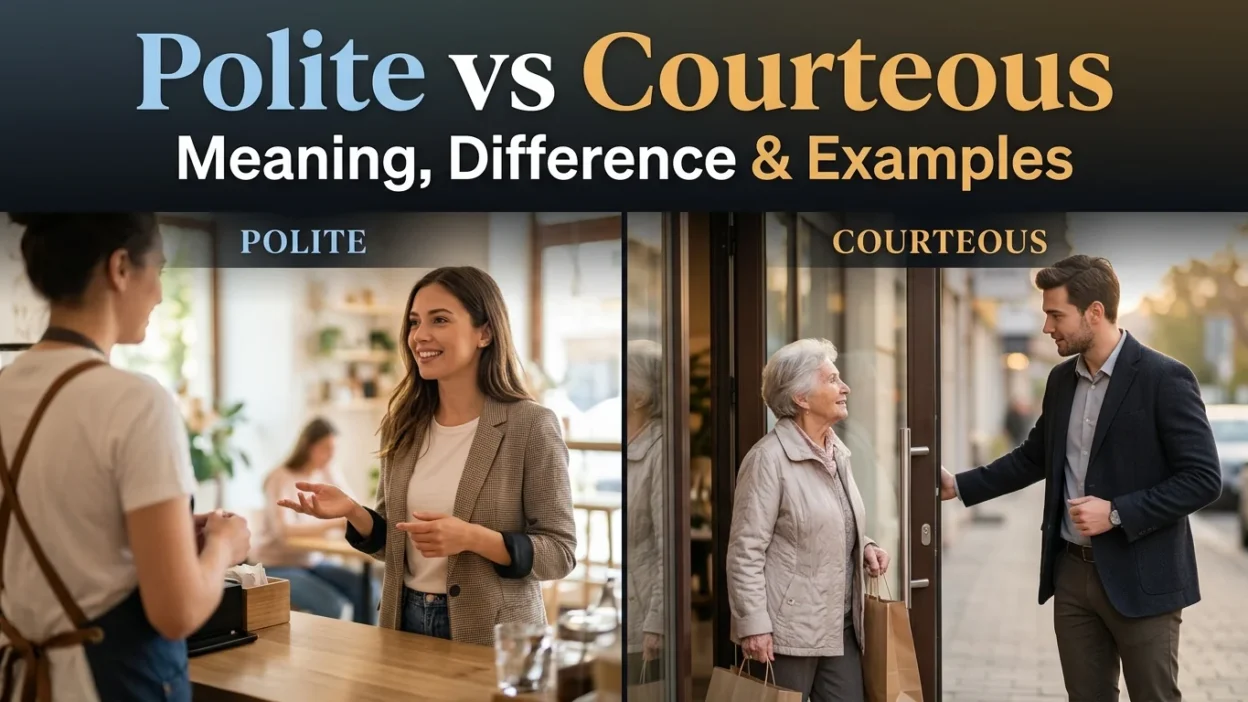
Understanding the difference between polite vs courteous can help you communicate more clearly and respectfully in everyday situations. Both words describe good manners, respectful behavior, and consideration for other people, but they have slightly different meanings. Polite usually refers to following social rules of good manners, while courteous emphasizes showing respect, thoughtfulness, and consideration toward others.
For example, saying “please” when asking for help is polite. Holding a door open for someone carrying heavy bags is courteous. Both actions demonstrate respect, but they highlight different aspects of good behavior. In many situations, the words can be used interchangeably, especially when describing respectful speech or behavior. However, understanding their subtle differences helps you choose the most appropriate word in conversations, emails, workplace communication, and formal writing.
if you are an English learner, a student, or someone who wants to improve everyday communication, learning when to use polite and courteous will help you express yourself naturally and confidently.
Quick Answer: What Is the Difference Between Polite and Courteous?
Polite means showing good manners and following accepted rules of respectful behavior. Courteous means showing respect, kindness, and consideration for other people, often through thoughtful actions. For example, saying “thank you” is polite, while helping someone who needs assistance is courteous. Both words describe respectful behavior and frequently overlap.
Why Do People Confuse Polite and Courteous?
People confuse these words because they share a similar meaning: treating others with respect and consideration. Both can describe how someone speaks, behaves, or interacts with others.
However, the main difference lies in their emphasis:
- Polite: Focuses on good manners, respectful language, and socially appropriate behavior.
- Courteous: Focuses on respectful treatment, thoughtfulness, and consideration for other people.
For example, a person who says “Excuse me” before interrupting someone is being polite. A person who waits patiently for another speaker to finish is being courteous.
These distinctions are not strict rules. A single action can be both polite and courteous, depending on the situation.
What Does Polite Mean?
Polite is an adjective that describes someone who uses good manners and behaves respectfully toward others.
Politeness often involves following social expectations, using respectful language, and avoiding behavior that might offend or inconvenience someone unnecessarily.
Examples of Polite
- She is always polite to her teachers.
- Please be polite when speaking to customers.
- He politely asked his neighbor to lower the music.
- It is polite to say “please” when making a request.
- The receptionist gave me a polite reply.
When Is Someone Being Polite?
Someone is being polite when they demonstrate good manners through their words or actions.
Common examples include:
- Saying “please,” “thank you,” and “excuse me.”
- Greeting people appropriately.
- Speaking respectfully to older people, colleagues, and strangers.
- Apologizing after making a mistake.
- Using respectful language in professional emails.
Example: “Would you mind helping me with this form?”
This sentence is polite because it makes a request respectfully rather than demanding assistance.
What Does Courteous Mean?
Courteous is an adjective that describes someone who shows respect, consideration, and thoughtfulness toward others.
Courteous behavior often involves paying attention to other people’s needs, making interactions pleasant, and acting with consideration. It can include spoken manners as well as helpful actions.
Examples of Courteous
- The driver was courteous to the passengers.
- She gave the visitor a courteous welcome.
- He was courteous enough to hold the door open.
- Our manager treated every employee in a courteous manner.
- The staff provided courteous service throughout the visit.
When Is Someone Being Courteous?
Someone is being courteous when they consider other people’s comfort, needs, or feelings and act respectfully toward them.
Common examples include:
- Offering your seat to someone who needs it.
- Listening without interrupting.
- Holding a door open for someone whose hands are full.
- Giving others enough space in a crowded area.
- Helping a visitor find the correct office.
- Responding to a complaint calmly and respectfully.
Example: “The receptionist noticed that the visitor was confused and helped her find the right department.”
This action is courteous because it demonstrates consideration and a willingness to help.
Polite vs Courteous: Comparison Table
| Feature | Polite | Courteous |
|---|---|---|
| Meaning | Showing good manners | Showing respect and consideration |
| Main focus | Appropriate manners and language | Thoughtfulness toward others |
| Common examples | Saying “please” and “thank you” | Offering help or making someone comfortable |
| Communication | Often emphasizes respectful words | Includes respectful words and considerate actions |
| Formality | Used in casual and formal situations | Often sounds slightly more formal |
| Workplace use | Polite emails and conversations | Courteous service and professional conduct |
| Grammar | Adjective; also used as an adverb in politely | Adjective; also used as an adverb in courteously |
| Opposite | Impolite or rude | Discourteous or inconsiderate |
Remember: These are differences in emphasis, not absolute boundaries. Saying “thank you” can be courteous, and helping someone can also be polite.
When Should You Use Polite vs Courteous?
Choose the word that best expresses the kind of respectful behavior you want to describe.
Use Polite When Talking About Good Manners
Use polite when describing respectful speech, appropriate behavior, or accepted social conventions.
Examples:
- Please be polite to your classmates.
- She wrote a polite response to the invitation.
- It is polite to greet your host when you arrive.
- He politely declined the offer.
In these examples, the emphasis is on manners and respectful communication.
Use Courteous When Emphasizing Consideration
Use courteous when describing thoughtful treatment, helpful behavior, or consideration for other people’s needs.
Examples:
- The hotel staff were courteous to every guest.
- She was courteous enough to let the people man go first.
- The customer service representative remained courteous during the complaint.
- He gave his colleague a courteous greeting.
Here, the emphasis is on respectful and considerate treatment.
Can You Use Both Words in the Same Situation?
Yes. In many situations, both words are correct.
For example:
- She was polite when answering the question.
- She was courteous when answering the question.
Both sentences are grammatically correct. The first emphasizes good manners in her response, while the second emphasizes her respectful and considerate attitude.
12 Examples of Polite vs Courteous in Sentences
These examples show how the two words work in everyday English.
- Polite: The student politely asked the teacher to explain the lesson again.
- Courteous: The teacher was courteous and took time to answer the student’s questions.
- Polite: It is polite to say “thank you” after receiving a gift.
- Courteous: The shop assistant was courteous and helped me find the right size.
- Polite: He sent a polite email declining the invitation.
- Courteous: She was courteous enough to inform the host that she would arrive late.
- Polite: Please remain polite during the discussion.
- Courteous: The driver was courteous and allowed pedestrians to cross safely.
- Polite: The receptionist gave a polite answer to my question.
- Courteous: The receptionist noticed my confusion and guided me to the correct office.
- Polite: It is polite to wait for your turn to speak.
- Courteous: It was courteous of him to listen carefully while his colleague explained the problem.
Examples Where Both Words Work
- She gave a polite and courteous response.
- The staff were polite and courteous throughout our visit.
- He remained polite and courteous even during a difficult conversation.
These examples demonstrate that politeness and courtesy often complement each other.
Common Mistakes When Using Polite and Courteous
Although these words have similar meanings, learners sometimes use them incorrectly.
Mistake 1: Assuming They Have Completely Different Meanings
Incorrect assumption: Polite describes words, while courteous describes actions only.
Correction: Both words can describe speech and actions. The difference is mainly one of emphasis.
For example, a polite gesture and a courteous remark are both possible expressions.
Mistake 2: Using Courteous as a Noun
Incorrect: “His courteous impressed everyone.”
Correct: “His courtesy impressed everyone.”
Courteous is an adjective, while courtesy is the related noun.
Mistake 3: Using Polite Instead of Politely
Incorrect: “She spoke polite to the customer.”
Correct: “She spoke politely to the customer.”
Use polite to describe a noun and politely to describe how an action is performed.
Mistake 4: Assuming Polite Always Means Sincere
A person can use polite words without genuinely caring about another person’s feelings.
For example, someone might say “Thank you” automatically without giving the interaction much thought.
Politeness does not necessarily reveal a person’s true feelings or intentions.
Mistake 5: Confusing Courteous With Courtly
Courteous means respectful and considerate. Courtly generally refers to the manners, customs, or style associated with a royal court or formal aristocratic settings.
Example:
- Courteous: The employee was courteous to every customer.
- Courtly: The novel describes the courtly manners of medieval nobles.
Memory Trick: How to Remember the Difference
Use this simple memory aid:
- Polite = Proper manners.
- Courteous = Considerate behavior.
Think of a polite person saying “please” before making a request. Think of a courteous person noticing that someone needs help and offering assistance.
Another useful trick is to remember that courteous is related to courtesy, a noun meaning respectful or considerate behavior.
If you are unsure which word to use, ask yourself:
- Am I emphasizing good manners? Choose polite.
- Am I emphasizing consideration for someone else? Choose courteous.
If both ideas apply, either word may be appropriate.
Polite vs Courteous in American and British English
Both polite and courteous are standard English words used in American and British English.
There is no major difference in their basic meanings between the two varieties.
| Context | American English | British English |
|---|---|---|
| Good manners | Please be polite. | Please be polite. |
| Respectful service | The staff were courteous. | The staff were courteous. |
| Formal communication | A polite response | A polite response |
| Considerate behavior | Courteous behavior | Courteous behavior |
Both varieties use polite in everyday conversations and courteous in everyday as well as formal contexts.
The choice often depends on the speaker’s intended emphasis and writing style rather than nationality.
Similar Words: Polite, Courteous, Respectful, Civil, and Considerate
Several English words describe good manners and respectful behavior, but each has a slightly different emphasis.
Polite vs Respectful
Polite focuses on good manners, while respectful emphasizes showing regard for someone, their feelings, rights, position, or opinions.
Example: “She was polite during the conversation and respectful of everyone’s opinions.”
Courteous vs Considerate
Courteous describes respectful and thoughtful behavior. Considerate specifically emphasizes thinking about other people’s needs and feelings.
Example: “The courteous driver was considerate enough to stop for the pedestrian.”
Polite vs Civil
Civil can mean behaving in a calm, respectful, and socially acceptable way, particularly when people disagree.
Example: “Although they disagreed, they remained civil throughout the meeting.”
Courteous vs Gracious
Courteous emphasizes respect and consideration. Gracious often suggests warmth, generosity, kindness, or a willingness to make others feel welcome.
Example: “The host was gracious and welcomed every guest warmly.”
Polite vs Well-Mannered
Polite describes respectful behavior, while well-mannered usually suggests that someone consistently follows accepted rules of good behavior.
Example: “The well-mannered child politely thanked the guests.”
Final Verdict: Is It Better to Say Polite or Courteous?
Neither word is universally better. The right choice depends on what you want to emphasize.
Choose polite when discussing good manners, respectful language, and socially appropriate behavior. Choose courteous when you want to emphasize consideration, thoughtfulness, and respectful treatment of other people.
For example, “She gave a polite reply” naturally emphasizes the manner of her response. “She provided courteous assistance” emphasizes the respectful and considerate help she offered.
In professional settings, both words are appropriate. You can describe an email as polite, a customer service experience as courteous, or a person as both polite and courteous.
The most important point is that both words help describe positive social behavior, and their meanings often overlap.
Frequently Asked Questions
1. Are polite and courteous the same thing?
They have similar meanings, but their emphasis differs slightly. Polite focuses on good manners and appropriate language, while courteous emphasizes respect, consideration, and thoughtfulness toward others. Both words can describe the same behavior.
2. What is the main difference between polite and courteous?
The main difference is the focus. Being polite means demonstrating good manners, while being courteous means treating others with respect and consideration. Saying “please” is a common example of politeness; offering help to someone who needs it is a common example of courtesy.
3. Is courteous more formal than polite?
Courteous can sound slightly more formal, particularly in business writing, customer service, and professional communication. However, it is not exclusively formal. Polite is also widely used in formal settings and everyday conversations.
4. Can a person be polite but not courteous?
Yes. Someone might use respectful language but fail to consider another person’s needs. For example, a person may politely decline to help someone who needs directions. Their words may be polite, even though their behavior may not be especially considerate.
5. What is the noun form of courteous?
The noun form of courteous is courtesy. For example, “She treated every visitor with courtesy.” The noun form of polite is politeness, as in “His politeness made a good impression.”
6. What is the opposite of polite and courteous?
The opposite of polite is generally impolite or rude. The opposite of courteous is discourteous or inconsiderate. These words describe behavior that lacks good manners, respect, or consideration.
7. Which word is better for professional emails: polite or courteous?
Both are correct. Use polite when describing the tone of an email, such as “Please send a polite response.” Use courteous when emphasizing respectful and considerate communication, such as “Maintain a courteous tone when responding to customers.”
Remember This
- Polite: Good manners and respectful language.
- Courteous: Respectful, thoughtful, and considerate behavior.
- Courtesy: The noun related to courteous.
- Politeness: The noun related to polite.
- Politely: The adverb form of polite.
- Courteously: The adverb form of courteous.
Both words are correct in many of the same situations. Choose the one that best communicates your intended meaning.
Conclusion
The difference between polite and courteous is subtle but useful. Polite behavior generally involves good manners, respectful words, and appropriate social conduct. Courteous behavior emphasizes consideration, thoughtfulness, and respect for other people’s needs. Although their meanings overlap, each word can communicate a slightly different aspect of positive behavior.
To use these words confidently, remember that politeness often appears in how we speak, while courtesy can be especially noticeable in how we treat others. A person can be polite when saying “thank you” and courteous when offering help to someone in need. In everyday English, professional communication, and formal writing, both words are valuable ways to describe respectful interactions.

Alice Allison is the Administrator at SleepCout, ensuring smooth operations while supporting a platform dedicated to coded dreams, dream interpretation, and insightful content that inspires curiosity, creativity, and imagination.