
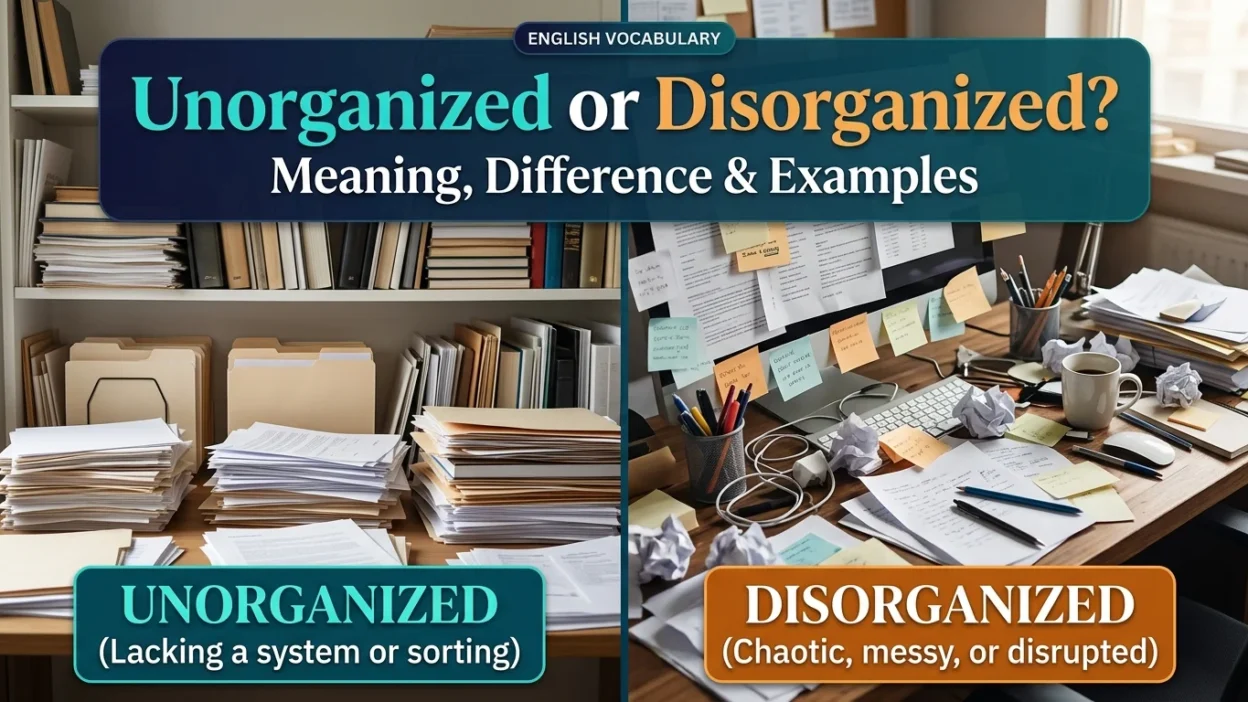
When deciding between unorganized or disorganized, both words are correct, but they have slightly different meanings. Unorganized usually describes something that has not been arranged into a proper system, while disorganized often describes something messy, poorly arranged, or lacking order. In many situations, the two words can be used interchangeably.
Choosing the right word depends on what you want to express. For example, an unorganized event may lack a formal plan or structure, while a disorganized desk may have papers and other items scattered everywhere. Similarly, an unorganized group may not have an established system, whereas a disorganized group may struggle to work efficiently because its activities lack coordination.
In this guide, you will learn the meanings of unorganized and disorganized, understand their differences, and discover when to use each word. You will also find practical examples, common mistakes, memory tricks, and answers to frequently asked questions to help you use both words confidently in everyday English.
Quick Answer: Unorganized or Disorganized?
Both unorganized and disorganized are correct English words. Unorganized generally means not arranged or established into an organized system. Disorganized usually means lacking order, structure, or coordination. Their meanings overlap, so either word may work in some situations. Use unorganized to emphasize the absence of organization and disorganized to emphasize disorder or poor arrangement.
Why Do People Confuse Unorganized and Disorganized?
People often confuse these words because both describe a lack of organization. They share similar meanings and can describe people, places, events, documents, and activities.
However, their usual emphasis is slightly different.
- Unorganized: Focuses on something that has not been organized or arranged into a system.
- Disorganized: Focuses on something that is messy, poorly arranged, or not functioning in an orderly way.
For example:
- The club is unorganized because it has no formal leadership structure.
- The club is disorganized because its members frequently miss meetings and lose important documents.
Both sentences describe organizational problems, but the first emphasizes the missing structure, while the second emphasizes the resulting disorder.
What Does Unorganized Mean?
Unorganized is an adjective that means not organized, arranged, or structured into an orderly system.
It can describe something that has not been sorted, planned, or formally established. It does not necessarily mean that something is messy; it may simply lack a formal arrangement.
Examples of Unorganized in Sentences
- The files are unorganized, so we need to sort them by date.
- The workers formed an unorganized group without a formal leader.
- Our trip remained unorganized because nobody created an itinerary.
- The information is unorganized and needs to be arranged into categories.
- The community has an unorganized volunteer network.
When Should You Use Unorganized?
Use unorganized when you want to emphasize that something lacks a planned structure, formal system, or deliberate arrangement.
For example:
- “The documents are unorganized.” This suggests that the documents have not been properly sorted.
- “The campaign is unorganized.” This suggests that the campaign lacks a clear structure or established plan.
The word is particularly useful when describing groups, records, plans, and systems that have not been formally arranged.
What Does Disorganized Mean?
Disorganized is an adjective that means lacking order, structure, or effective coordination. It often describes something that is messy, confused, or poorly managed.
It can also describe a person who struggles to keep belongings, tasks, or responsibilities in order.
Examples of Disorganized in Sentences
- My desk is disorganized because papers are scattered everywhere.
- The manager runs a disorganized office.
- Our meeting became disorganized when everyone started speaking at once.
- She feels disorganized when she has too many tasks to complete.
- The team lost time because of its disorganized workflow.
When Should You Use Disorganized?
Use disorganized when you want to emphasize disorder, confusion, poor coordination, or inefficient management.
For example:
- “My bedroom is disorganized.” This suggests that the room is messy or its contents are not arranged properly.
- “The presentation was disorganized.” This suggests that the ideas lacked a clear sequence or logical structure.
Unlike unorganized, disorganized often suggests that an existing arrangement or process is not working properly, although it can also describe something that has never been properly organized.
Unorganized vs. Disorganized: Comparison Table
| Feature | Unorganized | Disorganized |
|---|---|---|
| Main meaning | Not organized into a system | Lacking order or coordination |
| Main emphasis | Absence of organization | Disorder or poor arrangement |
| People | A person or group without an established structure | A person who struggles to manage tasks or belongings |
| Places | A space that has not been arranged | A messy or disorderly space |
| Events | An event without a clear plan | An event with confusion or poor coordination |
| Tone | Often neutral or descriptive | Often suggests a practical problem |
| Correct spelling? | Yes | Yes |
Important: These are general tendencies, not strict rules. Both words can describe the same situation, and context determines which is more natural.
When Should You Use Each Word?
Choosing between unorganized and disorganized becomes easier when you consider what you want to emphasize.
Use Unorganized When Something Lacks a System
Choose unorganized when something has not been sorted, planned, or formally structured.
Examples:
- The archive contains unorganized historical records.
- The neighborhood has an unorganized recycling program.
- We received unorganized notes from several students.
- The group is unorganized and has no elected officers.
Use Disorganized When Something Lacks Order or Coordination
Choose disorganized when something appears messy, confusing, or poorly managed.
Examples:
- His disorganized workspace makes it difficult to find tools.
- The staff delivered a disorganized presentation.
- Our schedule became disorganized after several delays.
- The disorganized team missed two important deadlines.
Can You Use Both Words in the Same Situation?
Yes. Consider these examples:
- “The files are unorganized.” The files have not been sorted into a useful system.
- “The files are disorganized.” The files are in disorder and difficult to navigate.
Both sentences are correct. The difference is the emphasis, not necessarily the underlying situation.
12 Examples of Unorganized and Disorganized in Sentences
Here are practical examples showing how both words work in everyday English.
- Unorganized: The teacher received unorganized notes from the students.
- Disorganized: The teacher’s desk was disorganized, with books piled on the floor.
- Unorganized: The local group remained unorganized because it had no official leadership.
- Disorganized: The committee held a disorganized meeting that achieved very little.
- Unorganized: I keep my photographs in unorganized folders on my computer.
- Disorganized: My computer desktop is disorganized, with icons scattered everywhere.
- Unorganized: The company inherited unorganized records from its previous owner.
- Disorganized: The company became disorganized after several managers resigned.
- Unorganized: We started with an unorganized plan for the school project.
- Disorganized: Our school project became disorganized when nobody followed the schedule.
- Unorganized: The volunteers worked as an unorganized group without a formal structure.
- Disorganized: The volunteers became disorganized when instructions changed unexpectedly.
These examples illustrate the general distinction, but remember that either word may fit when the context supports it.
Common Mistakes to Avoid
Even though both words are correct, some common mistakes can make your writing less clear.
Mistake 1: Thinking Unorganized Is Incorrect
Incorrect assumption: “Unorganized is not a real English word.”
Correct understanding: Both unorganized and disorganized are standard English words.
Mistake 2: Treating the Words as Completely Different
The words are not opposites. They have overlapping meanings and can sometimes replace one another without changing the basic message.
Mistake 3: Using Disorganized Only for Physical Messes
Disorganized can describe much more than a messy room. It can refer to meetings, businesses, plans, schedules, arguments, and people.
Example: “The explanation was disorganized.”
Mistake 4: Assuming Unorganized Always Means Messy
An unorganized collection might simply lack a classification system. It does not have to be physically messy.
Example: “The data is unorganized but still complete.”
Mistake 5: Confusing Unorganized With Unorganised
Both spellings are correct. Unorganized is the usual American English spelling, while unorganised is common in British English. The same spelling difference applies to disorganized and disorganised.
Easy Memory Trick: Unorganized vs. Disorganized
Use this simple memory trick:
- UN = Unset up: Think of something that has not been arranged into a system.
- DIS = Disorder: Think of something messy, confused, or poorly coordinated.
For example, imagine a box containing unsorted photographs. You could call them unorganized photographs. If the photographs, envelopes, and papers are scattered all over your desk, disorganized desk may be a more natural description.
This trick is a helpful guide, not an absolute grammatical rule.
American vs. British English
The main difference between American and British English is spelling, not meaning.
| American English | British English |
|---|---|
| Unorganized | Unorganised |
| Disorganized | Disorganised |
| Organize | Organise |
| Organization | Organisation |
American English generally prefers -ize, while British English commonly uses -ise. However, some British dictionaries and publications also accept or use -ize spellings.
Both forms are understandable in international English. The important thing is to follow the spelling convention used by your audience and remain consistent throughout your writing.
Similar Words: Unorganized, Disorganized, Unstructured, and Chaotic
Several related words can help you describe different kinds of organizational problems.
| Word | Meaning | Example |
|---|---|---|
| Unorganized | Not arranged into an organized system | The records are unorganized. |
| Disorganized | Lacking order or coordination | The office is disorganized. |
| Unstructured | Not following a defined structure | The discussion was unstructured. |
| Chaotic | Extremely confused or disorderly | The evacuation became chaotic. |
| Messy | Untidy or not cleanly arranged | His room is messy. |
| Unsystematic | Not following a consistent method | The research was unsystematic. |
Choose the word that best expresses the problem you want to describe. For instance, unstructured is useful when a process lacks a defined framework, while chaotic suggests a much higher level of confusion.
Final Verdict: Which Word Should You Choose?
Both unorganized and disorganized are correct, and neither is universally better than the other.
Use unorganized when you want to emphasize that something has not been arranged, planned, or established into a system. Use disorganized when you want to emphasize messiness, confusion, poor coordination, or ineffective management.
For example, an unorganized collection of papers may need sorting, while a disorganized office may need a better system for managing its daily work. In many real-world situations, both descriptions are acceptable.
The best choice depends on the context and the meaning you want to communicate.
Frequently Asked Questions
1. Is unorganized or disorganized correct?
Both are correct English words. Unorganized generally emphasizes the absence of an organized system, while disorganized emphasizes disorder, confusion, or poor coordination. The two words overlap in meaning.
2. What is the difference between unorganized and disorganized?
The main difference is emphasis. Unorganized often describes something that has not been arranged or structured. Disorganized often describes something that lacks order or is poorly managed. However, they are interchangeable in many contexts.
3. Is unorganized a real word?
Yes. Unorganized is a standard English adjective. It can describe unsorted documents, groups without formal structures, or activities that have not been properly planned.
4. Does disorganized mean messy?
Often, yes. Disorganized can mean messy or untidy, but it can also describe confusion or poor coordination. A disorganized meeting, for example, may be poorly managed even if the room is perfectly clean.
5. Which word is better for describing a person?
Both can describe a person, but disorganized is often more natural when discussing someone’s difficulty managing time, tasks, or belongings.
Example: “I’m disorganized, so I use a calendar to track my appointments.”
Unorganized may fit when emphasizing that someone has not established a system for handling responsibilities.
6. Is it unorganized or unorganised?
Both spellings are correct. Unorganized is standard in American English, while unorganised is common in British English. Choose the form appropriate for your audience.
7. Can unorganized and disorganized be used interchangeably?
Yes, in many contexts. For example, both can describe files that have not been arranged properly. However, unorganized may emphasize the lack of a system, whereas disorganized may emphasize disorder or poor arrangement.
8. What is the opposite of unorganized or disorganized?
The most common opposite is organized. Depending on the context, other suitable words include orderly, structured, systematic, and well-organized.
Remember This
- Unorganized: Not arranged or established into a proper system.
- Disorganized: Lacking order, coordination, or effective arrangement.
- Both are correct: Their meanings overlap, so context matters.
- American spelling: Unorganized and disorganized.
- Common British spelling: Unorganised and disorganised.
Conclusion
Choosing between unorganized and disorganized is easier when you understand the small difference in emphasis. Both words describe a lack of organization, but unorganized often focuses on the absence of a system, while disorganized often highlights disorder, confusion, or poor coordination. Neither word is inherently incorrect, and both can be appropriate for describing people, places, documents, plans, and groups.
When writing, consider the situation you want to describe and select the word that communicates your meaning most naturally. If you are talking about something that has not been properly arranged, unorganized may be suitable. If you are describing something messy or poorly managed, disorganized may be the better choice. With practice, you will become more confident using both words in everyday conversation, school assignments, and professional writing.

John Tyler is a dream researcher and content writer at SleepCout, sharing insightful articles about coded dreams, dream meanings, symbolism, sleep psychology, and practical guidance to help readers understand their dreams.