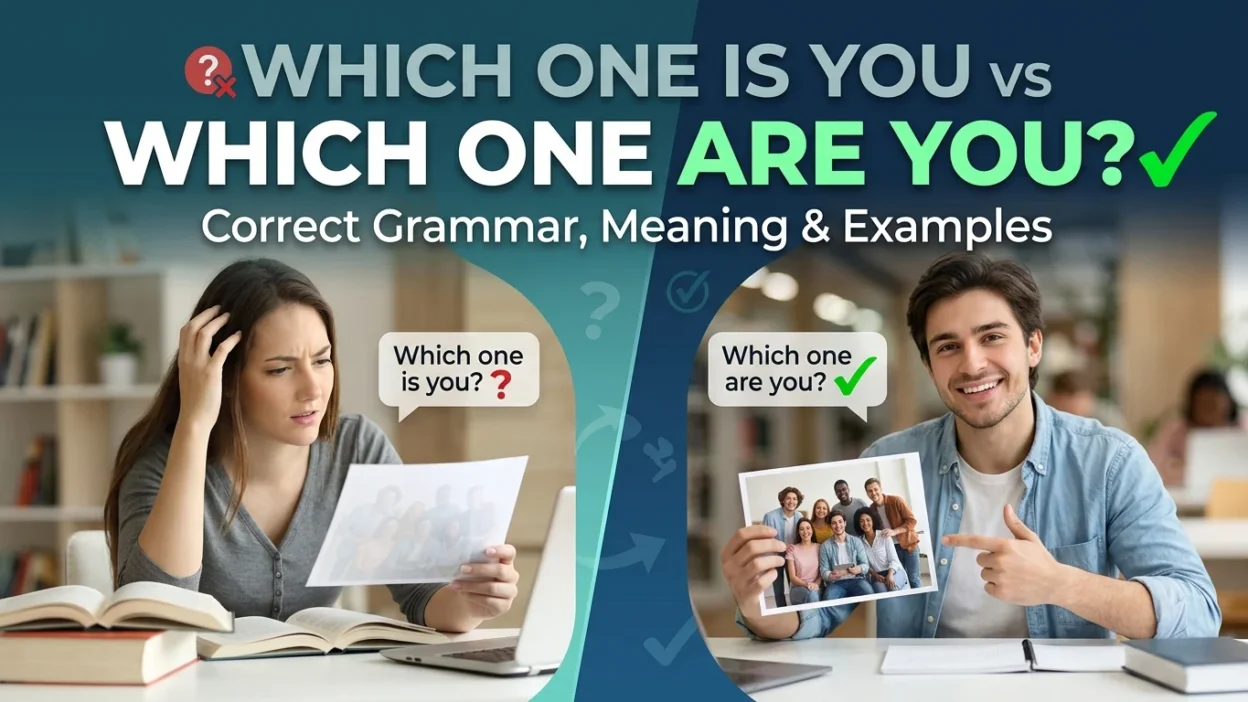
When asking someone to identify themselves or choose a person from a group, should you say “Which one is you” or “Which one are you”? The grammatically correct question in standard English is “Which one are you?” It uses the correct word order for a question with the verb are. For example, if you see a group photo and want someone to identify themselves, you can ask, “Which one are you in this picture?”
The phrase “Which one is you” may appear in casual conversations, dialects, or informal speech, but it is generally considered grammatically incorrect in standard written English. The confusion happens because English speakers sometimes use different word orders in statements and questions. Understanding how subject pronouns and linking verbs work will help you choose the correct expression in conversations, emails, classroom assignments, and everyday writing. In this guide, you will learn the difference between both phrases, when to use each one, and how to remember the correct form easily.
Quick Answer
“Which one are you?” is the correct form in standard English. Use it when asking someone to identify themselves among several people or things. “Which one is you?” is generally nonstandard because questions with the verb are usually place the verb before the subject pronoun you.
Why Do People Confuse “Which One Is You” and “Which One Are You”?
People confuse these expressions because both contain the same basic words: which one, is, are, and you. The main difference is how the verb agrees with the subject and how the words are arranged in a question.
In a statement, you might say:
- This person is you.
- You are the person in the photograph.
However, when you ask a direct question, the verb moves before the subject:
- Which person are you?
- Which one are you?
The correct choice is “Which one are you?” because you takes are, not is, in standard English.
What Does “Which One Are You?” Mean?
“Which one are you?” is a question used to identify a particular person or thing from a group of possibilities.
It is common when looking at photographs, meeting people in a group, choosing characters, or identifying someone’s position in a list.
Examples:
- There are five people in this photo. Which one are you?
- We have three team members with similar names. Which one are you?
- I can see several people in the video. Which one are you?
In each example, the speaker wants the other person to identify themselves.
What Does “Which One Is You?” Mean?
“Which one is you?” is an expression that some speakers may use in informal conversation or certain dialects. However, it is generally not accepted in standard written English.
The problem is the use of is with you. In standard English, you takes are, whether it refers to one person or several people.
For example:
- Nonstandard: Which one is you?
- Standard: Which one are you?
If you are learning English, writing an assignment, sending a professional message, or preparing for an English test, choose “Which one are you?”
Comparison Table: Which One Is You vs. Which One Are You
| Feature | Which one is you? | Which one are you? |
|---|---|---|
| Standard grammar | Generally nonstandard | Correct |
| Verb used | Is | Are |
| Natural in standard English | Usually no | Yes |
| Formal writing | Avoid | Use |
| English exams | Generally incorrect | Correct |
| Everyday identification question | Avoid in standard English | Recommended |
When Should You Use Each Expression?
Use “Which One Are You?” in Standard English
Use this question whenever you want someone to identify themselves from a selection.
Examples:
- Which one are you in this family photo?
- Which one are you on the team roster?
- Which one are you in the online meeting?
- Which one are you choosing?
The last example asks about a choice rather than identity, but the grammatical structure remains correct.
When Might You Hear “Which One Is You?”
You might encounter “Which one is you?” in casual speech, dialectal English, dialogue, or language-learning discussions. Hearing an expression in conversation does not automatically make it standard English.
You can recognize the phrase without adopting it in your own formal writing. If your goal is clear, grammatically standard English, use “Which one are you?”
12 Examples of “Which One Are You?” in Sentences
Here are practical examples showing how to use the correct expression naturally.
- Family photo: “Look at this old family picture. Which one are you?”
- Group photograph: “I recognize everyone except you. Which one are you?”
- Classroom: “There are four students in the picture. Which one are you?”
- Online meeting: “I can see several participants. Which one are you?”
- Sports team: “I know the players’ names, but which one are you?”
- School reunion: “You look different from your school days. Which one are you in this photo?”
- Social media: “I saw your group picture yesterday. Which one are you?”
- Video call: “I can see three people on the screen. Which one are you?”
- Character selection: “There are six characters in the game. Which one are you playing?”
- Workplace: “I have the staff list here. Which one are you?”
- Event photograph: “Which one are you among all these guests?”
- Choosing an option: “There are several designs available. Which one are you interested in?”
Notice that the exact meaning depends on the situation. The question can identify a person, ask about a role, or help clarify a selection.
Common Mistakes to Avoid
1. Using “Is” With “You”
Incorrect in standard English: “Which one is you?”
Correct: “Which one are you?”
Remember that you takes are, even when talking to one person.
2. Thinking “You” Always Means More Than One Person
The pronoun you can refer to one person or multiple people. In both cases, the correct verb is are.
- You are my friend.
- You are my friends.
3. Confusing Statements With Questions
A statement may use a different word order from a question.
- Statement: You are the person in the photo.
- Question: Which person are you?
4. Using the Phrase in Formal Writing
Avoid “Which one is you?” in essays, professional emails, schoolwork, and formal communication. Use “Which one are you?” instead.
5. Forgetting That “One” Does Not Change the Verb Agreement Here
Although one is singular, the question refers to the person addressed as you. The natural standard construction is “Which one are you?”
Memory Trick: How to Remember the Correct Phrase
Use this simple rule:
You + are = correct.
Remember these pairs:
- You are ready.
- Are you ready?
- Which one are you?
Whenever you ask a direct question using you and the verb be, remember that the verb is are.
A useful practice exercise is to complete this sentence:
“Here are three people in the picture. Which one ___ you?”
The correct answer is are.
American vs. British English
There is no important difference between standard American and standard British English in this case.
| English variety | Standard expression |
|---|---|
| American English | Which one are you? |
| British English | Which one are you? |
| Australian English | Which one are you? |
| Formal international English | Which one are you? |
Both American and British English use are with you. The phrase “Which one is you?” is not the standard alternative in either variety.
Similar Words and Expressions
Several related questions can help you identify people or ask someone to make a selection.
- Which one are you? — Asks someone to identify themselves.
- Who are you? — Asks about someone’s identity.
- Which person are you? — Asks someone to identify themselves among people.
- Which one is yours? — Asks which item belongs to someone.
- Which one do you want? — Asks someone to choose an item.
- Which one are you choosing? — Asks about a current selection.
- Which of these are you? — Can ask someone to identify themselves among several options, depending on the context.
- Which one is it? — Asks which item or option is being discussed.
Be careful with “Which one is yours?” It is correct because yours refers to possession, while “Which one are you?” asks about identity.
Final Verdict: Which One Is Correct?
“Which one are you?” is the correct expression in standard English.
Use it when asking someone to identify themselves in a picture, group, list, or selection. Avoid “Which one is you?” in formal writing and standard English conversations because it uses a nonstandard verb form.
The easiest way to remember the difference is to connect you with are: “You are” becomes “Are you?” in a direct question, and “Which one are you?” follows the same pattern.
Frequently Asked Questions
1. Is it “Which one is you” or “Which one are you”?
“Which one are you?” is correct in standard English. The word you takes are, so use this form when asking someone to identify themselves.
2. Why is “Which one is you?” grammatically incorrect?
In standard English, is does not agree with the subject you. The correct form uses are, as in “Which one are you?”
3. Can I say “Which one is you?” in casual conversation?
You may hear the phrase in some informal speech or dialects, but it is generally considered nonstandard. For clear, standard English, say “Which one are you?”
4. Is “Which one are you?” correct when talking to one person?
Yes. English uses are with you whether you are addressing one person or several people.
5. Is “Which one are you?” correct in American and British English?
Yes. Both standard American and British English use “Which one are you?” The grammatical rule is the same.
6. What is the difference between “Which one are you?” and “Who are you?”
“Which one are you?” usually asks someone to identify themselves from a known group or selection. “Who are you?” asks about someone’s identity more generally.
7. Can I use “Which one is yours?” instead?
Yes, but it has a different meaning. “Which one is yours?” asks which item belongs to someone, while “Which one are you?” asks the person to identify themselves.
Remember This
- Correct: Which one are you?
- Generally nonstandard: Which one is you?
- Rule: Use are with you in standard English.
- Tip: For questions about identity, use “Which one are you?” when choosing from a group.
Conclusion
The difference between “which one is you” and “which one are you” comes down to standard English grammar. Although you might hear the first expression in informal speech, “Which one are you?” is the correct and widely accepted form. It is suitable for everyday conversations, school assignments, professional communication, and English exams.
To remember the rule, practice using you are in statements and are you in questions. When you want someone to identify themselves in a photo, group, or list, simply ask, “Which one are you?” This small grammatical improvement will help you communicate more clearly and confidently.

Alice Allison is the Administrator at SleepCout, ensuring smooth operations while supporting a platform dedicated to coded dreams, dream interpretation, and insightful content that inspires curiosity, creativity, and imagination.