
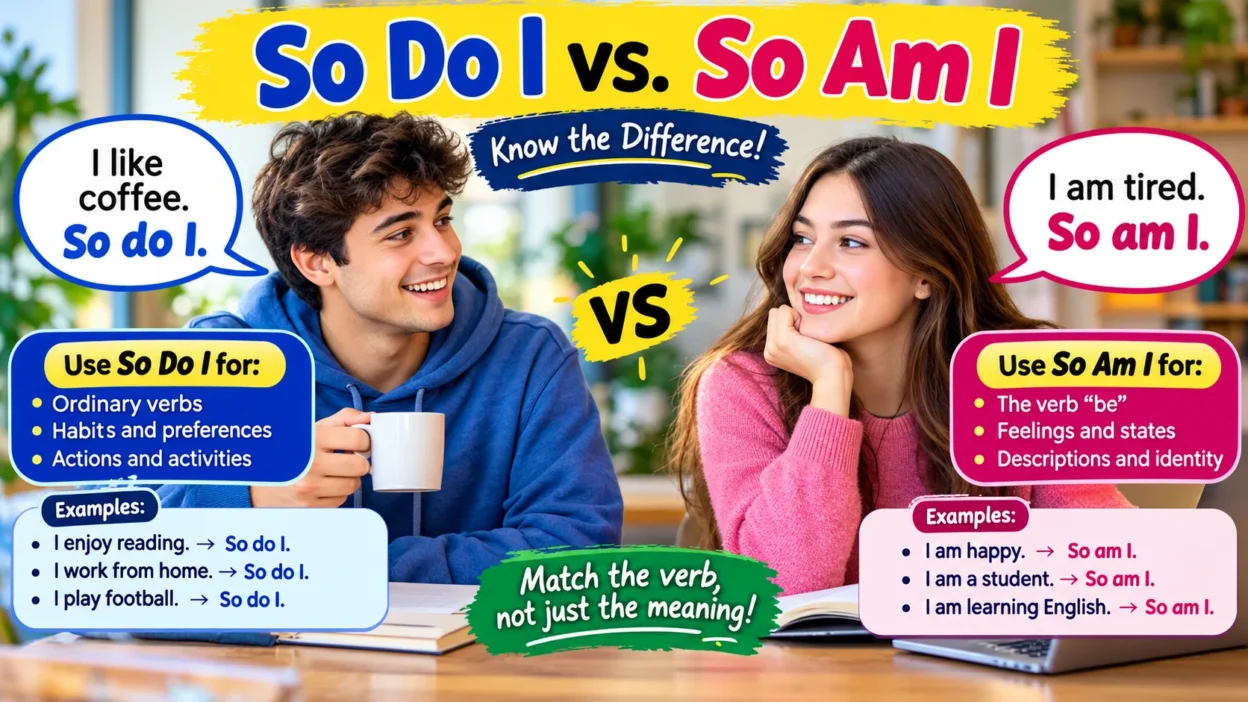
Have you ever wondered if to say “So do I” or “So am I” in English? Both expressions are used to agree with another person, but they are not interchangeable. The correct choice depends on the verb used in the original sentence. Understanding this simple grammar rule can help you speak more naturally, write accurately, and avoid common mistakes in everyday conversations.
The main difference between “so do I” and “so am I” is the auxiliary verb. We use “so do I” to agree with statements that use the simple present tense with an ordinary verb, such as “like,” “work,” or “enjoy.” We use “so am I” when agreeing with a statement that uses the verb “be,” especially when describing a state, feeling, or identity. For example, if someone says, “I like coffee,” you can reply, “So do I.” If someone says, “I am tired,” you can reply, “So am I.” Learning when to use each expression makes English conversations easier and more natural.
Quick Answer: So Do I vs. So Am I
“So do I” agrees with a positive statement that uses an ordinary verb, such as “I like tea.” “So am I” agrees with a positive statement that uses the verb “am,” such as “I am happy.” Choose the expression that matches the verb structure of the original sentence.
Why Do People Confuse So Do I and So Am I?
People often confuse these expressions because both communicate agreement and follow the same general pattern: so + auxiliary verb + subject.
The difference lies in the auxiliary verb.
- Do is used with many ordinary verbs in the simple present tense.
- Am is a form of the verb “be” and is used with descriptions, feelings, identities, and certain continuous verb forms.
For example:
- Person A: “I love music.”
- Person B: “So do I.”
However:
- Person A: “I am excited.”
- Person B: “So am I.”
Both responses mean that the second speaker feels the same way. The correct expression depends on the verb in the first speaker’s statement.
What Does “So Do I” Mean?
“So do I” means “I do too” or “I have the same preference, habit, or experience.”
It is commonly used to agree with positive statements in the simple present tense that contain ordinary verbs.
When to Use “So Do I”
Use “so do I” when the original statement uses a verb such as like, love, enjoy, want, need, know, or work.
Examples:
- “I like chocolate.” — “So do I.”
- “I enjoy reading.” — “So do I.”
- “I work from home.” — “So do I.”
- “I need some rest.” — “So do I.”
- “I know the answer.” — “So do I.”
In each example, the second speaker agrees with the first speaker.
How Is “So Do I” Formed?
The basic structure is:
So + do + subject
Examples:
- So do I.
- So do you.
- So do we.
- So do they.
For third-person singular subjects, use “does” instead of “do.”
- “She likes coffee.” — “So does he.”
- “He plays football.” — “So does she.”
Remember that “so do I” is not normally used to agree with a sentence containing the verb “be.”
Incorrect: “I am hungry.” — “So do I.”
Correct: “I am hungry.” — “So am I.”
What Does “So Am I” Mean?
“So am I” means “I am too” or “I share the same state, feeling, or condition.”
It is used when agreeing with a positive statement that contains the verb “am.”
Examples:
- “I am tired.” — “So am I.”
- “I am happy.” — “So am I.”
- “I am ready.” — “So am I.”
- “I am a student.” — “So am I.”
- “I am learning English.” — “So am I.”
In these examples, the second speaker uses “am” because the first speaker used “am.”
How Is “So Am I” Formed?
The basic structure is:
So + am + I
Examples:
- “I am nervous.” — “So am I.”
- “I am interested in art.” — “So am I.”
- “I am waiting for the bus.” — “So am I.”
Other forms of “be” work in the same pattern:
- “She is tired.” — “So am I.”
- “They are ready.” — “So are we.”
- “He was worried.” — “So was I.”
The auxiliary verb changes according to the original statement and the subject of the response.
So Do I vs. So Am I: Comparison Table
| Feature | So Do I | So Am I |
|---|---|---|
| Main purpose | Express agreement | Express agreement |
| Verb used | Ordinary present-tense verbs | The verb “be” |
| Common context | Habits, preferences, and actions | Feelings, states, identity, and ongoing actions |
| Example statement | I like tea. | I am thirsty. |
| Correct response | So do I. | So am I. |
| Similar meaning | I like it too. | I am too. |
| Common mistake | Using it after “I am” | Using it after “I like” |
The key rule is simple: match the auxiliary verb to the original statement.
When Should You Use Each Expression?
Use “So Do I” for Ordinary Present-Tense Verbs
Choose “so do I” when someone describes a habit, preference, or action using an ordinary verb in the simple present tense.
Examples:
- “I watch movies every weekend.” — “So do I.”
- “I prefer coffee to tea.” — “So do I.”
- “I speak English at work.” — “So do I.”
Use “So Am I” for States and Descriptions
Choose “so am I” when someone uses “am” to describe a feeling, condition, identity, or ongoing action.
Examples:
- “I am hungry.” — “So am I.”
- “I am a beginner.” — “So am I.”
- “I am studying for an exam.” — “So am I.”
What If the Original Sentence Uses Another Auxiliary Verb?
Use the corresponding auxiliary verb rather than automatically choosing “do” or “am.”
Examples:
- “I can swim.” — “So can I.”
- “I have finished my homework.” — “So have I.”
- “I will attend the meeting.” — “So will I.”
- “I was nervous.” — “So was I.”
This broader rule helps you agree correctly in many English conversations.
12 Examples of So Do I vs. So Am I
Here are practical examples showing how these expressions work in everyday English.
Examples of “So Do I”
1. Talking about food
Person A: “I love pizza.”
Person B: “So do I.”
2. Talking about hobbies
Person A: “I play video games.”
Person B: “So do I.”
3. Talking about reading
Person A: “I read books before bed.”
Person B: “So do I.”
4. Talking about work
Person A: “I work in an office.”
Person B: “So do I.”
5. Talking about preferences
Person A: “I prefer tea in the morning.”
Person B: “So do I.”
6. Talking about daily routines
Person A: “I exercise every day.”
Person B: “So do I.”
Examples of “So Am I”
7. Talking about feelings
Person A: “I am excited about the trip.”
Person B: “So am I.”
8. Talking about tiredness
Person A: “I am exhausted.”
Person B: “So am I.”
9. Talking about identity
Person A: “I am a university student.”
Person B: “So am I.”
10. Talking about emotions
Person A: “I am worried about the results.”
Person B: “So am I.”
11. Talking about readiness
Person A: “I am ready to leave.”
Person B: “So am I.”
12. Talking about ongoing actions
Person A: “I am learning a new language.”
Person B: “So am I.”
These examples show that the correct response depends on the verb structure, not simply on the meaning of the sentence.
Common Mistakes to Avoid
English learners sometimes choose “so do I” or “so am I” based on meaning alone. However, grammar determines which expression is correct.
Mistake 1: Saying “So Do I” After “I Am”
Incorrect: “I am hungry.” — “So do I.”
Correct: “I am hungry.” — “So am I.”
Why? The original statement uses “am,” so the response should use “am” too.
Mistake 2: Saying “So Am I” After an Ordinary Verb
Incorrect: “I like swimming.” — “So am I.”
Correct: “I like swimming.” — “So do I.”
Why? “Like” is an ordinary verb in the simple present tense, so “do” is needed.
Mistake 3: Ignoring Third-Person Singular Forms
Incorrect: “She likes music.” — “So do he.”
Correct: “She likes music.” — “So does he.”
Why? The auxiliary “does” is used with he, she, and it in the simple present tense.
Mistake 4: Using “So Do I” With Every Positive Statement
Incorrect: “I can drive.” — “So do I.”
Correct: “I can drive.” — “So can I.”
Why? The original statement uses “can,” so the response also uses “can.”
Mistake 5: Confusing Positive and Negative Agreement
“So do I” and “so am I” are used to agree with positive statements. To agree with negative statements, English commonly uses “neither” or “nor.”
For example:
- “I don’t like cold weather.” — “Neither do I.”
- “I am not ready.” — “Neither am I.”
These responses express agreement with a negative statement.
What Is an Easy Memory Trick?
Use this simple memory trick:
- Do = action or habit: “I play tennis.” — “So do I.”
- Am = state or description: “I am tired.” — “So am I.”
You can also remember the phrase “Copy the helper verb.”
If the original sentence uses “do,” “does,” “am,” “is,” “are,” “can,” or “will,” use the appropriate corresponding auxiliary in your response.
For example:
- “I enjoy cooking.” — “So do I.”
- “I am cooking.” — “So am I.”
- “I can cook.” — “So can I.”
This method is more reliable than memorizing individual sentences.
So Do I vs. So Am I in American and British English
There is no important difference between American and British English in the grammatical use of these expressions.
Both varieties use “so do I” to agree with suitable ordinary present-tense verbs and “so am I” to agree with statements using “am.”
Examples in both varieties:
- “I like football.” — “So do I.”
- “I am pleased to meet you.” — “So am I.”
British and American speakers may differ in vocabulary, pronunciation, or conversational preferences, but the basic grammatical rule remains the same.
In informal conversations, speakers in both varieties may also say “Me too.” This is a natural alternative in many situations.
Similar Expressions to So Do I and So Am I
Several English expressions communicate agreement. Learning their differences will help you respond naturally.
1. Me Too
“Me too” is a short, informal way to say that you share someone’s feeling, preference, or experience.
- “I love chocolate.” — “Me too.”
- “I am tired.” — “Me too.”
It works in many situations where “so do I” or “so am I” could also be used.
2. So Have I
Use “so have I” when agreeing with a statement that uses “have” as an auxiliary verb.
- “I have visited London.” — “So have I.”
- “I have finished the assignment.” — “So have I.”
3. So Can I
Use “so can I” to agree with a statement about ability or permission.
- “I can swim.” — “So can I.”
- “I can speak Spanish.” — “So can I.”
4. Neither Do I
Use “neither do I” to agree with a negative statement containing an ordinary present-tense verb.
- “I don’t eat meat.” — “Neither do I.”
- “I don’t watch television much.” — “Neither do I.”
5. Neither Am I
Use “neither am I” to agree with a negative statement that uses “am.”
- “I am not hungry.” — “Neither am I.”
- “I am not feeling well.” — “Neither am I.”
6. I Do Too and I Am Too
These expressions also communicate agreement, but the word order differs.
- “I like coffee.” — “I do too.”
- “I am tired.” — “I am too.”
These are useful alternatives when you want to emphasize that you share the same preference or state.
Final Verdict: Which One Is Correct?
Both “so do I” and “so am I” are correct English expressions. The right choice depends on the verb in the original statement.
Use “so do I” for statements such as “I like music,” “I enjoy reading,” and “I work here.”
Use “so am I” for statements such as “I am happy,” “I am tired,” and “I am learning English.”
If you remember one rule, remember this: match the auxiliary verb to the original sentence. Doing so will help you express agreement accurately and confidently.
Frequently Asked Questions
1. Is it “so do I” or “so am I”?
Both are correct, but they are used in different situations. Use “so do I” after suitable statements with ordinary present-tense verbs, such as “I like tea.” Use “so am I” after statements with “am,” such as “I am tired.”
2. Can I say “so am I” instead of “so do I”?
Not usually. The expressions are not interchangeable. Say “so am I” when agreeing with “I am happy,” but say “so do I” when agreeing with “I like happy endings.”
3. Is “so do I” grammatically correct?
Yes. “So do I” is grammatically correct when agreeing with a positive statement that uses an ordinary verb in the simple present tense. For example, “I enjoy swimming” — “So do I.”
4. Is “so am I” grammatically correct?
Yes. “So am I” is grammatically correct when agreeing with a positive statement that uses “am.” For example, “I am excited” — “So am I.”
5. Can I use “me too” instead of “so do I” or “so am I”?
Yes. “Me too” is a common, informal alternative in many everyday conversations. For example, “I like pizza” — “Me too,” or “I am tired” — “Me too.”
6. What is the difference between “so do I” and “neither do I”?
“So do I” agrees with a positive statement, while “neither do I” agrees with a negative statement.
- “I like coffee.” — “So do I.”
- “I don’t like coffee.” — “Neither do I.”
7. Can I say “so do I” after “I can swim”?
No. Because the original statement uses “can,” the appropriate response is “So can I.” The same principle applies to other auxiliary verbs: match the response to the original sentence’s grammatical structure.
8. Which is more natural: “so am I” or “me too”?
Both can sound natural. “So am I” follows a clear grammatical pattern and can sound slightly more deliberate, while “me too” is a common conversational response. The best choice depends on the situation and the speaker’s style.
Remember This
- I like coffee. → So do I.
- I am tired. → So am I.
- I can swim. → So can I.
- I don’t like coffee. → Neither do I.
- I am not tired. → Neither am I.
The most important rule is to match the auxiliary verb to the original statement.
Conclusion
Understanding “so do I” vs. “so am I” is easier when you focus on the verb in the original sentence. “So do I” is used to agree with ordinary present-tense verbs, while “so am I” is used to agree with statements containing “am.” Both expressions are useful in everyday conversations, classroom discussions, and written English.
Practice with simple examples until the pattern becomes natural. When someone says, “I love reading,” respond with “So do I.” When someone says, “I am excited,” respond with “So am I.” With regular practice, you will be able to choose the correct expression confidently and make your English sound more fluent.

John Tyler is a dream researcher and content writer at SleepCout, sharing insightful articles about coded dreams, dream meanings, symbolism, sleep psychology, and practical guidance to help readers understand their dreams.