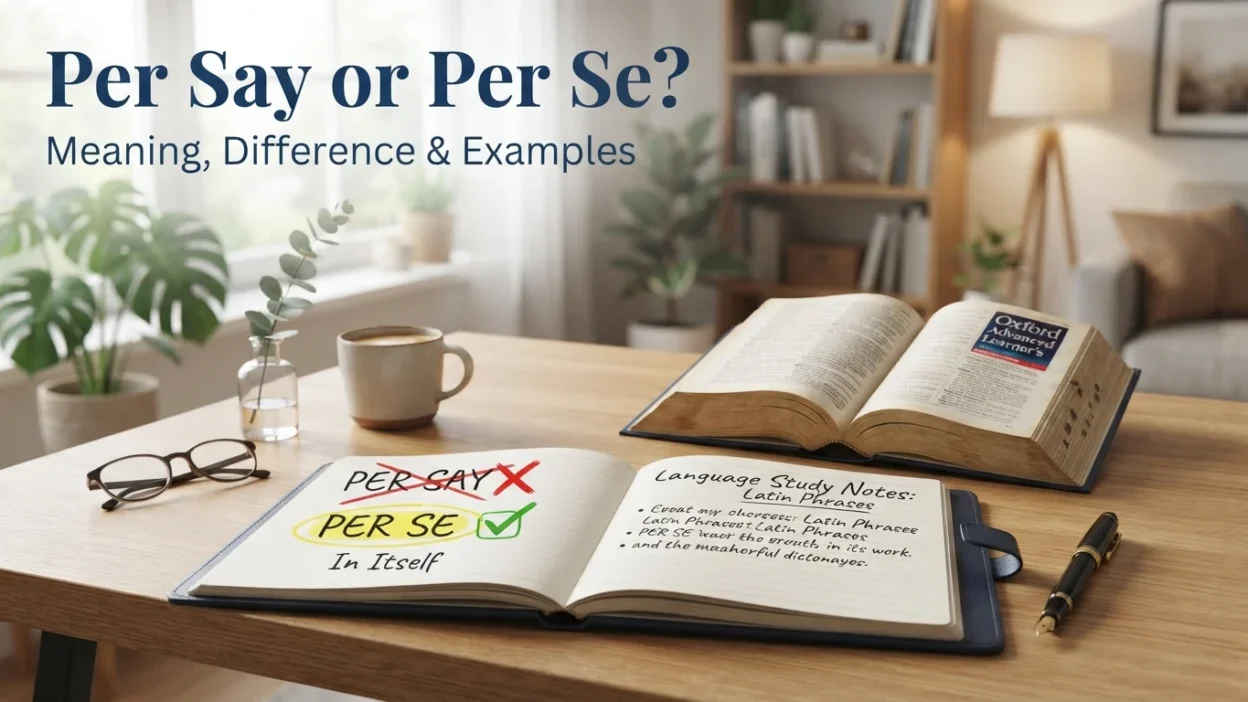
If you have ever wondered if the correct phrase is “per say” or “per se,” the answer is per se. It is a Latin phrase meaning “in itself,” “by itself,” or “intrinsically.” The spelling “per say” is a common mistake caused by the way per se sounds when spoken. For example, “The idea is not bad per se” means the idea is not bad in itself.
Understanding per se is useful because it often appears in formal writing, academic discussions, business communication, and everyday speech. Although the phrase may look unfamiliar, its meaning is simple once you connect it with “in itself.” This guide explains the difference between per say and per se, shows how to use per se naturally, and gives practical examples to help you remember the correct spelling.
Quick Answer
Per se is the correct spelling. Per say is a misspelling. Per se is a Latin phrase meaning “in itself,” “by itself,” or “as such.” Use it when you want to describe something on its own, without considering other factors. Example: “There is nothing wrong with the plan per se.”
Why Do People Confuse “Per Say” and “Per Se”?
People commonly confuse these expressions because per se is pronounced roughly like “per say.”
When someone hears the phrase in conversation, they may naturally assume it is spelled per say. However, per se comes from Latin, where se means “itself.”
So:
- ❌ per say — incorrect spelling
- ✅ per se — correct spelling
- Meaning: in itself; by itself; as such
The confusion is mainly between sound and spelling. The phrase is pronounced in a way that makes “say” seem like the obvious spelling.
What Does “Per Se” Mean?
Per se means “in itself” or “considered by itself.”
It is used when you want to separate something from its surrounding circumstances.
For example:
“The job is not difficult per se, but the long hours make it challenging.”
This means the job itself is not difficult. The problem comes from the long hours.
Another example:
“I don’t dislike the restaurant per se; I just don’t like the location.”
Here, the speaker is saying that the restaurant itself is not the problem.
First Word: “Per Say”
Per say is not the standard English spelling of the phrase.
You may see it in informal writing because people spell it according to its pronunciation, but it should be avoided in standard written English.
Incorrect:
The movie wasn’t bad per say.
Correct:
The movie wasn’t bad per se.
Second Word: “Per Se”
Per se is the correct form.
It comes from Latin and literally conveys the idea of something being considered “by itself” or “in itself.”
Example:
The rule isn’t unfair per se, but its application can cause problems.
Here, per se means the rule itself, without considering how it is applied.
Per Say vs Per Se: Comparison Table
| Expression | Correct? | Meaning | Example |
|---|---|---|---|
| Per say | ❌ No | Not the correct spelling | Avoid this form |
| Per se | ✅ Yes | In itself; by itself; as such | The idea isn’t bad per se. |
| By itself | ✅ Yes | Alone or independently | The machine works by itself. |
| In itself | ✅ Yes | Considered independently | The idea is not harmful in itself. |
When Should You Use “Per Se”?
Use per se when you want to say that something is not necessarily good, bad, difficult, unusual, etc. in itself, but may become so because of another factor.
Examples
- The idea isn’t wrong per se.
- I don’t dislike coffee per se; I just prefer tea.
- Working from home isn’t difficult per se.
- The book isn’t boring per se, but it is very technical.
- There is nothing illegal about the activity per se.
- The product isn’t expensive per se, but it costs more than similar products.
- Being competitive isn’t bad per se.
- The question isn’t complicated per se; it simply requires careful thought.
- The restaurant isn’t terrible per se, but the service is slow.
- Technology isn’t harmful per se; its effects depend on how people use it.
- The decision wasn’t unreasonable per se, although some people disagreed with it.
- Making mistakes isn’t embarrassing per se; refusing to learn from them can be.
Notice the common pattern:
Something + isn’t/is + adjective + per se + additional explanation
This structure is especially useful when you want to make a nuanced statement.
Common Mistakes With “Per Se”
1. Writing “Per Say”
This is the most common error.
❌ The plan isn’t bad per say.
✅ The plan isn’t bad per se.
2. Treating “Per Se” as a Verb
Per se is not a verb.
❌ I per se that the idea is wrong.
There is no standard English construction like this.
3. Using “Per Se” When “By Itself” Is Intended
Per se usually means in itself, not simply “without help.”
For example:
“The computer turned on by itself.”
This does not normally need per se. The phrase by itself is more appropriate.
4. Overusing “Per Se”
Although per se is correct, you do not need it in every formal sentence.
Instead of:
“The movie is enjoyable per se.”
You might simply say:
“The movie is enjoyable.”
Use per se when you specifically want to emphasize the thing itself.
Memory Trick for “Per Say” vs “Per Se”
A simple way to remember the spelling is:
Per se = in itself.
Think of “se” = itself.
Whenever you mean “in itself”, use:
per se
You can also remember:
Per se has an “e,” not “say.”
So when writing the phrase, don’t spell it based on how it sounds.
American vs British English
Per se is used in both American English and British English.
There is no standard American/British spelling difference here:
- American English: per se
- British English: per se
The phrase is borrowed from Latin, so its spelling remains the same in standard English.
The pronunciation can sound like “per say,” which explains why the misspelling is common in both varieties of English.
Similar Words and Phrases
Several expressions have meanings similar to per se.
In itself
This is often the easiest alternative.
The idea isn’t harmful in itself.
By itself
This usually emphasizes something being alone or independent.
The machine can operate by itself.
Intrinsically
This means something has a particular quality as an essential or inherent part of its nature.
The material is not intrinsically dangerous.
As such
This can sometimes replace per se, depending on the sentence.
The product is not defective as such.
These expressions are related, but they are not always interchangeable. Per se is specifically useful when you want to focus on something considered on its own.
Final Verdict: Per Say or Per Se?
The correct expression is per se, not per say.
Per se means “in itself,” “by itself,” or “as such.” It is commonly used when you want to distinguish something itself from its effects, circumstances, or related factors.
Remember:
✅ per se
❌ per say
For example:
The idea isn’t bad per se, but it needs some changes.
If you mean “in itself,” per se is the form you should use.
Frequently Asked Questions
Is “per say” or “per se” correct?
Per se is correct. Per say is a common misspelling caused by the pronunciation of the phrase.
What does “per se” mean?
Per se means “in itself,” “by itself,” or “as such.” It describes something considered on its own rather than in relation to other factors.
Is “per se” an English word?
Per se is an established English expression borrowed from Latin. It is commonly used in both formal and everyday English.
How do you pronounce “per se”?
Per se is commonly pronounced approximately like “per say.” This pronunciation is why some people mistakenly write “per say.”
Can I use “per se” in formal writing?
Yes. Per se is acceptable in formal, academic, professional, and general writing when it fits the meaning naturally.
What is another word for “per se”?
Depending on the sentence, alternatives include “in itself,” “by itself,” “intrinsically,” and “as such.” However, these expressions do not always have exactly the same use.
Is “per se” British or American?
Per se is used in both British and American English. The spelling does not change between the two varieties.
Remember This
- ✅ Per se = correct
- ❌ Per say = incorrect
- Per se means “in itself”
- It is pronounced roughly like “per say”
- It comes from Latin
- It is used in both American and British English
Conclusion
The confusion between per say and per se is understandable because the correct phrase sounds like “per say” when spoken. However, the standard written form is always per se. It means “in itself,” “by itself,” or “as such,” and it is useful when discussing something separately from other circumstances or effects.
When you are writing, remember the simple rule: if you mean “in itself,” write “per se.” For example, “The decision wasn’t wrong per se, but it created unexpected problems.” Once you connect per se with “in itself,” the spelling and meaning become much easier to remember.

John Tyler is a dream researcher and content writer at SleepCout, sharing insightful articles about coded dreams, dream meanings, symbolism, sleep psychology, and practical guidance to help readers understand their dreams.