English learners often confuse “better than” and “better then” because the words than and then sound similar in some varieties of English and are only one letter apart. However, they have completely different meanings and grammatical roles. “Better than” is the correct phrase when you are comparing two things, people, actions, or situations. “Better then” is usually incorrect when used for comparison.
Understanding this small difference can make your writing clearer and more natural. The key is to remember that than is commonly used for comparisons, while then usually relates to time, sequence, or what happens next. In this guide, you will learn the difference between better than and better then, when to use each word, common mistakes, practical examples, and an easy memory trick.
Quick Answer
“Better than” is correct when making a comparison. For example, “This book is better than that one.” “Then” refers to time or sequence, as in “We ate dinner, then watched a movie.” Therefore, use better than for comparisons, not better then.
Why Do People Confuse “Better Than” and “Better Then”?
The confusion happens because than and then are very similar in spelling and pronunciation. Both are common English words, but they perform different jobs.
The easiest distinction is:
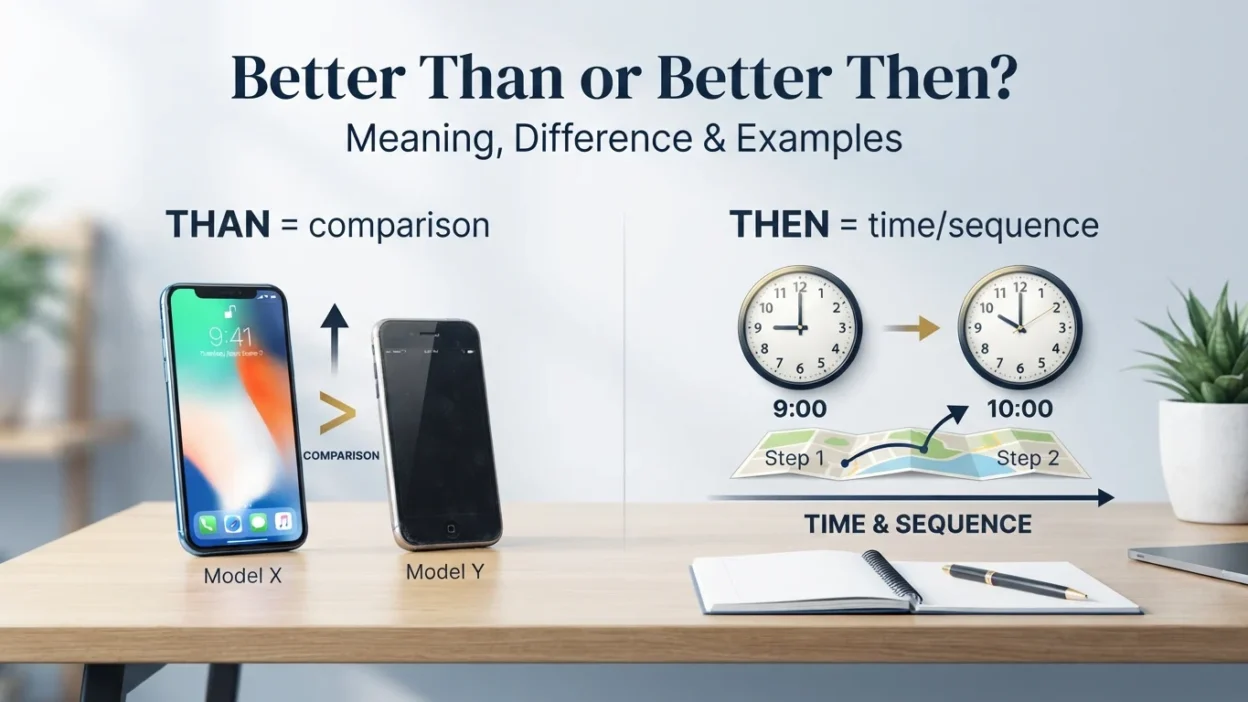
- Than = comparison
- Then = time or sequence
The word better is a comparative adjective. It normally compares one thing with another, so it is followed by than.
For example:
My new phone is better than my old phone.
Here, than introduces the thing being compared.
What Does “Better” Mean?
Better is the comparative form of good and well in many contexts. It means higher in quality, more suitable, more effective, healthier, or more desirable.
Examples:
- This restaurant is better.
- She feels better today.
- This method is better for beginners.
- Your second answer is better than the first.
When better is used to compare two things, than usually follows it.
What Does “Than” Mean?
Than is primarily used to introduce a comparison.
Examples:
- Ali is taller than Ahmed.
- This test was easier than the last one.
- I would rather walk than wait.
- This option is better than the other one.
The phrase better than means that one thing has a higher quality, value, or advantage compared with another.
What Does “Then” Mean?
Then usually refers to a time, sequence, result, or condition.
Examples:
- We had lunch, then we went home.
- I lived there then.
- Finish your homework, then you can play.
- If you are ready, then let’s begin.
Because then does not normally introduce a comparison, better then is not the standard spelling when you mean “better in comparison with.”
Better Than vs Better Then: Comparison Table
| Phrase | Correct for comparison? | Main meaning | Example |
|---|---|---|---|
| Better than | Yes | Makes a comparison | This phone is better than mine. |
| Better then | No | Usually a mistaken use of then | ❌ This phone is better then mine. |
| Then | No | Refers to time or sequence | We ate, then we left. |
| Than | Yes | Introduces a comparison | She is better than me at chess. |
When Should You Use “Better Than”?
Use better than when comparing two people, objects, ideas, choices, situations, skills, or experiences.
Comparing Things
This laptop is better than my old one.
Comparing People
Sara is better than me at drawing.
Comparing Ideas
Your first idea is better than the second one.
Comparing Experiences
The second movie was better than the first.
Comparing Performance
He is playing better than he did yesterday.
The basic structure is:
Subject + better + than + comparison
For example:
This solution + is + better + than + the previous one.
When Should You Use “Better Then”?
In ordinary comparison sentences, better then is incorrect.
For example:
❌ This restaurant is better then that restaurant.
Correct:
✅ This restaurant is better than that restaurant.
However, better and then can appear close together in a sentence when then has its normal meaning of sequence or time. The words are not functioning as the fixed comparative phrase better than.
For example:
If you find a better option, then choose it.
Here, then means something like “in that case” or “after that.” It is not part of the comparison itself.
10+ Examples of “Better Than”
- This book is better than the movie.
- My new job is better than my old one.
- Tea is better than coffee for me.
- She is better than me at mathematics.
- This road is better than the other one.
- The weather today is better than yesterday.
- Your second answer is better than your first.
- This computer is better than my previous one.
- Walking is sometimes better than driving.
- This solution is better than doing nothing.
- He feels better than he did yesterday.
- Practice is often better than simply reading about a skill.
Examples Showing “Then” Correctly
Because then is a real English word, it is important not to think that the word itself is always wrong.
Use then for sequence:
We finished dinner and then watched television.
Use then for a past time:
I lived in London then.
Use then for a result or consequence:
If you agree, then we can continue.
Notice that none of these examples use then to introduce a comparison.
Common Mistakes
Mistake 1: Using “then” after “better”
❌ This option is better then that one.
✅ This option is better than that one.
Mistake 2: Confusing Time With Comparison
❌ My new phone is better then my old phone.
✅ My new phone is better than my old phone.
The sentence compares two phones, so than is required.
Mistake 3: Assuming Similar Pronunciation Means Similar Meaning
Words that sound alike or nearly alike can still have completely different grammatical functions.
Remember:
than → comparison
then → time/sequence
Mistake 4: Writing “Better then” in Formal Writing
A spelling mistake like this can make otherwise clear writing look careless. Check whether you are comparing two things. If you are, choose than.
What Is an Easy Memory Trick?
Use this simple trick:
Than = Comparison
Both than and comparison contain the letter a.
better than = compare
Then = Time
Think of then as connected with when or what happens next.
First this, then that.
So remember:
Better than = better in comparison.
Then = next or at that time.
American vs British English
The distinction between than and then is essentially the same in both American and British English.
Both varieties use:
This is better than that.
And both use then for sequence or time:
We went home then.
Therefore, this is not normally a difference between American and British English. The important issue is the grammatical function of the word.
Similar Words to Know
Learning a few related words can make the distinction easier.
Than
Related to comparison:
- more than
- less than
- rather than
- other than
- better than
- worse than
- taller than
- faster than
Examples:
She is taller than her brother.
I would walk rather than wait.
Then
Related to time or sequence:
- afterward
- next
- later
- at that time
- subsequently
Example:
We finished the meeting and then went home.
Final Verdict: Better Than or Better Then?
The correct phrase is “better than” when you are making a comparison.
This car is better than that one.
Use then when you mean a time, sequence, or consequence:
We finished work, then we went home.
So, if you are wondering whether to write better than or better then, choose better than whenever the sentence compares two things.
Frequently Asked Questions
Is “better than” correct?
Yes. Better than is the standard phrase used when comparing one thing, person, or situation with another.
Is “better then” grammatically correct?
Not when then is being used to introduce a comparison. In that situation, than is required.
What is the difference between “than” and “then”?
Than is mainly used for comparisons, while then generally refers to time, sequence, or a consequence.
Is it “better than me” or “better then me”?
The standard form is “better than me.” For example: “She is better than me at tennis.”
Is “better than before” correct?
Yes. Better than before means that something has improved compared with its earlier condition.
I feel better than before.
Can “better” and “then” appear in the same sentence?
Yes. They can appear in the same sentence when they have separate grammatical functions.
Find a better solution, then tell me about it.
How can I remember “than” vs “then”?
Remember than = comparison and then = time or sequence. If you are comparing two things, use than.
Remember This
Better than = comparison.
Then = time, sequence, or consequence.
Think:
Better THAN something = compare.
First this, THEN that = sequence.
When you see better followed by a comparison, the correct word is almost always than.
Conclusion
The difference between better than and better then is simple once you understand the jobs of than and then. Than is used to make comparisons, which is why better than is the correct phrase. For example, “This method is better than the old method.”
Then has a different purpose. It commonly describes what happens next, refers to a particular time, or expresses a result. By remembering “than = comparison” and “then = sequence or time,” you can avoid this common English mistake in everyday conversation, schoolwork, and professional writing.

John Tyler is a dream researcher and content writer at SleepCout, sharing insightful articles about coded dreams, dream meanings, symbolism, sleep psychology, and practical guidance to help readers understand their dreams.