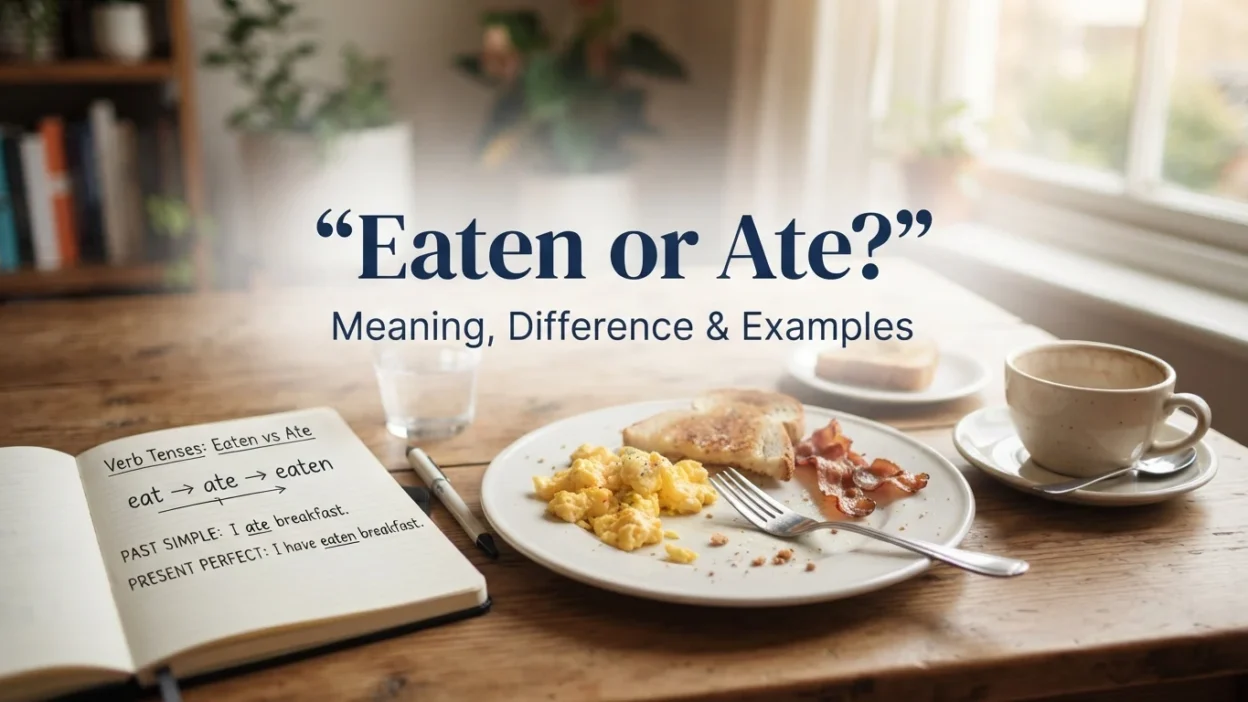
Many English learners wonder if “eaten” or “ate” is correct because both words come from the verb eat. The difference is mainly about verb tense and sentence structure. Ate is the simple past tense of eat, while eaten is the past participle. You use ate when talking about a completed action in the past, but eaten normally appears with helping verbs such as have, has, or had.
For example, you can say, “I ate breakfast at 8 a.m.” because the sentence describes a completed past action. However, you would say, “I have eaten breakfast” because have requires the past participle eaten. Understanding this difference will help you avoid common mistakes such as saying “I have ate” or “I eaten.”
Quick Answer
Ate is the simple past form of eat, while eaten is the past participle. Use ate by itself for a completed past action: “I ate lunch.” Use eaten with helping verbs such as have, has, or had: “I have eaten lunch.” The forms cannot normally be switched.
Why Do People Confuse “Eaten” and “Ate”?
People confuse these words because they are two forms of the same irregular verb:
- Eat = present/base form
- Ate = simple past
- Eaten = past participle
Unlike regular verbs, eat does not form its past tense by simply adding -ed.
For example:
- I eat breakfast every morning.
- I ate breakfast yesterday.
- I have eaten breakfast already.
The key is to look at the helping verb and the tense of the sentence.
What Does “Ate” Mean?
Ate is the simple past tense of eat. It describes an eating action that happened in the past.
Examples of “Ate”
- I ate breakfast early.
- She ate the whole sandwich.
- We ate dinner together.
- They ate pizza last night.
- He ate an apple after school.
You can usually use ate without a helping verb.
Correct:
I ate lunch at noon.
Incorrect:
I have ate lunch.
When have is present, use eaten, not ate.
What Does “Eaten” Mean?
Eaten is the past participle of eat. It is generally used with a helping verb to form perfect tenses.
Common combinations include:
- have eaten
- has eaten
- had eaten
- will have eaten
Examples of “Eaten”
- I have eaten breakfast.
- She has eaten already.
- We had eaten before they arrived.
- They have eaten all the cookies.
- By noon, he had eaten lunch.
Eaten can also appear in passive constructions:
The cake was eaten by the children.
Here, eaten is still the past participle.
Eaten vs Ate: Comparison Table
| Feature | Ate | Eaten |
|---|---|---|
| Verb | Eat | Eat |
| Form | Simple past | Past participle |
| Usually used with | No helping verb | Have, has, had, etc. |
| Example | I ate breakfast. | I have eaten breakfast. |
| Refers to past action | Yes | Yes, depending on construction |
| Can stand alone as the main past verb? | Yes | Usually no |
| Example question | Did you eat? / What did you eat? | Have you eaten? |
When Should You Use “Ate”?
Use ate when you are talking about a completed action in the simple past.
Use “ate” with past-time expressions
Common expressions include:
- yesterday
- last night
- last week
- two hours ago
- this morning, when referring to a completed past event
- when I was young
Examples:
I ate breakfast at 7 a.m. yesterday.
She ate at that restaurant last weekend.
We ate dinner two hours ago.
Questions with “Ate”
In questions using did, use the base form eat, not ate.
Correct:
Did you eat breakfast?
Incorrect:
Did you ate breakfast?
This happens because did already marks the past tense.
When Should You Use “Eaten”?
Use eaten when the sentence requires the past participle.
With “Have”
I have eaten already.
With “Has”
She has eaten lunch.
With “Had”
They had eaten before the movie started.
In the passive voice
All the food was eaten.
Notice that eaten normally needs a helping verb in these constructions.
10+ Examples of Eaten and Ate
- I ate breakfast at seven o’clock.
- I have eaten breakfast already.
- She ate an orange yesterday.
- She has eaten the orange.
- We ate dinner together last night.
- We have eaten dinner already.
- They ate all the cookies.
- They had eaten before we arrived.
- He ate too much at lunch.
- He has eaten too much today.
- The children ate the cake.
- The cake was eaten by the children.
- Did you eat anything?
- Have you eaten anything?
- I ate there last Friday.
- I have never eaten there before.
The examples show an important pattern: ate is used for simple past, while eaten is used as a past participle.
Common Mistakes with “Eaten” and “Ate”
Mistake 1: “I have ate.”
❌ I have ate breakfast.
✅ I have eaten breakfast.
After have, use the past participle eaten.
Mistake 2: “I eaten breakfast.”
❌ I eaten breakfast.
✅ I ate breakfast.
Or:
✅ I have eaten breakfast.
Without a suitable helping verb, eaten cannot normally function as the simple past tense.
Mistake 3: “Did you ate?”
❌ Did you ate lunch?
✅ Did you eat lunch?
After did, use the base form eat.
Mistake 4: “She has ate.”
❌ She has ate already.
✅ She has eaten already.
Mistake 5: “I had ate.”
❌ I had ate before they arrived.
✅ I had eaten before they arrived.
After had, use eaten.
Easy Memory Trick
Remember the three main forms:
Eat → Ate → Eaten
Think of them this way:
- Eat = now or general
- Ate = past
- Eaten = used with a helping verb
A simple formula is:
Yesterday → ate
Have/has/had → eaten
For example:
Yesterday, I ate pizza.
I have eaten pizza.
This quick pattern can help you choose the correct form in everyday writing and conversation.
American vs British English
The distinction between ate and eaten is essentially the same in American and British English.
Both varieties use:
- eat as the base form
- ate as the simple past
- eaten as the past participle
For example:
American English: I ate breakfast.
British English: I ate breakfast.
And:
American English: I have eaten already.
British English: I have eaten already.
Pronunciation can vary somewhat between speakers, but the grammatical distinction remains the same.
Similar Words and Verb Forms
Because eat is an irregular verb, it helps to learn all three forms together.
| Form | Example |
|---|---|
| Eat | I eat lunch at noon. |
| Ate | I ate lunch yesterday. |
| Eaten | I have eaten lunch already. |
Other related forms include:
- Eating — present participle/gerundShe is eating dinner.
- Eater — a person who eatsHe is a slow eater.
Learning the complete word family makes the differences easier to remember.
Final Verdict: Eaten or Ate?
The correct word depends on the grammatical structure.
Use ate as the simple past form:
I ate breakfast at 8 a.m.
Use eaten as the past participle, usually after have, has, or had:
I have eaten breakfast.
The simplest rule is: “Ate” is past; “eaten” goes with a helping verb.
FAQs
Is “eaten” the past tense of eat?
No. Ate is the simple past tense of eat. Eaten is the past participle.
Is it “I ate” or “I eaten”?
Say “I ate” when using the simple past.
I ate lunch.
If you use eaten, you need an appropriate helping verb:
I have eaten lunch.
Is “I have ate” correct?
No. The correct sentence is:
I have eaten.
After have, use the past participle eaten.
Is “I had ate” correct?
No. Say:
I had eaten before they arrived.
The past perfect uses had + past participle.
Is “Did you ate?” grammatically correct?
No. The correct form is:
Did you eat?
After did, use the base form eat.
What is the past participle of eat?
The past participle of eat is eaten.
The three principal forms are:
eat – ate – eaten
Can “eaten” be used without “have,” “has,” or “had”?
Yes, in some structures, particularly the passive voice.
The cake was eaten quickly.
So while eaten commonly appears with have, has, or had, those are not its only possible uses.
Remember This
Eat = present/base form
Ate = simple past
Eaten = past participle
- Yesterday, I ate.
- I have eaten.
- I had eaten.
- Did you eat?
The most important rule is have/has/had + eaten, not have/has/had + ate.
Understanding this pattern makes it much easier to use eaten or ate correctly in everyday English.
The difference between eaten and ate is simple once you understand their grammatical roles. Ate is the simple past form and describes an action completed in the past, while eaten is the past participle used in perfect and certain passive constructions.
When you are unsure, look for a helping verb. If the sentence contains have, has, or had, eaten is usually the form you need. If you are simply describing something that happened in the past, ate is generally correct.

John Tyler is a dream researcher and content writer at SleepCout, sharing insightful articles about coded dreams, dream meanings, symbolism, sleep psychology, and practical guidance to help readers understand their dreams.