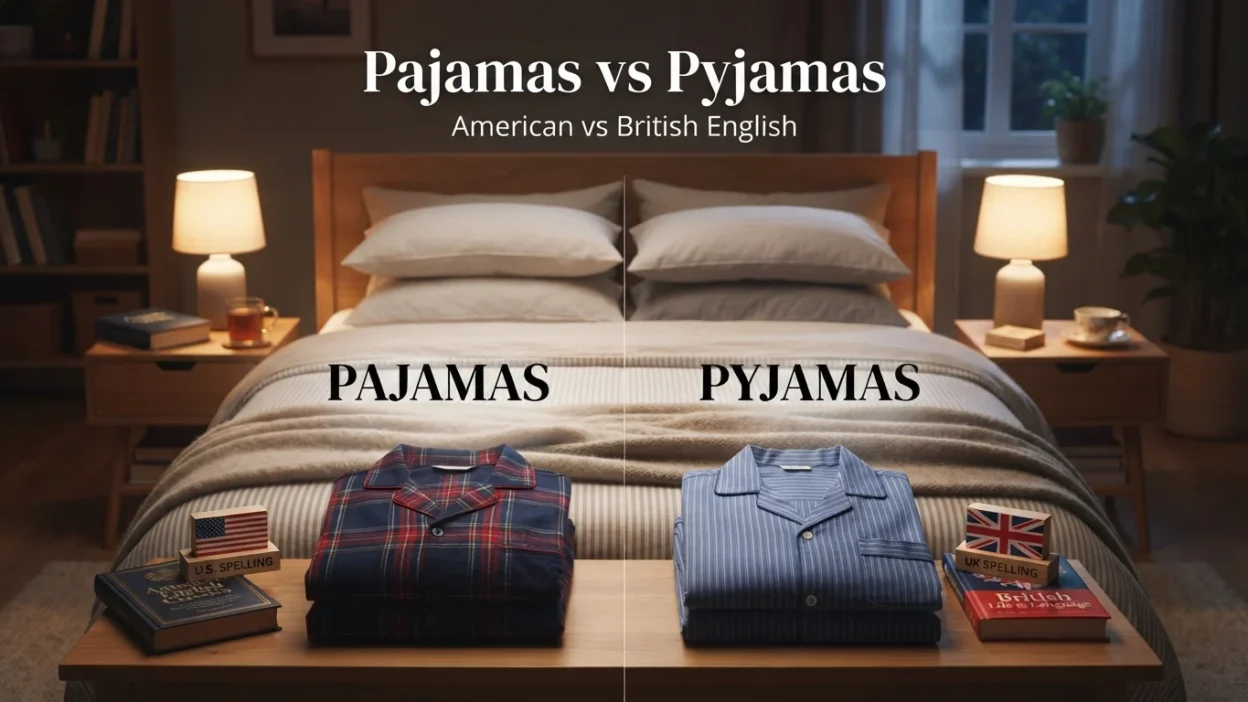
If you have ever wondered if “pajamas” or “pyjamas” is correct, the answer is simple: both spellings are correct. The difference is mainly based on regional English. Pajamas is the standard spelling in American English, while pyjamas is the standard spelling in British English and is also common in countries that follow British English conventions.
Both words refer to comfortable clothing worn for sleeping or relaxing at home. The pronunciation is essentially the same, so the main difference you will notice is the spelling. Knowing which form to use can help you write naturally for an American, British, or international audience.
Quick Answer: Pajamas vs Pyjamas
Pajamas and pyjamas mean the same thing: clothing worn for sleeping or relaxing. Pajamas is the usual American English spelling, while pyjamas is the usual British English spelling. Choose the spelling that matches the variety of English you are writing or speaking.
Why Do People Confuse “Pajamas” and “Pyjamas”?
People often confuse these words because they have:
- The same meaning
- Nearly the same pronunciation
- The same grammatical function
- Different spellings in different varieties of English
The spelling difference comes from regional conventions rather than a difference in meaning.
For example:
- American English: I bought new pajamas.
- British English: I bought new pyjamas.
Both sentences are correct.
What Does “Pajamas” Mean?
Pajamas is the standard American English spelling for clothing worn while sleeping or relaxing.
Pajamas can refer to a matching set, such as a shirt and trousers, or to sleepwear more generally.
Examples
- I need to buy new pajamas.
- These pajamas are very comfortable.
- She changed into her pajamas before bed.
- My favorite pajamas are blue.
In American English, pajamas is the spelling you will normally see in books, websites, stores, and everyday writing.
What Does “Pyjamas” Mean?
Pyjamas is the standard British English spelling of the same word.
It has exactly the same basic meaning as pajamas and refers to clothing worn for sleeping or relaxing.
Examples
- I need to buy new pyjamas.
- These pyjamas are very comfortable.
- She changed into her pyjamas before bed.
- My favorite pyjamas are blue.
You will commonly see pyjamas in British English and in many places where British spelling conventions are traditionally used.
Pajamas vs Pyjamas: Comparison Table
| Feature | Pajamas | Pyjamas |
|---|---|---|
| Meaning | Sleepwear or nightwear | Sleepwear or nightwear |
| Main variety | American English | British English |
| Pronunciation | Essentially the same | Essentially the same |
| Part of speech | Noun | Noun |
| Refers to | Clothing for sleeping/relaxing | Clothing for sleeping/relaxing |
| Common spelling | United States | United Kingdom |
| Correct? | Yes | Yes |
When Should You Use “Pajamas”?
Use pajamas when you are following American English spelling.
This is especially appropriate when:
- Writing for an American audience
- Following an American style guide
- Using American English in school or work
- Referring to American products or publications
- Keeping spelling consistent with other American forms
Examples
I packed two pairs of pajamas for my trip.
The children put on their pajamas before watching a movie.
Where did you buy those pajamas?
When Should You Use “Pyjamas”?
Use pyjamas when you are following British English spelling.
This is appropriate when:
- Writing for a British audience
- Following British English conventions
- Using British spelling in school or work
- Writing for readers in regions that commonly use British English
Examples
I packed two pairs of pyjamas for my trip.
The children put on their pyjamas before watching a movie.
Where did you buy those pyjamas?
The meaning remains unchanged.
10+ Examples of Pajamas and Pyjamas
Here are examples showing how the two spellings work in sentences:
- I bought a new pair of pajamas yesterday.
- I bought a new pair of pyjamas yesterday.
- She changed into her pajamas before going to bed.
- She changed into her pyjamas before going to bed.
- These pajamas are soft and comfortable.
- These pyjamas are soft and comfortable.
- My son refuses to wear his pajamas.
- My son refuses to wear his pyjamas.
- I packed my pajamas in a small bag.
- I packed my pyjamas in a small bag.
- Her new pajamas have a colorful pattern.
- Her new pyjamas have a colorful pattern.
- He received a pair of pajamas as a gift.
- He received a pair of pyjamas as a gift.
Notice that changing the spelling does not change the meaning of any sentence.
Common Mistakes With Pajamas and Pyjamas
Mistake 1: Thinking one spelling is incorrect
Both pajamas and pyjamas are correct.
The important point is regional usage.
Mistake 2: Mixing spelling styles unnecessarily
If you are writing in American English, pajamas will usually fit better.
If you are writing in British English, pyjamas will usually fit better.
Try to keep your spelling consistent throughout a piece of writing.
Mistake 3: Assuming the words have different meanings
They do not have different meanings. Both refer to sleepwear or clothing worn for relaxing.
Mistake 4: Confusing pajamas with a singular item
In everyday English, pajamas and pyjamas are normally treated as plural nouns.
For example:
- These pajamas are comfortable.
- My pyjamas are clean.
You can also say a pair of pajamas or a pair of pyjamas when referring to one set.
What Is an Easy Memory Trick?
Use the letter A in pajamas to remember America.
Pajamas → American English
Use the letter Y in pyjamas to remember British English.
Pyjamas → British English
A simple memory sentence is:
America wears pajamas; Britain writes pyjamas.
This is only a spelling memory trick—the clothing itself is the same.
Pajamas vs Pyjamas in American and British English
The main distinction is geographical.
American English generally uses:
pajamas
British English generally uses:
pyjamas
Other varieties of English may follow one convention or the other depending on local usage, education, publishing, and historical influence.
For example, a writer using British spelling may naturally write:
I forgot to pack my pyjamas.
An American writer would normally write:
I forgot to pack my pajamas.
Neither sentence is more correct than the other.
Similar Words for Pajamas and Pyjamas
Several related words can describe clothing worn for sleeping or relaxing.
Sleepwear
Sleepwear is a general term for clothing designed to be worn while sleeping.
The store sells comfortable sleepwear.
Nightwear
Nightwear is another general term, especially common in British English.
She bought some new nightwear.
Nightclothes
Nightclothes refers to clothes worn at night.
He changed into his nightclothes.
Nightdress
A nightdress is a loose dress worn for sleeping.
She wore a comfortable nightdress.
Pajama set / Pyjama set
This refers to a matching top and bottom intended as sleepwear.
I bought a new pajama set.
In British spelling:
I bought a new pyjama set.
Final Verdict: Pajamas or Pyjamas?
Pajamas and pyjamas are both correct. The difference is primarily a matter of regional spelling.
Use pajamas in American English.
Use pyjamas in British English.
If you are writing for an international audience, either form may be understood, but matching the spelling style of your target audience is usually the clearest approach.
Frequently Asked Questions
Is “pajamas” or “pyjamas” correct?
Both are correct. Pajamas is the standard American English spelling, while pyjamas is the standard British English spelling.
Is “pyjamas” British or American?
Pyjamas is primarily the British English spelling. It is also used in other varieties of English influenced by British spelling conventions.
Is “pajamas” American English?
Yes. Pajamas is the standard spelling commonly used in American English.
Do pajamas and pyjamas mean the same thing?
Yes. They have the same meaning and refer to clothing worn for sleeping or relaxing.
Why does American English use “pajamas”?
American English traditionally uses the spelling pajamas, while British English uses pyjamas. The difference is a regional spelling convention.
Should I write “pajamas” or “pyjamas” at school?
Follow the English variety required by your school, teacher, textbook, or style guide. If British English is expected, use pyjamas; if American English is expected, use pajamas.
Is “a pair of pajamas” correct?
Yes. A pair of pajamas is a common way to refer to one set of pajamas. The same applies to a pair of pyjamas.
Remember This
- Pajamas = American English
- Pyjamas = British English
- Both spellings are correct.
- Both have the same meaning.
- Both refer to sleepwear or nightwear.
- The pronunciation is essentially the same.
- Choose the spelling that matches your variety of English.
Conclusion
The difference between pajamas and pyjamas is simple: they are two regional spellings of the same word. American English generally uses pajamas, while British English generally uses pyjamas. Neither spelling changes the meaning.
When writing, the best approach is to consider your audience and remain consistent. If you are using American English, choose pajamas. If you are using British English, choose pyjamas. Once you remember the regional difference, this spelling question becomes easy to handle.

John Tyler is a dream researcher and content writer at SleepCout, sharing insightful articles about coded dreams, dream meanings, symbolism, sleep psychology, and practical guidance to help readers understand their dreams.