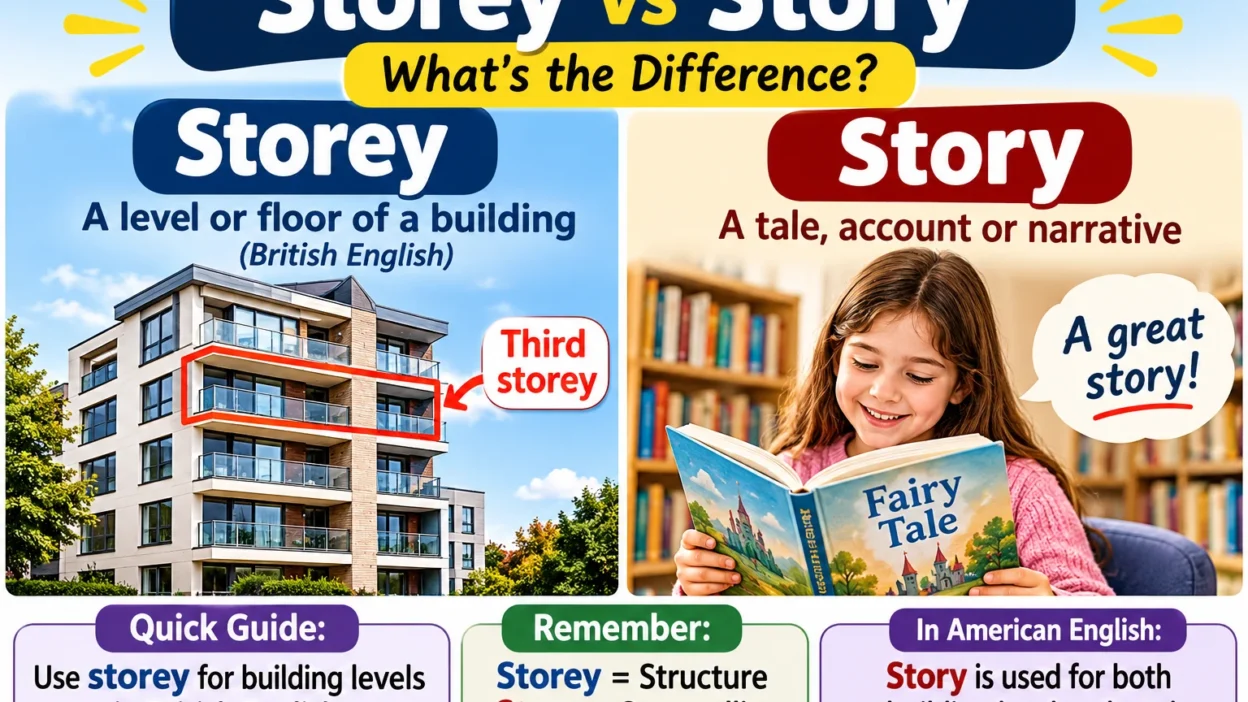
Have you ever wondered if to write storey or story when talking about a building’s height? These two words look almost identical and are pronounced the same, but their meanings and uses are different. Understanding the difference between storey and story can help you avoid spelling mistakes and communicate more clearly.
The main difference between storey and story is that storey refers to a level or floor of a building, while story usually refers to a tale, account, or narrative about real or imaginary events. However, there is an important exception: American English uses story for both meanings, including the floors of a building. British English generally uses storey for building levels and story for narratives. Let’s explore their definitions, spelling differences, common uses, and practical examples so you can choose the correct word confidently.
Quick Answer: Storey vs Story
Storey means one level or floor of a building and is the preferred spelling in British English. Story means a tale or account of events. In American English, story is also used to describe a building’s floor. Both words are pronounced the same.
Why Do People Confuse Storey and Story?
People often confuse storey and story because they:
- Have almost identical spellings.
- Share the same pronunciation.
- Are closely related in meaning when discussing buildings.
- Follow different spelling conventions in American and British English.
The biggest source of confusion is regional spelling. British English distinguishes between the two words, while American English uses story for both meanings.
For example:
- British English: The building has five storeys.
- American English: The building has five stories.
- Both varieties: She told me an interesting story.
1. Storey: Meaning, Definition, and Usage
Storey (plural: storeys) is a noun that refers to one level or floor of a building. It is mainly used in British English and other varieties that follow British spelling conventions.
When you describe how tall a building is, you can use storey to count its levels.
Definition: A storey is a level of a building, including the space between one floor and the floor or roof above it.
Examples of Storey in Sentences
- Our new house has two storeys.
- The office occupies the third storey of the building.
- They live in a four-storey apartment building.
- The hotel has twelve storeys and a beautiful rooftop.
- His bedroom is on the second storey.
- The old building has only one storey.
- We climbed the stairs to the fifth storey.
- The architect designed a six-storey shopping centre.
- Their school is a three-storey building.
- The top storey offers a wonderful view of the city.
Remember: Use storey when referring to building levels in British English.
2. Story: Meaning, Definition, and Usage
Story is a noun with several meanings. Most commonly, it refers to a description of real or imaginary events told through speech, writing, film, or another form of communication.
It can also refer to a news report, personal experience, explanation, or account of something that happened.
In American English, story also means a level or floor of a building.
Definition: A story is a narrative or account of events, if real or imaginary. In American English, it can also mean one level of a building.
Examples of Story in Sentences
- My grandmother told me a beautiful story.
- The children enjoyed reading a fairy tale story.
- He wrote a short story about friendship.
- The newspaper published a story about climate change.
- Everyone has a different story to tell.
- She shared her success story with the students.
- This movie is based on a true story.
- I love reading stories before bedtime.
- The journalist investigated the story carefully.
- Their house has three stories. (American English)
Remember: Use story for narratives in all major varieties of English and for building levels in American English.
Storey vs Story: Comparison Table
| Feature | Storey | Story |
|---|---|---|
| Part of speech | Noun | Noun |
| Main meaning | A level of a building | A tale or account |
| British English | Building level | Narrative |
| American English | Less common | Narrative and building level |
| Pronunciation | /ˈstɔːri/ | /ˈstɔːri/ |
| Plural | Storeys | Stories |
| Example | A five-storey house | An interesting story |
The most important distinction is regional spelling. British English uses storey for building levels, whereas American English uses story.
When to Use Storey vs Story
Choosing between these words becomes easier when you consider what you want to describe and which variety of English you are using.
Use Storey When:
- You are writing in British English.
- You are describing the number of floors in a building.
- You are discussing the architectural design of a structure.
- You want to follow British spelling conventions.
Examples:
- The apartment building has eight storeys.
- We moved into a two-storey house.
- The top storey is used for storage.
Use Story When:
- You are talking about a tale or narrative.
- You are describing someone’s experience.
- You are referring to a news report.
- You are writing in American English about building levels.
Examples:
- She shared an inspiring story.
- I read an interesting story yesterday.
- The building has ten stories.
10+ Examples of Storey vs Story in Everyday English
Here are some practical examples to help you understand the difference.
| Sentence | Correct Word | Explanation |
|---|---|---|
| The house has three storeys. | Storeys | British English building levels |
| She told an exciting story. | Story | A narrative |
| The hotel has twenty stories. | Stories | American English building levels |
| I enjoyed your travel story. | Story | A personal account |
| They built a four-storey house. | Storey | British English building levels |
| He writes short stories. | Stories | Written narratives |
| Our office is on the second storey. | Storey | A building level |
| The movie tells a true story. | Story | An account of real events |
| The apartment has six stories. | Stories | American English building levels |
| My grandfather shared his life story. | Story | A personal narrative |
| The school is a two-storey building. | Storey | British English building levels |
| The newspaper published an important story. | Story | A news report |
These examples show that context and regional spelling determine which word is appropriate.
Common Mistakes When Using Storey and Story
Even experienced English speakers sometimes mix up these words. Here are some mistakes worth avoiding.
1. Using Storey for a Narrative
Incorrect: She told me an interesting storey.
Correct: She told me an interesting story.
Why? A narrative is always called a story, not a storey.
2. Using Story in British English for a Building Level
Less appropriate in British English: The building has five stories.
Preferred British English: The building has five storeys.
Why? British English traditionally uses storey for a building level.
3. Confusing the Plural Forms
Incorrect: The building has three storey’s.
Correct: The building has three storeys.
Why? The plural of storey is storeys. An apostrophe is not needed.
4. Assuming Both Words Have Different Pronunciations
Incorrect assumption: Storey and story sound different.
Correct: Both words are pronounced the same.
Why? Their difference is primarily spelling and meaning, not pronunciation.
5. Forgetting American and British Differences
American English: The building has four stories.
British English: The building has four storeys.
Both are correct within their respective spelling conventions.
Easy Memory Trick: How to Remember Storey vs Story
Use these simple tricks to remember the difference:
- Storey = Structure: Think of a building’s structure and its different levels.
- Story = Storytelling: Think of books, movies, tales, and personal experiences.
Another easy way to remember:
If you are talking about a building in British English, use storey. If you are talking about a tale, use story. If you are writing American English, use story for both meanings.
American English vs British English: Storey vs Story
The difference between these words is especially important when comparing American and British English.
| Meaning | American English | British English |
|---|---|---|
| A building level | Story | Storey |
| A narrative | Story | Story |
| Multiple building levels | Stories | Storeys |
| Multiple narratives | Stories | Stories |
| A building with five levels | A five-story building | A five-storey building |
American English
In American English, story is the standard spelling for both a building level and a narrative.
Examples:
- The building has seven stories.
- We live in a two-story house.
- She wrote an interesting story.
British English
In British English, storey refers to a building level, while story refers to a narrative.
Examples:
- The building has seven storeys.
- We live in a two-storey house.
- She wrote an interesting story.
Important: Neither spelling is universally wrong. The correct choice depends on your audience and the variety of English you are using.
Similar Words to Storey and Story
Understanding related words can make it easier to use these terms correctly.
| Word | Meaning | Example |
|---|---|---|
| Floor | A level of a building | My office is on the third floor. |
| Level | One horizontal section of a building | The house has two levels. |
| Tale | A narrative or story | He told us an amusing tale. |
| Narrative | An account of connected events | The novel has a powerful narrative. |
| Episode | One event or part of a series | She described an interesting episode from her childhood. |
| Account | A description of an event | He gave an account of the accident. |
| Novel | A long fictional written work | She is reading a historical novel. |
| Fiction | Imaginary or invented writing | I enjoy reading fiction. |
These words are related but cannot always replace storey or story in every sentence.
Final Verdict: Storey vs Story
The difference between storey and story depends on meaning and regional spelling.
- Storey: A level or floor of a building in British English.
- Story: A narrative, tale, news report, or personal account in all major varieties of English.
- Story: Also means a building level in American English.
If you are writing for a British audience, use storey when describing building levels. If you are writing for an American audience, use story for both meanings.
Frequently Asked Questions (FAQs)
1. What is the difference between storey and story?
Storey refers to a level of a building in British English, while story refers to a narrative or tale. American English uses story for both a building level and a narrative.
2. Is storey British or American English?
Storey is primarily the British English spelling for a level of a building. American English generally uses story instead.
3. Is story or storey correct for a building?
Both can be correct. Use storey in British English and story in American English when referring to a building level.
4. What is the plural of storey?
The plural of storey is storeys. For example, “The building has five storeys.”
5. What is the plural of story?
The plural of story is stories. For example, “She enjoys reading adventure stories.”
6. Is a two-storey house the same as a two-story house?
Yes. Both expressions describe a house with two levels. Two-storey is the British English spelling, while two-story is the American English spelling.
7. Are storey and story pronounced the same?
Yes. Both words have the same pronunciation: /ˈstɔːri/. The difference is in their spelling and meaning.
8. Should I use storey or story in academic writing?
Choose the spelling based on your required English style guide. Use storey for building levels in British English and story in American English. For narratives, always use story.
Remember This
- Storey = A building level in British English.
- Story = A tale, narrative, or account.
- Story = A building level in American English.
- Storeys = The British English plural.
- Stories = The plural of story in both varieties and the American English plural for building levels.
The easiest rule is to remember that a building has storeys in British English, while a book contains stories.
Conclusion
Understanding the difference between storey and story is simple once you know their meanings and regional spelling conventions. Storey describes a building level in British English, whereas story describes a narrative, tale, or account. American English uses story for both meanings, making context especially important.
if you are writing an essay, describing a house, reading a book, or preparing professional content, choose the spelling that matches your intended meaning and audience. Remember: a building has storeys in British English, but a book has stories in every variety of English.

Adam Cody is a passionate writer at SleepCout, exploring coded dreams, dream meanings, sleep science, lucid dreaming, and symbolism through engaging, well-researched articles that inspire curiosity and self-discovery.