Understanding the difference between next Friday vs this Friday can help you avoid confusion when making plans, scheduling meetings, or talking about upcoming events. Both expressions refer to a Friday, but they do not always identify the same date. Their meanings depend on when you say them and how you use them in a sentence.
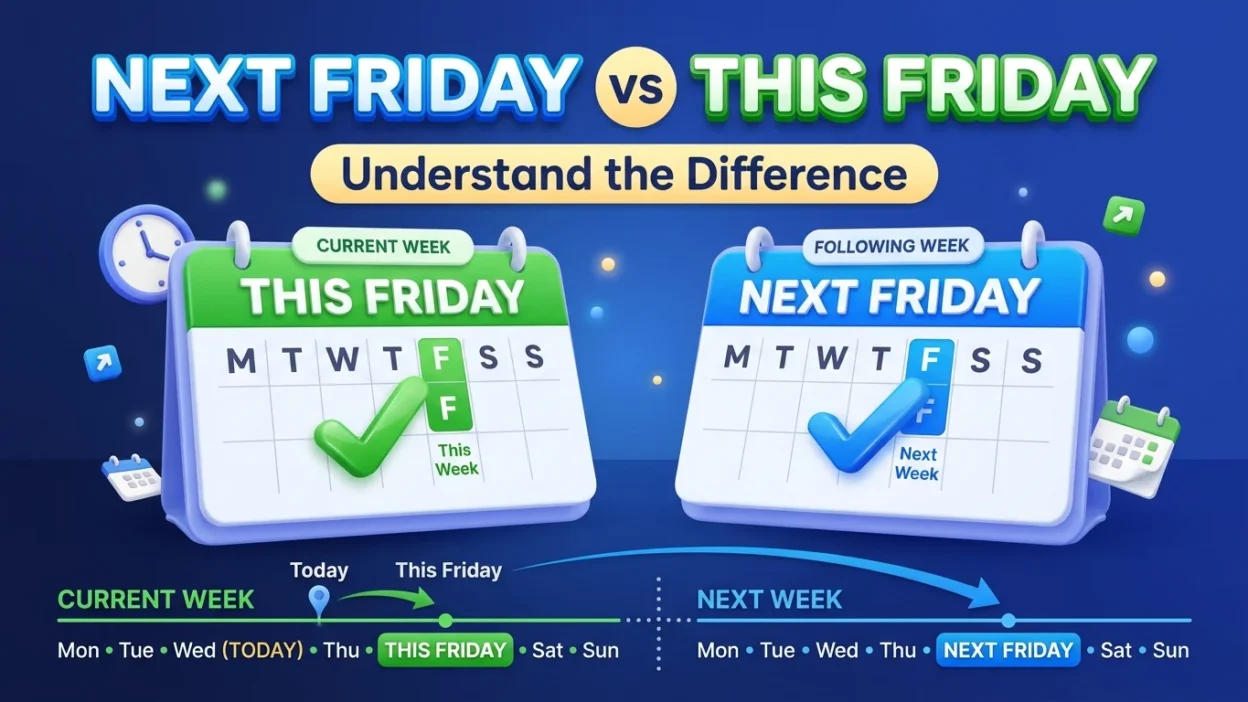
The phrase this Friday usually refers to the Friday in the current calendar week. In contrast, next Friday commonly refers to the Friday of the following week, especially when the current Friday is approaching or has not yet passed. However, everyday English speakers sometimes use these expressions differently, which can create misunderstandings. Learning how to distinguish them will make your conversations clearer and help you communicate dates more confidently.
Quick Answer
This Friday usually means the Friday in the current week, while next Friday usually means the Friday in the following week. However, people sometimes use next Friday to mean the upcoming Friday. To avoid confusion, mention the exact date when making important plans.
Why Do People Confuse Next Friday and This Friday?
People often confuse these expressions because both refer to a Friday that is coming in the future.
The main reason is that English speakers do not always use the same reference point when talking about upcoming days.
For example:
- On Monday, someone might use this Friday for the Friday four days away.
- Another person might use next Friday for that same upcoming Friday.
- Someone else might understand next Friday as the Friday of the following week.
The confusion becomes more noticeable when people make appointments, arrange meetings, or discuss travel plans.
The best solution is to clarify the date whenever there is a possibility of misunderstanding.
1. What Does This Friday Mean?
This Friday generally refers to the Friday belonging to the current calendar week.
It is commonly used when discussing something that will happen before the current week ends.
Examples of This Friday
- We have an important meeting this Friday.
- I am going to visit my grandparents this Friday.
- The school will organize a sports event this Friday.
- Are you available this Friday?
- I need to finish this project by this Friday.
When Is This Friday Used?
Use this Friday when you want to refer to the Friday in the current week.
For example, if today is Monday, November 9, and Friday is November 13, you can say:
“We are having a family dinner this Friday.”
Here, this Friday means November 13.
2. What Does Next Friday Mean?
Next Friday generally refers to the Friday in the following calendar week.
It is often used when discussing an event that will happen after the current week.
Examples of Next Friday
- Our final examination is next Friday.
- I will send you the documents next Friday.
- They are planning a wedding celebration next Friday.
- Can we schedule the meeting for next Friday?
- My brother will return home next Friday.
When Is Next Friday Used?
Use next Friday when you mean the Friday of the following week.
For example, if today is Monday, November 9, and the current week’s Friday is November 13, next Friday would generally mean November 20.
However, remember that some speakers use next Friday to mean the nearest upcoming Friday. Context matters.
Next Friday vs This Friday: Comparison Table
| Feature | This Friday | Next Friday |
|---|---|---|
| General meaning | Friday of the current week | Friday of the following week |
| Time reference | Current calendar week | Following calendar week |
| Typical use | Near-term plans | Plans for the following week |
| Example | I will call you this Friday. | I will call you next Friday. |
| Possible confusion | Depends on the current week | May mean the upcoming Friday |
| Best clarification | State the date | State the date |
When to Use This Friday vs Next Friday
Choosing the correct expression depends on the date you want to communicate.
Use This Friday When:
- You mean Friday in the current calendar week.
- You are discussing an upcoming event this week.
- You want to make plans for the nearest Friday within the current week.
Examples:
- Let’s go shopping this Friday.
- The office will close early this Friday.
- I have a doctor’s appointment this Friday.
Use Next Friday When:
- You mean Friday in the following calendar week.
- You are planning something beyond the current week.
- You want to distinguish a later Friday from the current week’s Friday.
Examples:
- Our new course starts next Friday.
- I will meet my friends next Friday.
- The company will announce the results next Friday.
Important: If you are arranging something important, use the exact date instead of relying entirely on these expressions.
12 Examples of Next Friday and This Friday in Sentences
Here are practical examples to help you understand the difference.
| No. | Sentence | Meaning |
|---|---|---|
| 1 | I have an appointment this Friday. | Friday of the current week |
| 2 | We will travel next Friday. | Friday of the following week |
| 3 | The meeting is scheduled for this Friday. | Current week’s Friday |
| 4 | My exams begin next Friday. | Following week’s Friday |
| 5 | Are you free this Friday? | Asking about the current week’s Friday |
| 6 | I will visit you next Friday. | Visiting the following week |
| 7 | The shop is offering discounts this Friday. | Discount this current week |
| 8 | Our new project starts next Friday. | Project starts the following week |
| 9 | Let’s have lunch this Friday. | Lunch during the current week |
| 10 | She will arrive next Friday. | Arrival during the following week |
| 11 | We have a school event this Friday. | Event this current week |
| 12 | The new movie will be released next Friday. | Release during the following week |
Examples in Short Conversations
Conversation 1:
Alex: Are you free this Friday?
Sam: Yes, I am. Let’s meet in the evening.
Conversation 2:
John: When will the new course begin?
Sarah: It will begin next Friday.
Conversation 3:
David: Can we postpone our meeting?
Michael: Sure. How about next Friday instead?
These conversations show how both expressions are naturally used in everyday English.
Common Mistakes When Using Next Friday and This Friday
Even fluent English speakers can misunderstand these expressions.
Here are some common mistakes to avoid.
1. Assuming Everyone Understands Next Friday the Same Way
Not everyone interprets next Friday identically.
Better approach: Mention the exact date when scheduling an important event.
2. Using This Friday for the Following Week
If you mean the Friday of the following calendar week, next Friday is generally more appropriate.
3. Forgetting the Current Day
The meaning of these expressions depends partly on the day you are speaking.
For example, saying next Friday on Saturday may be understood differently from saying it on Monday.
4. Ignoring Context
A conversation about an event happening this week may make this Friday clearer.
Always consider the surrounding conversation.
5. Not Confirming Important Appointments
If someone says, “Let’s meet next Friday,” do not assume you both mean the same date.
Confirm the calendar date before finalizing the appointment.
Memory Trick: How to Remember the Difference
Here is a simple way to remember these expressions:
- This Friday = This week.
- Next Friday = Next week.
Think of this as something belonging to the current week and next as something coming in the following week.
For example:
- This Friday: November 13.
- Next Friday: November 20.
This simple trick works when speakers are using the common calendar-week distinction.
American vs British English: Is There a Difference?
Both American and British English use this Friday and next Friday.
The basic distinction is similar in both varieties:
- This Friday generally refers to Friday in the current week.
- Next Friday generally refers to Friday in the following week.
However, speakers in both countries may interpret next Friday as the nearest upcoming Friday, particularly when speaking early in the week.
There is no strict American-versus-British rule that completely removes this ambiguity.
For clear communication in either variety, use the exact date.
Similar Words and Expressions
Several other English expressions are useful when talking about upcoming days and dates.
| Expression | Meaning | Example |
|---|---|---|
| Today | The current day | I am busy today. |
| Tomorrow | The day after today | I will call you tomorrow. |
| This weekend | The weekend in the current week | We are traveling this weekend. |
| Next week | The following week | I will start work next week. |
| This Monday | Monday of the current week | We have a meeting this Monday. |
| Next Monday | Monday of the following week | The course starts next Monday. |
| Last Friday | The previous Friday | I met him last Friday. |
| The following Friday | Friday after a previously mentioned date or event | We will meet again the following Friday. |
These expressions help you discuss schedules, appointments, and future plans more accurately.
Final Verdict: Next Friday vs This Friday
The main difference between next Friday and this Friday is their usual reference to the calendar week.
- This Friday generally means Friday in the current week.
- Next Friday generally means Friday in the following week.
Both expressions are correct English, but next Friday can sometimes be ambiguous because people interpret it differently.
When clarity matters, mention the exact date rather than relying on the phrase alone.
Frequently Asked Questions (FAQs)
1. Does Next Friday Mean This Coming Friday?
Not always. Next Friday commonly means the Friday of the following calendar week. However, some English speakers use it to mean the nearest upcoming Friday. The intended meaning depends on context and personal usage.
2. Does This Friday Mean the Friday of This Week?
Yes. In common usage, this Friday refers to the Friday in the current calendar week. For example, if today is Monday, this Friday generally means the Friday four days later.
3. Is Next Friday One Week Away?
Usually, it refers to the Friday in the following calendar week, but the actual number of days depends on the current day. It may be more than seven days away or, depending on usage, refer to the upcoming Friday.
4. What Is the Difference Between This Coming Friday and Next Friday?
This coming Friday generally emphasizes the nearest upcoming Friday. Next Friday may refer either to that Friday or to the Friday of the following week, depending on the speaker.
5. Is Next Friday Grammatically Correct?
Yes. Next Friday is a grammatically correct expression used in everyday English to discuss future plans, appointments, meetings, and events.
6. Can I Use This Friday and Next Friday in Formal Writing?
Yes. Both expressions are acceptable in formal and informal communication. However, professional emails, business schedules, and official invitations are clearer when they include the exact calendar date.
7. How Can I Avoid Confusion When Scheduling an Event?
The easiest solution is to mention the weekday and date together.
For example:
“Let’s meet on Friday, November 20.”
This removes uncertainty and helps everyone understand the intended schedule.
Remember This
- This Friday usually means Friday of the current week.
- Next Friday usually means Friday of the following week.
- Both expressions are correct in English.
- People may interpret next Friday differently.
- Always mention the exact date when making important plans.
Conclusion
Understanding next Friday vs this Friday is important for clear everyday communication. Although both expressions refer to an upcoming Friday, they generally describe different weeks. Use this Friday for the current week’s Friday and next Friday for the Friday of the following week. Remember that everyday speakers sometimes interpret these phrases differently.
The best way to avoid misunderstandings is to include the exact date when discussing meetings, appointments, travel, or other important events. With this simple habit, you can communicate your plans more confidently and use both expressions correctly in everyday English.

Charles Kyle is a passionate writer and dream researcher at SleepCout, dedicated to exploring coded dreams, lucid dreaming, dream symbolism, and sleep science. He creates engaging, well-researched content that helps readers understand their dreams and discover the fascinating connection between technology, imagination, and the sleeping mind.