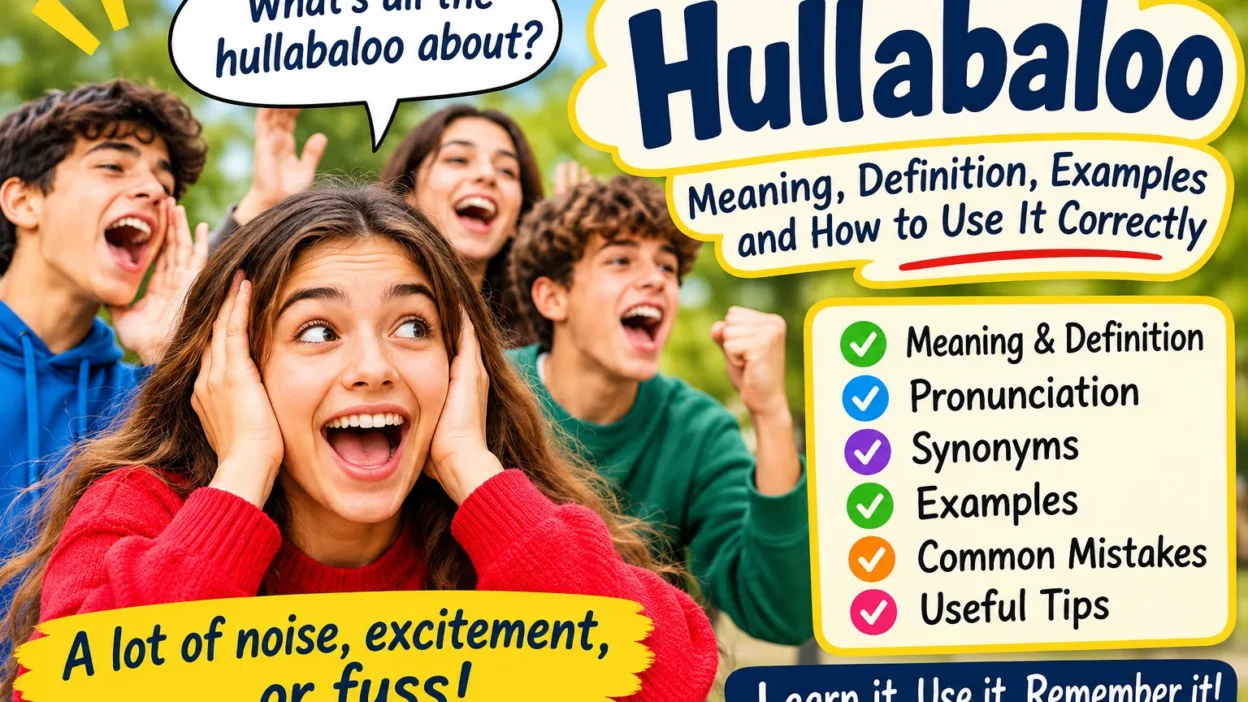
The English language contains many interesting words that make everyday conversations more colorful and expressive. One such word is hullabaloo. It is a lively, informal word used to describe a lot of noise, excitement, confusion, or unnecessary fuss about something. Although it may sound unusual, it is easy to understand once you see how people use it in everyday situations.
You might hear someone say, “What’s all the hullabaloo about?” when people are making a big deal out of something. The word can describe a noisy argument, a public commotion, a dramatic reaction, or excitement surrounding an event. It is often used in a humorous or slightly critical way. Learning the meaning of hullabaloo, its pronunciation, synonyms, and practical examples will help you understand this expressive English word and use it naturally in conversations and writing.
Quick Answer: What Does Hullabaloo Mean?
Hullabaloo means a lot of noise, excitement, confusion, or fuss, especially when people react loudly or dramatically to something. It is an informal noun commonly used to describe a commotion or unnecessary excitement. For example, “There was a huge hullabaloo over the new school rules.”
Why Do People Get Confused About Hullabaloo?
People sometimes find hullabaloo confusing because it does not sound like many familiar English words. Its unusual spelling and playful pronunciation can make it difficult to remember.
There are also several meanings associated with the word, depending on the situation:
- Noise: A loud disturbance caused by people.
- Commotion: A situation involving confusion, activity, or excitement.
- Fuss: An exaggerated reaction to something.
- Excitement: A noisy or enthusiastic response to an event.
The important thing to remember is that hullabaloo generally describes a noticeable disturbance or a lot of unnecessary attention.
What Does Hullabaloo Mean?
Hullabaloo is a noun that refers to loud noise, public excitement, confusion, or a commotion.
It is commonly used in informal conversations when people want to describe a situation that seems louder, more dramatic, or more complicated than necessary.
Pronunciation: hul-uh-buh-LOO
Phonetic spelling: /ˌhʌl.ə.bəˈluː/
Part of speech: Noun
Simple definition: A noisy disturbance, commotion, or unnecessary fuss.
Example: The children made a great hullabaloo when their favorite teacher entered the classroom.
In this sentence, hullabaloo describes the loud excitement created by the children.
Is Hullabaloo a Formal or Informal Word?
Hullabaloo is an informal word. It is suitable for everyday conversations, storytelling, casual writing, and humorous descriptions.
In formal writing, words such as commotion, disturbance, or controversy may be more appropriate, depending on the context.
Hullabaloo: Meaning and Usage Comparison
Although hullabaloo has several related meanings, its central idea remains the same: a situation that attracts attention through noise, excitement, or fuss.
| Meaning | Explanation | Example |
|---|---|---|
| Noise | Loud sounds made by people | The hullabaloo woke the baby. |
| Commotion | Confusion or disturbance | A hullabaloo started outside. |
| Fuss | Unnecessary excitement | There was too much hullabaloo over a small mistake. |
| Excitement | Noisy enthusiasm | The crowd created a hullabaloo after the victory. |
| Controversy | A loud public reaction | The announcement caused a political hullabaloo. |
When Should You Use Hullabaloo?
Use hullabaloo when describing a situation involving considerable noise, excitement, confusion, or fuss.
Here are some common situations where the word fits naturally.
1. When people are making too much noise
Use it to describe loud activity or disturbance.
Example: There was a terrible hullabaloo coming from the playground.
2. When someone makes a big deal about something
Use it when people react dramatically to a relatively small issue.
Example: I don’t understand all the hullabaloo about a simple dress code change.
3. When a crowd becomes excited
It can describe enthusiastic reactions at celebrations or public events.
Example: The stadium erupted into a hullabaloo after the winning goal.
4. When an argument attracts attention
Use it for noisy disagreements or public disputes.
Example: Their disagreement created quite a hullabaloo at the meeting.
15 Examples of Hullabaloo in Sentences
Understanding examples is one of the easiest ways to learn how to use hullabaloo correctly.
- The children made a huge hullabaloo when they saw the birthday cake.
- What’s all the hullabaloo about?
- There was a lot of hullabaloo outside the shopping mall.
- The announcement caused a considerable hullabaloo among employees.
- I wanted to enjoy my evening without all this hullabaloo.
- The neighbors complained about the hullabaloo coming from the party.
- Everyone created a hullabaloo when the famous singer arrived.
- The small disagreement turned into a major hullabaloo.
- There was unnecessary hullabaloo over a minor misunderstanding.
- The classroom was filled with hullabaloo before the teacher arrived.
- The new policy caused quite a hullabaloo on social media.
- We heard a strange hullabaloo coming from the street.
- The children stopped their hullabaloo when their mother entered.
- The sudden announcement created a hullabaloo throughout the office.
- Despite all the hullabaloo, the event went smoothly.
These examples show that hullabaloo can describe both positive excitement and negative disturbances.
Common Mistakes When Using Hullabaloo
Even though hullabaloo is easy to understand, learners sometimes make mistakes when using it.
1. Treating It as a Verb
Hullabaloo is a noun, not a verb.
Incorrect: They hullabaloo about everything.
Correct: They make a hullabaloo about everything.
2. Using It Only for Negative Situations
Hullabaloo does not always describe something unpleasant. It can also describe joyful excitement.
Example: The children created a happy hullabaloo at the birthday party.
3. Forgetting Its Informal Tone
Hullabaloo is generally conversational. It may sound too casual in academic or highly formal writing.
4. Confusing Noise With Ordinary Conversation
Not every conversation is a hullabaloo. The word usually suggests noticeable noise, commotion, excitement, or fuss.
Memory Trick: How to Remember Hullabaloo
Think of a crowded room where everyone is talking, laughing, shouting, and making noise.
That lively and noisy scene is a hullabaloo.
You can remember it with this simple association:
Hullabaloo = Noise + Excitement + Fuss
Another helpful way to remember it is through the phrase:
“What’s all the hullabaloo about?”
This common expression is used when someone wants to know why people are making so much noise or fuss about something.
Is Hullabaloo Different in American and British English?
Hullabaloo is understood in both American and British English.
| Feature | American English | British English |
|---|---|---|
| Spelling | Hullabaloo | Hullabaloo |
| Pronunciation | Similar | Similar |
| Meaning | Noise, commotion, fuss | Noise, commotion, fuss |
| Usage | Informal | Informal |
| Common expression | What’s all the hullabaloo about? | What’s all the hullabaloo about? |
There is no major difference in spelling or meaning between the two varieties.
The word is used in both countries, although its frequency may vary depending on the speaker and context.
What Are Some Words Similar to Hullabaloo?
Several English words have meanings similar to hullabaloo. However, they are not always interchangeable.
| Similar word | Meaning | Example |
|---|---|---|
| Commotion | Noisy confusion or disturbance | A commotion started in the hallway. |
| Uproar | A loud public reaction | The decision caused an uproar. |
| Ruckus | Noisy or disorderly activity | The children made a ruckus. |
| Fuss | Unnecessary excitement or concern | Don’t make a fuss about it. |
| Clamor | Loud and persistent noise or demand | The crowd raised a clamor. |
| Hubbub | A mixture of loud voices and activity | I couldn’t hear over the hubbub. |
| Turmoil | A state of confusion or disorder | The organization was in turmoil. |
| Fracas | A noisy argument or fight | A fracas broke out after the match. |
Hullabaloo vs. Commotion
Both words describe noisy or confusing situations. However, commotion is a more neutral and widely applicable word, while hullabaloo often sounds more playful or informal.
Hullabaloo vs. Uproar
Uproar usually suggests a strong public reaction, protest, or loud disagreement. Hullabaloo can describe smaller, less serious situations as well.
Hullabaloo vs. Fuss
Fuss emphasizes unnecessary concern or attention, whereas hullabaloo often emphasizes the noise and commotion surrounding a situation.
Frequently Asked Questions About Hullabaloo
1. What is the simple meaning of hullabaloo?
Hullabaloo means a lot of noise, excitement, confusion, or fuss. It describes a situation where people are making considerable noise or creating unnecessary excitement about something.
2. Is hullabaloo a positive or negative word?
Hullabaloo can be either positive or negative. It may describe happy excitement at a celebration or an unpleasant disturbance caused by an argument.
3. Is hullabaloo a noun or a verb?
Hullabaloo is a noun. It names a noisy disturbance, commotion, or fuss. You can use it in expressions such as “make a hullabaloo” or “cause a hullabaloo.”
4. How do you pronounce hullabaloo?
Hullabaloo is pronounced hul-uh-buh-LOO. The final syllable receives the strongest stress. Its phonetic spelling is /ˌhʌl.ə.bəˈluː/.
5. What is another word for hullabaloo?
Common synonyms include commotion, uproar, ruckus, fuss, hubbub, and clamor. The best alternative depends on if you want to emphasize noise, excitement, confusion, or public reaction.
6. Is hullabaloo a British word?
Hullabaloo is used in both British and American English. Its spelling and general meaning remain the same in both varieties.
7. What does “What’s all the hullabaloo about?” mean?
This expression means “Why is everyone making so much noise or fuss?” It is commonly used when someone wants to understand the reason behind a commotion or exaggerated reaction.
Remember This
- Hullabaloo is a noun.
- It means noise, commotion, excitement, or fuss.
- It is an informal English word.
- It can describe positive or negative situations.
- Its pronunciation is hul-uh-buh-LOO.
- It is used in both American and British English.
Conclusion
Hullabaloo is an expressive English word that makes everyday communication more colorful. It describes a noisy situation, public commotion, excitement, or unnecessary fuss. if people are celebrating, arguing, or reacting dramatically to an announcement, hullabaloo can help describe the situation in a lively and memorable way.
The easiest way to remember this word is to associate it with a crowd making lots of noise and excitement. Practice using it in sentences such as “What’s all the hullabaloo about?” and “There was a huge hullabaloo at the party.” With a little practice, you will be able to understand and use hullabaloo naturally in everyday English.

Adam Cody is a passionate writer at SleepCout, exploring coded dreams, dream meanings, sleep science, lucid dreaming, and symbolism through engaging, well-researched articles that inspire curiosity and self-discovery.