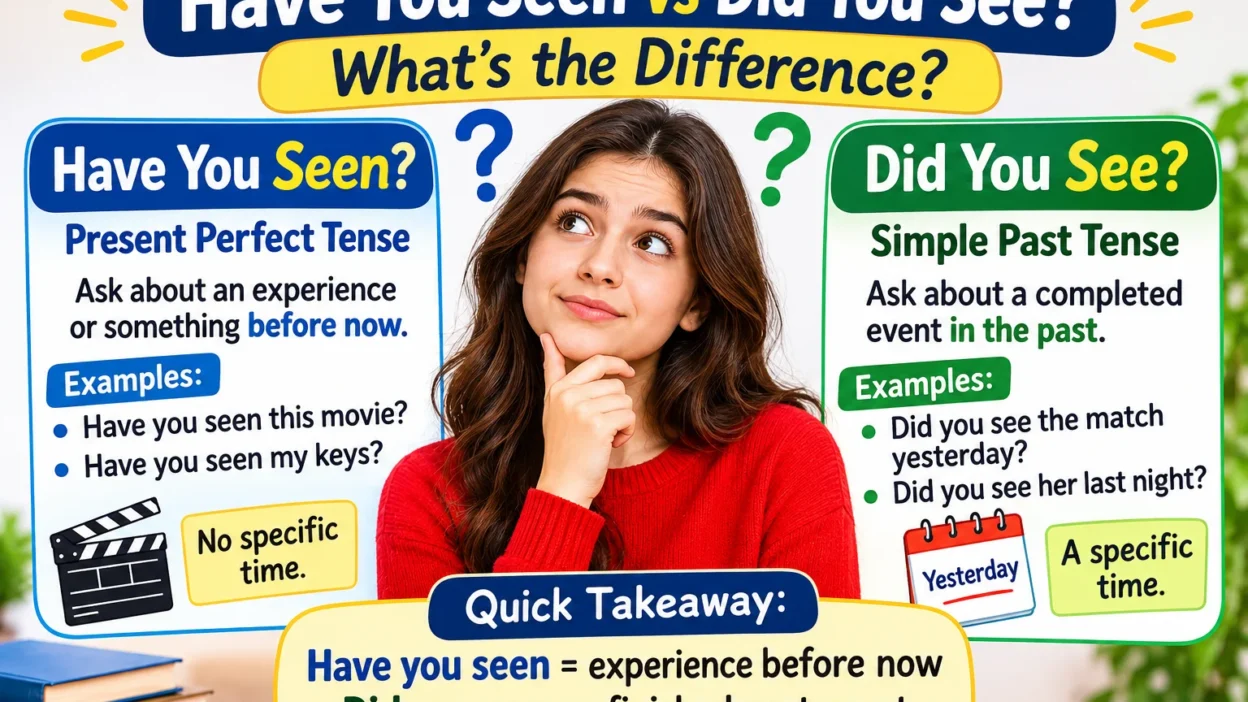
Have you ever wondered if to say “Have you seen?” or “Did you see?” when asking someone about something they watched, noticed, or experienced? Both expressions are grammatically correct, but they are used in different situations. Understanding the difference will help you speak and write English more naturally.
The main difference between have you seen and did you see is the connection to time. “Have you seen” uses the present perfect tense and usually asks about an experience or something that may have happened at an unspecified time before now. “Did you see” uses the simple past tense and asks about a completed event, often connected to a specific past time. For example, you might ask, “Have you seen this movie?” when asking if someone has watched it at any time. However, you would say, “Did you see the movie last night?” when referring to a particular past occasion.
Quick Answer: Have You Seen vs Did You See
“Have you seen” is the present perfect form, used to ask if someone has experienced or noticed something before now without specifying exactly when. “Did you see” is the simple past form, used to ask about a completed past event, often at a particular time. The correct choice depends on the time and context.
Why Do People Confuse Have You Seen and Did You See?
People often confuse these expressions because both ask about seeing something in the past.
They can also have similar meanings in everyday conversations. However, their grammatical structures and time references are different.
Consider these examples:
- Have you seen my phone? – You are asking if someone has seen your phone at any time up to now.
- Did you see my phone yesterday? – You are asking if someone saw your phone at a particular time in the past.
The important difference is the relationship between the past action and the present moment.
What Does Have You Seen Mean?
“Have you seen” is the present perfect tense of the verb “see.”
It follows this structure:
Have + subject + past participle (seen)?
We use it to ask about experiences, recent events, or situations where the exact time is not important.
When to Use Have You Seen
Use “have you seen” in these situations:
1. To ask about life experiences
When you want to know if someone has ever watched or experienced something.
- Have you seen the Eiffel Tower?
- Have you seen this movie before?
2. To ask about something up to now
Use it when asking if someone has noticed or found something.
- Have you seen my keys?
- Have you seen Sarah today?
3. To ask about recent events
Use it when something has happened recently and is relevant to the present.
- Have you seen the latest news?
- Have you seen the new school announcement?
4. To ask about something without mentioning a specific past time
- Have you seen that beautiful painting?
- Have you seen this kind of bird before?
What Does Did You See Mean?
“Did you see” is the simple past tense question form of the verb “see.”
It follows this structure:
Did + subject + base form of the verb?
Notice that we use “see,” not “saw” or “seen,” after “did.”
We use “did you see” to ask about an action or experience that happened at a completed time in the past.
When to Use Did You See
1. To ask about a specific past event
- Did you see the match yesterday?
- Did you see the accident this morning?
2. To ask about something that happened at a particular time
- Did you see him at the party last night?
- Did you see the teacher after class?
3. To ask about a completed past experience
- Did you see that movie when you were younger?
- Did you see the fireworks during the festival?
4. To ask if someone noticed something in the past
- Did you see my message yesterday?
- Did you see what happened outside?
Have You Seen vs Did You See: Comparison Table
| Feature | Have You Seen | Did You See |
|---|---|---|
| Tense | Present perfect | Simple past |
| Verb structure | Have + seen | Did + see |
| Time reference | Before now | Completed past |
| Specific past time | Usually not specified | Often specified |
| Main purpose | Ask about experience or recent events | Ask about past events |
| Example | Have you seen this film? | Did you see this film last night? |
| Time expressions | Ever, never, recently, yet | Yesterday, last night, ago |
| Connection to present | Often relevant | Focuses on the past |
When to Use Have You Seen vs Did You See
Choosing between these expressions becomes easier when you understand the situation.
Use Have You Seen When:
- You are asking about someone’s experience.
- You do not mention a specific completed past time.
- You want to know if something has happened before now.
- The situation is connected to the present.
Examples:
- Have you seen this movie?
- Have you seen my brother today?
- Have you seen the new shopping mall?
- Have you seen this type of flower before?
Use Did You See When:
- You are asking about a completed past event.
- You mention a specific past time.
- You want to know if someone noticed something at a particular moment.
- You are discussing a past occasion.
Examples:
- Did you see the match yesterday?
- Did you see John last weekend?
- Did you see the accident this morning?
- Did you see the rainbow after the rain?
15 Examples of Have You Seen vs Did You See in Sentences
Here are practical examples to help you understand the difference.
| Have You Seen (Present Perfect) | Did You See (Simple Past) |
|---|---|
| Have you seen my new car? | Did you see my new car yesterday? |
| Have you seen this movie? | Did you see this movie last night? |
| Have you seen Sarah today? | Did you see Sarah at school yesterday? |
| Have you seen the latest news? | Did you see the news this morning? |
| Have you seen my glasses? | Did you see my glasses on the table? |
| Have you seen this book before? | Did you see this book at the library? |
| Have you seen the new teacher? | Did you see the new teacher yesterday? |
| Have you seen that famous actor? | Did you see that actor at the event? |
| Have you seen my message yet? | Did you see my message last night? |
| Have you seen the garden? | Did you see the garden when you visited? |
| Have you seen this photograph before? | Did you see this photograph at the exhibition? |
| Have you seen the new advertisement? | Did you see the advertisement on TV yesterday? |
| Have you seen my wallet anywhere? | Did you see my wallet in the car? |
| Have you seen the children today? | Did you see the children this morning? |
| Have you seen that beautiful sunset? | Did you see the sunset yesterday evening? |
Remember: The first column focuses on experiences or events up to now, while the second focuses on completed past situations.
Common Mistakes to Avoid
English learners sometimes make mistakes when using these two expressions. Here are the most common ones.
1. Using Saw After Did
Incorrect: Did you saw that movie?
Correct: Did you see that movie?
Why? The auxiliary verb “did” already indicates the past tense, so the main verb must remain in its base form.
2. Using Seen Without Have
Incorrect: Did you seen my phone?
Correct: Did you see my phone?
Correct: Have you seen my phone?
Why? “Seen” is the past participle and requires an appropriate auxiliary verb, such as “have” in the present perfect.
3. Using Have You Seen With a Finished Past Time
Incorrect: Have you seen him yesterday?
Correct: Did you see him yesterday?
Why? We generally use the simple past with finished past-time expressions such as “yesterday,” “last week,” and “two days ago.”
4. Confusing Present Perfect With Simple Past
Incorrect: Have you seen the match last night?
Correct: Did you see the match last night?
Why? “Last night” refers to a completed time in the past, so the simple past is appropriate.
Easy Memory Trick to Remember the Difference
Here is a simple way to remember when to use each expression:
Present perfect
HAVE YOU SEEN = EXPERIENCE BEFORE NOW
Have you seen?
Think about an experience, something recent, or something that may have happened at any time before now.
Example: Have you seen this movie?
Simple past
DID YOU SEE = COMPLETED PAST EVENT
Did you see?
Think about a finished event or a particular moment in the past.
Example: Did you see this movie yesterday?
An easy rule is:
- No specific finished past time? Consider Have you seen?
- A specific finished past time? Use Did you see?
Have You Seen vs Did You See in American and British English
Both American and British English use “have you seen” and “did you see.” The basic grammatical difference remains the same.
However, there can be some differences in everyday usage.
American English:
American speakers often use the simple past when talking about recent completed events.
Example: Did you see the news today?
British English:
British speakers may prefer the present perfect when discussing recent events that have a connection to the present.
Example: Have you seen the news today?
These are general tendencies, not strict rules. Both forms are understood in both varieties of English, and the correct choice depends on the context.
Similar Words and Related Grammar
Understanding these related expressions can help you use the present perfect and simple past more confidently.
| Expression | Meaning | Example |
|---|---|---|
| Have you watched? | Asking about an experience or completed viewing | Have you watched this series? |
| Did you watch? | Asking about a past viewing event | Did you watch the show yesterday? |
| Have you heard? | Asking if someone knows something recently or before now | Have you heard the news? |
| Did you hear? | Asking about something heard in the past | Did you hear that noise last night? |
| Have you noticed? | Asking about something noticed before now | Have you noticed the change? |
| Did you notice? | Asking about a past observation | Did you notice the mistake yesterday? |
These examples follow the same general tense patterns as “have you seen” and “did you see.”
Final Verdict: Have You Seen vs Did You See
The difference between “have you seen” and “did you see” is mainly about time and context.
- Have you seen uses the present perfect tense and asks about an experience or event before now without focusing on a specific finished past time.
- Did you see uses the simple past tense and asks about a completed past event, often with a specific time reference.
Both expressions are correct. Choose the one that matches the situation you are describing.
Frequently Asked Questions (FAQs)
1. Is it correct to say have you seen or did you see?
Both expressions are grammatically correct. Use “have you seen” to ask about experiences or events before now without a specific finished past time. Use “did you see” to ask about a completed event in the past.
2. What is the difference between have you seen and did you see?
“Have you seen” is present perfect, while “did you see” is simple past. The first focuses on experiences or events up to now, whereas the second focuses on completed past events.
3. Should I say have you seen this movie or did you see this movie?
Both are correct, depending on the meaning.
- Have you seen this movie? (Asking if someone has watched it at any time before now.)
- Did you see this movie last night? (Asking about a particular past occasion.)
4. Can I use have you seen with yesterday?
Generally, no. “Yesterday” refers to a finished past time, so use the simple past.
Correct: Did you see him yesterday?
Incorrect: Have you seen him yesterday?
5. Is have you ever seen correct?
Yes. “Have you ever seen” is a correct present perfect construction used to ask if someone has experienced something at any time in their life.
Example: Have you ever seen snow?
6. Why do we say did you see instead of did you saw?
Because “did” already marks the question as past tense. The main verb must stay in its base form.
Correct: Did you see the accident?
Incorrect: Did you saw the accident?
7. Can have you seen and did you see have the same meaning?
They can refer to the same general experience, but their emphasis is different. “Have you seen” connects the experience to the present, while “did you see” places the question in a completed past situation.
Remember This
- Have you seen? = Present perfect tense.
- Did you see? = Simple past tense.
- Use “seen” after have or has.
- Use “see” after did.
- Use the simple past with finished past-time expressions such as yesterday and last night.
The easiest way to remember the difference is that “have you seen” asks about an experience before now, while “did you see” asks about something that happened in the past.
Conclusion
Understanding the difference between “have you seen” and “did you see” can make your English conversations clearer and more natural. Although both expressions ask about seeing something, they are used in different time contexts. The present perfect focuses on experiences or events up to now, while the simple past focuses on completed past situations.
Practice using both expressions in everyday conversations. Ask questions such as “Have you seen this movie?” or “Did you see the match yesterday?” With regular practice, you will become more confident in choosing the correct tense.

John Tyler is a dream researcher and content writer at SleepCout, sharing insightful articles about coded dreams, dream meanings, symbolism, sleep psychology, and practical guidance to help readers understand their dreams.