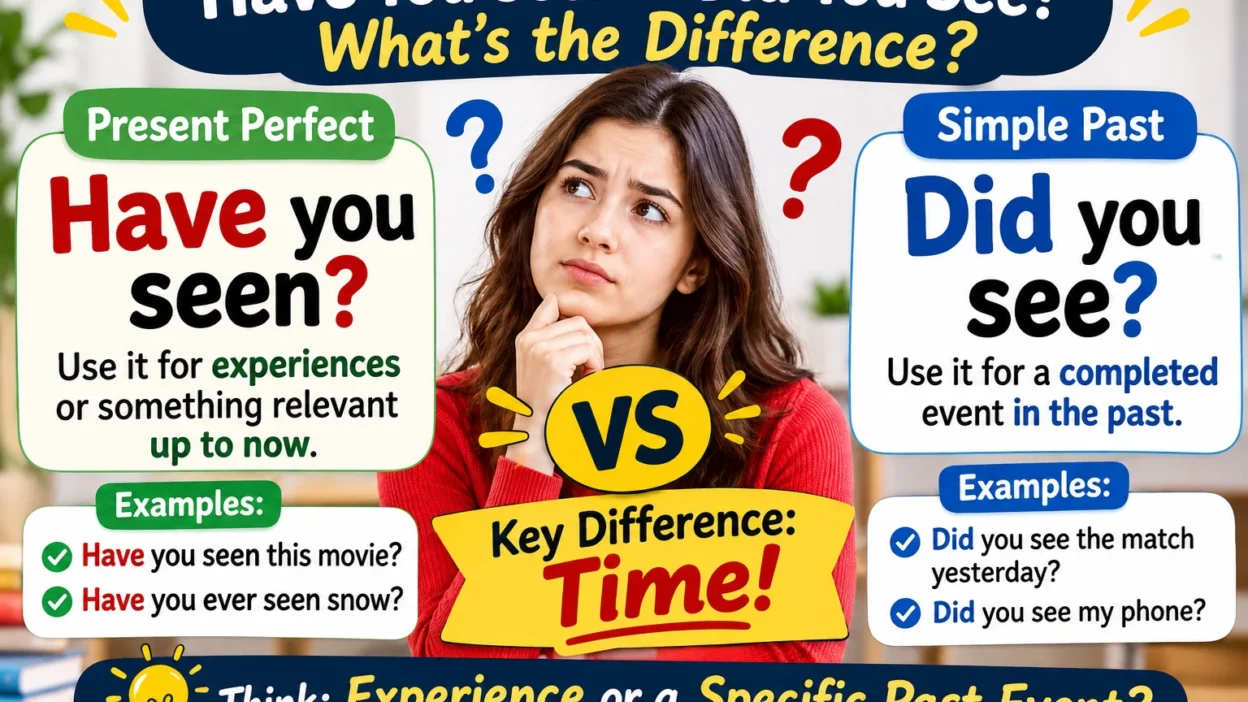
Have you ever wondered if to say “Have you seen?” or “Did you see?” when asking someone about something they watched, noticed, or experienced? Both expressions are correct English, but they are used in different situations. Understanding the difference will help you speak more naturally and avoid common grammar mistakes.
The main difference between have you seen and did you see is the time connection. “Have you seen?” uses the present perfect tense and usually asks about an experience or something that may be relevant now. “Did you see?” uses the simple past tense and asks about a completed event at a specific time in the past. For example, you might ask, “Have you seen this movie?” when asking about someone’s experience, but “Did you see the movie last night?” when referring to a particular past event.
Quick Answer: Have You Seen vs Did You See
“Have you seen?” is the present perfect form, used to ask if someone has had an experience or seen something before now. “Did you see?” is the simple past form, used to ask about a completed past event, often at a specific time. The correct choice depends on the time and context.
Why Do People Confuse Have You Seen and Did You See?
People often confuse these expressions because both ask if someone has watched, noticed, or looked at something.
However, English uses different tenses to express different relationships with time.
- Have you seen? focuses on experience or a connection to the present.
- Did you see? focuses on a completed action in the past.
For example:
- Have you seen my new car? (Asking if someone has seen it before now.)
- Did you see my new car yesterday? (Asking about a specific past occasion.)
The difference becomes easier to understand when you look at how each tense works.
What Does Have You Seen Mean?
“Have you seen” is the present perfect tense of the verb see.
It follows this structure:
Have + subject + past participle (seen)?
Examples:
- Have you seen this movie?
- Have you seen my phone?
- Have you seen the latest news?
- Have you seen John today?
We use this expression when the exact time is not important or when the experience has a connection to the present.
When to Use Have You Seen
Use “have you seen” in these situations:
1. Asking about life experiences
- Have you ever seen snow?
- Have you seen a live performance?
2. Asking if someone has seen something recently
- Have you seen the latest episode?
- Have you seen today’s newspaper?
3. Asking about something that may still be missing
- Have you seen my keys?
- Have you seen my glasses?
4. Asking about something relevant now
- Have you seen the new company announcement?
- Have you seen this interesting photograph?
What Does Did You See Mean?
“Did you see” is the simple past tense of the verb see.
It follows this structure:
Did + subject + base form of the verb?
Examples:
- Did you see the movie?
- Did you see my brother?
- Did you see that accident?
- Did you see the match yesterday?
Use “did you see” when asking about something that happened at a completed time in the past.
When to Use Did You See
Use “did you see” in these situations:
1. Asking about a specific past event
- Did you see the match last night?
- Did you see the accident yesterday?
2. Talking about a completed occasion
- Did you see Sarah at the party?
- Did you see the fireworks?
3. Asking about something at a particular time
- Did you see him this morning?
- Did you see the announcement during the meeting?
4. Asking about a past experience with a specific time reference
- Did you see that movie when you were younger?
- Did you see the Eiffel Tower during your trip to Paris?
Have You Seen vs Did You See: Comparison Table
| Feature | Have You Seen? | Did You See? |
|---|---|---|
| Tense | Present perfect | Simple past |
| Verb structure | Have + subject + seen | Did + subject + see |
| Main focus | Experience or present relevance | Completed past event |
| Time reference | Unspecified or connected to now | Completed past time |
| Common words | Ever, never, yet, already | Yesterday, last night, ago |
| Example | Have you seen this film? | Did you see the film yesterday? |
| Main purpose | Asking about experience | Asking about a past occasion |
When to Use Have You Seen vs Did You See
Choosing the correct expression depends on what you want to communicate.
Use Have You Seen When Asking About Experience
Use the present perfect when the exact time does not matter.
Examples:
- Have you seen the ocean?
- Have you seen this movie before?
- Have you seen a shooting star?
You are asking if the experience has happened at any point up to now.
Use Did You See When Asking About a Past Event
Use the simple past when the event happened at a definite, completed time.
Examples:
- Did you see the ocean during your vacation?
- Did you see this movie last weekend?
- Did you see that shooting star last night?
Here, you are asking about a particular past occasion.
Can You Use Both in the Same Situation?
Yes! Both expressions can be correct when the context changes.
Consider these examples:
- Have you seen the new teacher? (Asking if you have seen the teacher at any time up to now.)
- Did you see the new teacher this morning? (Asking about a particular time.)
The situation determines which tense is more appropriate.
12 Examples of Have You Seen vs Did You See
Here are practical examples to help you understand the difference.
| Have You Seen? | Did You See? |
|---|---|
| Have you seen my phone? | Did you see my phone on the table yesterday? |
| Have you seen this movie? | Did you see this movie last weekend? |
| Have you seen John today? | Did you see John at the office yesterday? |
| Have you seen the latest news? | Did you see the news last night? |
| Have you seen my new shoes? | Did you see my new shoes at the party? |
| Have you seen that documentary? | Did you see that documentary on Sunday? |
| Have you seen the manager? | Did you see the manager during yesterday’s meeting? |
| Have you ever seen snow? | Did you see snow during your winter vacation? |
| Have you seen this photograph before? | Did you see this photograph when I showed it to you? |
| Have you seen the new building? | Did you see the new building when you visited us? |
| Have you seen this message yet? | Did you see my message yesterday? |
| Have you seen the latest episode? | Did you see the latest episode last night? |
Short Conversations
Conversation 1: Asking about a movie
A: Have you seen the new action movie?
B: Yes, I have. It is amazing!
Conversation 2: Asking about yesterday
A: Did you see the football match last night?
B: Yes, I did. It was exciting!
Conversation 3: Looking for something
A: Have you seen my wallet?
B: No, I haven’t. Where did you last see it?
Conversation 4: Talking about a past event
A: Did you see Mary at the wedding?
B: Yes, I saw her near the entrance.
Common Mistakes to Avoid
English learners sometimes make mistakes when choosing between these two expressions.
1. Using Seen After Did
Incorrect: Did you seen that movie?
Correct: Did you see that movie?
Why? After did, always use the base form of the verb. The word “did” already indicates the past tense.
2. Using See After Have
Incorrect: Have you see this picture?
Correct: Have you seen this picture?
Why? The present perfect requires the past participle. The past participle of see is seen.
3. Using Present Perfect With a Specific Finished Past Time
Incorrect: Have you seen him yesterday?
Correct: Did you see him yesterday?
Why? “Yesterday” refers to a completed past time, so the simple past is normally required.
4. Confusing Experience With a Specific Event
Incorrect in a question about general experience: Did you ever see snow?
Better: Have you ever seen snow?
Why? When asking if someone has had an experience at any time in their life up to now, the present perfect is generally preferred. However, the simple past is also possible in some varieties and contexts.
Memory Trick: How to Remember the Difference
Use this simple trick:
- Have you seen = Ever in your life or up to now?
- Did you see = At a particular time in the past?
Remember these two examples:
- Have you seen Paris? (Asking about life experience.)
- Did you see Paris during your trip last year? (Asking about a specific past trip.)
Think about if you are asking about someone’s experience or a completed past event. This will help you choose the correct expression.
American vs British English: Have You Seen vs Did You See
Both American and British English use “have you seen” and “did you see” with the same basic grammatical differences.
However, there are some differences in everyday usage.
British English:
British speakers often use the present perfect with words such as just, already, and yet.
Examples:
- Have you seen the new film yet?
- Have you just seen Peter?
- Have you already seen this?
American English:
American speakers also use the present perfect, but they may use the simple past more frequently in some informal situations.
Examples:
- Did you see the new film yet?
- Did you just see Peter?
- Did you already see this?
Both varieties are correct in their respective contexts. The choice can depend on the speaker, region, and conversational style.
Similar Words and Expressions
Understanding related expressions can help you improve your English grammar.
| Expression | Meaning | Example |
|---|---|---|
| Have you watched? | Asking about an experience of watching something | Have you watched this series? |
| Did you watch? | Asking about a past viewing event | Did you watch the match yesterday? |
| Have you ever seen? | Asking about an experience in someone’s life | Have you ever seen a whale? |
| Did you notice? | Asking about something noticed in the past | Did you notice the mistake? |
| Have you noticed? | Asking about something noticed up to now | Have you noticed the changes? |
| Have you heard? | Asking if someone knows some news or information | Have you heard the news? |
| Did you hear? | Asking about something heard at a past time | Did you hear that noise last night? |
Final Verdict: Which One Should You Use?
Both “have you seen” and “did you see” are grammatically correct. The right choice depends on your intended meaning.
- Use have you seen when asking about someone’s experience or something relevant up to the present.
- Use did you see when asking about a completed past event, especially one connected to a specific finished time.
For example:
- Have you seen this movie? (General experience.)
- Did you see this movie last night? (Specific past event.)
Understanding this difference will make your English questions clearer and more natural.
Frequently Asked Questions (FAQs)
1. Is it correct to say have you seen or did you see?
Yes, both expressions are grammatically correct. “Have you seen” is present perfect, while “did you see” is simple past. Use the first for experiences or present relevance and the second for completed past events.
2. What is the main difference between have you seen and did you see?
The main difference is their relationship with time. “Have you seen” connects an experience or action to the present, while “did you see” asks about something that happened in the past.
3. Should I say have you seen this movie or did you see this movie?
Both are correct. Say “Have you seen this movie?” when asking about someone’s experience without specifying a time. Say “Did you see this movie last night?” when asking about a particular past occasion.
4. Can I say did you seen?
No. “Did you seen” is grammatically incorrect in standard English. After “did,” use the base form of the verb. The correct expression is “Did you see?”
5. Can I use have you seen with yesterday?
Normally, no. “Yesterday” refers to a completed time in the past, so use the simple past. Say “Did you see him yesterday?” rather than “Have you seen him yesterday?”
6. Is have you ever seen correct?
Yes. “Have you ever seen” is a correct present perfect question. It asks if someone has experienced seeing something at any point in their life. For example: “Have you ever seen a rainbow?”
7. Is did you see more common in American English?
American English speakers commonly use “did you see” for completed past events. In informal American conversation, it can also appear with words such as “yet” and “already,” where British speakers may prefer the present perfect.
Remember This
Present perfect
HAVE YOU SEEN?
Have + subject + seen
Use it for experiences or situations connected to the present.
Example: Have you seen my new car?
Simple past
DID YOU SEE?
Did + subject + see
Use it for completed events in the past.
Example: Did you see my new car yesterday?
Conclusion
The difference between “have you seen” and “did you see” is mainly about how you refer to time. “Have you seen” uses the present perfect tense to ask about experiences or events connected to the present. “Did you see” uses the simple past tense to ask about completed events that happened at a particular time.
To remember the rule, think about if you are asking about an experience or a specific past event. Use “have you seen” for experiences up to now and “did you see” for completed past occasions. With regular practice and these examples, you can use both expressions confidently in everyday English.

Charles Kyle is a passionate writer and dream researcher at SleepCout, dedicated to exploring coded dreams, lucid dreaming, dream symbolism, and sleep science. He creates engaging, well-researched content that helps readers understand their dreams and discover the fascinating connection between technology, imagination, and the sleeping mind.