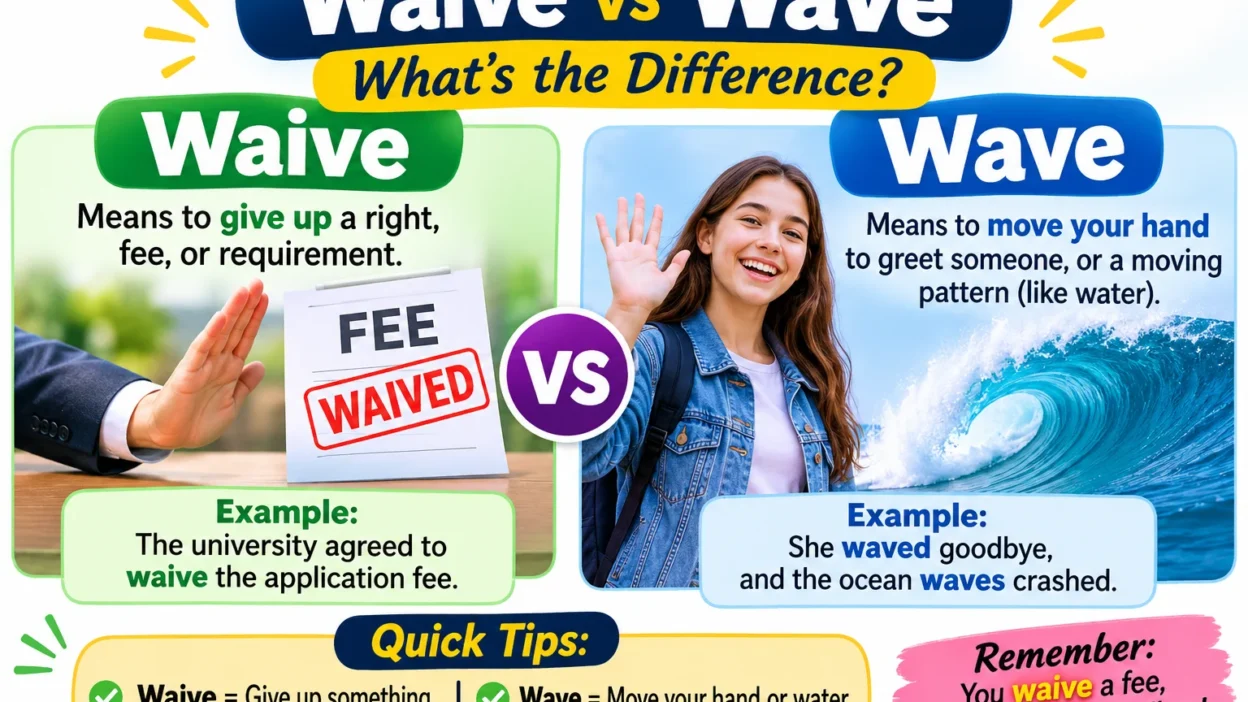
The English words waive and wave sound exactly the same, but they have completely different meanings and uses. If you have ever wondered if to write waive or wave in a sentence, you are not alone. These two words are commonly confused because they are pronounced identically but spelled differently. Understanding their meanings will help you avoid spelling mistakes and communicate more clearly.
The main difference between waive and wave is that waive means to voluntarily give up a right, claim, fee, or requirement, while wave can mean moving your hand to greet someone or a movement of water, sound, or energy. For example, a university may waive an application fee, while a person may wave goodbye to a friend. Learning when to use each word is simple once you understand their meanings and see them in everyday sentences.
Quick Answer
Waive means to give up or officially remove a right, fee, or requirement. Wave means to move your hand to greet someone or refers to a moving pattern, such as an ocean wave. Both words are pronounced the same, but their meanings, spellings, and grammatical uses are different.
Why Do People Confuse Waive and Wave?
People confuse waive and wave because they are homophones. Homophones are words that sound the same but have different spellings and meanings.
Both words are pronounced /weɪv/, which sounds like “wayv.”
However, their meanings are very different:
- Waive: To voluntarily give up a right, fee, or requirement.
- Wave: To move your hand or describe a moving pattern of water, sound, or energy.
For example:
- The school agreed to waive the admission fee.
- She smiled and waved at her teacher.
The pronunciation is identical, but the context tells you which spelling to use.
1. Waive: Meaning, Definition, and Usage
Waive is a verb that means to voluntarily give up, surrender, or officially decide not to require something.
It is commonly used in legal, financial, educational, and professional situations.
Common Meanings of Waive
- To give up a legal right.
- To remove or cancel a fee.
- To choose not to enforce a rule or requirement.
- To voluntarily surrender a claim or privilege.
Examples of Waive
- The university agreed to waive the application fee.
- He decided to waive his right to appeal.
- The company will waive the late payment charge.
- Students can request to waive certain requirements.
- She agreed to waive her claim to the property.
Common Phrases with Waive
- Waive a fee
- Waive a right
- Waive a requirement
- Waive a penalty
- Waive a charge
- Waive a claim
- Waive an application fee
Important: Waive does not mean physically moving your hand. It is mainly used when someone gives up a right, benefit, fee, or requirement.
2. Wave: Meaning, Definition, and Usage
Wave can be used as both a noun and a verb. It has several meanings, depending on the context.
As a verb, it usually means moving your hand or arm to greet someone, say goodbye, or attract attention.
As a noun, it can describe a movement of water, sound, light, or energy.
Common Meanings of Wave
- To move your hand to greet someone.
- To say goodbye using a hand gesture.
- A moving ridge of water.
- A sudden increase or arrival of something.
- A pattern of movement in sound, light, or energy.
Examples of Wave
- She waved at me from across the street.
- He raised his hand to wave goodbye.
- The children played in the ocean waves.
- A huge wave hit the beach.
- The teacher waved her hand to get attention.
Common Phrases with Wave
- Wave goodbye
- Wave hello
- Ocean wave
- Sound wave
- Heat wave
- Wave your hand
- A wave of excitement
Important: Wave can describe both a physical hand movement and a movement or pattern in nature and science.
Waive vs Wave: Comparison Table
| Feature | Waive | Wave |
|---|---|---|
| Part of speech | Verb | Noun and verb |
| Pronunciation | /weɪv/ | /weɪv/ |
| Main meaning | Give up a right or fee | Move your hand or a moving pattern |
| Common use | Legal and financial situations | Greetings, water, and science |
| Example | Waive a fee | Wave goodbye |
| Past tense | Waived | Waved |
| Present participle | Waiving | Waving |
| Related noun | Waiver | Wave |
The easiest distinction is that waive is about giving something up, while wave is about movement.
When to Use Waive vs Wave
Choosing the correct word becomes easier when you consider what you want to express.
When to Use Waive
Use waive when someone voluntarily gives up a right, fee, charge, claim, or requirement.
Examples:
- The bank agreed to waive the service fee.
- You may waive your right to a refund.
- The college decided to waive the entrance requirement.
If the sentence involves giving something up or removing an obligation, waive is usually the correct choice.
When to Use Wave
Use wave when describing a hand gesture, a movement of water, or a pattern of energy.
Examples:
- Please wave when you see me.
- The ocean wave was enormous.
- She gave me a friendly wave.
- A heat wave affected the entire region.
If the sentence involves movement, greeting, or a pattern, use wave.
12 Examples of Waive vs Wave in Sentences
Here are practical examples to help you understand the difference.
| No. | Sentence | Correct Word |
|---|---|---|
| 1 | The bank agreed to ___ the annual fee. | Waive |
| 2 | She stopped to ___ at her friend. | Wave |
| 3 | The school will ___ the registration charge. | Waive |
| 4 | He gave us a friendly ___. | Wave |
| 5 | The company decided to ___ the penalty. | Waive |
| 6 | The children played among the ocean ___. | Waves |
| 7 | You can request to ___ the requirement. | Waive |
| 8 | She began to ___ goodbye. | Wave |
| 9 | The court allowed him to ___ his right to appeal. | Waive |
| 10 | A large ___ crashed against the shore. | Wave |
| 11 | The hotel agreed to ___ the cancellation fee. | Waive |
| 12 | He smiled and ___ at the crowd. | Waved |
More Examples in Everyday Contexts
Waive:
- The manager offered to waive the extra charges.
- The organization may waive membership fees for eligible applicants.
- He chose to waive his right to remain anonymous.
Wave:
- My mother waved from the front door.
- The flag waved in the strong wind.
- A wave of happiness came over her.
Common Mistakes When Using Waive and Wave
Even fluent English speakers sometimes confuse these homophones in writing.
Here are some mistakes to avoid.
Mistake 1: Using Wave Instead of Waive
Incorrect: The company agreed to wave the late fee.
Correct: The company agreed to waive the late fee.
Why? The company is removing a charge, not moving its hand.
Mistake 2: Using Waive Instead of Wave
Incorrect: She smiled and waived at her neighbor.
Correct: She smiled and waved at her neighbor.
Why? She is making a greeting gesture.
Mistake 3: Confusing Their Past Tenses
Both words add “-ed” in the past tense, but their meanings remain different.
- Waived: The bank waived the fee.
- Waved: The child waved at his father.
Mistake 4: Confusing Waiver and Wave
A waiver is a document or agreement in which someone gives up a right or claim.
A wave is a movement or pattern, or a hand gesture.
Examples:
- Please sign the liability waiver.
- The ocean wave reached the shore.
Easy Memory Trick: How to Remember Waive vs Wave
Here is a simple way to remember these two words.
WAIVE = GIVE UP
Think of giving up a fee, right, or requirement.
Example: The bank waived the fee.
WAVE = HAND MOVEMENT
Think of waving your hand to greet someone.
Example: She waved hello.
Quick memory tip: If you are giving something up, use waive. If you are moving your hand or describing water movement, use wave.
Waive vs Wave in American and British English
There is no meaningful difference between waive and wave in American and British English.
Both varieties use the same spellings, meanings, and pronunciations.
| Word | American English | British English |
|---|---|---|
| Waive | Give up a right or fee | Give up a right or fee |
| Wave | Hand gesture or moving pattern | Hand gesture or moving pattern |
Examples:
- American: The company agreed to waive the fee.
- British: The company agreed to waive the fee.
- American: She waved goodbye.
- British: She waved goodbye.
Both words are standard in English-speaking countries.
Similar Words to Waive and Wave
Learning related words can help you expand your vocabulary.
Words Related to Waive
- Surrender: To give up something.
- Relinquish: To voluntarily give up a right or possession.
- Forgo: To decide not to have or use something.
- Abandon: To give up something completely.
- Waiver: A document or act of giving up a right or claim.
Words Related to Wave
- Gesture: A movement used to communicate.
- Salute: A gesture of greeting or respect.
- Ripple: A small movement on the surface of water.
- Tide: The regular rise and fall of the sea.
- Surge: A sudden powerful movement or increase.
These words are related in meaning, but they are not always interchangeable.
Final Verdict: Waive or Wave?
The difference between waive and wave is simple:
- Waive means to give up a right, fee, charge, or requirement.
- Wave means to move your hand in greeting or describes a moving pattern, such as an ocean wave.
Both words sound the same, but you must choose the spelling that matches your intended meaning.
Remember: You waive a fee, but you wave goodbye.
Frequently Asked Questions (FAQs)
1. What is the difference between waive and wave?
Waive means to voluntarily give up a right, fee, or requirement. Wave means to move your hand to greet someone or describes a movement of water, sound, or energy. They sound the same but have different meanings and spellings.
2. Are waive and wave pronounced the same?
Yes. Waive and wave are homophones. Both are pronounced /weɪv/, like “wayv.” Their pronunciation is identical, but their meanings and spellings are different.
3. Is it waive or wave a fee?
The correct expression is waive a fee. It means to remove or cancel a fee so that someone does not have to pay it.
Example: The university agreed to waive the application fee.
4. Is it waive or wave goodbye?
The correct expression is wave goodbye. It means moving your hand to say goodbye to someone.
Example: She waved goodbye before leaving.
5. What is the past tense of waive and wave?
The past tense of waive is waived, while the past tense of wave is waved.
Examples:
- The company waived the extra charge.
- The little girl waved at her mother.
6. What is a waiver?
A waiver is an act or document that shows someone has voluntarily given up a right, claim, or legal protection.
Example: Participants must sign a liability waiver before joining the activity.
7. Is waive a noun or a verb?
Waive is primarily a verb. It means to give up or officially remove a right, fee, or requirement. Its related noun is waiver.
Remember This
- Waive = Give up something.
- Wave = Move your hand or describe a movement.
- Waived = Past tense of waive.
- Waved = Past tense of wave.
- Both words are pronounced the same.
Never write “wave a fee” when you mean to cancel a charge. Write “waive a fee.”
Conclusion
Understanding the difference between waive and wave is easy once you remember their meanings. Although both words sound identical, they are used in completely different situations. Use waive when someone gives up a right, fee, claim, or requirement. Use wave when someone moves their hand to greet another person or when describing moving water or energy.
The best way to remember these words is through everyday examples: a company can waive a fee, but a person can wave goodbye. Practice using both words in your own sentences, and you will become more confident about choosing the correct spelling.

Alice Allison is the Administrator at SleepCout, ensuring smooth operations while supporting a platform dedicated to coded dreams, dream interpretation, and insightful content that inspires curiosity, creativity, and imagination.