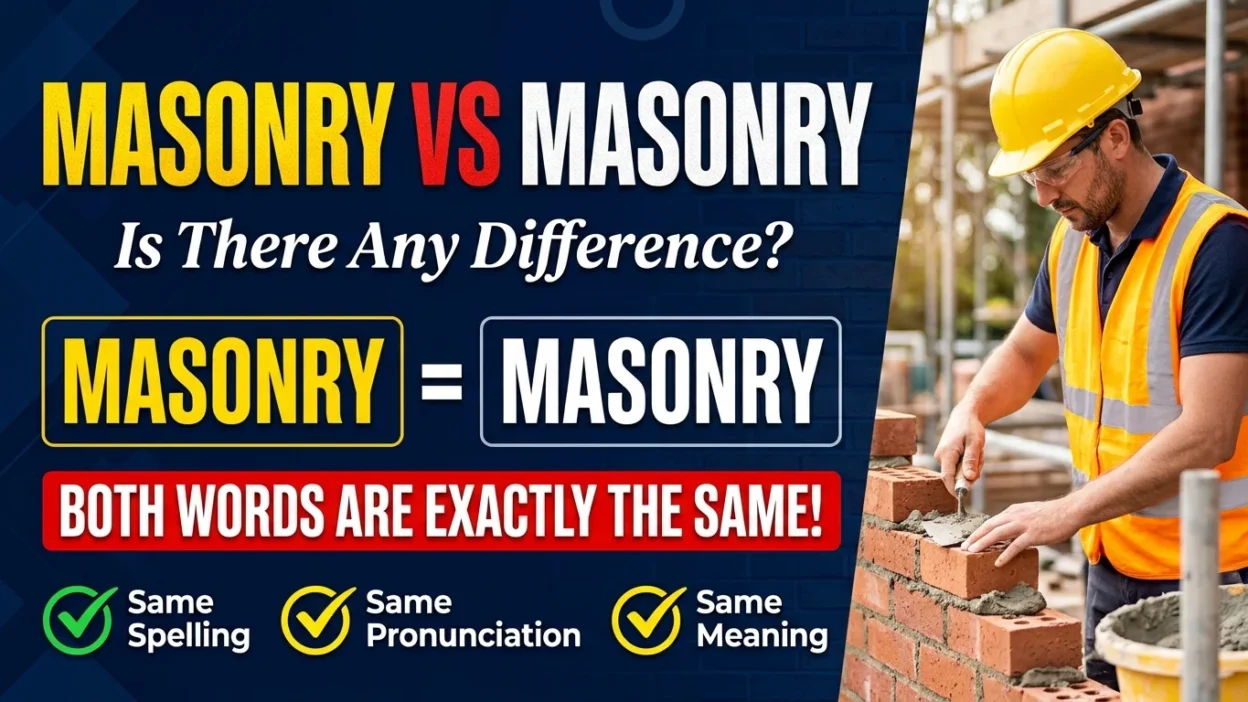
The comparison masonry vs masonry may look like a comparison between two different words, but both sides contain exactly the same spelling. Masonry is a standard English word used in construction, architecture, and building work. It refers to the craft of building structures with materials such as bricks, stones, and concrete blocks.
People may search for this comparison because they are unsure if there are two different spellings or meanings. However, there is no difference between the two expressions. Both are pronounced the same way, written identically, and have the same meaning. Understanding the word masonry, its pronunciation, and its correct usage can help English learners, students, writers, and construction professionals use it confidently.
Quick Answer
There is no difference between masonry and masonry because they are exactly the same word. Masonry means the work or technique of building structures using bricks, stones, concrete blocks, or similar materials. Both expressions have identical spelling, pronunciation, and meaning.
Why Do People Confuse It?
People sometimes become confused when comparing words that look or sound similar. In this case, however, the two expressions are identical.
Possible reasons for this confusion include:
- Accidentally typing the same word twice.
- Copying and pasting a keyword incorrectly.
- Confusing masonry with another construction-related term.
- Searching for differences between two spellings that are actually identical.
If you intended to compare masonry with another word, checking the spelling of the second word will help clarify the comparison.
First Word: Masonry
Masonry is a noun that refers to the construction technique of building structures using individual materials such as bricks, stones, and concrete blocks.
It can describe both the building work and the finished construction.
Examples:
- The masonry work on the house is almost complete.
- He has years of experience in masonry.
- The old building features beautiful stone masonry.
Masonry is commonly associated with walls, buildings, fireplaces, chimneys, and other structures.
Second Word: Masonry
The second word, masonry, has exactly the same spelling and meaning as the first one.
It is also a noun and refers to construction using bricks, stones, concrete blocks, and similar materials.
Examples:
- The contractor specializes in masonry.
- The masonry around the entrance needs repair.
- Good masonry can improve a building’s strength and appearance.
There is no linguistic difference between the first and second occurrences.
Masonry vs Masonry: Comparison Table
| Feature | First Masonry | Second Masonry |
|---|---|---|
| Spelling | Masonry | Masonry |
| Pronunciation | Same | Same |
| Meaning | Brick or stone construction | Brick or stone construction |
| Word type | Noun | Noun |
| Usage | Construction | Construction |
| Origin | Same | Same |
| Difference | None | None |
When to Use Each
Since both words are identical, you can use either one in exactly the same situations.
Use masonry when talking about:
- Brick construction.
- Stone building techniques.
- Concrete block construction.
- Building walls and foundations.
- Repairing brickwork.
- Traditional construction methods.
- Decorative stonework.
There is no situation where the first spelling is correct and the second spelling is incorrect.
12 Examples of Masonry in Sentences
Here are 12 practical examples showing how to use masonry correctly.
- The workers completed the masonry work before the rainy season.
- Masonry is an important part of traditional construction.
- The house has beautiful brick masonry.
- He learned masonry from his father.
- The contractor hired an experienced masonry team.
- The old wall needs professional masonry repairs.
- Stone masonry gives the building a traditional appearance.
- The school offers training in masonry techniques.
- The damaged masonry was carefully restored.
- Good masonry requires skill and attention to detail.
- The architect included decorative masonry in the building design.
- The company specializes in residential and commercial masonry.
Common Mistakes
Here are some common mistakes related to the word masonry.
Mistake 1: Thinking both words have different meanings
Incorrect assumption: The first masonry refers to bricks, while the second refers to stones.
Correction: Both can refer to construction using bricks, stones, and similar materials.
Mistake 2: Confusing masonry with a mason
Masonry refers to the construction work or technique, while a mason is a person who performs that work.
Mistake 3: Using masonry as a verb
Masonry is a noun, not a standard verb.
Incorrect: He will masonry the wall.
Correct: He will build the wall using masonry techniques.
Mistake 4: Assuming there are two different spellings
Both expressions are spelled M-A-S-O-N-R-Y.
Memory Trick
Remember this simple rule:
Masonry = Building with bricks, stones, or concrete blocks.
Also remember:
- Masonry is the work.
- Mason is the worker.
- Masonry construction is the building technique.
Since both sides of masonry vs masonry are identical, there is nothing new to memorize about their differences.
American vs British English
The spelling masonry is the same in both American and British English.
| Feature | American English | British English |
|---|---|---|
| Spelling | Masonry | Masonry |
| Meaning | Same | Same |
| Word type | Noun | Noun |
| Usage | Construction | Construction |
There is no American-versus-British spelling difference for this word.
Similar Words
Here are some construction-related words that are useful to understand:
- Mason: A person who builds with bricks or stones.
- Brickwork: Construction or work involving bricks.
- Stonework: Construction or decorative work involving stone.
- Bricklaying: The process of laying bricks.
- Construction: The process of building structures.
- Mortar: A material used to bind bricks and stones together.
- Concrete: A building material made from cement, water, and aggregates.
- Carpentry: The craft of working with wood.
These words are related to construction, but they do not all have the same meaning as masonry.
Final Verdict
There is no difference between masonry vs masonry. Both expressions have identical spelling, pronunciation, grammatical classification, and meaning.
Masonry is a noun referring to construction work involving bricks, stones, concrete blocks, and similar materials. If you intended to compare masonry with another word, double-check the second word before making the comparison.
Frequently Asked Questions
1. Is there any difference between masonry and masonry?
No. Both are exactly the same word. They have identical spelling, pronunciation, and meaning.
2. What does masonry mean?
Masonry means the construction of structures using individual materials such as bricks, stones, and concrete blocks.
3. Is masonry a noun or a verb?
Masonry is a noun. It describes a construction technique, building work, or the resulting structure.
4. What is the difference between a mason and masonry?
A mason is a person who works with bricks or stones, while masonry refers to the construction work or technique performed by that person.
5. Is masonry the same in American and British English?
Yes. Masonry has the same spelling and general meaning in American and British English.
6. How do you pronounce masonry?
Masonry is commonly pronounced MAY-suhn-ree. Its pronunciation is the same in both expressions.
7. What are examples of masonry materials?
Common masonry materials include bricks, natural stones, concrete blocks, and mortar used to join building units.
Remember This
- Masonry and masonry are exactly the same word.
- Both have identical spelling and pronunciation.
- Masonry is a noun.
- It refers to construction using bricks, stones, or concrete blocks.
- There is no difference between the American and British spellings.
Conclusion
The comparison masonry vs masonry does not involve two different words. Both expressions are identical in spelling, pronunciation, and meaning. Masonry is a construction-related noun that describes building with materials such as bricks, stones, and concrete blocks.
If you are learning English, remember that a mason is the person who performs masonry work. If you intended to compare masonry with another construction term, check the spelling of the second word to find the correct comparison.

Charles Kyle is a passionate writer and dream researcher at SleepCout, dedicated to exploring coded dreams, lucid dreaming, dream symbolism, and sleep science. He creates engaging, well-researched content that helps readers understand their dreams and discover the fascinating connection between technology, imagination, and the sleeping mind.