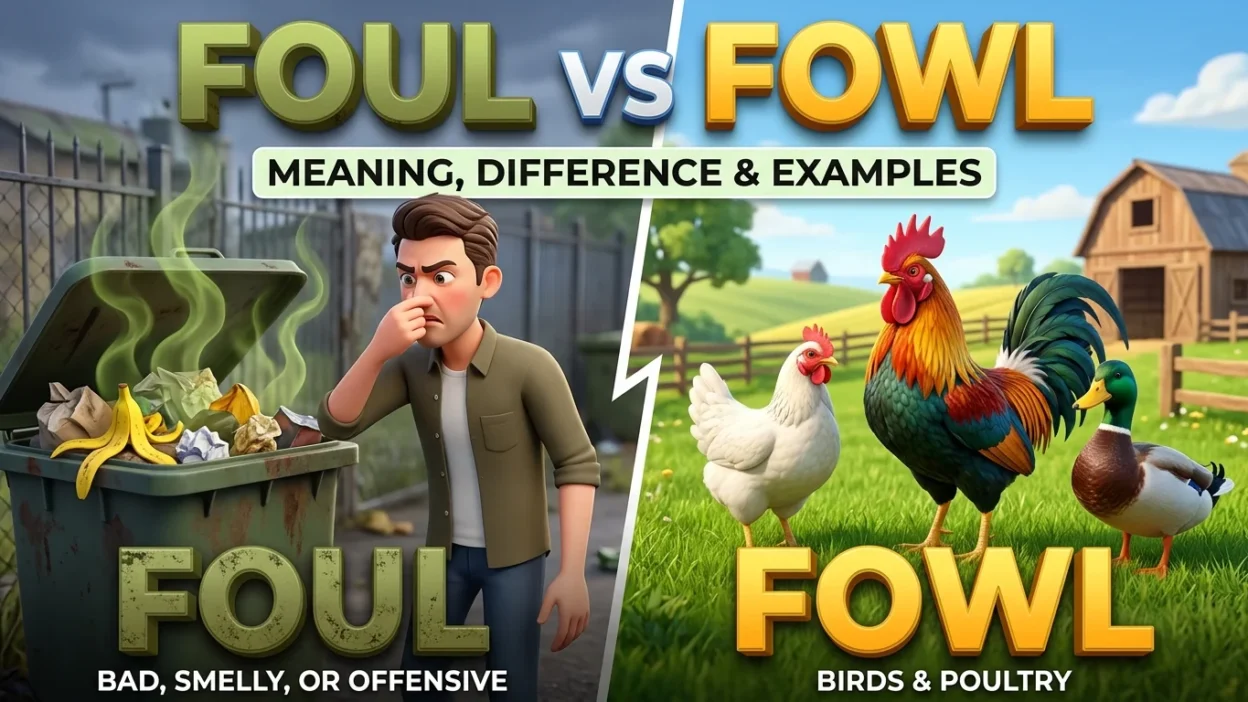
The English words foul and fowl sound exactly the same, but they have completely different meanings. This makes them easy to confuse, especially for English learners, students, and people who are improving their spelling and vocabulary. Understanding the difference between foul and fowl will help you use both words correctly in everyday conversations and writing.
Although both words are pronounced /faʊl/, their meanings depend on their spelling and context. Foul usually describes something unpleasant, offensive, dirty, or against the rules. Fowl, on the other hand, refers to birds, especially domestic birds such as chickens, ducks, and turkeys. Learning a few simple examples and remembering their meanings will make it much easier to distinguish these commonly confused words.
Quick Answer: Foul vs Fowl
Foul means unpleasant, offensive, dirty, or against the rules. It can also describe unfair behavior in sports. Fowl means a bird, particularly a domesticated bird raised for its eggs or meat. Both words sound identical but have different spellings, meanings, and uses. For example, a foul smell is unpleasant, while a chicken is a type of fowl.
Why Do People Confuse Foul and Fowl?
People often confuse these words because they are homophones.
Homophones are words that have the same pronunciation but different meanings and spellings.
Here is why foul and fowl can be confusing:
- Same pronunciation: Both are pronounced /faʊl/.
- Different spellings: One contains “ou,” while the other contains “ow.”
- Different meanings: Foul describes something unpleasant or improper, while fowl refers to birds.
- Similar everyday usage: Both words appear in common expressions, conversations, and written English.
The easiest way to avoid confusion is to understand what each word describes.
1. Foul: Meaning and Examples
Foul is an adjective, noun, and verb. It has several meanings depending on the context.
Foul as an Adjective
As an adjective, foul describes something unpleasant, offensive, dirty, or unacceptable.
Examples:
- The kitchen had a foul smell.
- He used foul language during the argument.
- The river was polluted with foul water.
- Nobody wanted to enter the foul-smelling room.
- The weather was foul throughout the weekend.
Foul as a Noun
As a noun, foul refers to an unfair or illegal action, particularly in sports.
Examples:
- The referee called a foul.
- The player committed a serious foul.
- The basketball team received a penalty after the foul.
Foul as a Verb
As a verb, foul means to make something dirty, obstruct something, or commit an illegal action in sports.
Examples:
- The player fouled his opponent.
- Oil fouled the water.
- The fishing net became fouled with weeds.
Common Expressions with Foul
Here are some frequently used expressions:
- Foul language: Offensive or rude language.
- Foul play: Dishonest or illegal behavior.
- Foul smell: An unpleasant smell.
- Foul mood: An angry or unpleasant mood.
- Foul weather: Bad or unpleasant weather.
2. Fowl: Meaning and Examples
Fowl is a noun that refers to birds, especially birds kept for their meat or eggs.
Common examples of fowl include:
- Chickens
- Ducks
- Turkeys
- Geese
- Guinea fowl
Fowl is commonly used when discussing poultry, farming, cooking, and wildlife.
Fowl in Everyday English
Examples:
- The farmer raises fowl on his farm.
- Chickens are a common type of domestic fowl.
- The market sells fresh meat from different kinds of fowl.
- Ducks and geese are waterfowl.
- The farmer built a shelter for his fowl.
Is Fowl Singular or Plural?
Fowl can be used as both a singular and plural noun, depending on the context.
Examples:
- A fowl was walking across the farm.
- Several fowl were feeding near the barn.
When referring to a particular bird, you can also use more specific words such as chicken, duck, or turkey.
Foul vs Fowl: Comparison Table
| Feature | Foul | Fowl |
|---|---|---|
| Meaning | Unpleasant, offensive, or improper | A type of bird |
| Part of speech | Adjective, noun, verb | Noun |
| Pronunciation | /faʊl/ | /faʊl/ |
| Refers to | Smells, behavior, rules, and conditions | Birds and poultry |
| Common phrase | Foul language | Domestic fowl |
| Example | The room smells foul. | The farmer keeps fowl. |
The main difference: Foul describes something unpleasant or an improper action, while fowl refers to birds.
When to Use Foul and Fowl
Knowing when to use each word makes your writing clearer.
When to Use Foul
Use foul when talking about:
- Something with a bad smell.
- Offensive or inappropriate language.
- Unfair behavior or illegal actions.
- Bad weather or unpleasant conditions.
- Rules being broken in sports.
Examples:
- The garbage produced a foul smell.
- The referee noticed a foul.
- He was punished for using foul language.
When to Use Fowl
Use fowl when talking about:
- Birds raised for meat or eggs.
- Domestic poultry.
- Certain types of wild birds.
- Farming and poultry production.
- Birds used as food.
Examples:
- The farmer owns several types of fowl.
- Turkey is a popular type of fowl.
- The restaurant serves roasted fowl.
12 Examples of Foul vs Fowl in Sentences
These examples show how both words work in everyday English.
| No. | Sentence | Correct Word |
|---|---|---|
| 1 | The refrigerator has a foul smell. | Foul |
| 2 | Chickens are domestic fowl. | Fowl |
| 3 | The referee called a foul during the match. | Foul |
| 4 | The farmer raises fowl for food. | Fowl |
| 5 | He apologized for his foul language. | Foul |
| 6 | Ducks are a type of waterfowl. | Fowl |
| 7 | The player committed a foul. | Foul |
| 8 | The farm has many different fowl. | Fowl |
| 9 | The garbage produced a foul odor. | Foul |
| 10 | Turkey is a popular type of fowl. | Fowl |
| 11 | The team was penalized for foul play. | Foul |
| 12 | The farmer feeds the fowl every morning. | Fowl |
More Examples in Everyday Contexts
- Foul: His behavior was considered foul by everyone.
- Fowl: We saw several fowl near the lake.
- Foul: The drain was blocked by foul waste.
- Fowl: The poultry farmer takes care of his fowl.
Common Mistakes When Using Foul and Fowl
Even experienced English speakers sometimes confuse homophones. Here are some mistakes to avoid.
Mistake 1: Using fowl when describing a bad smell
Incorrect: The kitchen has a fowl smell.
Correct: The kitchen has a foul smell.
Why? Foul describes something unpleasant.
Mistake 2: Using foul when talking about birds
Incorrect: Chickens are a type of foul.
Correct: Chickens are a type of fowl.
Why? Fowl refers to birds.
Mistake 3: Confusing foul play with fowl
Incorrect: The police suspected fowl play.
Correct: The police suspected foul play.
Why? Foul play means dishonest, suspicious, or criminal behavior.
Mistake 4: Confusing the spelling in sports
Incorrect: The referee called a fowl.
Correct: The referee called a foul.
Why? A foul in sports is an action that breaks the rules.
Easy Memory Trick: How to Remember Foul vs Fowl
Here is a simple trick to remember the difference:
- Foul = Feelings or something unpleasant. Think of a foul smell or foul language.
- Fowl = Feathered birds. Think of chickens, ducks, and turkeys.
Remember:
FOWL has a W like wings.
This simple connection can help you remember that fowl refers to birds.
American vs British English: Foul vs Fowl
There is no major difference between American and British English in the meaning or spelling of these words.
Both varieties use:
- Foul for unpleasant things, offensive behavior, and rule-breaking.
- Fowl for birds, particularly poultry.
Both words are pronounced the same way in standard American and British English, although individual accents may vary slightly.
Examples:
- American English: The referee called a foul.
- British English: The referee called a foul.
- American English: The farmer raises fowl.
- British English: The farmer raises fowl.
The spelling and meanings remain the same in both varieties.
Similar Words You Should Know
Learning related words can help expand your English vocabulary.
| Word | Meaning | Example |
|---|---|---|
| Poultry | Domestic birds raised for meat or eggs | Poultry farming is common here. |
| Chicken | A common domestic bird | The chicken laid an egg. |
| Turkey | A large domestic bird | We cooked a turkey. |
| Duck | A waterbird | The duck swam across the pond. |
| Offensive | Causing dislike or anger | His comments were offensive. |
| Unpleasant | Not enjoyable or agreeable | There was an unpleasant smell. |
| Nasty | Very unpleasant or offensive | That was a nasty odor. |
| Homophone | A word that sounds like another word but has a different meaning | Foul and fowl are homophones. |
Final Verdict: Foul or Fowl?
The difference between foul and fowl is simple once you understand their meanings.
- Use foul when describing something unpleasant, offensive, dirty, or against the rules.
- Use fowl when referring to birds, especially chickens, ducks, turkeys, and other poultry.
Although both words sound exactly alike, they cannot be used interchangeably.
Frequently Asked Questions (FAQs)
1. What is the difference between foul and fowl?
Foul describes something unpleasant, offensive, or against the rules. Fowl refers to birds, particularly domestic birds such as chickens, ducks, and turkeys. Both words have the same pronunciation but different meanings and spellings.
2. Are foul and fowl homophones?
Yes. Foul and fowl are homophones because they sound the same but have different spellings and meanings. Both are pronounced /faʊl/.
3. Is fowl a bird?
Yes. Fowl is a noun used for birds, particularly domestic birds raised for meat or eggs. Chickens, ducks, turkeys, and geese are common examples.
4. Does foul mean bad or unpleasant?
Yes. Foul commonly means unpleasant, offensive, dirty, or disgusting. For example, a foul smell is a very unpleasant smell.
5. What does foul play mean?
Foul play refers to dishonest, unfair, suspicious, or illegal behavior. It is often used when discussing possible criminal activity or wrongdoing.
Example: The police suspected foul play in the incident.
6. Is fowl singular or plural?
Fowl can be both singular and plural. You can say “a fowl” when referring to one bird and “several fowl” when referring to multiple birds.
7. What is an easy way to remember foul vs fowl?
Remember that fowl has a W like wings, so it refers to birds. Foul describes something unpleasant, such as a foul smell or foul language.
Remember This
- Foul = Bad, unpleasant, offensive, or against the rules.
- Fowl = A bird, especially a domestic bird.
- Foul and fowl = Homophones with the same pronunciation.
If you remember that fowl has wings and foul describes something unpleasant, you will rarely confuse these words again.
Conclusion
Understanding the difference between foul and fowl is important for improving your English vocabulary and avoiding common spelling mistakes. Although these words sound alike, their meanings are completely different. Foul describes unpleasant things, offensive language, or unfair actions, while fowl refers to birds such as chickens, ducks, and turkeys.
The best way to remember their difference is to connect fowl with feathered birds and foul with unpleasant things. Practice using both words in sentences, and you will become more confident using them correctly in everyday conversations and writing.

John Tyler is a dream researcher and content writer at SleepCout, sharing insightful articles about coded dreams, dream meanings, symbolism, sleep psychology, and practical guidance to help readers understand their dreams.