Choosing between “if so” and “if yes” can be confusing because both expressions refer to an affirmative answer or situation. They are often used when asking questions, giving instructions, or responding to something mentioned earlier. However, they are not always interchangeable.
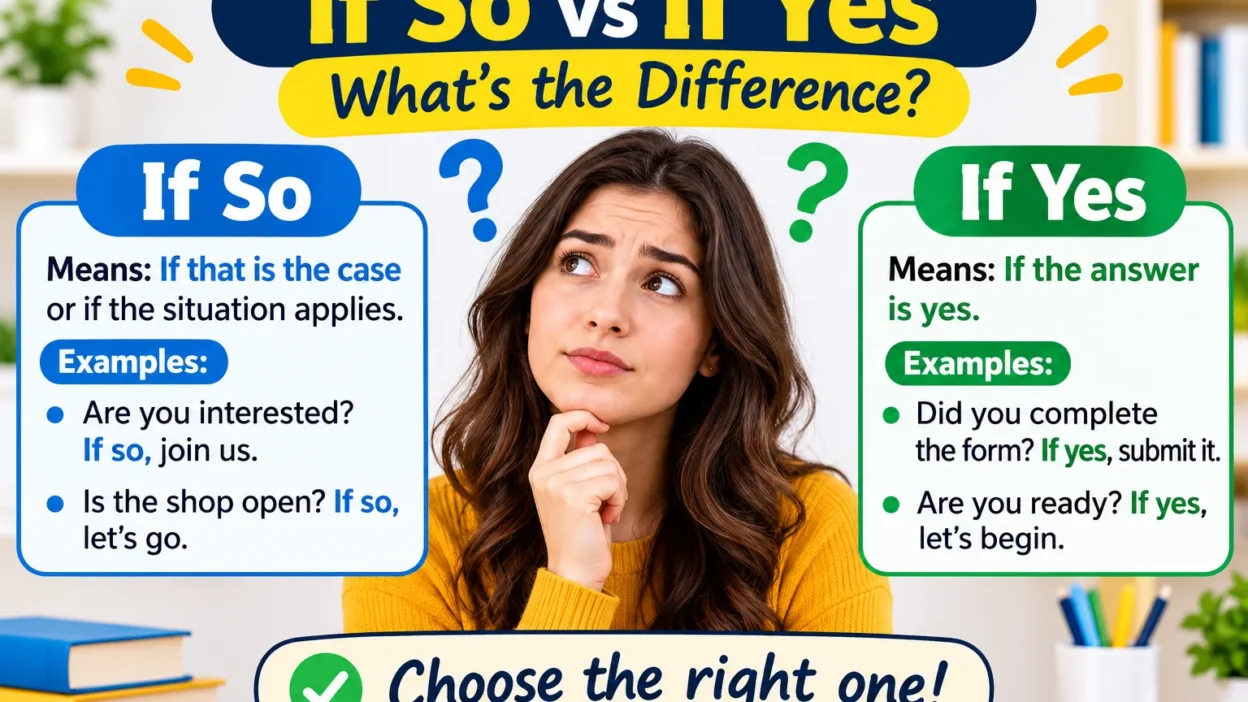
The main difference is that “if so” refers to a previously mentioned situation, fact, or possibility, while “if yes” specifically refers to an affirmative answer to a yes-or-no question. For example, you might say, “Are you interested? If so, please contact me.” You can also say, “Did you complete the assignment? If yes, submit it today.”
Understanding this small difference can make your English sound more natural and polished. In this guide, you will learn the meanings, grammatical differences, common uses, and practical examples of both expressions. You will also discover which expression is more appropriate in everyday conversations, professional communication, and formal writing.
Quick Answer: If So vs If Yes
“If so” means “if that is the case” and refers to a situation or fact mentioned earlier. “If yes” means “if your answer is yes” and specifically refers to an affirmative response. Both can be correct, but “if so” is generally more natural and flexible in everyday and formal English.
Why Do People Confuse If So and If Yes?
People confuse these expressions because they can communicate nearly the same idea in certain situations.
For example:
- Are you available tomorrow? If so, let me know.
- Are you available tomorrow? If yes, let me know.
Both sentences are understandable and grammatically acceptable.
The confusion happens because both expressions can follow a yes-or-no question. However, their emphasis is slightly different.
- If so: Focuses on if the previously mentioned situation is true.
- If yes: Focuses directly on receiving an affirmative answer.
Another reason for confusion is that English speakers often use “if so” as a shorter alternative to repeating an entire statement.
What Does If So Mean?
“If so” is a conditional expression that means “if that is true,” “if that is the case,” or “if this situation applies.”
It refers to information, a possibility, or a circumstance mentioned earlier.
It is commonly used in conversations, emails, instructions, articles, and professional communication.
Examples of If So
- Are you planning to attend the meeting? If so, please arrive early.
- Do you need any assistance? If so, contact our support team.
- Is the restaurant still open? If so, let’s have dinner there.
- Have you finished your work? If so, you can leave.
- Are you interested in the position? If so, send your resume.
- Is the information correct? If so, we can publish it.
- Do you live nearby? If so, we can meet today.
- Have you received the package? If so, please confirm delivery.
- Is your computer working properly? If so, continue with the installation.
- Are you feeling better? If so, you can return to work.
In all these examples, “if so” refers to the situation or possibility mentioned in the preceding question.
What Does If Yes Mean?
“If yes” means “if the answer is yes” or “if you answer affirmatively.”
It is generally used when the speaker wants to refer specifically to a positive response to a yes-or-no question.
This expression is particularly common in questionnaires, surveys, forms, instructions, and situations where answers are classified as yes or no.
Examples of If Yes
- Did you attend the training session? If yes, sign the attendance sheet.
- Have you submitted your application? If yes, provide the confirmation number.
- Do you agree with the statement? If yes, select the appropriate option.
- Are you a registered member? If yes, enter your membership number.
- Did you receive the email? If yes, please reply.
- Have you paid the registration fee? If yes, keep your receipt.
- Do you have previous experience? If yes, describe it below.
- Are you eligible for the scholarship? If yes, complete the application form.
- Would you like to participate? If yes, write your name on the list.
- Have you read the instructions? If yes, proceed to the next section.
Here, “if yes” explicitly refers to a positive answer.
If So vs If Yes: Comparison Table
| Feature | If So | If Yes |
|---|---|---|
| Meaning | If that is the case | If the answer is yes |
| Main focus | A situation or fact | An affirmative answer |
| Usage | General and flexible | More answer-focused |
| Formality | Natural in formal and informal English | Often used in forms and instructions |
| Context | Questions and statements | Mainly yes-or-no questions |
| Natural alternative | If that is the case | If your answer is yes |
| Example | Are you busy? If so, call later. | Is your answer yes? If yes, continue. |
Important: Both expressions are grammatically correct. The best choice depends on what you want to emphasize.
When Should You Use If So and If Yes?
Knowing the context makes it easier to choose the correct expression.
1. When to Use If So
Use “if so” when referring to a previously mentioned situation, condition, or possibility.
Examples:
- Is your flight delayed? If so, contact the airline.
- Do you have any questions? If so, feel free to ask.
- Are you interested in learning English? If so, practice every day.
It is especially useful when you want to avoid repeating an entire statement.
2. When to Use If Yes
Use “if yes” when you specifically want to refer to an affirmative answer.
Examples:
- Did you complete the test? If yes, submit your paper.
- Are you over 18? If yes, continue to the next page.
- Do you have a driving license? If yes, provide its details.
It is particularly useful when a form, survey, or instruction requires a clear yes-or-no response.
3. When Both Are Acceptable
Sometimes, both expressions work naturally.
For example:
- Are you available this evening? If so, let’s meet.
- Are you available this evening? If yes, let’s meet.
Both sentences communicate the same practical message. However, “if so” sounds more conversational and natural in many contexts.
If So vs If Yes: 15 Practical Example Sentences
Here are more examples to help you understand how these expressions work in everyday English.
| If So | If Yes |
|---|---|
| Are you hungry? If so, let’s eat. | Did you eat breakfast? If yes, tell me what you had. |
| Is the shop open? If so, let’s visit it. | Did you visit the shop? If yes, what did you buy? |
| Do you need help? If so, ask me. | Do you want help? If yes, raise your hand. |
| Are you ready? If so, let’s begin. | Have you prepared everything? If yes, start now. |
| Is she coming? If so, save her a seat. | Did she confirm? If yes, inform everyone. |
| Do you enjoy reading? If so, visit the library. | Have you read this book? If yes, share your opinion. |
| Is the road closed? If so, take another route. | Did you check the road conditions? If yes, tell us. |
| Are you feeling tired? If so, take a break. | Did you sleep well? If yes, you should feel rested. |
Notice: The two expressions can appear in similar contexts, but “if so” refers more broadly to the situation, while “if yes” highlights the answer.
Common Mistakes When Using If So and If Yes
Even advanced English learners sometimes use these expressions incorrectly.
Mistake 1: Thinking They Always Mean Exactly the Same Thing
Incorrect understanding: Both expressions are interchangeable in every situation.
Correct understanding: They overlap in meaning, but “if so” can refer to a broader situation, whereas “if yes” specifically refers to an affirmative answer.
Mistake 2: Using If Yes After a Question That Does Not Require a Yes-or-No Answer
Awkward: What is your favorite color? If yes, tell me.
Better: What is your favorite color? If you know, tell me.
An open-ended question requires an appropriate conditional expression, not an automatic yes-or-no response.
Mistake 3: Repeating Information Unnecessarily
Wordy: Are you interested in the course? If you are interested in the course, please register.
Better: Are you interested in the course? If so, please register.
“If so” helps avoid unnecessary repetition.
Mistake 4: Forgetting the Comma
When “if so” or “if yes” begins a separate introductory clause, a comma is generally appropriate.
Correct:
- Are you available? If so, call me.
- Did you finish? If yes, submit your work.
Memory Trick: How to Remember the Difference
Use this simple trick:
- SO = Situation: Think of “if that is so” or “if that is the case.”
- YES = Yes Answer: Think of an explicit positive response.
Remember these two examples:
If so: Are you interested? If so, join us.
If yes: Is your answer yes? If yes, select the box.
If you remember that “so” refers to a situation and “yes” refers to an affirmative answer, choosing between them becomes much easier.
If So vs If Yes in American and British English
Both “if so” and “if yes” are understood in American and British English.
There is no significant difference in spelling or grammatical rules between the two varieties.
| Expression | American English | British English |
|---|---|---|
| If so | Correct and natural | Correct and natural |
| If yes | Correct and understandable | Correct and understandable |
In both varieties, “if so” is a flexible choice in everyday and professional communication.
“If yes” is also useful, particularly in surveys, forms, and direct instructions.
Similar Words and Expressions
Several other expressions can communicate similar meanings.
1. If That’s the Case
This means the same as “if so.”
Example: Are you busy today? If that’s the case, we can meet tomorrow.
2. If That’s True
This expression refers to if previously mentioned information is accurate.
Example: He is moving abroad. If that’s true, we should organize a farewell party.
3. If Your Answer Is Yes
This explicitly refers to an affirmative response.
Example: Do you want to participate? If your answer is yes, sign here.
4. If Not
This is used to introduce the opposite condition.
Example: Are you ready? If not, take another five minutes.
5. If You Agree
This is used when the condition involves agreement.
Example: If you agree, we can finalize the plan today.
Final Verdict: If So or If Yes?
Both “if so” and “if yes” are correct English expressions, but they have slightly different uses.
Choose “if so” when you want to refer to a previously mentioned situation, fact, or possibility. It is flexible, concise, and natural in everyday conversations and professional writing.
Choose “if yes” when you specifically want to refer to an affirmative answer to a yes-or-no question. It is especially useful in surveys, questionnaires, forms, and direct instructions.
When both expressions are possible, “if so” is often the smoother choice in ordinary conversation.
Frequently Asked Questions (FAQs)
1. Is it correct to say if so or if yes?
Yes, both expressions are grammatically correct. “If so” means “if that is the case,” while “if yes” means “if the answer is yes.” Choose the expression that best matches your intended meaning.
2. Is if so more natural than if yes?
In many everyday conversations, “if so” sounds more natural because it can refer to a situation or possibility without directly repeating the word “yes.” However, “if yes” is perfectly acceptable in suitable contexts.
3. Can I use if yes in formal writing?
Yes. “If yes” is acceptable in formal writing, particularly in questionnaires, application forms, surveys, and instructions. However, “if so” may be a smoother choice in formal paragraphs and professional correspondence.
4. What does if so mean in a sentence?
“If so” means “if that is true” or “if that is the case.” For example, “Are you interested in the job? If so, send your application today.”
5. What is another way to say if yes?
You can use “if your answer is yes,” “if you agree,” or “if that is the case,” depending on the context. The most direct alternative is “if your answer is yes.”
6. Can if so and if yes be used interchangeably?
Sometimes, yes. When responding to a yes-or-no question, both expressions can communicate a similar message. However, “if so” has a broader meaning, so they are not interchangeable in every sentence.
7. Should I use a comma after if so and if yes?
Yes, when either expression begins a separate introductory clause, a comma is generally used afterward.
Examples:
- If so, please contact us.
- If yes, continue to the next question.
Remember This
- If so = If that is the case.
- If yes = If the answer is yes.
- Both expressions are grammatically correct.
- “If so” is more flexible in everyday English.
- “If yes” is especially useful for direct yes-or-no responses.
Conclusion
Understanding the difference between “if so” and “if yes” helps you communicate more clearly in English. Although both expressions can follow yes-or-no questions, “if so” refers to a situation or condition, while “if yes” focuses on an affirmative answer. Their meanings sometimes overlap, but their emphasis is different.
For everyday conversations, emails, and professional writing, “if so” is often a natural and flexible choice. Use “if yes” when you specifically need to refer to a positive response, especially in forms, surveys, and instructions. With regular practice and the examples in this guide, you can use both expressions confidently.

John Tyler is a dream researcher and content writer at SleepCout, sharing insightful articles about coded dreams, dream meanings, symbolism, sleep psychology, and practical guidance to help readers understand their dreams.