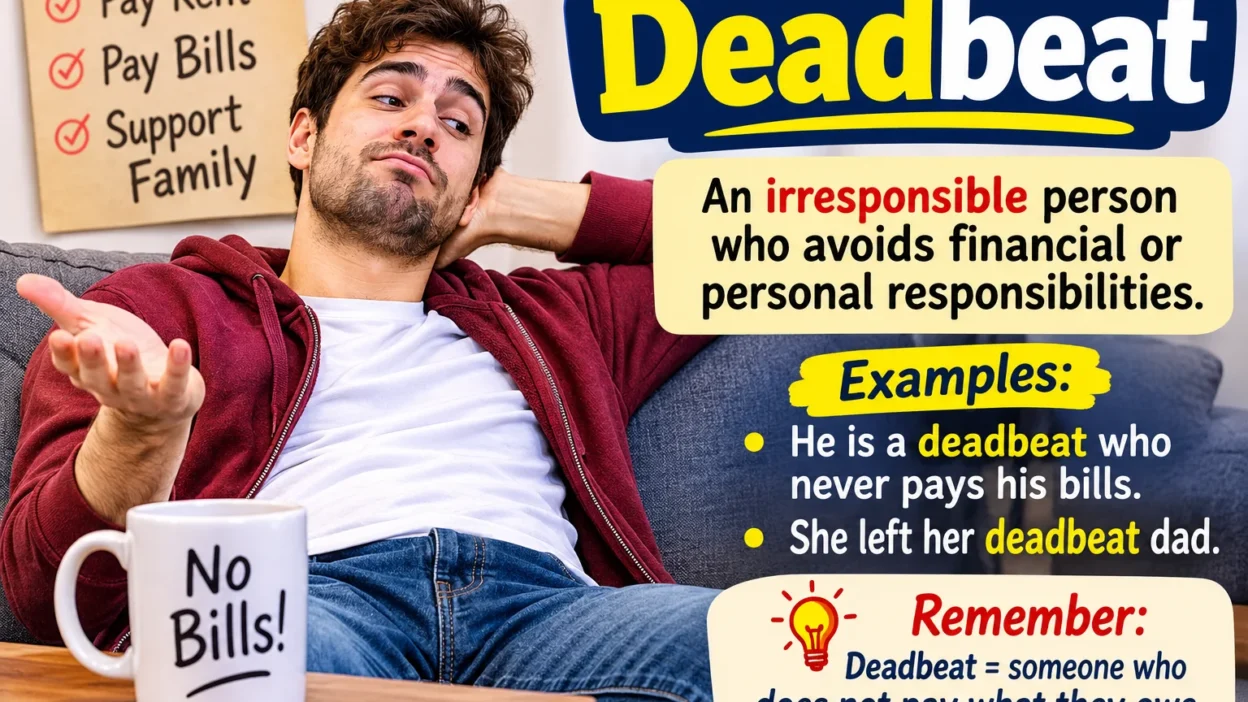
The word deadbeat is commonly used in everyday English to describe someone who fails to meet their financial or personal responsibilities. It often refers to a person who does not pay money they owe, avoids paying child support, or depends on others without making an effort to contribute. For example, someone who repeatedly borrows money but never pays it back might be called a deadbeat.
However, the meaning of deadbeat can change depending on the context. It is also used to describe someone considered lazy, irresponsible, or unwilling to work. Although it is a familiar word in American English, it can sound insulting or judgmental when used to describe another person. Understanding its meaning, common expressions, and correct usage will help you recognize it in conversations, books, movies, and everyday situations.
Quick Answer: What Does Deadbeat Mean?
Deadbeat is an informal and usually insulting noun describing someone who avoids financial or personal responsibilities, especially someone who does not pay debts or support their dependents. It can also describe a lazy or irresponsible person. For example, a person who refuses to repay borrowed money may be called a deadbeat.
Why Do People Confuse Deadbeat?
People sometimes misunderstand deadbeat because it has several related meanings.
Depending on the situation, it can describe:
- Someone who does not pay debts.
- A parent who refuses to pay child support.
- Someone who depends on others financially without contributing.
- A person considered lazy or irresponsible.
It is also confused with words such as freeloader, slacker, and irresponsible person. Although these words have similar meanings, they are not interchangeable in every situation.
First Word: Deadbeat (Noun)
Deadbeat is primarily an informal noun used for someone who fails to fulfill financial obligations or behaves irresponsibly.
Meaning of Deadbeat
A deadbeat is a person who does not pay money they owe or avoids responsibilities that others expect them to fulfill.
It is especially common in discussions about unpaid debts, child support, and financial obligations.
Examples of Deadbeat
- He is a deadbeat who never pays his bills on time.
- Her ex-husband is a deadbeat who refuses to pay child support.
- Nobody wants to lend money to that deadbeat again.
- The landlord complained about a deadbeat tenant who owed several months of rent.
- Stop acting like a deadbeat and take responsibility for your expenses.
Is Deadbeat a Negative Word?
Yes. Deadbeat is generally a negative and judgmental word. It expresses criticism of someone’s behavior, especially their failure to meet financial obligations.
Use it carefully because calling someone a deadbeat can sound offensive.
Second Word: Deadbeat (Adjective)
Although deadbeat is mainly used as a noun, it can also appear before another noun as an informal descriptive modifier.
For example:
- Deadbeat dad
- Deadbeat parent
- Deadbeat tenant
- Deadbeat borrower
These expressions describe someone who fails to meet a particular responsibility.
Deadbeat dad is a particularly common expression for a father who fails to provide financial support or fulfill parental responsibilities.
Deadbeat: Comparison Table
| Expression | Meaning | Example |
|---|---|---|
| Deadbeat | An irresponsible person who avoids obligations | He is a deadbeat. |
| Deadbeat dad | A father who fails to support his child | The child receives no support from her deadbeat dad. |
| Deadbeat parent | A parent who neglects responsibilities | The court addressed the deadbeat parent’s unpaid support. |
| Deadbeat borrower | Someone who fails to repay borrowed money | The lender reported the deadbeat borrower. |
| Deadbeat tenant | A tenant who avoids paying rent | The landlord complained about the deadbeat tenant. |
When Should You Use Deadbeat?
Use deadbeat when discussing someone who repeatedly avoids financial responsibilities or fails to contribute when they reasonably should.
Common situations include:
1. Unpaid debts
When someone borrows money and refuses to repay it.
Example: He has become a deadbeat because he never pays back his loans.
2. Child support
When a parent fails to provide legally or otherwise expected financial support for their child.
Example: The mother struggled because the child’s father was a deadbeat.
3. Financial irresponsibility
When someone consistently avoids paying bills or meeting financial commitments.
Example: His friends consider him a deadbeat because he always asks them to cover his expenses.
4. General irresponsibility
When someone avoids responsibilities and relies too heavily on other people.
Example: Stop being a deadbeat and find a way to support yourself.
12 Examples of Deadbeat in Sentences
Here are 12 practical examples to help you understand how to use deadbeat naturally.
- My neighbor is a deadbeat who never pays his bills.
- She does not want to marry a deadbeat who cannot manage his finances.
- The company took legal action against a deadbeat customer.
- His friends stopped lending him money because he was a deadbeat.
- The court ordered the deadbeat father to pay child support.
- Nobody trusts a deadbeat who constantly breaks financial promises.
- He called his former business partner a deadbeat after he failed to repay the loan.
- The landlord finally evicted the deadbeat tenant.
- You should not depend on a deadbeat to pay your share of the expenses.
- Her brother was tired of supporting his deadbeat roommate.
- The newspaper published a story about parents who avoid their financial responsibilities.
- Instead of calling him a deadbeat, explain why he needs to fulfill his obligations.
Common Mistakes When Using Deadbeat
Avoid these common mistakes when learning this word.
Mistake 1: Thinking deadbeat only means lazy
Although it can describe a lazy or irresponsible person, it is particularly associated with avoiding financial responsibilities.
Mistake 2: Using it as a polite description
Deadbeat is not a neutral or polite word. It can offend someone.
Mistake 3: Confusing it with unemployed
An unemployed person does not necessarily avoid responsibilities. Someone can be unemployed and still be responsible and hardworking.
Mistake 4: Assuming every person with debt is a deadbeat
Having financial difficulties does not automatically make someone a deadbeat. The word usually suggests irresponsible behavior or deliberately avoiding obligations.
Mistake 5: Using it in formal writing without considering the tone
In professional or legal writing, expressions such as person who has failed to pay debts or individual who has not fulfilled financial obligations are often more appropriate.
Memory Trick: How to Remember Deadbeat
Use this simple memory trick:
Think of deadbeat = someone who does not pay what they owe.
Imagine lending someone money and repeatedly asking for it back, but they never repay you. You might informally call that person a deadbeat.
Remember:
- Dead = Not active or productive (in this expression, part of an idiom-like compound).
- Beat = Part of the established word, not a separate meaning to interpret literally.
- Deadbeat = An irresponsible person who avoids obligations.
Deadbeat in American vs British English
The word deadbeat is used in both American and British English, but it is particularly familiar in American everyday speech.
| Feature | American English | British English |
|---|---|---|
| Usage | Common and familiar | Recognized and understood |
| Tone | Informal and insulting | Informal and insulting |
| Financial meaning | Someone who avoids paying debts | Someone who avoids financial obligations |
| Common expression | Deadbeat dad | Deadbeat dad |
In both varieties, deadbeat dad is understood as a negative expression for a father who fails to support his child.
Other expressions, such as freeloader and layabout, may be used depending on the situation.
Similar Words to Deadbeat
Several English words have meanings related to deadbeat, but each has a slightly different emphasis.
| Word | Meaning | Example |
|---|---|---|
| Freeloader | Someone who takes advantage of others’ generosity | He is a freeloader who never pays for dinner. |
| Slacker | Someone who avoids working hard | Stop being a slacker and finish your work. |
| Moocher | Someone who frequently asks others for money or favors | My cousin is always borrowing money like a moocher. |
| Lazybones | A lazy person | Get up, lazybones! |
| Irresponsible | Someone who does not act responsibly | He is irresponsible with money. |
| Scrounger | Someone who gets things from others without contributing | They called him a scrounger. |
| Defaulter | Someone who fails to meet a financial or other obligation | The bank contacted the loan defaulter. |
Deadbeat vs. Freeloader: A deadbeat is especially associated with unpaid debts and neglected responsibilities, while a freeloader takes advantage of other people’s generosity.
Deadbeat vs. Slacker: A deadbeat may avoid financial obligations, while a slacker generally avoids work or effort.
Deadbeat vs. Defaulter: A defaulter is a more formal term for someone who fails to meet an obligation, particularly a financial one.
Frequently Asked Questions (FAQs)
1. What does deadbeat mean in simple words?
Deadbeat means an irresponsible person who avoids paying debts or fulfilling important responsibilities. It is an informal and usually insulting term.
2. Is deadbeat a bad word?
Deadbeat is not a swear word, but it is an insulting and judgmental expression. Calling someone a deadbeat can hurt their feelings.
3. What does deadbeat dad mean?
A deadbeat dad is a father who fails to provide financial support or meet important responsibilities toward his children. The expression is often used when a father refuses to pay child support.
4. What is another word for deadbeat?
Similar words include freeloader, moocher, slacker, scrounger, and irresponsible person. The best alternative depends on the context.
5. Is deadbeat formal or informal?
Deadbeat is an informal word. It is common in everyday conversations, newspapers, and popular media, but more neutral expressions are preferable in formal writing.
6. Can a deadbeat be someone who does not work?
Yes. People sometimes use deadbeat to describe someone who refuses to work or contribute and depends on others. However, being unemployed does not automatically make someone a deadbeat.
7. What is the opposite of a deadbeat?
Possible opposites include a responsible person, a reliable person, a hardworking person, or someone who fulfills their financial obligations.
Remember This
- Deadbeat is an informal noun.
- It describes someone who avoids financial or personal responsibilities.
- It is commonly associated with unpaid debts and child support.
- It can also describe someone who depends on others without contributing.
- It is generally an insulting or judgmental word.
Conclusion
The word deadbeat describes someone who avoids responsibilities, especially financial obligations such as paying debts, bills, or child support. It can also refer to someone considered lazy or unwilling to contribute. Understanding its meaning and context will help you recognize it in everyday English conversations.
Remember that deadbeat is an informal and often offensive expression. If you want to communicate politely or professionally, consider alternatives such as irresponsible person, non-paying customer, or someone who has failed to meet their obligations. Using the right expression will make your English clearer and more appropriate.

John Tyler is a dream researcher and content writer at SleepCout, sharing insightful articles about coded dreams, dream meanings, symbolism, sleep psychology, and practical guidance to help readers understand their dreams.