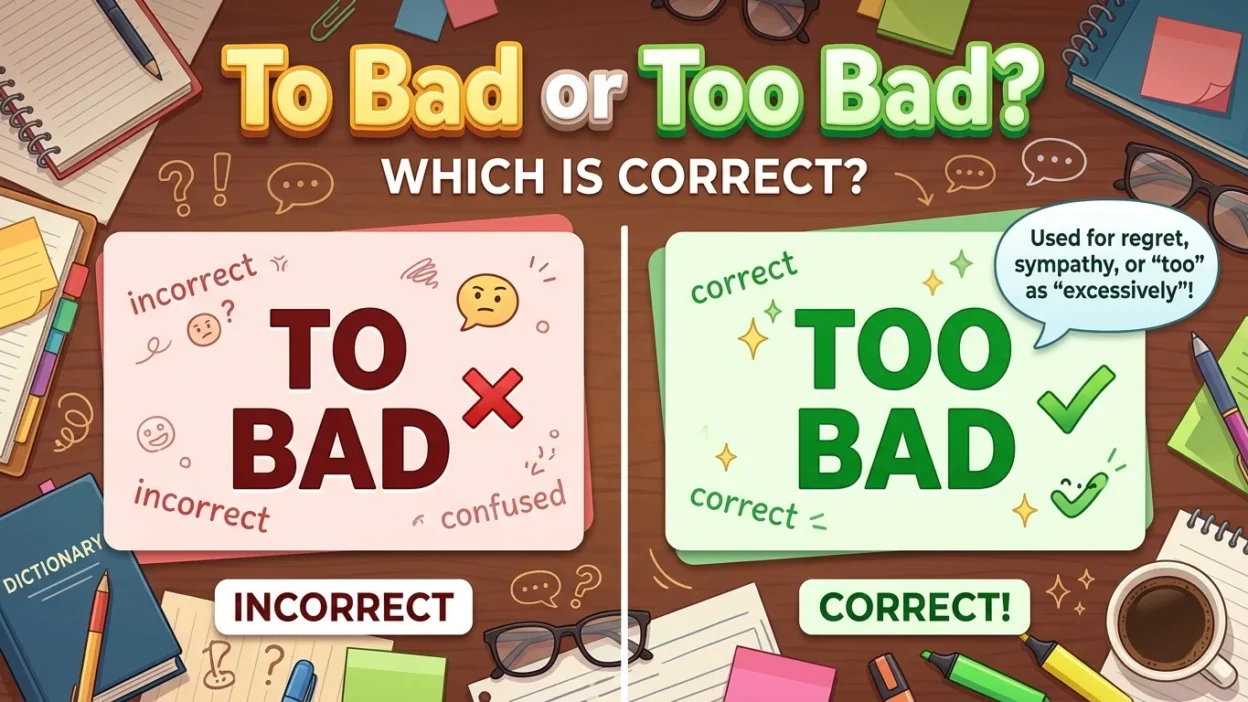
Have you ever written “to bad” when you meant “too bad”? You are not alone. These two expressions look almost identical, but they have completely different grammatical roles. One is usually an incorrect spelling when you want to express disappointment, while the other is the correct expression.
The correct phrase is “too bad” when you mean unfortunate, disappointing, excessive, or regrettable. For example, “It’s too bad you missed the party” means that it is unfortunate that you missed it. “To” is a common English preposition or part of an infinitive, while “too” can mean “also” or “more than necessary.” Understanding this small difference can help you avoid a very common English mistake in texts, emails, schoolwork, and everyday writing.
Quick Answer
“Too bad” is correct when expressing disappointment or saying that something is unfortunate. “To bad” is normally incorrect in this expression. Remember: too means “excessively” or “unfortunately” in phrases such as “too bad,” while to is generally used before a noun, pronoun, or verb.
Why Do People Confuse “To Bad” and “Too Bad”?
People often confuse these words because to and too sound alike in many varieties of English.
There is also only one extra letter between them, making the mistake easy to make when typing quickly.
Compare:
- It’s too bad you cannot come. ✓
- It’s to bad you cannot come. ✗
The first sentence uses too because the phrase expresses regret or disappointment.
What Does “To” Mean?
To is a very common English word with several grammatical uses.
“To” Before a Verb
It commonly introduces an infinitive:
- I want to learn English.
- She decided to leave early.
- We need to study.
- He likes to read.
“To” Showing Direction
It can also indicate movement toward a place or person:
- I went to school.
- She walked to the store.
- Give the book to John.
Is “To Bad” Ever Correct?
The exact sequence “to bad” can technically occur when to has its normal grammatical function and bad belongs to a different structure, but it is not the correct spelling of the expression “too bad.”
For example, a sentence such as:
- “I tried to bad-mouth him.”
uses to before the verb phrase bad-mouth, not the expression “too bad.”
So, if you want to say something is unfortunate, use too bad.
What Does “Too” Mean?
Too has two major meanings in English.
1. “Too” Means Excessively
It can mean more than is desirable or necessary.
- The coffee is too hot.
- This bag is too heavy.
- The music is too loud.
- He is too tired to work.
2. “Too” Means Also
It can also mean “also” or “as well.”
- I want to come too.
- She likes chocolate too.
- He is going too.
“Too Bad” as an Expression
In “too bad,” the phrase commonly expresses disappointment, regret, or sympathy.
- It’s too bad you missed the train.
- That’s too bad.
- It’s too bad we cannot stay longer.
Depending on tone and context, “too bad” can sometimes sound sympathetic, neutral, or even slightly sarcastic.
To Bad vs Too Bad: Comparison Table
| Phrase | Correct? | Meaning | Example |
|---|---|---|---|
| to bad | Usually ✗ | Not the expression used for disappointment | To bad you missed it. ✗ |
| too bad | ✓ | Unfortunate, disappointing, or regrettable | Too bad you missed it. ✓ |
| to | ✓ | Direction, purpose, or infinitive marker | I want to go. |
| too | ✓ | Also or excessively | It is too expensive. |
When Should You Use “To”?
Use to when it functions as a preposition or infinitive marker.
Examples
- I am going to work.
- She wants to eat.
- Give this to me.
- We walked to the park.
- He decided to stay.
A useful question is: Is “to” showing direction or coming before a verb?
If yes, to may be the word you need.
When Should You Use “Too”?
Use too when you mean “also” or “excessively.”
Examples
- I want some too. = I want some also.
- It is too expensive. = It is excessively expensive.
- She is coming too. = She is also coming.
- The box is too heavy. = The box is excessively heavy.
And when you mean “unfortunate” in the expression, use too bad.
10+ Examples of “Too Bad”
- It’s too bad you missed the bus.
- That’s too bad; I hope you feel better soon.
- It’s too bad the concert was canceled.
- Too bad we cannot stay longer.
- It’s too bad she could not join us.
- That’s too bad about your broken phone.
- It’s too bad the restaurant was closed.
- Too bad you forgot your umbrella.
- It’s too bad they had to leave early.
- That’s too bad, but there will be another opportunity.
- It’s too bad the weather changed suddenly.
- Too bad he could not attend the meeting.
Common Mistakes
Mistake 1: Using “To Bad” for Disappointment
It’s to bad you missed the game.
✓ It’s too bad you missed the game.
Mistake 2: Confusing “Too” With “To” Before a Verb
❌ I want too go home.
✓ I want to go home.
Here, to introduces the verb go.
Mistake 3: Forgetting the Second “O”
❌ That’s to bad.
✓ That’s too bad.
The extra o matters because too is a different word with a different meaning.
Mistake 4: Assuming Similar Pronunciation Means Similar Meaning
To and too can sound alike, but spelling should depend on meaning and grammatical function.
Memory Trick: “Too” Has Two Os
Here is an easy way to remember it:
Too = Two Os
When you mean “too bad” as in unfortunate or disappointing, remember the two o’s in too.
You can also remember:
- to → direction or infinitive
- too → also, excessively, or “too bad”
Think:
Too bad = two O’s
This simple trick is especially useful for students and English learners.
American vs British English
There is no spelling difference between American and British English for this distinction.
Both varieties use:
- to for direction and infinitives
- too for “also” and “excessively”
- too bad for expressing disappointment or regret
For example:
- American English: That’s too bad.
- British English: That’s too bad.
The spelling is the same.
Similar Words and Expressions
Several English words and phrases can appear similar to too bad, but they have different meanings.
That’s unfortunate
This is a more formal way to express regret.
- That’s unfortunate that you cannot attend.
What a shame
This often expresses sympathy or disappointment.
- What a shame you missed the event.
Sadly
This directly expresses sadness or regret.
- Sadly, the event was canceled.
Unfortunately
This is common in both spoken and written English.
- Unfortunately, we cannot accept your application.
Too bad
This is more conversational.
- Too bad you couldn’t come.
Final Verdict: To Bad or Too Bad?
If you are trying to say that something is unfortunate, disappointing, or regrettable, the correct expression is:
“Too bad.” ✓
Not:
“To bad.” ✗
Remember that to and too have different grammatical functions. To is commonly used for direction and before verbs, while too can mean “also,” “excessively,” or form expressions such as “too bad.”
Frequently Asked Questions
Is “to bad” correct?
“To bad” is normally incorrect when you mean “unfortunate” or “disappointing.” In that situation, the correct phrase is “too bad.”
Is it “too bad” or “to bad”?
The correct expression is “too bad.” Use it when you want to express disappointment, regret, or that something is unfortunate.
What does “too bad” mean?
“Too bad” commonly means that something is unfortunate, disappointing, or regrettable. For example, “It’s too bad you missed the party.”
Is “too bad” grammatically correct?
Yes. “Too bad” is a standard English expression. The word too can indicate an undesirable degree and is also used in this expression to communicate disappointment.
Can “to bad” ever be correct?
The words to and bad can appear next to each other in a different grammatical construction, but “to bad” is not the correct spelling of the expression meaning “unfortunate.”
Does “too bad” mean “very bad”?
Not exactly. “Too bad” can mean “unfortunate” or “regrettable” when used as an expression. In other contexts, too can mean excessively, as in “too bad to ignore.”
Is “too bad” the same in American and British English?
Yes. Both American and British English use “too bad” with the same spelling and basic meanings.
Remember This
Too bad = unfortunate or disappointing. ✓
To = commonly used for direction or before a verb. ✓
- Too bad you missed the train. ✓
- I want to go home. ✓
- I went to the station. ✓
- I want too go home. ✗
The easiest memory trick is: “Too has two O’s.”
Conclusion
The difference between “to bad” and “too bad” is small in spelling but important in meaning. When you want to say that something is unfortunate, disappointing, or regrettable, always write “too bad.” The expression is common in everyday English and works naturally in conversations, messages, and informal writing.
Use to for purposes such as direction and infinitives, while too means “also,” “excessively,” or appears in expressions such as “too bad.” Once you connect each spelling with its function, this common mistake becomes much easier to avoid.

Charles Kyle is a passionate writer and dream researcher at SleepCout, dedicated to exploring coded dreams, lucid dreaming, dream symbolism, and sleep science. He creates engaging, well-researched content that helps readers understand their dreams and discover the fascinating connection between technology, imagination, and the sleeping mind.