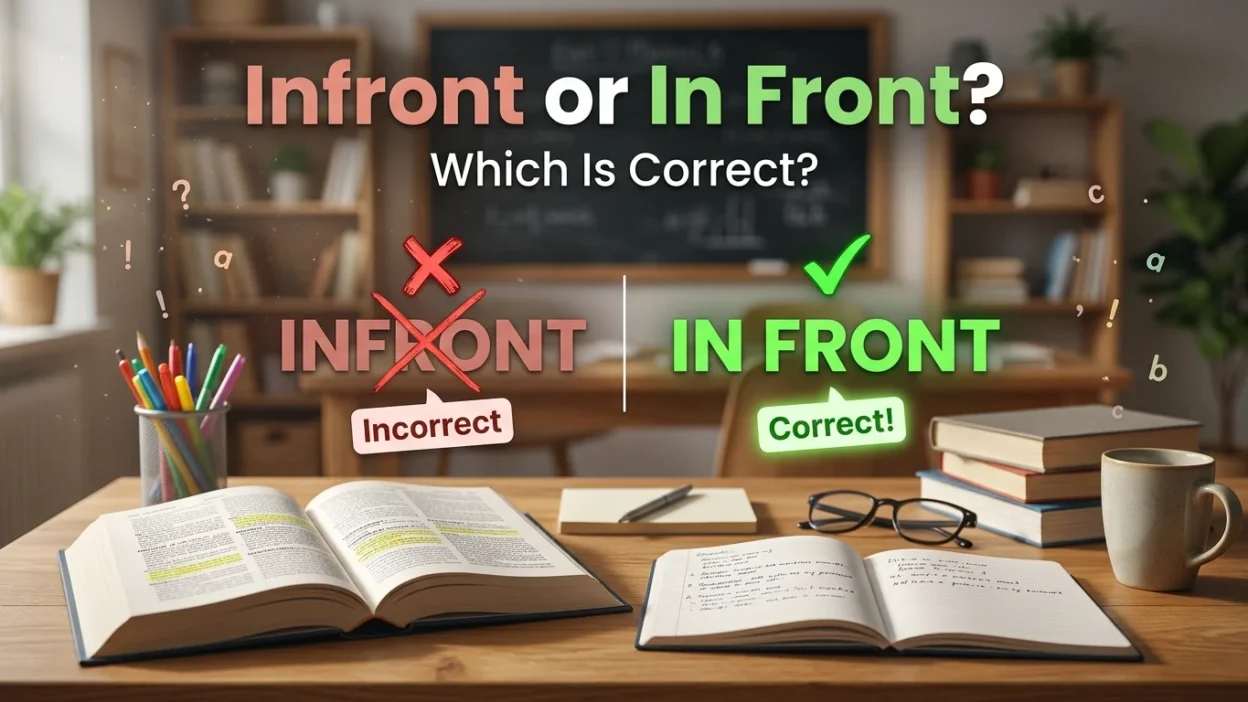
When writing or speaking English, you may wonder if the correct form is “infront” or “in front.” The answer is simple: “in front” is the correct standard English form. The two words should be written separately. “Infront” is generally considered a misspelling and should not be used in standard English writing.
The phrase “in front” is commonly used to describe a position, location, or relationship between people or things. For example, you can say, “The car is parked in front of the house” or “She stood in front of me.” Understanding this small spelling difference can help you write more clearly and avoid a common mistake in everyday English, school assignments, emails, and professional writing.
Quick Answer: Infront or In Front?
“In front” is correct, while “infront” is incorrect in standard English. The phrase is normally written as two words and is often followed by “of,” as in “in front of the building.” Use “in front” when talking about a position that is ahead of or before someone or something.
Why Do People Confuse “Infront” and “In Front”?
People often confuse “infront” and “in front” because English contains many compound words that are written as one word.
For example:
- inside
- outside
- beforehand
- forward
This can make learners assume that “in front” should also be written as one word.
However, front is a noun in this expression, and in functions as a preposition. They remain separate:
in + front = in front
The most common construction is:
in front of + noun/pronoun
Examples:
- in front of the house
- in front of me
- in front of the school
- in front of the camera
Is “Infront” a Word?
No, “infront” is not the standard spelling of the phrase.
You may occasionally see “infront” written informally or as a typing mistake, but it should generally be corrected to “in front.”
Correct
The teacher is standing in front of the class.
Incorrect
The teacher is standing infront of the class.
For school, academic, business, and professional writing, always use “in front.”
What Does “In Front” Mean?
“In front” describes a position that is ahead of someone or something.
It can refer to physical location:
The bus is in front of the station.
It can also describe position relative to another person:
He was standing in front of me.
The phrase can sometimes have a figurative meaning as well:
She spoke confidently in front of the audience.
Here, “in front of” means before or in the presence of the audience.
What Is the Meaning of “In Front”?
The phrase “in front” can have several related uses.
1. Ahead of Something
The car stopped in front of our house.
The car is positioned ahead of the house from the relevant viewpoint.
2. Before Someone
Please stand in front of me.
The person should stand ahead of the speaker.
3. In the Presence of Someone
He was nervous speaking in front of his classmates.
Here, it means speaking while the classmates are watching or listening.
4. At the Forward Part of Something
We found seats in front.
This can refer to the forward area of a place, depending on context.
Infront vs In Front: Comparison Table
| Expression | Correct? | Meaning | Example |
|---|---|---|---|
| in front | ✅ Yes | Ahead of or before | She stood in front of me. |
| in front of | ✅ Yes | Ahead of someone/something | The car is in front of the house. |
| infront | ❌ No | Nonstandard spelling/misspelling | ❌ He stood infront of me. |
When Should You Use “In Front”?
Use “in front” when describing a position that is ahead of another person or thing.
Examples
- The children are playing in front of the school.
- A tree stands in front of our house.
- She parked her bicycle in front of the store.
- Please wait in front.
- He was sitting in front of me.
- The speaker stood in front of the audience.
When another person or thing follows the phrase, “in front of” is usually the appropriate construction.
10+ Examples of “In Front”
Here are practical examples showing how to use “in front” correctly:
- The bus stopped in front of the hotel.
- My brother is standing in front of the door.
- There is a large tree in front of our house.
- She sat in front of me during the movie.
- The teacher wrote the answer in front of the students.
- Please wait in front until I arrive.
- He gave a speech in front of hundreds of people.
- The taxi is waiting in front of the restaurant.
- Don’t park your car in front of the gate.
- A camera was placed in front of the stage.
- The children lined up in front of the classroom.
- She felt nervous speaking in front of her friends.
Notice that in front remains two separate words in every example.
Common Mistakes With “In Front”
Mistake 1: Writing “Infront”
❌ The shop is infront of the bank.
✅ The shop is in front of the bank.
Mistake 2: Joining the Words
Because some English expressions become compound words, learners may incorrectly combine in and front.
Remember:
in front, not infront
Mistake 3: Confusing “In Front” With “Before”
“In front of” can describe physical position, while before can have several meanings.
Compare:
The car is in front of the house.
This describes location.
I arrived before him.
This describes time or order.
Mistake 4: Forgetting “Of”
When identifying what something is positioned ahead of, the usual construction is:
in front of + noun/pronoun
For example:
She stood in front of me.
Not:
❌ She stood in front me.
A Simple Memory Trick
Use this easy rule:
“In front” has space because “front” is still a separate noun.
Think:
IN + FRONT = IN FRONT
You can also remember the common pattern:
in front of
For example:
- in front of the house
- in front of the car
- in front of me
- in front of the teacher
If you’re unsure, write “in front” as two words.
American vs British English
There is no major American-versus-British spelling difference for this phrase.
Both American English and British English use:
in front
Examples:
- American English: The car is in front of the house.
- British English: The car is in front of the house.
The spelling “infront” is not the standard form simply because of a difference between American and British English.
Similar Words and Phrases
Several expressions are related to “in front.”
Ahead of
Means farther forward or before someone/something.
The runner is ahead of me.
Before
Can refer to time, order, or position.
She arrived before me.
Behind
The opposite position of being in front.
The bicycle is behind the car.
In the lead
Often used when someone is winning or performing better than others.
Our team is in the lead.
At the front
Refers to a position at the forward part of something.
We sat at the front of the classroom.
Final Verdict: Infront or In Front?
The correct form is “in front.”
“Infront” should generally not be used in standard English. When describing something positioned ahead of another person or thing, use “in front of”:
The car is in front of the house.
For clear and correct English writing, remember that in front is always written as two words.
Frequently Asked Questions
Is “infront” one word or two?
The standard form is two words: “in front.” “Infront” is generally considered a misspelling and should be avoided in formal and standard English writing.
Is “in front of” grammatically correct?
Yes. “In front of” is a standard English phrase used to describe position, location, or being in someone’s presence.
The children are in front of the school.
Can I write “infront” in formal English?
No. In formal, academic, professional, and educational writing, use “in front” rather than “infront.”
Is “in front” a preposition?
“In front of” commonly functions as a prepositional phrase.
The car is in front of the house.
The phrase connects the position of the car with the house.
Why is “infront” incorrect?
English does not normally combine in and front into a single word in this expression. The standard spelling is in front, with a space.
What is the opposite of “in front”?
The opposite is usually “behind.”
The teacher is in front of the students.
The students are behind the teacher.
Should I say “in front me” or “in front of me”?
The correct expression is “in front of me.”
She was standing in front of me.
The word “of” is needed in this construction.
Remember This
- ✅ in front — correct
- ✅ in front of — correct
- ❌ infront — incorrect in standard English
- “In front” means ahead of or before someone/something.
- Use “in front of” when you identify the person or thing that follows the phrase.
- American and British English use the same spelling.
Conclusion
The difference between “infront” and “in front” is simple but important. “In front” is the correct standard form, and it should always be written as two words. The phrase commonly describes a physical position ahead of someone or something, as in “The car is in front of the house.”
Remember the basic pattern in + front = in front. When you need to identify what or whom something is positioned ahead of, use “in front of.” Avoid “infront” in schoolwork, professional communication, and other standard English writing.

John Tyler is a dream researcher and content writer at SleepCout, sharing insightful articles about coded dreams, dream meanings, symbolism, sleep psychology, and practical guidance to help readers understand their dreams.