English has many words that look or sound alike but have completely different meanings. This can make terms such as homophone, homograph, and homonym confusing, especially for students and English learners. Although these three terms are closely related, they describe different relationships between words.
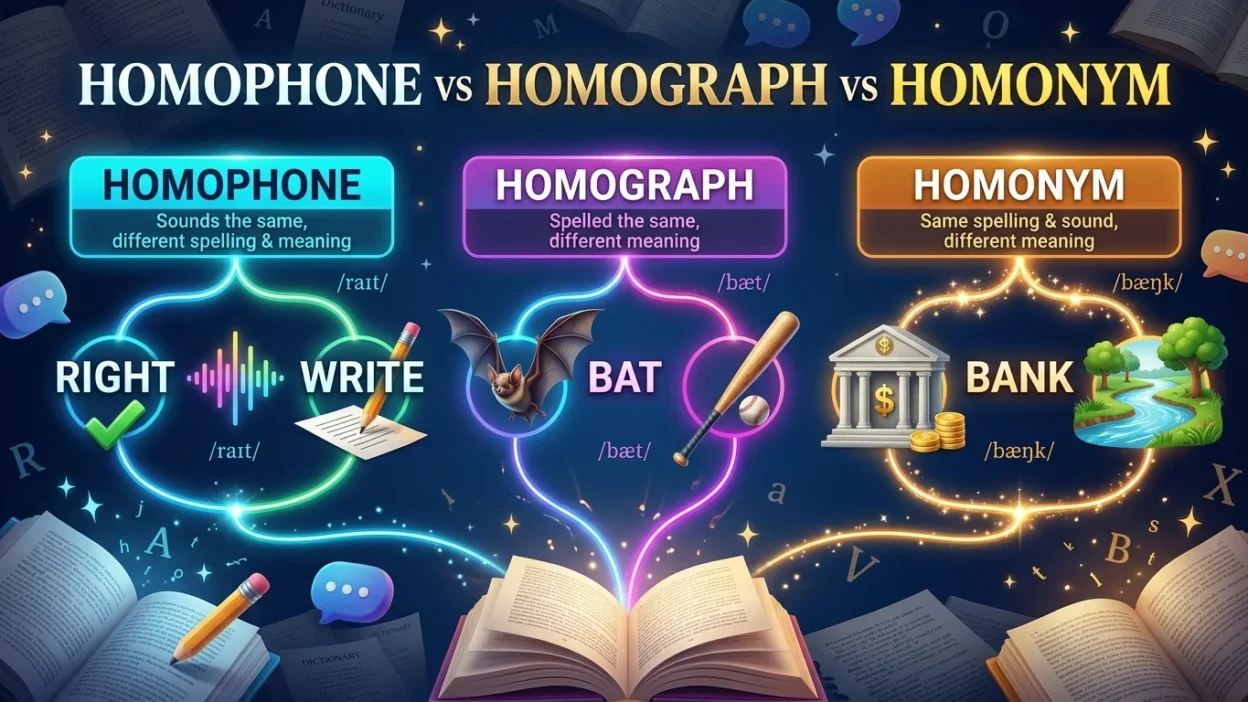
The easiest way to understand them is to focus on sound, spelling, and meaning. Homophones have the same pronunciation but different meanings and usually different spellings. Homographs have the same spelling but may have different pronunciations and meanings. Homonyms are words that share the same form or sound while having different meanings, although definitions can vary depending on how the term is used. Once you understand these basic ideas, the difference becomes much easier to remember and apply in everyday English.
Quick Answer
Homophones sound the same but have different meanings and often different spellings, such as two and too. Homographs are spelled the same but have different meanings, such as bat (animal) and bat (sports equipment). Homonyms is a broader term for words that share a form or sound but have different meanings.
Why People Confuse It
People often confuse homophone vs homograph vs homonym because all three terms describe words that are somehow alike.
The key difference is what exactly the words share:
- Homophone → same sound
- Homograph → same spelling
- Homonym → same word form or sound, but different meanings
The word homo- means “same,” while -phone relates to sound and -graph relates to writing.
So, the names themselves provide a useful clue:
- Homophone = same sound
- Homograph = same writing
- Homonym = same name or word form
There is some variation in how dictionaries and linguists define homonym, which is why the term can sometimes overlap with homophones and homographs.
First Word: Homophone
A homophone is a word that has the same pronunciation as another word but a different meaning. The spelling may be different.
For example:
- flower and flour
- sea and see
- right and write
- to, too, and two
These pairs or groups sound alike when spoken, but their meanings and spellings are different.
Example
I can see the sea.
Here, see means to look at or perceive something, while sea means a large body of salt water.
They sound the same, so they are homophones.
Easy Rule
If the words sound the same, think homophone.
Second Word: Homograph
A homograph is a word that has the same spelling as another word but has a different meaning.
Some homographs are pronounced differently. Others are pronounced the same.
For example:
- bat → an animal
- bat → equipment used in baseball or cricket
Both are spelled bat, but they have different meanings.
Another example is lead:
- lead /liːd/ → to guide someone
- lead /led/ → a type of metal
They have identical spelling but different pronunciations and meanings.
Easy Rule
If the words are spelled the same, think homograph.
Comparison Table
| Term | What Is the Same? | What Is Different? | Example |
|---|---|---|---|
| Homophone | Sound | Meaning and often spelling | right / write |
| Homograph | Spelling | Meaning and sometimes pronunciation | lead / lead |
| Homonym | Word form or sound, depending on definition | Meaning | bat / bat |
A useful way to remember the distinction is:
Homophone = sound
Homograph = spelling
Homonym = same word/form with different meaning
When to Use Each
Understanding when to use each term depends on what relationship you are describing.
Use “Homophone” When Sound Is the Same
Use homophone when two or more words sound alike but have different meanings.
Examples:
- pair and pear
- night and knight
- buy and by
- peace and piece
For example:
“Peace” and “piece” are homophones.
Use “Homograph” When Spelling Is the Same
Use homograph when words have identical spelling but different meanings.
Examples:
- bat → animal
- bat → sports equipment
Another example:
The wind was strong enough to wind the flag around the pole.
Here, wind can have different pronunciations and meanings.
Use “Homonym” for the Broader Relationship
Homonym is often used for words that have the same spelling or pronunciation but different meanings. Depending on the linguistic definition being used, homonyms can overlap with homophones and homographs.
For students, the safest approach is to remember the specific terms first:
Same sound = homophone.
Same spelling = homograph.
10+ Examples of Homophones, Homographs, and Homonyms
1. Right / Write — Homophones
- right = correct or opposite of left
- write = form words using letters
Example:
Please write the right answer.
2. Sea / See — Homophones
- sea = large body of salt water
- see = perceive with your eyes
Example:
We went to the sea to see the boats.
3. Flower / Flour — Homophones
- flower = part of a plant
- flour = powder used in cooking and baking
Example:
The flower was placed beside the flour.
4. Pair / Pear — Homophones
- pair = two things
- pear = a type of fruit
Example:
I bought a pair of shoes and a pear.
5. Bat / Bat — Homographs and commonly treated as homonyms
- bat = a flying mammal
- bat = sports equipment
Example:
A bat flew past the cricket bat.
6. Bark / Bark — Homographs and commonly treated as homonyms
- bark = outer covering of a tree
- bark = sound made by a dog
Example:
The dog’s bark woke me up near the tree.
7. Lead / Lead — Homographs
- lead /liːd/ = guide
- lead /led/ = a metal
Example:
She will lead the team, but the old pipe contained lead.
8. Tear / Tear — Homographs
- tear /tɪər/ = drop of liquid from the eye
- tear /ter/ = rip or pull apart
Example:
A tear rolled down her cheek when she saw the tear in her dress.
9. Bass / Bass — Homographs
- bass = a low musical sound
- bass = a type of fish
The spelling is the same, but the pronunciation can differ.
10. Ring / Ring — Homonyms
- ring = circular piece of jewelry
- ring = sound made by a bell or telephone
Example:
The phone began to ring while she looked at her ring.
11. Bank / Bank — Homonyms
- bank = financial institution
- bank = land beside a river
Example:
We stopped at the bank near the river.
12. Park / Park — Homonyms
- park = public green area
- park = leave a vehicle in a particular place
Example:
We decided to park near the park.
Common Mistakes
One common mistake is assuming that all words with the same spelling or pronunciation are automatically called homonyms.
The terms are more specific than that.
Mistake 1: Calling Every Similar-Sounding Word a Homograph
This is incorrect.
A homograph focuses on spelling, while a homophone focuses on pronunciation.
Wrong idea:
Right and write are homographs.
Better:
Right and write are homophones because they sound the same.
Mistake 2: Thinking Homophones Must Have Different Spellings
Most examples do have different spellings, but words with the same spelling and pronunciation can also have overlapping classifications depending on the linguistic framework.
The important feature is that homophones share pronunciation.
Mistake 3: Assuming Homographs Always Sound Different
Not all homographs have different pronunciations.
For example, bat has the same pronunciation in both meanings:
- animal
- sports equipment
It is still a homograph because the spelling is identical.
Mistake 4: Treating “Homonym” as Completely Separate
Homonym is often used as a broader category, and terminology varies between dictionaries and linguistic traditions.
That is why you may sometimes see the same word described as both a homonym and a more specific type such as a homophone or homograph.
Memory Trick
Use this simple three-word memory trick:
PHONE = Sound
Think of a phone as something you hear.
Homophone → same sound
GRAPH = Writing
Think of a graph as something written or represented visually.
Homograph → same spelling
NYM = Name
The ending -nym relates to a name or word.
Homonym → same word/name form with a different meaning
So remember:
PHONE = SOUND
GRAPH = SPELLING
NYM = WORD/NAME
American vs British English
The concepts of homophones, homographs, and homonyms are generally the same in American and British English.
However, pronunciation differences between the two varieties can affect whether particular words sound identical.
For example, some words may be pronounced differently in British and American English. As a result, a pair that sounds identical in one variety may have a slight pronunciation difference in another.
Spelling differences can also exist between American and British English, such as:
- color / colour
- center / centre
- favorite / favourite
These spelling differences are not normally examples of homographs simply because they look different in the two varieties.
The main concepts remain consistent across both forms of English.
Similar Words
Several related terms can help you understand this topic.
Heteronym
A heteronym is a type of homograph whose spelling is the same but whose pronunciation and meaning are different.
Examples include:
- lead /liːd/ and lead /led/
- tear /tɪər/ and tear /ter/
Homophone
A homophone focuses specifically on sound.
Examples:
- one / won
- sun / son
- hear / here
Homograph
A homograph focuses specifically on spelling.
Examples:
- bat / bat
- bark / bark
- lead / lead
Homonym
A homonym is a broader and sometimes inconsistently defined term for words that share a form or sound but have unrelated meanings.
This is why definitions may vary slightly between sources.
Final Verdict
The easiest way to understand homophone vs homograph vs homonym is to focus on what the words share.
- Homophone = same sound
- Homograph = same spelling
- Homonym = same word/form or sound with a different meaning, depending on the definition being used
For example, right and write are homophones because they sound alike. Lead and lead are homographs because they are spelled alike but have different meanings and pronunciations. Bat and bat are commonly described as homographs and homonyms because the spelling and pronunciation are the same while the meanings differ.
Frequently Asked Questions
What is the difference between a homophone and a homograph?
A homophone has the same pronunciation as another word but a different meaning. A homograph has the same spelling as another word but a different meaning. For example, sea and see are homophones, while bat and bat are homographs.
What is the difference between a homonym and a homophone?
A homophone specifically refers to words that sound the same. Homonym is a broader or differently defined term that can refer to words sharing the same form or sound but having different meanings.
Is “bat” a homophone or homograph?
Bat is a homograph because the word has the same spelling in its different meanings. It is also commonly classified as a homonym because the meanings are different while the form is the same.
Is “right” and “write” a homonym?
Right and write are definitely homophones because they have the same pronunciation but different spellings and meanings. Whether they are called homonyms depends on the definition of “homonym” being used.
Is “lead” a homograph?
Yes. Lead is a homograph because it has the same spelling but can represent different words with different meanings and pronunciations.
Are homographs always pronounced differently?
No. Some homographs have different pronunciations, while others have the same pronunciation but different meanings. Bat is a common example where the pronunciation remains the same.
What is the easiest way to remember these three terms?
Remember phone = sound, graph = writing, and nym = name or word. Therefore, homophones relate to sound, homographs relate to spelling, and homonyms relate to words with different meanings that share a form or sound.
Remember This
Homophone → same sound
Homograph → same spelling
Homonym → same form or sound, different meaning
If you are unsure, first ask yourself: “Are these words sounding the same, spelled the same, or both?” That simple question will usually point you toward the correct term.
Understanding these three concepts also makes confusing English vocabulary much easier to recognize. Once you learn to look at sound, spelling, and meaning separately, words that once seemed complicated become much easier to understand.
Conclusion
The difference between homophone vs homograph vs homonym becomes simple when you focus on the feature the words share. Homophones share pronunciation, homographs share spelling, and homonyms are commonly used for words with the same form or sound but different meanings.
Learning these terms is useful for students, writers, teachers, and English learners because they explain why many English words can sound or look alike while meaning completely different things. Remember PHONE = sound, GRAPH = spelling, and NYM = word or name, and you will have a quick way to tell them apart.

Charles Kyle is a passionate writer and dream researcher at SleepCout, dedicated to exploring coded dreams, lucid dreaming, dream symbolism, and sleep science. He creates engaging, well-researched content that helps readers understand their dreams and discover the fascinating connection between technology, imagination, and the sleeping mind.