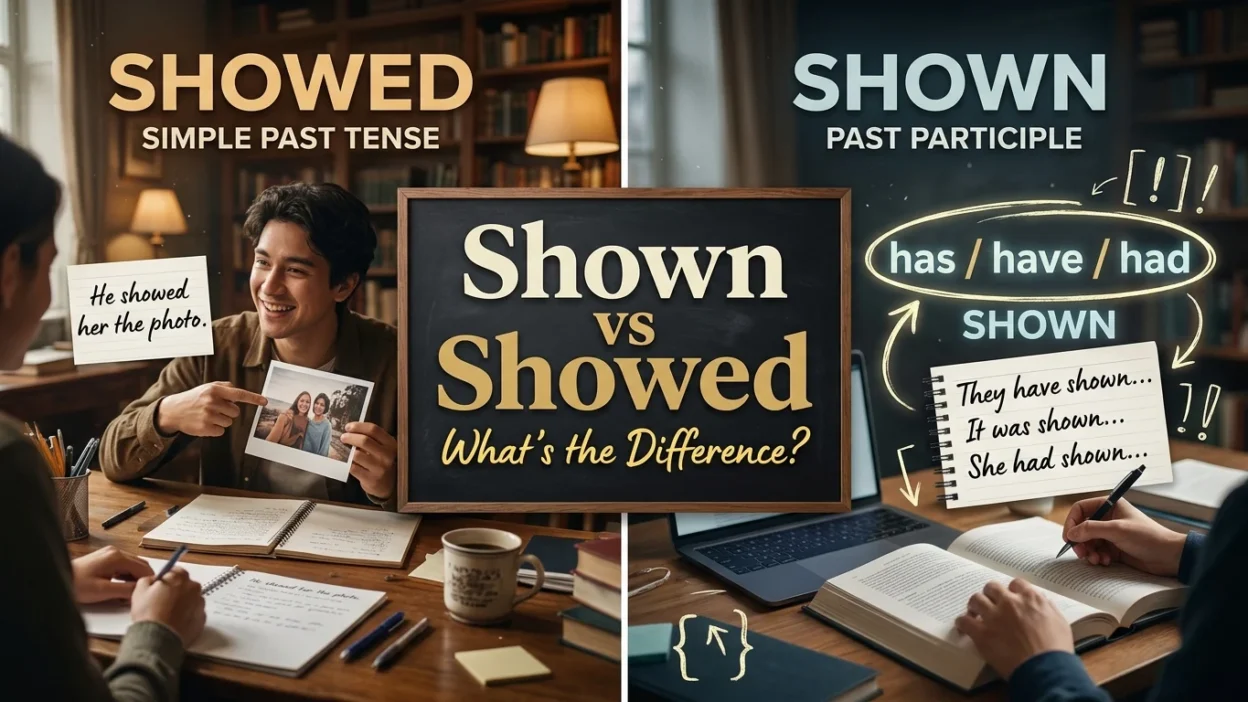
When talking about the verb show, many English learners wonder if the correct past form is shown or showed. Both words are correct, but they do not work in exactly the same grammatical situations. The main difference is that showed is the simple past form, while shown is usually used as the past participle.
For example, you can say, “She showed me her new book yesterday.” But after helping verbs such as has, have, or had, you normally use shown: “She has shown me her new book.” Understanding this small difference can help you avoid common grammar mistakes and make your writing and speaking more natural.
Quick Answer: Shown vs Showed
Showed is the simple past form of show, while shown is the past participle. Use showed for a completed action in the simple past: “He showed me the picture.” Use shown mainly with has, have, had, or in passive constructions: “He has shown me the picture.”
Why Do People Confuse Shown and Showed?
The confusion happens because show is an irregular verb with two different past forms:
- Show → base form
- Showed → simple past
- Shown → past participle
Unlike regular verbs, you cannot simply add -ed to every form.
Compare:
- I show the report every Monday.
- I showed the report yesterday.
- I have shown the report to my manager.
The key is to look at the helping verb and the tense of the sentence.
What Does “Showed” Mean?
Showed is the simple past tense of “show.”
It describes an action that happened and was completed in the past.
Examples of “Showed”
- She showed me her new dress.
- He showed us the way.
- They showed great courage.
- Maria showed me her photographs.
- The teacher showed the students a video.
A common pattern is:
Subject + showed + object
Tom showed me his new phone.
You can also use showed without an object:
The results showed that the plan worked.
What Does “Shown” Mean?
Shown is the past participle of “show.”
It is generally used with helping verbs such as has, have, and had.
Examples of “Shown”
- She has shown me the report.
- He has shown great improvement.
- They had shown us the correct route.
- The results have shown a clear difference.
- She had shown excellent leadership.
“Shown” can also appear in passive constructions:
The movie was shown on television.
The results were shown to the students.
A Useful Grammar Pattern
Have/has/had + shown
- I have shown
- She has shown
- They had shown
Shown vs Showed: Comparison Table
| Feature | Showed | Shown |
|---|---|---|
| Base verb | Show | Show |
| Verb form | Simple past | Past participle |
| Main use | Simple past | Perfect tenses and passive voice |
| Common helpers | Usually none | Has, have, had, be |
| Example | She showed me the photo. | She has shown me the photo. |
| Can stand alone as past tense? | Yes | Usually no |
| Correct after “has” | ❌ Has showed | ✅ Has shown |
| Correct after “was” in passive | Usually ❌ | ✅ Was shown |
When Should You Use “Showed”?
Use showed when you are describing a completed action in the past.
Use “showed” for simple past
He showed me his new car yesterday.
Sarah showed us her project last week.
The teacher showed the class a diagram.
Words such as yesterday, last week, last year, earlier, and two days ago often signal the simple past.
More examples
- We showed them our house.
- She showed great interest in the subject.
- The experiment showed unexpected results.
When Should You Use “Shown”?
Use shown when the grammar requires a past participle.
After “has,” “have,” or “had”
He has shown remarkable improvement.
We have shown the document to our lawyer.
She had shown me the email before.
In passive sentences
The photograph was shown to the audience.
The results were shown on the screen.
The documentary was shown on television.
Remember:
showed = simple past
shown = past participle
10+ Examples of Shown and Showed
- She showed me her new apartment.
- He has shown considerable improvement.
- They showed us the correct direction.
- I have shown him the answer.
- The teacher showed us an interesting experiment.
- The results have shown a significant change.
- We showed our guests around the city.
- She had shown me the photograph earlier.
- The movie was shown at the local theater.
- He showed everyone his new invention.
- The report has shown several important problems.
- The students were shown a short video.
- She showed great patience during the discussion.
- Researchers have shown that the method can be effective.
Notice how showed works as the simple past, while shown follows a helping verb or appears in the passive voice.
Common Mistakes with Shown and Showed
Mistake 1: “I have showed him.”
❌ I have showed him the picture.
✅ I have shown him the picture.
After have, use the past participle shown.
Mistake 2: “She shown me yesterday.”
❌ She shown me the picture yesterday.
✅ She showed me the picture yesterday.
There is no helping verb before “shown,” so the simple past showed is needed.
Mistake 3: “He had showed us.”
❌ He had showed us the way.
✅ He had shown us the way.
After had, use shown.
Mistake 4: “The movie was showed.”
❌ The movie was showed on television.
✅ The movie was shown on television.
This is a passive construction, so shown is correct.
A Simple Memory Trick
Remember this pattern:
Show → Showed → Shown
Think of it like this:
- Yesterday? → Showed
- Has/have/had? → Shown
- Passive “was/were”? → Shown
For example:
Yesterday, she showed me the photo.
She has shown me the photo.
The photo was shown to everyone.
This quick test will help you choose the correct form in most everyday sentences.
American vs British English
Both American English and British English use showed as the simple past and shown as the past participle.
For example:
American English:
He showed me the results.
He has shown me the results.
British English:
He showed me the results.
He has shown me the results.
There is no major American-versus-British difference in the basic distinction between these two forms.
Similar Words and Verb Forms
Understanding “shown vs showed” becomes easier when you compare it with other forms of show.
| Form | Example |
|---|---|
| Show | I want to show you something. |
| Shows | She shows me her work. |
| Showing | He is showing us the house. |
| Showed | She showed me the picture. |
| Shown | She has shown me the picture. |
The form changes depending on the tense and grammatical structure.
Final Verdict: Shown or Showed?
Both shown and showed are correct, but they have different grammatical functions.
Use showed as the simple past:
She showed me her new book yesterday.
Use shown as the past participle, especially after has, have, or had, and in passive constructions:
She has shown me her new book.
The book was shown to the class.
So, if you are talking about a completed past action by itself, showed is usually the right choice. If a helping verb such as has, have, or had is present, shown is normally required.
Frequently Asked Questions
Is “shown” the past tense of “show”?
Not exactly. Showed is the simple past form of “show,” while shown is its past participle.
Is “showed” grammatically correct?
Yes. Showed is completely correct when used as the simple past of “show.”
She showed me the letter.
Is “shown” grammatically correct?
Yes. Shown is correct as the past participle.
He has shown great improvement.
Which is correct: “has showed” or “has shown”?
Has shown is correct in standard English.
She has shown excellent progress.
Which is correct: “had showed” or “had shown”?
Had shown is correct.
He had shown me the document before the meeting.
Which is correct: “was showed” or “was shown”?
Was shown is correct when “show” is used in the passive voice.
The film was shown at the festival.
Can “showed” and “shown” be used interchangeably?
No. They have different grammatical roles. Showed is the simple past, while shown is normally the past participle.
Remember This
Showed = simple past
Shown = past participle
- Yesterday → showed
- Has/have/had → shown
- Was/were in passive voice → shown
If you remember these three patterns, choosing between shown and showed becomes much easier.
Conclusion
The difference between shown and showed is mainly grammatical rather than a difference in meaning. Both forms come from the verb show, but showed functions as the simple past, while shown functions as the past participle.
When describing something that happened in the past, use showed: “She showed me the picture.” When using perfect tenses or passive constructions, use shown: “She has shown me the picture” or “The picture was shown to the class.” Learning these patterns will help you use the verb “show” correctly and confidently.

Charles Kyle is a passionate writer and dream researcher at SleepCout, dedicated to exploring coded dreams, lucid dreaming, dream symbolism, and sleep science. He creates engaging, well-researched content that helps readers understand their dreams and discover the fascinating connection between technology, imagination, and the sleeping mind.