The English language is full of interesting literary devices that make writing more expressive, creative, and memorable. One such device is zeugma. Although the word may look unfamiliar, you have probably encountered this technique in books, poems, speeches, and everyday expressions. Understanding zeugma can help you appreciate how writers use words in surprising and imaginative ways.
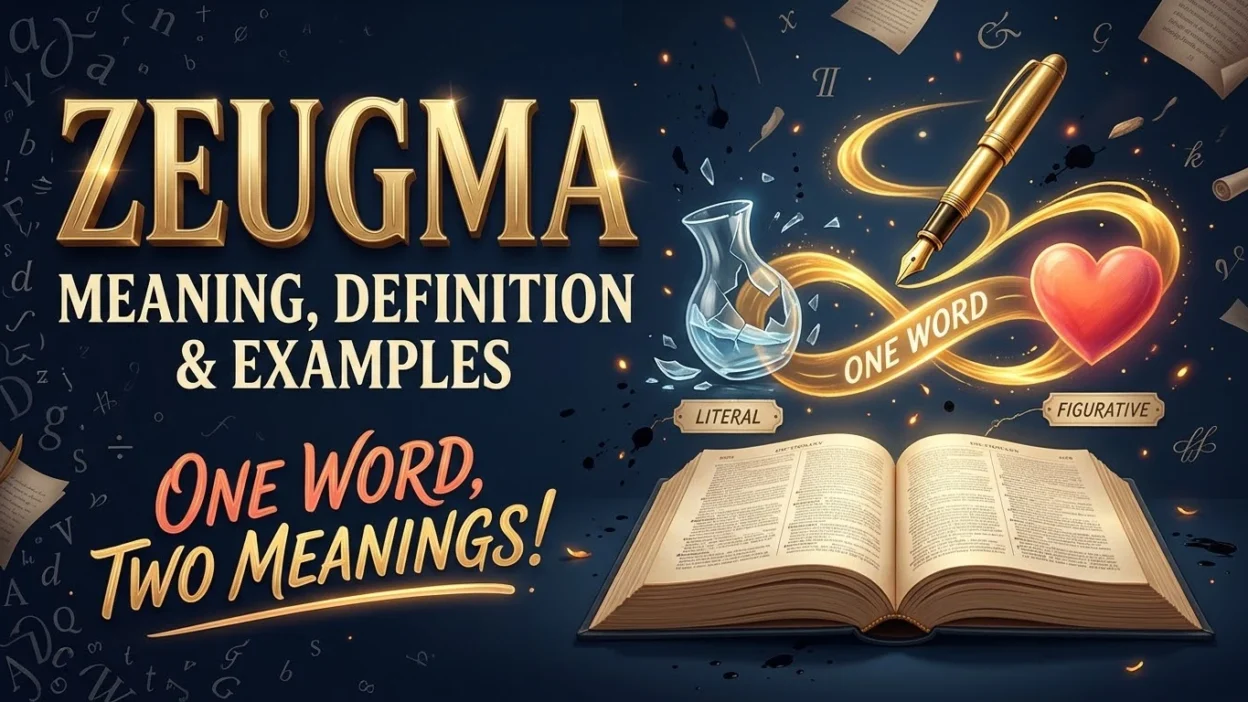
Zeugma is a figure of speech in which one word, usually a verb or adjective, connects two or more other words or phrases, but it applies to each in a different sense. This technique creates humor, emphasis, contrast, or a memorable effect. Writers often use it to make sentences more engaging without adding unnecessary words. if you are a student, an English learner, or someone interested in creative writing, learning zeugma will help you understand how language can communicate more than one idea at once.
Quick Answer: What Is Zeugma?
Zeugma is a figure of speech in which one word connects two or more parts of a sentence while having a different meaning or application for each. It is commonly used for humor, creativity, emphasis, and dramatic effect. For example: “She broke his car and his heart.”
Why Do People Confuse Zeugma?
People sometimes confuse zeugma because it is closely related to other literary devices, especially syllepsis.
Both techniques involve one word connecting multiple parts of a sentence. However, their meanings and grammatical relationships can differ depending on the definition or literary tradition being used.
Zeugma can also be confusing because:
- It is not commonly taught in everyday English lessons.
- Its examples often contain figurative language.
- One word may have both a literal and a figurative meaning.
- It is sometimes confused with ordinary parallel sentence structures.
The easiest way to recognize zeugma is to look for one word that connects two different ideas.
First Word: Zeugma
Zeugma is a noun that refers to a literary device in which one word governs or connects two or more other words or phrases.
- Pronunciation: ZOOG-muh
- Part of speech: Noun
- Origin: From the Greek word zeugma, meaning “yoking” or “joining.”
- Plural: Zeugmas or zeugmata
The word describes a writing technique rather than an ordinary action.
Examples:
- He lost his keys and his patience.
- She opened her door and her heart.
- The teacher corrected our homework and our behavior.
In these sentences, one word connects two different ideas.
Second Word: Syllepsis
Syllepsis is another literary device in which a single word connects two or more parts of a sentence, but its meaning or grammatical function may differ across them.
It is closely related to zeugma, and the two terms are sometimes used interchangeably.
Examples:
- He caught a fish and a cold.
- She lost her coat and her temper.
- He took his hat and his leave.
In each example, one verb applies to two different objects in different senses.
Important: The distinction between zeugma and syllepsis is not always consistent. Different grammar and literary references may classify the same sentence differently.
Zeugma vs. Syllepsis: Comparison Table
| Feature | Zeugma | Syllepsis |
|---|---|---|
| Meaning | One word connects multiple sentence elements | One word connects multiple elements, often with different meanings or grammatical applications |
| Main purpose | Creates emphasis, humor, or contrast | Creates wordplay, humor, or surprise |
| Structure | One governing word connects two or more elements | One word applies to multiple elements in different ways |
| Word usage | Often involves literal and figurative meanings | Often involves different senses or grammatical relationships |
| Literary effect | Memorable and expressive writing | Clever and unexpected expressions |
| Relationship | Sometimes used as a broader term | Often treated as a related or overlapping device |
Remember: The terminology overlaps. It is best to understand how the shared word works rather than relying only on the label.
When Should You Use Zeugma?
Zeugma is useful when you want to make your writing more interesting without making sentences unnecessarily long.
Here are some situations where you can use it:
1. To create humor
Zeugma can connect two unexpected ideas to make readers smile.
Example: He lost his wallet and his confidence.
2. To create emotional impact
It can combine physical and emotional experiences.
Example: She broke the glass and his heart.
3. To make writing memorable
A surprising connection between words can make a sentence stick in the reader’s mind.
4. To add creativity to storytelling
Writers can use zeugma to make ordinary descriptions more imaginative.
5. To create contrast
It can bring together two very different ideas in one sentence.
Example: She carried the suitcase and the burden of responsibility.
15+ Examples of Zeugma in Sentences
The following examples demonstrate how zeugma works in everyday and creative English.
| No. | Example | Explanation |
|---|---|---|
| 1 | She broke his car and his heart. | Broke refers to physical damage and emotional pain. |
| 2 | He lost his keys and his patience. | Lost refers to misplacing something and becoming frustrated. |
| 3 | She opened the window and her mind. | Opened is used literally and figuratively. |
| 4 | He stole her heart and her wallet. | Stole refers to romance and theft. |
| 5 | The teacher corrected our homework and our behavior. | Corrected applies to schoolwork and conduct. |
| 6 | She caught a butterfly and a cold. | Caught refers to capturing and becoming ill. |
| 7 | He left his home and his childhood behind. | Left refers to departing and moving beyond a life stage. |
| 8 | She held his hand and her breath. | Held describes two different actions. |
| 9 | He took his coffee and his leave. | Took applies to drinking or receiving coffee and departing. |
| 10 | They shared their food and their secrets. | Shared applies to physical and personal things. |
| 11 | She managed the business and his expectations. | Managed refers to different kinds of responsibilities. |
| 12 | He spent his money and his energy. | Spent applies to financial and physical resources. |
| 13 | She carried the bags and the responsibility. | Carried is literal in one case and figurative in the other. |
| 14 | He swallowed his pride and the medicine. | Swallowed refers to accepting something emotionally and taking something physically. |
| 15 | The storm destroyed the village and our hopes. | Destroyed applies to physical damage and emotional disappointment. |
| 16 | She won the competition and everyone’s admiration. | Won applies to a prize and people’s respect. |
| 17 | He answered the question and the criticism. | Answered applies to responding to a question and addressing criticism. |
These examples show how one word can connect different meanings and make sentences more expressive.
Common Mistakes When Using Zeugma
Although zeugma is a useful literary technique, learners sometimes misunderstand how it works.
Here are some mistakes to avoid:
1. Confusing it with ordinary coordination
Not every sentence with one verb and two objects is zeugma.
Incorrect identification:
“She bought apples and oranges.”
Both objects receive the same ordinary action, so this is not a clear example of zeugma.
2. Thinking every unusual sentence is zeugma
A sentence must contain a meaningful connection between multiple elements through one governing word.
3. Ignoring the different meanings
The interesting effect often comes from the shared word having different applications.
4. Overusing the technique
Using too many zeugmatic expressions can make writing sound unnatural or confusing.
5. Confusing zeugma with metaphor
A metaphor makes a comparison without using “like” or “as.” Zeugma connects multiple elements through one governing word. A sentence can sometimes involve both techniques.
Memory Trick: How to Remember Zeugma
Here is an easy way to remember the meaning of zeugma:
Think of ZEUGMA = ONE WORD, MULTIPLE CONNECTIONS.
Remember these three steps:
- Find the main verb or adjective.
- Look for two or more words connected to it.
- Check if the word has a different meaning or application for each.
For example:
“She broke the glass and his heart.”
- Main word: Broke
- First connection: The glass (physical meaning)
- Second connection: His heart (emotional meaning)
This simple method makes zeugma easier to identify.
Zeugma in American vs. British English
Zeugma is a literary device used in both American and British English.
There is no major difference in its definition or basic usage between the two varieties.
| Feature | American English | British English |
|---|---|---|
| Meaning | Same literary device | Same literary device |
| Usage | Literature, speeches, creative writing | Literature, speeches, creative writing |
| Spelling | Zeugma | Zeugma |
| Pronunciation | Generally ZOOG-muh | Generally ZOOG-muh |
| Grammar | Same general principles | Same general principles |
The main differences between American and British English usually involve spelling, vocabulary, and pronunciation, not the meaning of zeugma.
Similar Literary Devices and Words
Zeugma is connected to several other literary devices. Understanding these terms can help you recognize different writing techniques.
1. Syllepsis
A closely related figure of speech in which one word connects multiple elements with different meanings or grammatical applications.
2. Pun
A form of wordplay that uses words with multiple meanings or similar sounds to create humor.
3. Metaphor
A figure of speech that describes something by comparing it to something else.
4. Personification
A literary technique that gives human qualities to animals, objects, or abstract ideas.
5. Parallelism
A writing technique that uses similar grammatical structures to express related ideas.
6. Chiasmus
A rhetorical device in which words or ideas are repeated in reverse grammatical order.
7. Antithesis
A figure of speech that places contrasting ideas together to create emphasis.
These devices make writing more expressive, but each has a different purpose and structure.
Final Verdict: What Does Zeugma Mean?
Zeugma is a figure of speech in which one word connects two or more parts of a sentence, often with different meanings or applications.
It is commonly used to create humor, emotional impact, contrast, and memorable expressions.
For example, in “She broke his car and his heart,” the word “broke” connects physical damage with emotional pain.
Understanding this technique can improve your reading comprehension and help you become a more creative writer.
Frequently Asked Questions (FAQs)
1. What is zeugma in simple words?
Zeugma is a figure of speech in which one word connects two or more words or phrases while applying to each in a different sense. It makes sentences more creative, humorous, or expressive.
2. What is an example of zeugma?
An example is: “She broke his car and his heart.” The word “broke” refers to physical damage to a car and emotional pain caused to a person.
3. Is zeugma a figure of speech?
Yes. Zeugma is a rhetorical and literary figure of speech. Writers use it to connect different ideas through one governing word.
4. What is the difference between zeugma and syllepsis?
Zeugma and syllepsis are closely related literary devices. Both involve one word connecting multiple elements. Some references distinguish them by their grammatical structure, while others use the terms interchangeably.
5. What is the origin of the word zeugma?
The word zeugma comes from the Greek word zeugma, meaning “yoking” or “joining.” This reflects how one word joins different parts of a sentence.
6. Why do writers use zeugma?
Writers use zeugma to create humor, emphasize ideas, express contrasting meanings, and make sentences more memorable. It can also help make writing concise and creative.
7. Is zeugma used in everyday English?
Yes. Zeugma appears in conversations, jokes, advertisements, literature, and creative writing. People may use it naturally without knowing its technical name.
Remember This
- Zeugma is a figure of speech.
- One word connects two or more sentence elements.
- The shared word often has different meanings or applications.
- It creates humor, contrast, and emphasis.
- It is closely related to syllepsis.
- Writers use it to make sentences more memorable.
Conclusion
Zeugma is an interesting literary device that shows how one word can connect different ideas in a creative way. It helps writers express physical and emotional meanings together, create humor, and make ordinary sentences more memorable. Examples such as “She broke his car and his heart” demonstrate how a single word can carry more than one meaning.
Learning zeugma is useful for students, English learners, and anyone interested in improving their writing skills. Once you understand its structure, you can easily recognize it in books, speeches, poems, and everyday expressions. Try creating your own zeugma sentences to make your English more expressive and imaginative.

John Tyler is a dream researcher and content writer at SleepCout, sharing insightful articles about coded dreams, dream meanings, symbolism, sleep psychology, and practical guidance to help readers understand their dreams.