The English words former vs latter are often confusing because both refer to people, things, or ideas mentioned earlier in a sentence or conversation. Although they are closely related, they have different meanings. Understanding the difference helps you write clearer sentences, avoid confusion, and communicate more effectively.
The word former refers to the first of two people or things mentioned, while latter refers to the second or last one. For example, if someone says, “I like tea and coffee, but I prefer the former,” they mean tea. If they prefer the latter, they mean coffee. These words are especially useful in formal writing, academic discussions, business communication, and everyday English. In this guide, you will learn what former and latter mean, how to use them correctly, and how to recognize the difference through simple explanations and practical examples.
Quick Answer: Former vs Latter
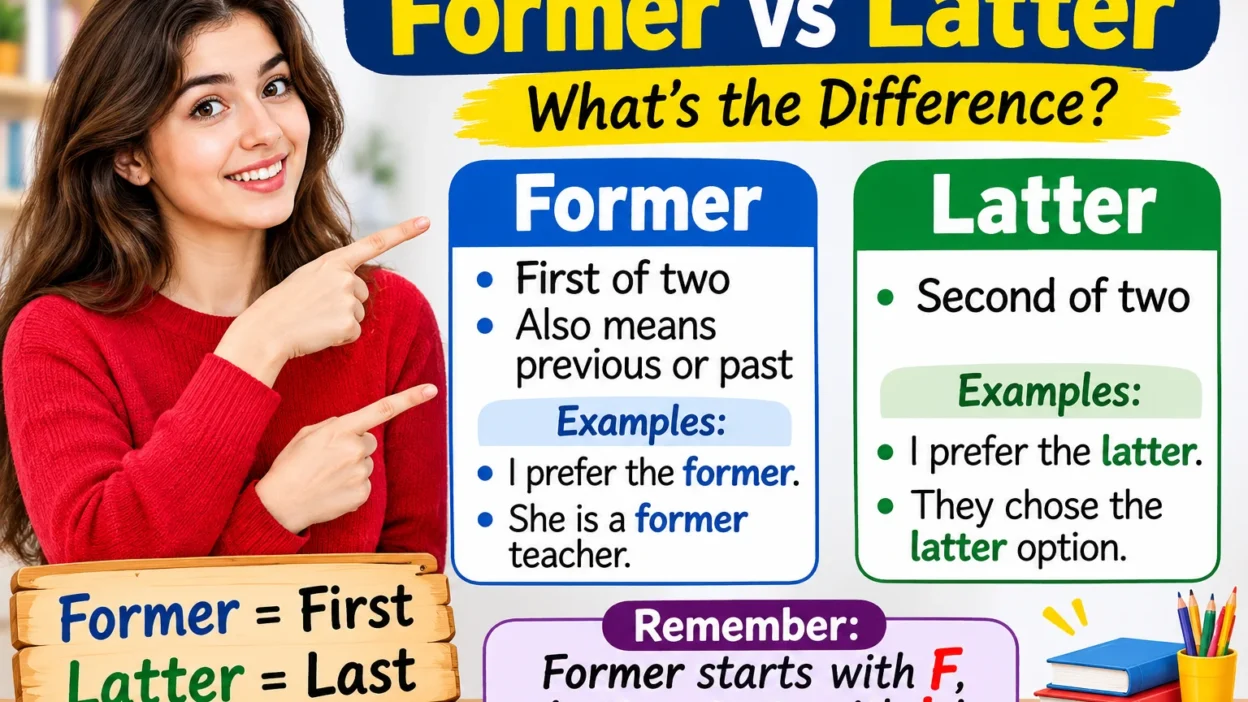
Former refers to the first of two people, things, or choices mentioned. Latter refers to the second of two people, things, or choices mentioned. For example, in “I enjoy reading and writing, but I prefer the former,” former means reading. If the sentence uses latter, it means writing.
Why Do People Confuse Former and Latter?
People often confuse these words because they perform similar grammatical functions. Both refer back to something already mentioned rather than introducing a new person or object.
However, their meanings are opposite:
- Former: The first of two things mentioned.
- Latter: The second of two things mentioned.
Another reason for confusion is that former can also describe someone who previously held a position or had a particular status.
For example:
- She is a former teacher. (She was a teacher in the past.)
- I like apples and oranges. I prefer the former. (I prefer apples.)
Understanding the context makes it easier to choose the correct word.
What Does Former Mean?
Former has two common meanings in English. It can refer to the first of two things mentioned or describe something that existed or happened in the past.
1. Former Meaning the First of Two
When discussing two people, things, or choices, former refers to the first one mentioned.
Examples:
- I like tea and coffee, but I prefer the former. (Tea)
- Both John and David are talented, but the former is more experienced. (John)
- We can travel by bus or train. The former is cheaper. (Bus)
2. Former Meaning Previous or Past
Former can also describe a person who previously had a particular job, position, relationship, or status.
Examples:
- She is a former student of this university.
- The former president visited the country.
- He met his former manager yesterday.
- My former colleague now lives abroad.
Important: In this meaning, former does not necessarily refer to the first of two things. It means previous or earlier.
What Does Latter Mean?
Latter refers to the second of two people, things, ideas, or choices that have already been mentioned.
It helps readers identify the last item in a pair without repeating its name.
Latter Meaning the Second of Two
Examples:
- I like tea and coffee, but I prefer the latter. (Coffee)
- Sarah and Emily are friends. The latter is a doctor. (Emily)
- You can choose between a laptop and a tablet. The latter is more portable. (Tablet)
Latter is generally used when two options or subjects have already been introduced.
Important: Latter does not mean previous, old, or former in the sense of a past job or relationship.
Former vs Latter: Comparison Table
| Feature | Former | Latter |
|---|---|---|
| Main meaning | First of two | Second of two |
| Other meaning | Previous or past | No equivalent common past-status meaning |
| Refers to | First-mentioned item | Last-mentioned item |
| Usage | Formal and everyday English | Mostly formal English |
| Example | I prefer the former. | I prefer the latter. |
| Refers to past jobs | Yes | No |
| Opposite | Latter | Former |
When Should You Use Former and Latter?
Choosing between these words becomes simple when you understand what you want to describe.
When to Use Former
Use former when:
- You want to refer to the first of two previously mentioned things.
- You are talking about someone’s previous job or position.
- You want to describe a past relationship or situation.
- You need a concise expression in formal writing.
Examples:
- I prefer summer to winter. The former is warmer.
- He is a former employee of the company.
- My former school was located in Lahore.
When to Use Latter
Use latter when:
- You want to refer to the second of two things mentioned.
- You are comparing two choices.
- You want to avoid repeating the second item.
- You are writing formal or academic sentences.
Examples:
- We discussed history and geography. The latter was more interesting.
- You can select a red or blue shirt. I prefer the latter.
- Both options are useful, but the latter is more affordable.
12 Examples of Former and Latter in Sentences
Here are practical examples to help you understand how these words work in everyday and formal English.
| No. | Sentence | Meaning |
|---|---|---|
| 1 | I like tea and coffee, but I prefer the former. | Tea |
| 2 | I like tea and coffee, but I prefer the latter. | Coffee |
| 3 | Ali and Ahmed attended the meeting. The former arrived early. | Ali |
| 4 | Ali and Ahmed attended the meeting. The latter arrived early. | Ahmed |
| 5 | She is a former employee of this company. | She worked there before. |
| 6 | He met his former teacher yesterday. | His previous teacher |
| 7 | We can travel by car or train. The latter is cheaper. | Train |
| 8 | Both reading and writing are important. The former improves vocabulary. | Reading |
| 9 | Both reading and writing are important. The latter improves expression. | Writing |
| 10 | He was a former football player. | He played football in the past. |
| 11 | You can choose between pizza and burgers. I prefer the former. | Pizza |
| 12 | You can choose between pizza and burgers. I prefer the latter. | Burgers |
More Examples in Everyday Conversations
– “Do you prefer online classes or classroom lessons?”
“I prefer the latter.”
– “Would you like tea or juice?”
“The former, please.”
These examples show how former and latter can make conversations shorter and more precise.
Common Mistakes When Using Former and Latter
Even experienced English learners sometimes misuse these words. Here are some mistakes to avoid.
1. Mixing Up Their Meanings
Incorrect: I like apples and bananas. I prefer the latter, meaning apples.
Correct: I like apples and bananas. I prefer the former.
The former refers to apples because they are mentioned first.
2. Using Latter for a Previous Job
Incorrect: She is a latter employee of the company.
Correct: She is a former employee of the company.
Use former to describe someone who previously worked somewhere.
3. Using Them for Too Many Items
Former and latter are traditionally used to distinguish between two items.
Unclear: I like tea, coffee, juice, and milk. I prefer the latter.
Better: I like tea, coffee, juice, and milk. I prefer milk.
When discussing more than two items, repeating the name is usually clearer.
4. Using Them Without Mentioning the Items First
Incorrect: I prefer the latter.
Correct: I prefer tea and coffee. I prefer the latter.
Readers need to know which two things you are discussing.
5. Forgetting the Correct Order
Always remember that former refers to the first item and latter refers to the second item.
Easy Memory Trick to Remember Former vs Latter
Here is a simple way to remember the difference:
- Former = First
- Latter = Last
Both words begin with different letters, so connect the F in former with First and the L in latter with Last.
For example:
“I like cats and dogs.”
- Former = Cats
- Latter = Dogs
For the other meaning of former, remember that a former employee is someone who worked at a company in the past.
Former vs Latter in American and British English
There is no significant difference between American and British English when it comes to the meanings of former and latter.
Both varieties use these words in the same way:
| Word | American English | British English |
|---|---|---|
| Former | First of two; previous | First of two; previous |
| Latter | Second of two | Second of two |
Examples:
- American English: He is a former teacher.
- British English: He is a former teacher.
- American English: I prefer the latter option.
- British English: I prefer the latter option.
The spelling and basic usage remain the same in both varieties.
Similar Words Related to Former and Latter
Understanding related words can help you expand your vocabulary.
| Word | Meaning | Example |
|---|---|---|
| Previous | Happened or existed before | My previous job was stressful. |
| Earlier | Before the present time | I arrived earlier today. |
| First | Coming before others | She finished first. |
| Last | Coming after all others | He was the last person to leave. |
| Subsequent | Happening afterward | Subsequent events changed everything. |
| Preceding | Coming before something | The preceding chapter was interesting. |
| Following | Coming after something | Read the following paragraph. |
Remember that these words are related in meaning but are not always interchangeable with former and latter.
Final Verdict: Former vs Latter
The difference between former and latter is simple:
- Former means the first of two things mentioned. It can also mean previous or past.
- Latter means the second of two things mentioned.
For example:
“I enjoy swimming and running, but I prefer the former.”
Here, former means swimming.
“I enjoy swimming and running, but I prefer the latter.”
Here, latter means running.
Use these words when discussing two clearly identified things. If you are referring to several items, repeating the name is often a better choice.
Frequently Asked Questions (FAQs)
1. What is the main difference between former and latter?
Former refers to the first of two things mentioned, while latter refers to the second. Former can also describe something or someone from the past, such as a former employee.
2. Does former mean first or last?
Former means first when referring to two previously mentioned things. For example, in “tea and coffee,” the former means tea.
3. Does latter mean second?
Yes. Latter refers to the second or last of two things mentioned earlier in a sentence or discussion.
4. Can former mean previous?
Yes. Former can describe a previous job, position, relationship, or status. For example, “He is my former boss” means he was your boss in the past.
5. Can I use former and latter for three things?
It is better not to use these words for three or more items. They are traditionally used to distinguish between two things. Repeating the specific item is clearer.
6. Is latter the opposite of former?
Yes. When referring to two things mentioned in a sentence, former means the first and latter means the second.
7. Are former and latter formal words?
Yes. Both words are commonly associated with formal writing, academic texts, professional communication, and detailed explanations. However, they can also appear in everyday conversations.
8. Is it correct to say “the former and the latter”?
Yes. This is a correct expression used when referring to two previously mentioned people, things, or ideas.
Example: “Both options are good, but the former and the latter have different advantages.”
Remember This
- Former = First of two things.
- Latter = Last or second of two things.
- Former can also mean previous or past.
- Latter does not mean a previous job or position.
- Use these words mainly when discussing two clearly identified items.
The easiest trick: Former starts with F, just like First. Latter starts with L, just like Last.
Conclusion
Understanding former vs latter is important for improving your English vocabulary and writing skills. Although both words refer to previously mentioned subjects, they have opposite meanings. Former identifies the first item, while latter identifies the second. Former also has another meaning: something or someone from the past.
With regular practice and simple examples, you can use both words confidently in conversations, academic writing, and professional communication. Just remember Former = First and Latter = Last, and you will find it much easier to choose the correct word.

Alice Allison is the Administrator at SleepCout, ensuring smooth operations while supporting a platform dedicated to coded dreams, dream interpretation, and insightful content that inspires curiosity, creativity, and imagination.