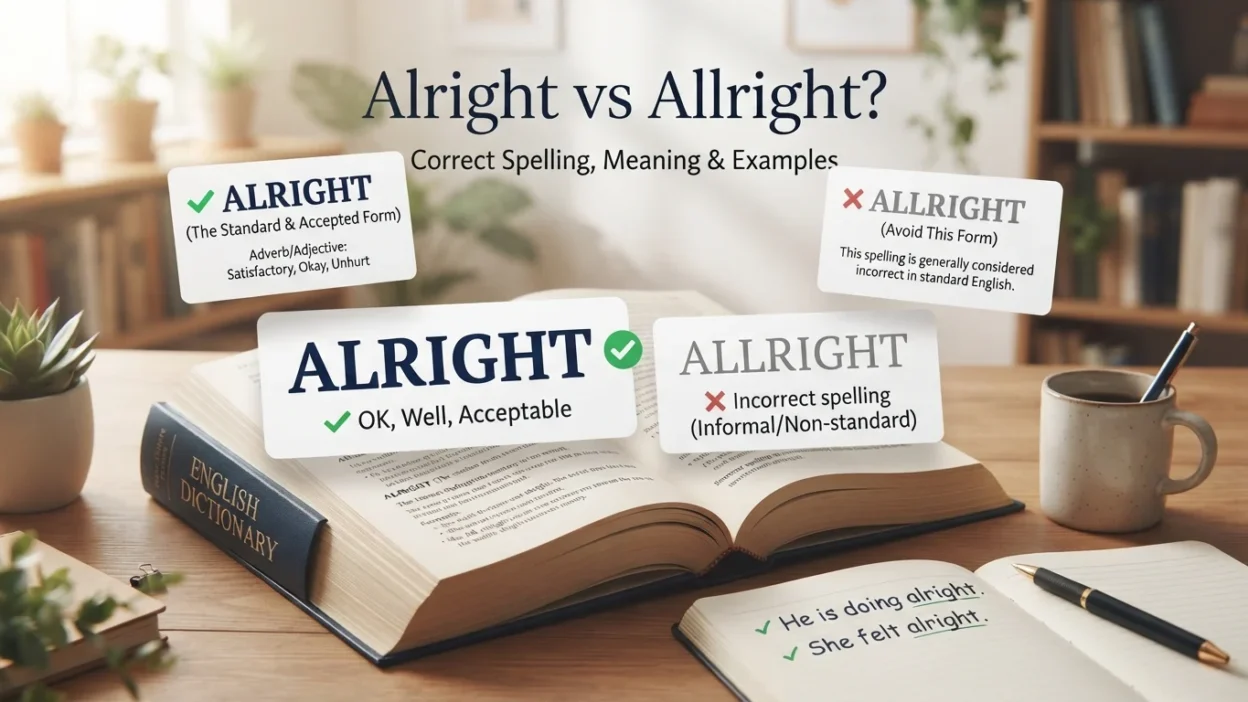
If you are wondering if “alright” or “allright” is correct, the standard spelling is alright. Allright is generally considered a misspelling in modern standard English. Alright is widely used to mean “okay,” “satisfactory,” or “in a good condition.” It can also be used informally to ask if someone is okay, as in “Are you alright?”
Although alright has traditionally been criticized by some style guides because all right is the older and more established form, it is now a common word in both everyday and informal written English. If you want the safest choice for formal writing, however, all right is usually preferred. Understanding the difference between alright, all right, and allright can help you avoid spelling mistakes and choose the appropriate form for your audience.
Quick Answer
Alright is the correct one-word spelling, while allright is generally incorrect. However, all right is also correct and is traditionally preferred in formal English. Use alright in informal or everyday writing, and use all right when you want the more conventional formal form.
Why Do People Confuse It?
The confusion comes from the phrase all right.
The word all means “everything” or “the whole amount,” while right can mean correct, satisfactory, or acceptable. Together, all right means “okay,” “acceptable,” or “completely correct.”
Over time, all right developed a commonly used one-word form: alright.
Because English contains many words that combine two separate words into one, such as:
- already
- altogether
- always
- although
some people naturally assume that all right should become allright.
But English does not form the word that way. The accepted one-word form is alright, not allright.
What Does “Alright” Mean?
Alright is an informal or conversational form meaning okay, satisfactory, acceptable, or well.
Examples
- “Are you alright?”
- “Everything will be alright.”
- “The movie was alright, but not amazing.”
- “It’s alright if you need more time.”
In many everyday situations, alright sounds natural and familiar.
What Does “Allright” Mean?
Allright is generally considered a misspelling.
You may see it occasionally in informal messages, social media posts, or other user-generated writing, but it is not the standard spelling you should normally use.
❌ “Are you allright?”
✅ “Are you alright?”
For formal writing, you can also write:
✅ “Are you all right?”
Alright vs Allright: Comparison Table
| Word | Correct? | Meaning | Recommended Use |
|---|---|---|---|
| alright | Yes | Okay, satisfactory, well | Common in informal/everyday English |
| all right | Yes | Okay, satisfactory, correct | Traditional and preferred in formal writing |
| allright | No | — | Avoid it |
When Should You Use “Alright”?
Use alright when you want the common one-word form in conversational or informal English.
Examples
Are you alright?
This asks whether someone is okay.
I think the food was alright.
This means the food was acceptable or satisfactory.
It will be alright.
This reassures someone that things will be okay.
Is it alright if I leave early?
This asks for permission.
She seems alright now.
This means she seems okay.
When Should You Use “All Right”?
All right is the traditional form and is often the safer choice in formal, academic, or professional writing.
Examples
- “Are you all right?”
- “Everything is all right.”
- “It is all right to ask questions.”
- “The results are all right, but they could be improved.”
- “All right, let’s begin.”
If you are writing an academic paper, formal report, or other carefully edited document, all right is a good choice.
10+ Examples of “Alright” and “All Right”
Here are practical examples showing how the forms are used:
- Are you alright?
- Everything will be alright.
- Is it alright if I sit here?
- The test went alright.
- She said she was alright.
- It’s alright to make mistakes while learning.
- Are you all right after the journey?
- Everything is all right now.
- It is all right to change your mind.
- All right, let’s move on to the next question.
- The project is coming along alright.
- He looked alright after getting some rest.
Notice that allright does not appear in standard examples because it is not the standard spelling.
Common Mistakes
1. Writing “Allright”
❌ “Everything is allright.”
✅ “Everything is alright.”
Or:
✅ “Everything is all right.”
2. Assuming “Alright” Is Always Wrong
Some people learn that alright is incorrect and should never be used. That is too absolute.
Alright is an established and widely used form, particularly in informal and conversational English.
3. Using “Alright” in Every Formal Situation
Although alright is widely accepted and common, all right remains the more traditional choice for formal writing.
If you want to avoid any style disagreement, choose all right in formal contexts.
Memory Trick
Remember:
All + right → all right → alright
But never:
all + right → allright ❌
A simple trick is:
Alright has only one “l” after the a.
So:
✅ alright
❌ allright
American vs British English
Both American and British English use all right, and alright is also found in both varieties.
The main difference is often style and formality, rather than geography.
Traditional formal writing tends to favor all right, while alright is especially common in informal communication, dialogue, and everyday writing.
If you are unsure which form to choose, all right is the conservative choice for formal English.
Similar Words
Several expressions can have meanings close to alright:
- okay — acceptable or satisfactory
- fine — satisfactory or in good condition
- good — positive or satisfactory
- acceptable — good enough for a particular purpose
- well — in good health or condition
- okay with — willing to accept something
- satisfactory — meeting an expected standard
For example:
- “Are you alright?”
- “Are you okay?”
- “Are you fine?”
These can have similar meanings depending on the context.
Final Verdict
Alright is the correct one-word spelling.
Allright is generally incorrect and should be avoided.
However, there is an important third option: all right. This is the traditional two-word form and is often preferred in formal, academic, and carefully edited writing.
So remember:
Alright ✅
All right ✅
Allright ❌
Frequently Asked Questions
Is “alright” a correct word?
Yes. Alright is a widely used English word, especially in informal and conversational writing. Some formal style traditions still prefer all right.
Is “allright” one word?
No. Allright is generally considered a misspelling. The accepted forms are alright and all right.
Which is more correct: “alright” or “all right”?
Both alright and all right are used, but all right is the traditional form and is generally the safer choice for formal writing.
Is “alright” formal English?
Alright is common and established, but it can be viewed as less formal than all right. For formal or academic writing, all right is often preferable.
Can I say “Are you alright?”
Yes. “Are you alright?” is a natural and common way to ask whether someone is okay.
Is “all right” two words?
Yes. All right is normally written as two separate words.
Is “allright” ever acceptable?
You may encounter allright as a spelling error or in informal user-generated text, but it is not the standard form and should generally be avoided.
Remember This
Alight and allright are not the answer here.
For this word:
- alright = correct one-word form
- all right = correct traditional two-word form
- allright = incorrect spelling
When in doubt, especially in formal writing, choose all right.
Conclusion
The correct spelling is alright, not allright. Alright is commonly used to mean okay, satisfactory, or well, while all right is the traditional two-word form with the same basic meaning. Both can be found in modern English, although all right is often preferred in formal writing.
The easiest mistake to avoid is adding an extra l. Remember that allright is not the standard spelling. Choose alright for everyday and informal writing, or all right when you want the more traditional formal form.

John Tyler is a dream researcher and content writer at SleepCout, sharing insightful articles about coded dreams, dream meanings, symbolism, sleep psychology, and practical guidance to help readers understand their dreams.