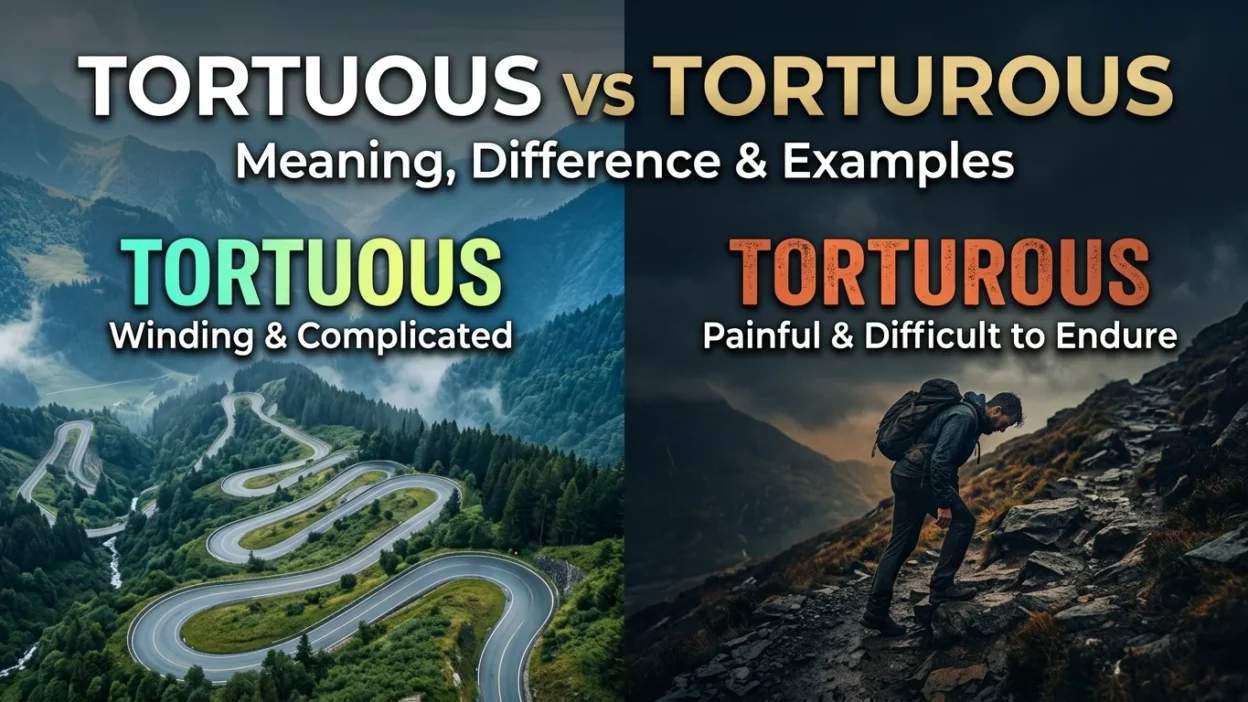
Have you ever wondered if to use tortuous or torturous? These two English words look and sound similar, but they have different meanings. Choosing the wrong word can change the meaning of your sentence, especially when describing a difficult journey, a complicated process, or a painful experience.
The main difference between tortuous vs torturous is that tortuous describes something full of twists, turns, or complications, while torturous describes something extremely painful, distressing, or difficult to endure. For example, “We drove along a tortuous mountain road” describes a winding road, whereas “The recovery process was torturous” describes an extremely unpleasant experience. Both words can also be used figuratively, making their meanings easy to confuse. In this guide, you will learn how to use each word correctly, understand their differences, explore practical examples, and avoid common spelling and vocabulary mistakes.
Quick Answer: Tortuous vs Torturous
Tortuous means winding, twisting, or complicated. It commonly describes roads, routes, arguments, and processes. Torturous means extremely painful, distressing, or difficult to endure. It commonly describes experiences, waiting periods, and physical or emotional suffering. Remember: a tortuous road has many turns, while a torturous experience causes intense discomfort.
Why Do People Confuse Tortuous and Torturous?
People often confuse these words for three main reasons:
- Similar spelling: Both words begin with “tort” and contain many of the same letters.
- Similar pronunciation: They sound alike, especially when spoken quickly.
- Overlapping contexts: Both words can describe difficult situations, but they emphasize different kinds of difficulty.
The key is to identify what you want to describe. If something twists, turns, or follows a complicated path, use tortuous. If something causes intense pain or suffering, use torturous.
1. What Does Tortuous Mean?
Tortuous is an adjective that means winding, twisting, or full of complicated turns. It can describe something physically curved or something difficult to understand because it is complicated.
Examples of Tortuous in Sentences
- The hikers followed a tortuous path through the mountains.
- The lawyer presented a tortuous argument that confused the jury.
- We drove along a tortuous road with many sharp bends.
- The company went through a tortuous process to obtain approval.
- The river followed a tortuous course across the valley.
When Should You Use Tortuous?
Use tortuous when describing:
- Roads and paths: A route with many bends and turns.
- Processes: A complicated procedure with many steps.
- Arguments: Reasoning that is difficult to follow.
- Stories or explanations: Narratives that take complicated or indirect paths.
- Negotiations: Discussions involving many complications or changes of direction.
For example, “The application process was tortuous” means the process was complicated and difficult to navigate. It does not necessarily mean that the process caused physical pain.
2. What Does Torturous Mean?
Torturous is an adjective that means extremely painful, distressing, or difficult to endure. It can describe physical suffering, emotional distress, or an experience that feels almost unbearable.
Examples of Torturous in Sentences
- The injured athlete endured a torturous recovery.
- Waiting for the final results was torturous.
- The patient described the pain as torturous.
- The long hours in the uncomfortable room were torturous.
- It was a torturous experience to watch the family struggle.
When Should You Use Torturous?
Use torturous when describing:
- Physical pain: Severe discomfort or suffering.
- Emotional distress: An intensely upsetting experience.
- Waiting: A period that feels painfully long.
- Difficult experiences: Situations that are extremely unpleasant to endure.
- Recovery or treatment: A process involving substantial pain or distress.
For example, “The final hours of the journey were torturous” means those hours were extremely unpleasant or difficult to endure. The sentence emphasizes suffering rather than the shape or complexity of the route.
Tortuous vs Torturous: Comparison Table
| Feature | Tortuous | Torturous |
|---|---|---|
| Meaning | Winding, twisting, or complicated | Painful, distressing, or agonizing |
| Main idea | Complexity or turns | Suffering or discomfort |
| Common nouns | Road, path, argument, process | Pain, wait, experience, ordeal |
| Physical use | A winding mountain road | A painful recovery |
| Figurative use | A complicated explanation | An emotionally distressing experience |
| Example | The route was tortuous. | The journey was torturous. |
| Memory clue | Twists and turns | Pain and suffering |
Important: A situation can be both tortuous and torturous, depending on what you want to emphasize. A complicated legal process might be tortuous because it involves many twists and torturous because enduring it is extremely stressful.
When Should You Use Tortuous or Torturous?
Choose the word according to the meaning of your sentence.
Use Tortuous for Complexity
Use tortuous when something has many twists, turns, or complications.
Examples:
- The tortuous road wound through the hills.
- Her tortuous explanation made the simple issue difficult to understand.
- Negotiations followed a tortuous path before the agreement was signed.
Use Torturous for Suffering
Use torturous when something causes or involves intense pain, distress, or discomfort.
Examples:
- The patient experienced torturous pain.
- The wait for news about the missing traveler was torturous.
- The exhausting examination felt torturous to the students.
Can You Use Both Words in One Sentence?
Yes. You can use both words when a situation is complicated and painful to endure.
Example: “The tortuous legal process became torturous for everyone involved.”
Here, tortuous describes the complicated process, while torturous describes how difficult and distressing it was to experience.
12 Examples of Tortuous vs Torturous in Sentences
These examples show how the correct word changes the meaning.
- Tortuous: The cyclists climbed a tortuous mountain road.
- Torturous: The cyclists found the painful recovery after their injuries torturous.
- Tortuous: The detective uncovered a tortuous chain of events.
- Torturous: The uncertainty surrounding the investigation was torturous.
- Tortuous: The river followed a tortuous route through the forest.
- Torturous: The injured climber endured a torturous night.
- Tortuous: The instructions contained a tortuous explanation of the rules.
- Torturous: The final hours of waiting felt torturous.
- Tortuous: The negotiations took a tortuous course before reaching an agreement.
- Torturous: The prolonged uncertainty proved torturous for the family.
- Tortuous: The author created a tortuous plot full of unexpected twists.
- Torturous: The patient described the severe pain as torturous.
Notice that tortuous often describes a structure, route, or chain of reasoning. Torturous focuses on the suffering associated with an experience.
Common Mistakes When Using Tortuous and Torturous
Mistake 1: Using Torturous to Describe a Winding Road
Incorrect for the intended meaning: “We drove along a torturous road full of sharp bends.”
Better: “We drove along a tortuous road full of sharp bends.”
If you mean the road itself has many twists and turns, tortuous is the correct word.
However, “The drive along the rough mountain road was torturous” is correct if you mean the drive was extremely uncomfortable.
Mistake 2: Using Tortuous to Describe Severe Pain
Incorrect for the intended meaning: “The patient suffered tortuous pain.”
Better: “The patient suffered torturous pain.”
Use torturous when emphasizing severe suffering.
Mistake 3: Assuming Both Words Mean the Same Thing
Although both words can describe difficult situations, their meanings are not interchangeable in every context.
- A tortuous explanation is complicated or difficult to follow.
- A torturous explanation would suggest that listening to it is extremely distressing or unpleasant.
Mistake 4: Confusing Tortuous With Torturous Because of the Word Torture
Both words are related to the idea of twisting, but torturous is the word more directly associated with torture and suffering in modern usage.
Do not choose a word merely because it resembles another word. Consider the intended meaning.
Memory Trick: How to Remember Tortuous vs Torturous
Use these two simple memory tricks:
- Tortuous = turns. Both words contain the letter sequence “tu,” but remember that a tortuous route twists and turns.
- Torturous = torture. The word torturous resembles torture, helping you remember its connection to pain and suffering.
Another easy way to remember the difference is to ask yourself:
- Does it twist, turn, or become complicated? Choose tortuous.
- Does it cause pain, distress, or intense discomfort? Choose torturous.
American vs British English: Is There a Difference?
There is no significant difference in the meanings of tortuous and torturous between American and British English. Both varieties use the words with essentially the same distinction.
| Word | American English | British English |
|---|---|---|
| Tortuous | Winding or complicated | Winding or complicated |
| Torturous | Painful or distressing | Painful or distressing |
The same examples work in both varieties:
- American English: The tortuous road led to the village.
- British English: The tortuous road led to the village.
- American English: The wait was torturous.
- British English: The wait was torturous.
Pronunciation can vary slightly by accent, but the spelling and core meanings remain the same.
Similar Words: Tortuous, Torturous, Tortuousness, and Torture
Understanding related vocabulary can make the distinction even clearer.
Tortuous vs Tortuousness
Tortuous is an adjective describing something winding or complicated. Tortuousness is the noun referring to that quality.
- Adjective: The road was tortuous.
- Noun: The tortuousness of the road made driving difficult.
Torturous vs Torture
Torturous is an adjective describing something extremely painful or distressing. Torture is a noun or verb associated with causing severe pain or suffering.
- Adjective: The recovery was torturous.
- Noun: The victim described the torture.
- Verb: The uncertainty continued to torture the family emotionally.
Tortuous vs Complicated
Both words can describe something difficult to understand or navigate. However, tortuous often suggests twists, indirectness, or unnecessary complexity, while complicated is a broader and more neutral term.
Example: “The instructions were complicated” is a general statement. “The instructions were tortuous” suggests they were unusually convoluted.
Torturous vs Agonizing
Both words can describe intense suffering. Agonizing often emphasizes severe pain or emotional distress, while torturous can emphasize a prolonged or difficult experience.
Example: “The wait was agonizing” and “The wait was torturous” both describe an extremely unpleasant wait.
Final Verdict: Tortuous or Torturous?
The difference between tortuous and torturous comes down to what you want to emphasize.
Choose tortuous for something winding, twisting, indirect, or complicated. Choose torturous for something painful, distressing, or extremely difficult to endure.
For example:
- “The tortuous road climbed through the mountains.”
- “The torturous wait left everyone anxious.”
Both words are correct English words, but they serve different purposes. Choosing the one that matches your intended meaning will make your writing clearer and more precise.
Frequently Asked Questions
1. What is the main difference between tortuous and torturous?
Tortuous means winding, twisting, or complicated. Torturous means extremely painful, distressing, or difficult to endure. A tortuous route has many turns, while a torturous experience causes intense discomfort or suffering.
2. Is a tortuous journey the same as a torturous journey?
No. A tortuous journey suggests a route with many twists and turns or a complicated course. A torturous journey describes a journey that is extremely unpleasant, painful, or difficult to endure. Depending on the circumstances, a journey can be both.
3. Can tortuous describe an argument?
Yes. Tortuous can describe an argument that is convoluted, indirect, or difficult to follow. For example, “The speaker presented a tortuous argument that confused the audience.”
4. Can torturous describe emotional pain?
Yes. Torturous can describe intense emotional distress as well as physical pain. For example, “The uncertainty about her family’s safety was torturous.”
5. Are tortuous and torturous pronounced the same way?
No, although they sound similar. Their pronunciation differs slightly, and the exact difference can vary by accent. Because they are easy to confuse when spoken, learning their meanings and common word pairings is especially helpful.
6. Is tortuous a negative word?
Usually, yes, especially when it describes an unnecessarily complicated argument, process, or route. However, it can simply describe a winding physical feature without implying that it is bad.
7. What is a simple synonym for tortuous and torturous?
For tortuous, useful synonyms include winding, twisting, and convoluted. For torturous, useful synonyms include agonizing, excruciating, and painful. The best synonym depends on the sentence and the intensity of the meaning.
Remember This
- Tortuous = twists, turns, and complexity.
- Torturous = torture, pain, and suffering.
If you remember these two associations, you can choose the correct word in most everyday writing situations. When in doubt, ask whether you are describing the shape or complexity of something, or the pain involved in experiencing it.
Understanding this distinction will help you communicate more accurately in essays, emails, conversations, and other forms of English writing.
The English language contains many word pairs that look almost identical but carry different meanings. Learning these differences helps you express ideas precisely and avoid misunderstandings. With regular practice and attention to context, using tortuous and torturous correctly will soon become second nature.

John Tyler is a dream researcher and content writer at SleepCout, sharing insightful articles about coded dreams, dream meanings, symbolism, sleep psychology, and practical guidance to help readers understand their dreams.