Have you ever wondered if to say “sorry for bothering you” or “sorry to bother you”? Both expressions are common in everyday English, especially when you want to interrupt someone, ask for help, or apologize for taking up their time. Although they sound similar, there is a small difference in how they are used.
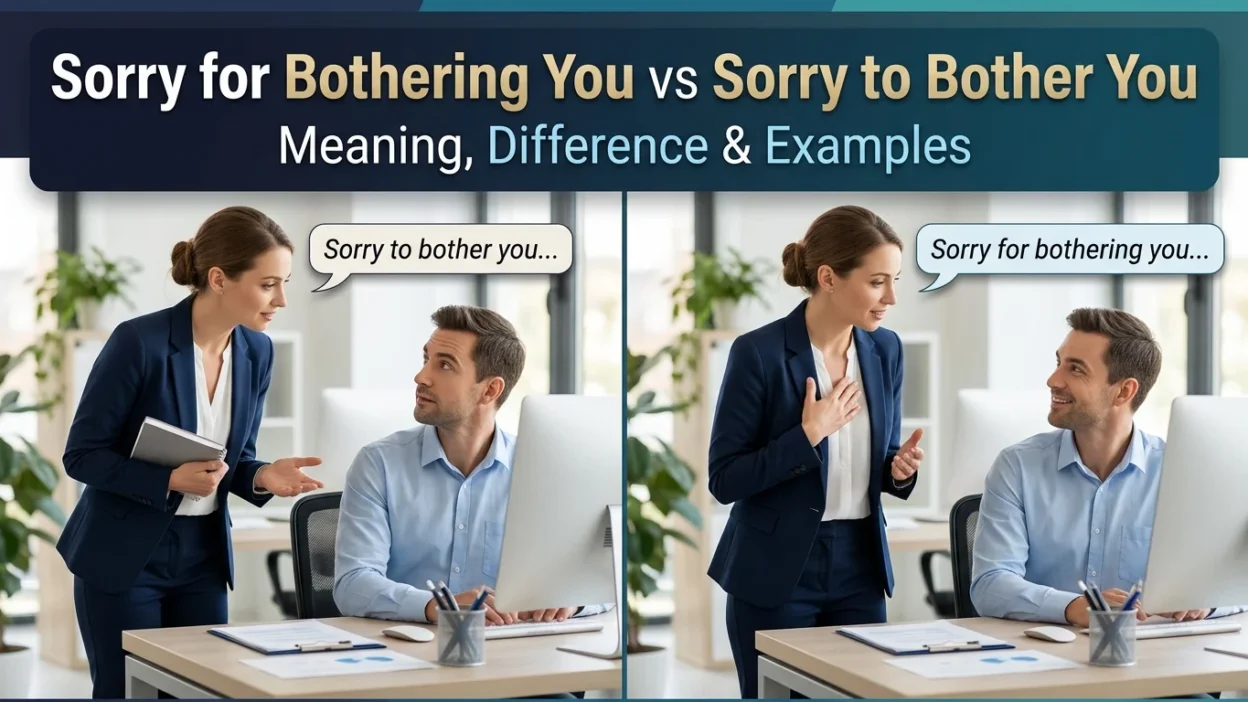
The main difference between “sorry for bothering you” and “sorry to bother you” is the timing and context. “Sorry to bother you” is usually used before or while interrupting someone, while “sorry for bothering you” is often used after you have already interrupted them or taken up their time. Both expressions are polite and natural, and neither is grammatically incorrect. The best choice depends on the situation and what you want to communicate.
In this guide, you will learn the meaning of each phrase, how to use them correctly, and which expression sounds more natural in conversations, emails, text messages, and professional situations. You will also find practical examples to help you choose the right phrase confidently.
Quick Answer
“Sorry to bother you” is generally used before or as you interrupt someone, while “sorry for bothering you” often acknowledges an interruption that has already happened. Both are polite and grammatically correct. Use “Sorry to bother you” to begin a request and “Sorry for bothering you” to apologize for the interruption or inconvenience.
Why Do People Confuse These Expressions?
People often confuse these phrases because they communicate almost the same basic message: an apology for interrupting someone or taking up their time.
Both expressions contain the word “sorry,” which communicates regret or politeness. The difference lies in the grammatical structure and the way the speaker presents the interruption.
- Sorry to bother you: Uses “to bother,” with the infinitive form of the verb.
- Sorry for bothering you: Uses “for bothering,” with the -ing form of the verb after the preposition “for.”
The timing is a useful guideline, but it is not a strict rule. You can use either phrase in some situations, depending on whether you are introducing a request, apologizing for an interruption, or expressing regret.
What Does “Sorry to Bother You” Mean?
“Sorry to bother you” is a polite expression used when you are about to interrupt someone, approach them with a request, or ask for their attention.
It shows that you recognize the other person may be busy and that you want to be respectful of their time.
Examples of “Sorry to Bother You”
- Sorry to bother you, but could you help me with this question?
- Sorry to bother you while you’re working.
- Sorry to bother you, but I need your signature.
- Sorry to bother you so late, but I have an urgent question.
- Sorry to bother you, but do you know where the meeting is?
When Is It Most Appropriate?
Use “sorry to bother you” when starting a conversation, sending an unexpected message, asking for assistance, or interrupting someone who is busy.
Example in a professional email:
“Hi Sarah, sorry to bother you, but could you please review the attached document when you have a moment?”
This opening is polite because it acknowledges the recipient’s time before making a request.
What Does “Sorry for Bothering You” Mean?
“Sorry for bothering you” is a polite apology that acknowledges the act of interrupting someone, disturbing them, or taking up their time.
It is particularly natural when the interruption has already happened or when you want to express regret about the inconvenience you may have caused.
Examples of “Sorry for Bothering You”
- Sorry for bothering you during your lunch break.
- I’m sorry for bothering you with so many questions.
- Sorry for bothering you earlier today.
- I apologize for bothering you while you were busy.
- Sorry for bothering you again about the same issue.
When Is It Most Appropriate?
Use “sorry for bothering you” when referring to an interruption that has occurred, especially if you have already asked several questions, contacted someone repeatedly, or realized that you interrupted their work.
Example in a text message:
“I’m sorry for bothering you earlier. I didn’t realize you were in an important meeting.”
This sentence naturally expresses regret about a previous interruption.
Comparison Table: Sorry for Bothering You vs Sorry to Bother You
| Feature | Sorry to bother you | Sorry for bothering you |
|---|---|---|
| Main purpose | Politely introduce an interruption or request | Apologize for the act of bothering someone |
| Common timing | Before or while interrupting | Often after an interruption |
| Grammar | Sorry + to-infinitive | Sorry + for + gerund |
| Tone | Polite and considerate | Polite and apologetic |
| Email use | Starting a request | Acknowledging an interruption |
| Conversation example | “Sorry to bother you, can I ask something?” | “Sorry for bothering you earlier.” |
| Is it correct? | Yes | Yes |
Remember that these are typical usage patterns, not absolute rules. Both phrases can work before, during, or after an interruption when the context makes the meaning clear.
When Should You Use Each Expression?
1. Use “Sorry to Bother You” Before Making a Request
This expression is particularly useful when you want to get someone’s attention politely.
Examples:
- Sorry to bother you, but may I ask a question?
- Sorry to bother you, but could you check this file?
- Sorry to bother you, but do you have a minute?
2. Use “Sorry for Bothering You” After an Interruption
This expression works well when you are acknowledging something you have already done.
Examples:
- Sorry for bothering you during your break.
- I’m sorry for bothering you earlier.
- Sorry for bothering you with all those questions.
3. Use Either Phrase in a Professional Email
Both expressions are acceptable in workplace communication. Choose the one that fits your message.
Before a request:
“Sorry to bother you, but could you send me the latest report?”
After an interruption:
“Sorry for bothering you during your meeting earlier.”
You can also avoid apologizing unnecessarily by writing a direct, polite request:
“Hi Alex, could you please review the report when you have a chance?”
4. Use Either Phrase in Casual Conversations
Both expressions sound natural when speaking with friends, classmates, or colleagues.
- Sorry to bother you, but do you have a pen?
- Sorry for bothering you while you were watching the movie.
The first introduces a request; the second acknowledges an interruption.
12 Examples of “Sorry for Bothering You” and “Sorry to Bother You”
The following examples show how the expressions work in everyday situations.
- Asking a coworker for help: “Sorry to bother you, but could you explain this spreadsheet to me?”
- Apologizing for a previous interruption: “Sorry for bothering you earlier when you were busy.”
- Sending a professional email: “Sorry to bother you, but could you review my application?”
- Messaging a friend: “Sorry to bother you, but I need your advice.”
- Contacting a teacher: “Sorry to bother you, but I have a question about today’s lesson.”
- Apologizing for repeated questions: “I’m sorry for bothering you with so many questions.”
- Asking for directions: “Sorry to bother you, but could you tell me how to get to the station?”
- Contacting someone late at night: “Sorry to bother you so late, but I need to ask you something important.”
- Following up on a request: “Sorry to bother you again, but have you had a chance to review the document?”
- Apologizing after calling someone: “Sorry for bothering you during your family dinner.”
- Starting a workplace conversation: “Sorry to bother you, but do you have a moment to discuss the project?”
- Acknowledging an inconvenience: “I’m sorry for bothering you with this issue again. I appreciate your patience.”
These examples demonstrate that the context, rather than the phrase alone, determines which expression is most suitable.
Common Mistakes to Avoid
Even though both phrases are correct, English learners sometimes make mistakes when using them.
Mistake 1: Thinking One Expression Is Always Correct
Incorrect understanding: “Sorry to bother you” is correct, but “sorry for bothering you” is wrong.
Correction: Both are grammatically correct. They differ mainly in structure and typical context.
Mistake 2: Using the Wrong Verb Form
Incorrect: “Sorry for to bother you.”
Correct: “Sorry to bother you.”
Correct: “Sorry for bothering you.”
After the preposition “for,” use the -ing form of the verb in this construction.
Mistake 3: Over-Apologizing in Professional Messages
Repeating apologies in every email can make your message unnecessarily hesitant.
Instead of writing:
“Sorry to bother you. I’m really sorry, but could I ask another question?”
Try:
“Hi Mark, could you clarify one more point when you have a moment?”
A polite request does not always require an apology.
Mistake 4: Assuming “Bother” Always Means Something Serious
The word “bother” can refer to a minor interruption, a request for help, or an inconvenience. It does not necessarily suggest that you have caused a serious problem.
For example, “Sorry to bother you, do you know the time?” is a normal, polite question.
What Is an Easy Memory Trick?
Use this simple memory trick:
- To bother = about to ask. Think of “Sorry to bother you” when approaching someone or introducing a request.
- For bothering = for what happened. Think of “Sorry for bothering you” when acknowledging an interruption or apologizing for taking up someone’s time.
For example:
“Sorry to bother you, can I ask something?” — You are introducing a request.
“Sorry for bothering you earlier.” — You are referring to a previous interruption.
This trick is helpful, but remember that the distinction is flexible rather than absolute.
American vs British English: Is There a Difference?
Both “sorry to bother you” and “sorry for bothering you” are standard and natural in American and British English.
There is no major grammatical difference between the two varieties regarding these expressions.
| Situation | American English | British English |
|---|---|---|
| Starting a request | Sorry to bother you, but can you help? | Sorry to bother you, but could you help? |
| Apologizing afterward | Sorry for bothering you earlier. | Sorry for bothering you earlier. |
| Professional email | Both phrases are acceptable | Both phrases are acceptable |
| Casual conversation | Both phrases are common | Both phrases are common |
British English speakers may sometimes prefer more indirect wording, such as “Sorry to trouble you,” depending on the person and situation. However, this is a matter of style and individual preference, not a strict rule separating British and American English.
Similar Words and Expressions
Several other expressions communicate a similar message. Choosing the right one depends on how formal, casual, or apologetic you want to sound.
1. Sorry to Interrupt You
Use this when you are speaking while someone is already doing or saying something.
Example: “Sorry to interrupt you, but the manager is waiting.”
2. Sorry to Disturb You
This is a polite alternative that can sound slightly more formal.
Example: “Sorry to disturb you, but I need your approval.”
3. Sorry to Trouble You
This expression is especially common in polite requests and may sound more formal or traditional.
Example: “Sorry to trouble you, but could you direct me to the reception desk?”
4. Sorry for the Inconvenience
Use this when you want to apologize for a problem or difficulty rather than simply interrupting someone.
Example: “Sorry for the inconvenience caused by the delayed delivery.”
5. Excuse Me
Use this to get someone’s attention, politely interrupt, or ask to pass.
Example: “Excuse me, could you tell me where the library is?”
6. I Hope I’m Not Disturbing You
Use this when you want to acknowledge that the other person may be busy.
Example: “I hope I’m not disturbing you. Do you have a moment to talk?”
Final Verdict: Which Phrase Should You Use?
Both “sorry for bothering you” and “sorry to bother you” are correct, polite English expressions. Neither is universally better than the other.
Choose “sorry to bother you” when you are approaching someone, beginning a request, or interrupting them politely. Choose “sorry for bothering you” when you want to acknowledge an interruption, particularly one that has already happened.
For example, if you are starting an email to ask for help, “Sorry to bother you, but could you help me?” is a natural choice. If you are apologizing for a previous interruption, “Sorry for bothering you earlier” is more suitable.
Ultimately, both expressions are useful. Understanding the context will help you sound natural, polite, and confident in everyday and professional English.
Frequently Asked Questions
1. Is “Sorry for bothering you” grammatically correct?
Yes, “sorry for bothering you” is grammatically correct. The preposition “for” is followed by the gerund “bothering.” The phrase is commonly used to apologize for interrupting someone or taking up their time.
2. Is “Sorry to bother you” more polite?
Both expressions are polite. “Sorry to bother you” is especially useful when introducing a request, while “sorry for bothering you” often acknowledges an interruption. The politeness of either expression depends on the situation, tone, and surrounding words.
3. Should I say “sorry to bother you” or “sorry for bothering you” in an email?
Use “sorry to bother you” when starting a request or asking for someone’s attention. Use “sorry for bothering you” when apologizing for a previous interruption or repeated messages. Both are acceptable in professional emails.
4. Can I say “sorry for bothering you again”?
Yes. “Sorry for bothering you again” is correct and natural when you want to apologize for contacting someone another time. You can also say “Sorry to bother you again” when introducing another request.
5. What is the difference between “sorry to bother you” and “sorry to interrupt you”?
“Sorry to bother you” is a general expression for asking for someone’s attention or making a request. “Sorry to interrupt you” specifically refers to interrupting an activity or conversation that is already happening.
6. Is “sorry for disturbing you” correct?
Yes. “Sorry for disturbing you” is grammatically correct and similar in meaning to “sorry for bothering you.” It is useful when you want to apologize for interrupting someone, distracting them, or disturbing their peace.
7. Can I use “sorry to bother you” with my boss or teacher?
Yes. It is appropriate when addressing a boss, teacher, or other person in a position of authority. For example, “Sorry to bother you, but could I ask a question about the assignment?” is polite and natural.
Remember This
- Sorry to bother you: Usually introduces a request or interruption.
- Sorry for bothering you: Often acknowledges an interruption or inconvenience.
- Both phrases are grammatically correct.
- Both work in American and British English.
- Context matters more than a strict timing rule.
Conclusion
“Sorry for bothering you” and “sorry to bother you” are two useful expressions for polite communication. Although they share a similar meaning, “sorry to bother you” is generally preferred when introducing a request or approaching someone, while “sorry for bothering you” often expresses regret about an interruption that has already occurred. Learning this distinction can help you communicate more naturally in conversations, emails, and workplace situations.
The easiest way to remember the difference is to connect “to bother” with approaching someone and “for bothering” with acknowledging the act of bothering them. However, both phrases can be appropriate in overlapping situations. Focus on your intended meaning, keep your message clear, and choose the expression that fits the context. With practice, you will be able to use both phrases confidently and politely.

John Tyler is a dream researcher and content writer at SleepCout, sharing insightful articles about coded dreams, dream meanings, symbolism, sleep psychology, and practical guidance to help readers understand their dreams.