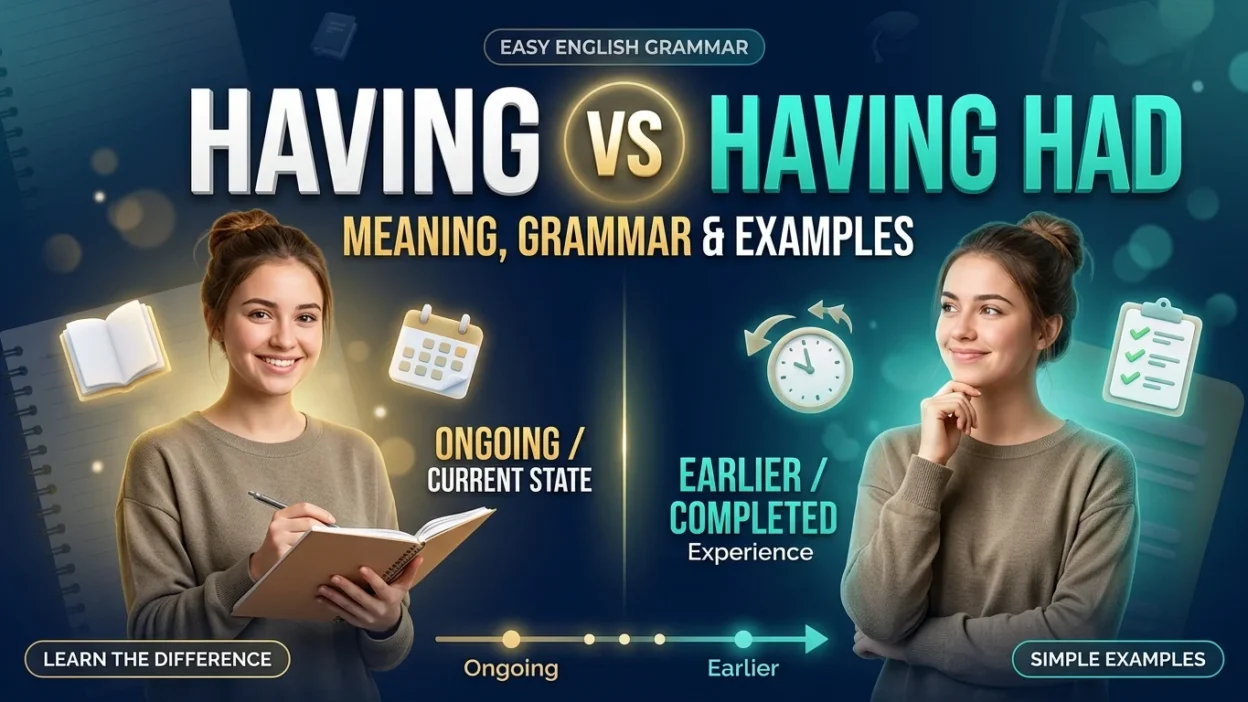
English learners often confuse “having” vs. “having had” because both expressions use the word having, but they express different grammatical ideas. The main difference is that “having” can describe an ongoing experience, possession, or an action, while “having had” usually refers to something experienced, possessed, or completed before another point or action. The correct choice depends on the sentence and the meaning you want to express.
For example, “Having a car makes life easier” describes possession, while “Having had a car before, I knew how expensive maintenance could be” refers to a past experience. Understanding this difference will help you write clearer sentences, improve your grammar, and sound more natural in everyday conversations. In this guide, you will learn how to use both expressions, recognize their grammatical patterns, avoid common mistakes, and understand the difference through simple explanations and practical examples.
Quick Answer: Having vs. Having Had
Having is the -ing form of have and can describe possession, an experience, or an action. Having had combines having with the past participle had and often refers to an experience or situation that occurred before another action. For example, “Having a headache, I went home” and “Having had a headache earlier, I rested.”
Why Do People Confuse Having and Having Had?
People confuse these expressions because both begin with having, and both can appear at the beginning of a sentence.
However, their grammatical structures are different.
- Having + noun: Describes possession, an experience, or an activity.
- Having + past participle: Forms a perfect participle when the verb is transitive or takes an appropriate complement.
- Having had + noun: Uses the perfect participle of have to refer to an earlier experience, possession, or situation.
Consider these examples:
- Having breakfast, I listened to the news. — This can describe an activity happening at the same time as another action.
- Having had breakfast, I left for work. — This emphasizes that breakfast was finished before leaving.
The second example highlights the earlier completion of the action.
1. What Does Having Mean?
Having is the present participle of the verb have. It can be used in several ways, depending on the sentence.
A. Having to Show Possession
When followed by a noun, having can describe possessing or owning something.
Examples:
- Having a good friend is a blessing.
- Having enough money makes life easier.
- Having a reliable car saves time.
In these examples, having refers to possession or the state of having something.
B. Having to Describe an Experience
The word can also refer to an experience or event.
Examples:
- I am having a wonderful day.
- She is having trouble understanding the lesson.
- We are having a meeting this afternoon.
Here, having forms part of the present continuous tense: am/is/are + having.
C. Having to Describe an Action
Having can also appear in participle clauses to describe an action or situation.
Examples:
- Having finished my homework, I watched television.
- Having completed the assignment, she submitted it.
- Having arrived early, they found good seats.
Notice that these examples use having + past participle, not simply having + noun. This structure often indicates that one action happened before another.
2. What Does Having Had Mean?
Having had is the perfect participle form of the verb have. It consists of having followed by had, the past participle of have.
It is commonly used to show that an experience, possession, or situation occurred before another action or point in time.
A. Having Had to Describe a Past Experience
Examples:
- Having had a similar experience, I understood her feelings.
- Having had several interviews, he felt more confident.
- Having had a difficult childhood, she valued stability.
Each example refers to an experience that occurred before the main clause’s action or situation.
B. Having Had to Describe Earlier Possession
Examples:
- Having had two cars before, he knew which model to choose.
- Having had a large house, they understood the costs of maintaining one.
- Having had several pets, she knew how much care they required.
In these sentences, having had emphasizes previous possession or experience.
C. Having Had to Explain an Earlier Situation
Examples:
- Having had enough rest, I felt ready to work.
- Having had little time to prepare, she kept her presentation simple.
- Having had no previous training, he found the task challenging.
The phrase connects an earlier condition with a later result.
Having vs. Having Had: Comparison Table
| Feature | Having | Having had |
|---|---|---|
| Grammatical form | Present participle of have | Perfect participle of have |
| Basic structure | Having + noun or other complement | Having had + noun or other complement |
| Main idea | Possession, experience, or activity | Earlier possession, experience, or situation |
| Time relationship | Depends on the sentence | Usually emphasizes an earlier situation |
| Example | Having a dog is enjoyable. | Having had a dog, I understood the responsibility. |
| Common use | General statements and ongoing activities | Referring to previous experiences or completed situations |
Important: Neither expression has one fixed meaning in every context. The surrounding words and the sentence structure determine its meaning.
When Should You Use Having or Having Had?
Use having when you want to describe possession, an experience, or an action without specifically emphasizing that the experience occurred before another action.
Use having had when you want to emphasize an earlier experience, possession, or situation that helps explain a later action or result.
Use Having When:
- You are describing a general situation: “Having a supportive family is important.”
- You are talking about an activity: “She is having lunch.”
- You are describing an earlier action using a perfect participle: “Having completed the course, he applied for a job.”
Use Having Had When:
- You are referring to previous experience: “Having had similar problems, I knew what to do.”
- You are describing something you previously possessed: “Having had a bicycle as a child, I enjoyed cycling again.”
- You are explaining a later result: “Having had enough sleep, she felt energetic.”
Remember that having can also appear in a perfect participle clause, as in “Having finished the work, I went home.” The distinction is not simply present versus past; it depends on the grammatical construction and intended meaning.
12 Examples of Having vs. Having Had
The following examples show how both expressions work in natural English.
Examples Using Having
- Having a positive attitude can help you overcome challenges.
- Having enough time, we decided to visit the museum.
- Having breakfast is part of my morning routine.
- She is having difficulty solving the problem.
- Having completed the training, he felt more confident.
- Having good communication skills is important at work.
Examples Using Having Had
- Having had a similar experience, I understood his concerns.
- Having had breakfast, we started our journey.
- Having had enough practice, she performed confidently.
- Having had two previous jobs, he knew what employers expected.
- Having had little sleep, I struggled to concentrate.
- Having had the opportunity to travel, they appreciated different cultures.
What Do These Examples Teach Us?
Examples 5 and 8 are particularly useful for understanding the difference:
- “Having completed the training, he felt more confident.” — The earlier action is completing the training.
- “Having had enough practice, she performed confidently.” — The earlier situation is the experience of receiving enough practice.
The first sentence uses having + past participle; the second uses having had + noun phrase. Both can express an earlier event or situation, but their grammatical structures differ.
Common Mistakes to Avoid
Mistake 1: Treating Having and Having Had as Interchangeable
Incorrect reasoning: Both expressions always mean the same thing.
Correct understanding: Their meanings depend on the structure and context.
- Having a car can be expensive.
- Having had a car before, I understood its maintenance costs.
The first expresses a general fact; the second refers to previous experience.
Mistake 2: Using Had Instead of Having Had in a Participle Clause
Incorrect: Had a similar experience, I understood his problem.
Correct: Having had a similar experience, I understood his problem.
The first sentence does not work as a standard participle clause in this context. The second correctly connects the previous experience with the main clause.
Mistake 3: Confusing Having Had With Had Had
These forms serve different grammatical purposes.
- Having had: Having had enough rest, I felt better.
- Had had: I had had enough rest before the journey began.
Having had is a perfect participle construction. Had had is the past perfect form of have.
Mistake 4: Using Having Had for Every Past Action
Not every past event requires having had.
- Natural: After I ate breakfast, I left.
- Also correct: Having eaten breakfast, I left.
You do not need to use having had breakfast unless that structure fits your intended meaning and style.
Mistake 5: Creating an Unclear Subject
The person or thing performing the action in a participle clause should normally match the subject of the main clause.
Unclear: Having had a long day, the bed looked comfortable.
Better: Having had a long day, I thought the bed looked comfortable.
The revised sentence makes it clear who had the long day.
Easy Memory Trick: Having vs. Having Had
Use this simple trick to remember the difference:
- Having = having something, experiencing something, or doing something.
- Having had = having experienced or possessed something before another event.
Try asking yourself: “Am I describing a situation or experience that came before the main action?”
If the answer is yes, having had may be appropriate. If you are describing possession, an activity, or another kind of action, having may be the better choice.
However, remember that having + past participle can also describe an earlier action, as in “Having finished dinner, we went for a walk.”
American vs. British English: Is There a Difference?
There is no significant grammatical difference between American and British English in the use of having and having had. Both varieties use these constructions in the same basic ways.
For example:
- American English: Having had enough experience, she applied for the position.
- British English: Having had enough experience, she applied for the position.
Both sentences are correct.
Differences may occur in word choice, pronunciation, or conversational style, but the grammatical distinction between these expressions remains the same.
Similar Words and Grammatical Structures
Understanding related forms can help you use having and having had more accurately.
Having vs. Had
- Having: Having enough money makes travel easier.
- Had: I had enough money to buy the ticket.
Having is a participle or gerund form, while had is a past-tense or past-participle form.
Having Had vs. Had Had
- Having had: Having had enough practice, she felt prepared.
- Had had: She had had enough practice before the competition.
The first is a perfect participle construction; the second is past perfect.
Having Done vs. Having Had
- Having done: Having done the work, he went home.
- Having had: Having had a difficult day, he went home early.
Both can connect an earlier event or situation to a later one. The verb and its complement determine the meaning.
After Having vs. Having Had
- After having lunch, we returned to work.
- Having had lunch, we returned to work.
Both sentences are grammatical. The first explicitly uses after to show the time relationship, while the second expresses the same sequence through a perfect participle clause.
Final Verdict: Which One Is Correct?
Both having and having had are grammatically correct, but they are not interchangeable in every sentence.
Use having to describe possession, activities, experiences, or actions in an appropriate grammatical structure. Use having had when you want to refer to a previous experience, possession, or situation, often to explain what happened afterward.
For example, “Having a car is convenient” describes a general situation, while “Having had a car before, I knew what to expect” refers to previous experience. Choosing the correct form depends on your intended meaning and the structure of the sentence.
Frequently Asked Questions
1. What is the main difference between having and having had?
Having is the present participle of have, while having had is its perfect participle form. Having can describe possession, activities, and experiences. Having had generally emphasizes an earlier experience, possession, or situation.
2. Is having had grammatically correct?
Yes. Having had is a standard and grammatically correct construction.
Example: “Having had enough experience, she accepted the new responsibility.”
It is particularly useful when connecting an earlier situation with a later action or result.
3. Can I start a sentence with having had?
Yes. You can begin a sentence with having had when the participle clause is properly connected to the main clause.
Example: “Having had little sleep, Mark decided to rest.”
The phrase explains Mark’s earlier condition and connects it to his decision.
4. Is having had past tense?
Not exactly. Having had is a perfect participle construction, not a finite past-tense verb. It usually refers to an earlier event or situation, but the main clause provides the grammatical tense of the sentence.
5. What is the difference between having had and had had?
Having had is a perfect participle, while had had is the past perfect form of have.
Examples:
- Having had dinner, we watched a movie.
- We had had dinner before the movie started.
Both can refer to an earlier event, but they function differently in a sentence.
6. Can having had refer to possession?
Yes. It can describe something a person possessed previously.
Example: “Having had a dog before, she knew how much care it needed.”
This construction emphasizes the person’s previous experience with dog ownership.
7. Is having had more formal than having?
Not necessarily. Both are used in formal and informal contexts. However, participle clauses such as “Having had several opportunities, she felt confident” may sound more formal or written than “Because she had several opportunities, she felt confident.”
Remember This
- Having: Can describe possession, an experience, or an activity.
- Having + past participle: Can indicate an action completed before another action.
- Having had: Often refers to an earlier experience, possession, or situation.
- Had had: Is the past perfect form of have.
- Context matters: Choose the construction that expresses your intended meaning clearly.
Conclusion
Understanding having vs. having had becomes easier when you focus on their grammatical forms and the relationships between events. Having has several uses, including describing possession, activities, and actions. Having had is a perfect participle construction that often emphasizes an earlier experience or situation. Both forms are correct when used in the appropriate context.
To improve your English, practice creating sentences with both expressions. Write one sentence about something you currently have or do, and another about an experience you had before a later event. With regular practice, you will become more confident in choosing the correct form and expressing your ideas naturally.