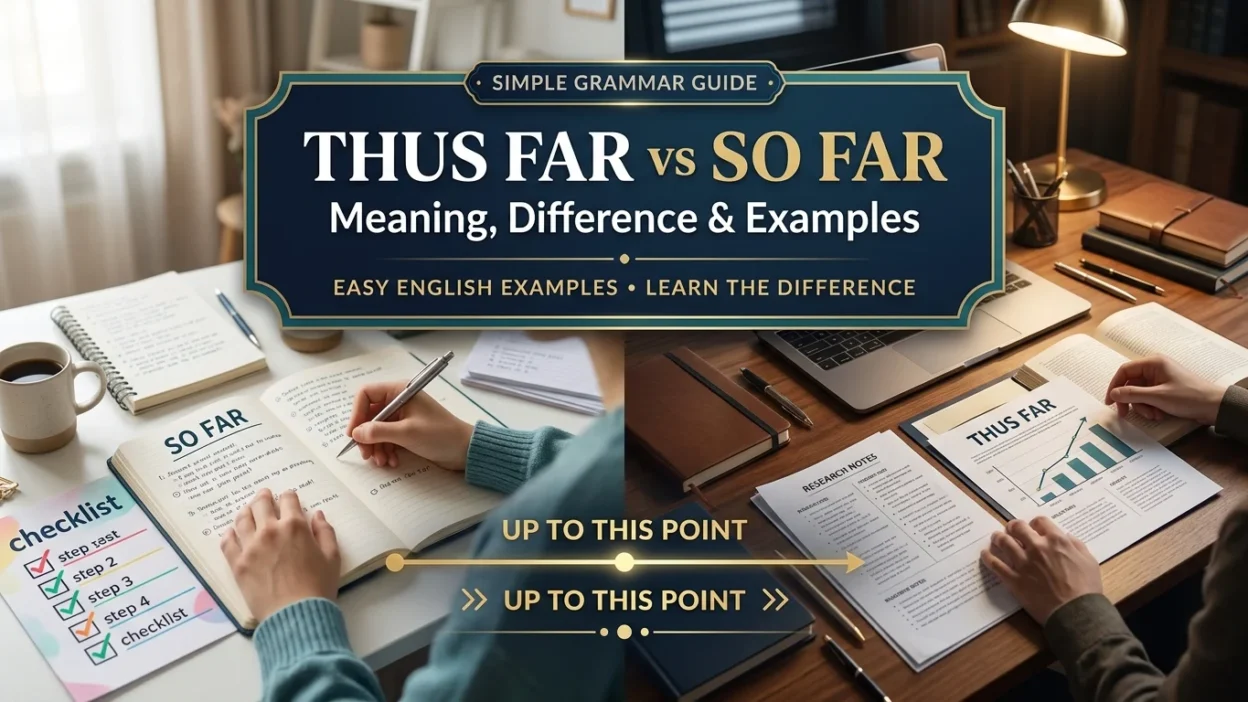
The phrases “thus far” and “so far” both mean “until now” or “up to this point.” They are used to describe something that has happened, been achieved, or remained true up to the present moment. Although they have similar meanings, they differ slightly in tone, formality, and everyday usage.
Understanding the difference between thus far and so far can help you choose the right expression for emails, conversations, academic writing, and professional communication. For example, “So far, the project is going well” sounds natural in everyday conversation, while “Thus far, the project has met its objectives” sounds more formal and polished. Both sentences are grammatically correct, but the context influences which phrase is the better choice.
In this guide, you will learn what each expression means, how to use it correctly, and which phrase sounds more natural in different situations. You will also find practical examples, common mistakes, and answers to frequently asked questions.
Quick Answer: Thus Far vs. So Far
“Thus far” and “so far” both mean “until now” or “up to this point.” The main difference is tone. “So far” is more common in everyday English and casual conversations, while “thus far” sounds more formal and is often used in academic, professional, or analytical writing. Both expressions are correct and usually interchangeable.
Why Do People Confuse Thus Far and So Far?
People confuse these expressions because they communicate almost the same idea. Both refer to a period that began in the past and continues up to the present.
For example:
- So far: So far, we have received ten applications.
- Thus far: Thus far, we have received ten applications.
Both sentences are correct and convey the same information.
The confusion arises because learners may assume that one expression is grammatically correct and the other is not. In reality, the primary difference is stylistic rather than grammatical.
Remember these key points:
- So far is the more natural choice for everyday communication.
- Thus far is a more formal alternative.
- Both can describe progress, results, experiences, and developments up to the present.
- Both commonly appear with the present perfect tense.
What Does “Thus Far” Mean?
“Thus far” means “up to this point,” “until now,” or “to this stage.” It describes how far something has progressed or what has happened within a period extending to the present.
The expression often appears in formal writing, reports, presentations, academic discussions, and professional communication.
Examples of Thus Far in Sentences
- Thus far, the research has produced encouraging results.
- The team has completed three stages thus far.
- Thus far, no serious problems have been reported.
- Our investigation has revealed no new evidence thus far.
- The proposal has received positive feedback thus far.
In each example, “thus far” indicates the situation up to the current moment.
When Should You Use Thus Far?
Use “thus far” when you want your writing to sound formal, measured, or analytical.
It works especially well in:
- Academic papers and research reports
- Business reports and project updates
- Formal presentations
- Professional correspondence
- Discussions of evidence, findings, and progress
For example:
“Thus far, the findings support our original hypothesis.”
This sentence sounds appropriate in a research report because it presents a measured assessment of the available findings.
What Does “So Far” Mean?
“So far” means “until now,” “up to now,” or “up to this point.” It describes something that has happened or a situation that has continued from the past to the present.
It is one of the most common expressions in everyday English and works in both casual and professional contexts.
Examples of So Far in Sentences
- So far, everything is going well.
- I have read five chapters so far.
- We haven’t received a reply so far.
- The trip has been enjoyable so far.
- So far, nobody has complained.
These sentences describe experiences, progress, or situations up to the present.
When Should You Use So Far?
Use “so far” when you want a natural, straightforward expression that works in most situations.
It is particularly useful in:
- Everyday conversations
- Emails and messages
- Informal updates
- Discussions about progress
- Descriptions of ongoing experiences
- General writing and storytelling
For example:
“So far, I am enjoying my new job.”
This sounds natural in a conversation with a friend or colleague.
Thus Far vs. So Far: Comparison Table
| Feature | Thus Far | So Far |
|---|---|---|
| Meaning | Until now; up to this point | Until now; up to this point |
| Formality | More formal | Neutral and conversational |
| Common use | Academic and professional writing | Everyday speech and general writing |
| Grammar | Often used with the present perfect | Often used with the present perfect |
| Tone | Formal, measured | Natural, direct |
| Correctness | Correct | Correct |
| Interchangeability | Usually interchangeable with “so far” | Usually interchangeable with “thus far” |
Key takeaway: Both expressions are correct. Choose “so far” for most everyday situations and “thus far” when a more formal tone is appropriate.
When Should You Use Each Expression?
Although these phrases often mean the same thing, choosing the right one can make your writing sound more natural.
Use “Thus Far” in Formal Writing
Choose “thus far” when discussing progress, research, evidence, or results in a formal setting.
Examples:
- Thus far, the experiment has confirmed our expectations.
- The committee has reviewed six proposals thus far.
- Thus far, the evidence remains inconclusive.
Use “So Far” in Everyday Conversations
Choose “so far” when talking naturally about your experiences, plans, or progress.
Examples:
- So far, my day has been great.
- I have saved $200 so far.
- So far, we haven’t had any problems.
Can You Use Both in Professional Emails?
Yes. Both expressions are acceptable in professional emails.
For example:
- “So far, we have completed the first phase of the project.”
- “Thus far, we have completed the first phase of the project.”
The first sounds direct and approachable. The second sounds more formal. Neither is inherently more correct.
12 Examples of Thus Far vs. So Far
The following examples show how both expressions work in different contexts.
| With “Thus Far” | With “So Far” |
|---|---|
| Thus far, the project has remained on schedule. | So far, the project has remained on schedule. |
| Thus far, the results have been positive. | So far, the results have been positive. |
| We have interviewed eight candidates thus far. | We have interviewed eight candidates so far. |
| Thus far, no major errors have been identified. | So far, no major errors have been identified. |
| The investigation has uncovered little evidence thus far. | The investigation has uncovered little evidence so far. |
| Thus far, the plan appears effective. | So far, the plan appears effective. |
| The company has hired twelve employees thus far. | The company has hired twelve employees so far. |
| Thus far, the discussion has been productive. | So far, the discussion has been productive. |
| No final decision has been made thus far. | No final decision has been made so far. |
| Thus far, the student has performed well. | So far, the student has performed well. |
| We have received several responses thus far. | We have received several responses so far. |
| Thus far, the treatment has shown promising results. | So far, the treatment has shown promising results. |
In most of these examples, changing one expression to the other does not change the essential meaning. The main difference is the tone.
More Examples in Everyday Contexts
Conversation:
“How is your new course going?”
“So far, I really like it.”
Professional report:
“Thus far, the department has achieved most of its quarterly targets.”
Email:
“So far, we have received feedback from three team members.”
Academic writing:
“Thus far, the available evidence does not establish a clear relationship between the two variables.”
Common Mistakes to Avoid
Both expressions are straightforward, but a few mistakes can make your sentences less natural.
1. Thinking “Thus Far” Is Incorrect
Incorrect assumption: “Thus far” is an outdated or grammatically incorrect phrase.
Correction: “Thus far” is a correct English expression. It simply sounds more formal than “so far.”
2. Thinking “So Far” Is Too Informal for Every Professional Situation
“So far” is perfectly acceptable in many professional emails, reports, and presentations.
Example:
“So far, we have completed 80% of the work.”
There is no need to replace it with “thus far” unless you prefer a more formal tone.
3. Using the Wrong Tense
Both expressions frequently appear with the present perfect when describing actions or developments extending from the past to the present.
Natural examples:
- We have completed four tasks so far.
- We have completed four tasks thus far.
The present simple can also be appropriate when describing a current situation:
- So far, everything looks good.
- Thus far, everything looks good.
Choose the tense based on the meaning of the sentence rather than the expression itself.
4. Using Both Expressions Unnecessarily
Avoid combining them to express the same idea twice.
Awkward: “Thus far, we have made progress so far.”
Better: “Thus far, we have made progress.”
Or: “So far, we have made progress.”
5. Assuming “Thus Far” Always Sounds Better
Longer or more formal wording is not automatically better. In ordinary conversation, “so far” often sounds clearer and more natural.
Memory Trick: How to Remember the Difference
Use this simple memory trick:
- So far = simple and everyday.
- Thus far = formal and polished.
Think of “so far” as the phrase you would naturally use when talking to a friend. Think of “thus far” as a phrase you might choose when writing a formal report.
For example:
- Everyday: “So far, the meeting has been useful.”
- Formal: “Thus far, the meeting has achieved its intended objectives.”
Both communicate progress up to the present.
Thus Far vs. So Far in American and British English
Both “thus far” and “so far” are accepted in American and British English. Neither expression is exclusive to one variety.
| Context | American English | British English |
|---|---|---|
| Everyday conversation | So far, so good. | So far, so good. |
| Work updates | We have made good progress so far. | We have made good progress so far. |
| Formal reports | Thus far, the results are encouraging. | Thus far, the results are encouraging. |
| Academic writing | Both are acceptable. | Both are acceptable. |
The choice generally depends on formality, context, and personal writing style rather than nationality.
In both varieties, “so far” is a particularly natural choice for everyday communication, while “thus far” often sounds more formal.
Similar Words and Expressions
Several other expressions can communicate a meaning similar to “thus far” and “so far.” However, some have slightly different uses.
| Expression | Meaning | Example |
|---|---|---|
| Until now | Up to the present | Until now, everything has worked well. |
| Up to now | From the past to the present | Up to now, we have received five applications. |
| To date | Up to the present date | To date, the company has opened four offices. |
| As of now | At the present time | As of now, the meeting is still scheduled. |
| So far | Up to this point | So far, the plan is working. |
| Thus far | Up to this point, often formally | Thus far, the evidence is convincing. |
| Hitherto | Until now, in formal or literary use | Hitherto, the method had remained untested. |
These expressions overlap in meaning, but they are not interchangeable in every sentence. For instance, “as of now” often emphasizes the current state, while “to date” frequently refers to accumulated results over a period.
Final Verdict: Thus Far or So Far?
Both “thus far” and “so far” are grammatically correct and generally mean “until now” or “up to this point.”
Choose “so far” for everyday conversations, emails, and most general writing. It is simple, natural, and widely useful.
Choose “thus far” when you want a more formal or analytical tone, especially in academic writing, reports, and discussions of research or results.
If you are unsure which phrase to use, “so far” is usually the safest choice for ordinary communication. Use “thus far” when its more formal tone suits your audience and purpose.
Frequently Asked Questions
1. Are “thus far” and “so far” the same?
Yes. Both expressions generally mean “until now” or “up to this point.” The main difference is tone: “so far” is more conversational, while “thus far” is more formal.
2. Is “thus far” more formal than “so far”?
Yes. “Thus far” generally sounds more formal and is often used in academic writing, research reports, and professional documents. “So far” is common in everyday speech and general writing.
3. Is “thus far” grammatically correct?
Yes. “Thus far” is a standard English expression that means “up to this point.” For example, “Thus far, the investigation has revealed no new evidence.”
4. Can I use “so far” in formal writing?
Yes. “So far” is acceptable in professional emails, reports, academic contexts, and other formal writing. Whether it is the best choice depends on the desired tone and the conventions of the document.
5. Should I use “thus far” or “so far” in an email?
Use “so far” for most routine emails because it sounds natural and clear. Use “thus far” when you want a more formal tone, such as in a detailed report or a formal progress update.
6. Which tense is commonly used with “thus far” and “so far”?
Both expressions commonly appear with the present perfect tense when describing actions or developments continuing up to the present.
Examples:
- We have completed three stages so far.
- We have completed three stages thus far.
They can also be used with other tenses when the context calls for them.
7. Is “so far, so good” correct?
Yes. “So far, so good” is a common English expression meaning that something has been satisfactory up to the present, although the situation may continue to develop.
Example: “The new computer is working well. So far, so good!”
Remember This
- Thus far: More formal; means “up to this point.”
- So far: More conversational; means “until now.”
- Both expressions are grammatically correct.
- Both can describe progress, results, and experiences.
- Both are used in American and British English.
- When in doubt, use “so far” in everyday communication.
Conclusion
The difference between “thus far” and “so far” is mainly a matter of style. Both expressions describe something that has happened or remained true up to the present moment. They can often replace each other without changing the essential meaning of a sentence. Understanding their tone helps you make more natural choices in different situations.
For everyday conversations, emails, and general writing, “so far” is usually the most natural option. For formal reports, academic discussions, and analytical writing, “thus far” can be a suitable alternative. Neither expression is inherently better in every situation. Choose the one that fits your audience, purpose, and writing style, and you will use both confidently and correctly.

John Tyler is a dream researcher and content writer at SleepCout, sharing insightful articles about coded dreams, dream meanings, symbolism, sleep psychology, and practical guidance to help readers understand their dreams.