
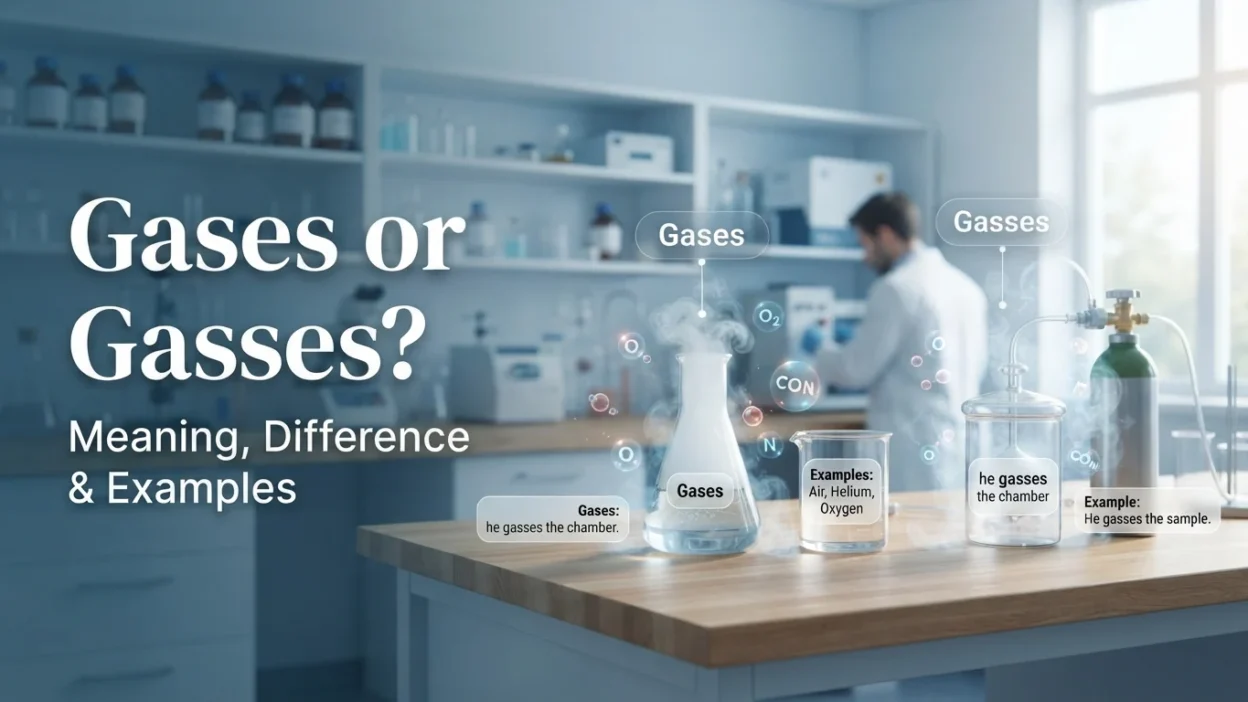
When you want to talk about more than one gas, the correct spelling is usually “gases.” The word “gasses” also exists, but it has a different meaning. This small spelling difference can change the meaning of a sentence, so it is important to understand when each form is appropriate.
Gases is the plural of gas when referring to substances such as oxygen, nitrogen, carbon dioxide, or natural gas. Gasses, on the other hand, is the third-person singular form of the verb “gas” in the sense of attacking, exposing, or filling something with gas. For most writing about chemistry, science, the atmosphere, or physical substances, gases is the word you need.
Quick Answer
“Gases” is the correct plural of “gas” when you mean multiple gas substances. “Gasses” is a verb form meaning someone or something treats, attacks, or fills something with gas. For example, “Oxygen and nitrogen are gases,” but “The machine gasses the material.”
Why Do People Confuse “Gases” and “Gasses”?
The confusion comes from the spelling of the plural form of gas.
Many English nouns simply add -s to form their plurals:
- book → books
- car → cars
- plant → plants
Because gas ends in s, some writers assume its plural should be gasses. However, the standard plural noun is gases, with only one s in the middle.
The spelling gasses is valid, but it normally functions as a verb, not as the ordinary plural noun.
First Word: Gases
Gases is the plural noun form of gas.
A gas is a state of matter that does not have a fixed shape or fixed volume. Examples include oxygen, hydrogen, helium, and carbon dioxide.
Examples of “Gases”
- Several gases are present in Earth’s atmosphere.
- Oxygen and nitrogen are important gases.
- Some gases are invisible.
- Scientists study how different gases behave.
- Greenhouse gases affect Earth’s climate.
In these examples, gases means more than one type or quantity of gas.
Second Word: Gasses
Gasses is generally a verb.
It is the third-person singular present form of gas when “gas” is being used as a verb.
For example:
- The machine gasses the chamber.
- The treatment gasses the material.
- The device gasses the room with a particular substance.
The verb gas can have different meanings depending on context, including filling or treating something with gas.
Therefore, gasses should not normally be used as the plural noun for gas.
Gases vs Gasses: Comparison Table
| Word | Part of Speech | Meaning | Example |
|---|---|---|---|
| Gases | Noun | More than one gas | Different gases are present in the atmosphere. |
| Gasses | Verb | Treats, fills, or exposes something to gas | The machine gasses the chamber. |
The easiest distinction is:
Gases = plural noun
Gasses = verb
When Should You Use “Gases”?
Use gases when you are talking about multiple gases or different types of gas.
Common contexts include:
- Chemistry
- Physics
- Environmental science
- Medicine
- Biology
- Weather
- Industrial processes
- The atmosphere
- Fuel and energy
Examples
Different gases have different properties.
Carbon dioxide and methane are examples of gases.
The atmosphere contains several important gases.
Some gases can be harmful when inhaled.
When Should You Use “Gasses”?
Use gasses when gas is functioning as a verb and the subject is singular in the present tense.
For example:
The equipment gasses the chamber.
Here, “gasses” describes what the equipment does.
You may also encounter this spelling in specialized technical contexts involving the treatment or exposure of something to gas.
10+ Examples of “Gases” and “Gasses”
Examples with “Gases”
- The atmosphere contains several different gases.
- Oxygen and nitrogen are common gases.
- Scientists analyze gases in the laboratory.
- Some gases have strong odors.
- Greenhouse gases are widely studied.
- Certain gases can be dangerous in enclosed spaces.
- The experiment produced several gases.
- Different gases have different boiling points.
- The container prevents the gases from escaping.
- Industrial plants may release gases into the air.
Examples with “Gasses”
- The machine gasses the chamber during the process.
- The equipment gasses the material before testing.
Notice that gases is normally a noun, while gasses describes an action.
Common Mistakes
Mistake 1: Using “gasses” as the plural noun
❌ The atmosphere contains many gasses.
✅ The atmosphere contains many gases.
Mistake 2: Assuming every plural ending in -s needs another “s”
❌ Scientists studied several gasses.
✅ Scientists studied several gases.
Mistake 3: Changing “gases” to “gasses” in scientific writing
If you mean different gas substances, use gases.
❌ Different gasses were identified in the sample.
✅ Different gases were identified in the sample.
Mistake 4: Treating “gasses” as an alternative spelling of “gases”
They are not interchangeable in standard usage. Gases is the normal plural noun, while gasses has a verb use.
Memory Trick
Remember this simple rule:
Gases = many gases
The word gases is the plural noun you will most often need.
Think:
Gas → gases
If you are describing an action performed by something, gasses may be appropriate:
The machine gasses the chamber.
So remember:
Things = gases
Action = gasses
American vs British English
There is no major American-versus-British spelling difference for the ordinary plural noun.
Both American and British English use:
gas → gases
The spelling gasses can appear when gas is being used as a verb, particularly in technical contexts.
Therefore, whether you are writing for an American, British, or international audience, gases is the standard plural noun.
Similar Words
Several related forms can cause confusion:
Gas
Gas is the singular noun.
Oxygen is a gas.
Gases
Gases is the plural noun.
Oxygen and nitrogen are gases.
Gassing
Gassing is the -ing form of the verb gas.
The equipment is gassing the chamber.
Gassed
Gassed is the past-tense or past-participle form of the verb gas.
The material was gassed during the procedure.
These forms have different grammatical functions, so context matters.
Final Verdict: Gases or Gasses?
For the ordinary plural of gas, use gases.
Gases = more than one gas.
Gasses = a verb form of gas, used when describing an action involving gas.
So if you are writing a sentence such as:
“The atmosphere contains several ___.”
The correct answer is:
The atmosphere contains several gases.
For science, chemistry, environmental topics, and everyday references to multiple gas substances, gases is almost certainly the spelling you need.
Frequently Asked Questions
Is “gases” the plural of gas?
Yes. Gases is the standard plural noun of gas.
One gas → several gases
Is “gasses” a correct word?
Yes, but it has a different grammatical use. Gasses is generally a third-person singular present-tense verb form of gas.
Should I write “greenhouse gases” or “greenhouse gasses”?
The standard expression is “greenhouse gases.” Here, gases is the plural noun referring to multiple types of gas.
Why isn’t the plural of gas “gasses”?
English plural formation does not always work by simply adding an extra s based on the final letter of a word. The standard plural of gas is gases.
Is “gases” used in American English?
Yes. Gases is the standard plural form in American English.
Is “gases” used in British English?
Yes. British English also uses gases as the ordinary plural noun of gas.
What is the difference between “gases” and “gasses”?
Gases is a plural noun meaning more than one gas. Gasses is generally a verb meaning that someone or something treats, fills, or exposes something to gas.
Remember This
Gas → gases when you mean more than one gas.
Gasses is generally a verb.
- ✅ Gases = plural noun
- ✅ Gasses = verb
- ❌ Don’t normally use gasses as the plural noun
Conclusion
The correct plural spelling of gas is gases. Use it when talking about multiple gases, such as oxygen, nitrogen, carbon dioxide, or other substances. This is the form you will normally see in scientific, educational, environmental, and everyday writing.
Gasses is also a legitimate English word, but it serves a different grammatical purpose. It is generally a verb form of gas, as in “The machine gasses the chamber.” Keeping this noun-versus-verb distinction in mind makes the choice simple: when you mean multiple gases, write gases.

John Tyler is a dream researcher and content writer at SleepCout, sharing insightful articles about coded dreams, dream meanings, symbolism, sleep psychology, and practical guidance to help readers understand their dreams.