If you have ever seen the words elegy and eulogy, you may have wondered whether they mean the same thing. Both words are associated with death, mourning, and remembering someone, but they are not interchangeable. Understanding the difference can help you choose the right word when speaking or writing about loss.
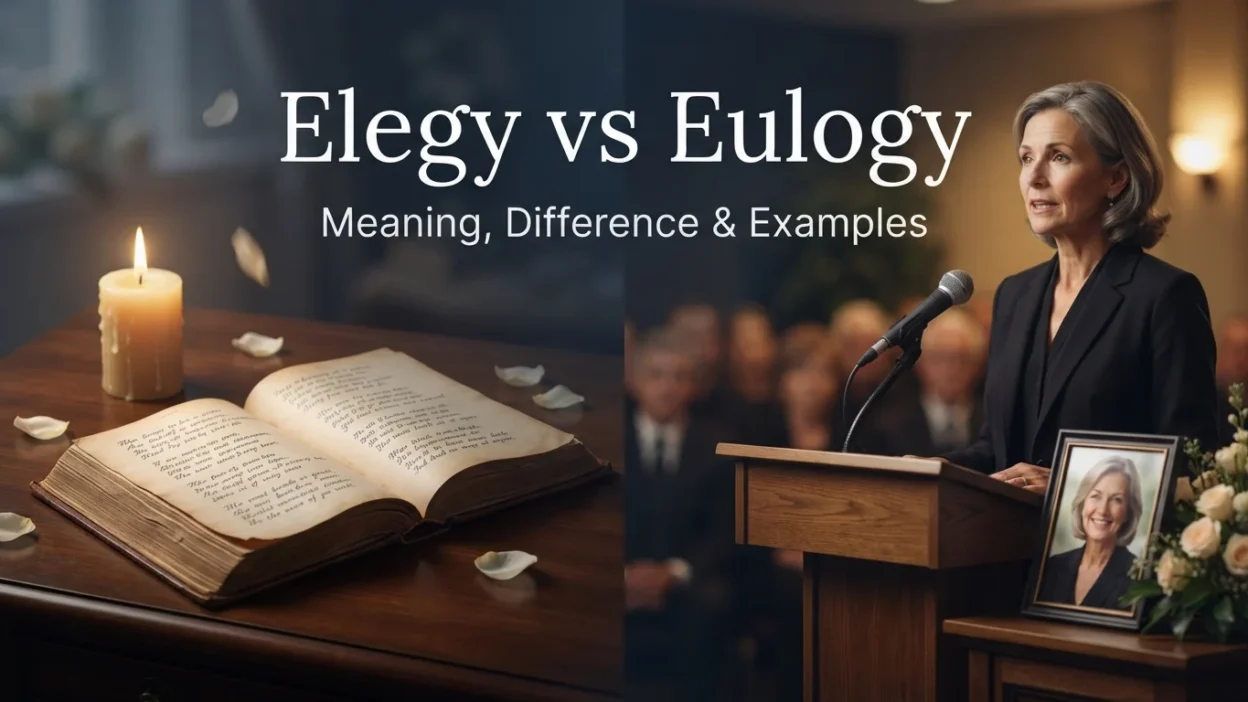
An elegy is a poem, song, or piece of writing that expresses sorrow, especially over someone’s death. A eulogy, on the other hand, is a speech or piece of writing that praises and remembers a person who has died, usually delivered at a funeral or memorial service. While an elegy often focuses on grief and reflection, a eulogy usually focuses on the person’s life, character, achievements, and memories.
Quick Answer: Elegy vs Eulogy
An elegy is a poem or reflective work expressing grief, especially after someone’s death. A eulogy is a speech or written tribute praising and remembering someone who has died. An elegy is often literary or artistic, while a eulogy is commonly delivered at a funeral or memorial service.
Why Do People Confuse Elegy and Eulogy?
People confuse elegy and eulogy because both words are connected with death and remembrance.
They can both express sadness and honor someone who has died. However, their typical forms and purposes are different.
- Elegy → focuses strongly on grief, loss, mourning, and reflection.
- Eulogy → focuses strongly on praise, memories, character, and the life of the deceased.
- Elegy → often appears as a poem, song, or literary work.
- Eulogy → is commonly a speech given at a funeral or memorial.
For example:
She wrote an elegy for her late friend.
His daughter delivered a eulogy at his funeral.
What Does “Elegy” Mean?
An elegy is a poem or other piece of writing or music that expresses sorrow, mourning, or reflection, traditionally especially for someone who has died.
Elegies often explore emotions surrounding loss. They may remember the deceased, reflect on mortality, or express the writer’s personal grief.
Examples of “Elegy”
- The poet wrote an elegy after his brother died.
- The song became an elegy for the victims of the disaster.
- Her poem is a moving elegy for her grandmother.
- The book contains an elegy for a disappearing way of life.
Importantly, elegy is not limited to a funeral speech. It is often a literary or artistic form.
What Does “Eulogy” Mean?
A eulogy is a speech or written tribute that praises and remembers a person who has died.
A eulogy is commonly delivered by a family member, friend, colleague, religious leader, or another person close to the deceased during a funeral or memorial service.
A eulogy may include:
- Personal memories
- Stories about the deceased
- Their accomplishments
- Their personality and character
- Their relationships
- Expressions of love and respect
- Words of comfort for others
Examples of “Eulogy”
- Sarah gave a eulogy at her father’s funeral.
- His brother delivered a heartfelt eulogy.
- The eulogy described her kindness and generosity.
- He spent the evening preparing a eulogy for his grandfather.
Elegy vs Eulogy: Comparison Table
| Feature | Elegy | Eulogy |
|---|---|---|
| Basic meaning | Expression of grief or mourning | Speech or tribute praising someone who died |
| Common form | Poem, song, or literary work | Speech or written tribute |
| Main focus | Grief, loss, reflection | Praise, memories, life, character |
| Usually connected with death? | Yes, traditionally | Yes |
| Usually delivered at a funeral? | Not necessarily | Often |
| Can be artistic? | Yes | Sometimes, but usually ceremonial |
| Example | A poem mourning a friend | A speech at a friend’s funeral |
When Should You Use “Elegy” or “Eulogy”?
Use elegy when you are talking about a work that expresses mourning, grief, or reflection.
The poet wrote an elegy for his childhood friend.
Use eulogy when you mean a speech or tribute honoring someone who has died.
Maria gave a eulogy at her mother’s funeral.
A Simple Rule
Think:
Elegy = grief expressed in a literary or artistic work.
Eulogy = praise expressed in a funeral or memorial tribute.
The distinction is not absolute in every context. A eulogy can contain grief, and an elegy can praise or remember the deceased. The words differ mainly in their usual form and emphasis.
Elegy vs Eulogy: 10+ Examples
- The poet wrote an elegy after the death of his friend.
- Her son delivered a moving eulogy at the funeral.
- The poem is an elegy for those who lost their lives.
- The family asked James to give the eulogy.
- The musician composed an elegy for his late teacher.
- Her eulogy included several funny stories about her mother.
- The book contains an elegy for a vanished culture.
- He prepared a short eulogy for the memorial service.
- The poet’s elegy expresses deep sadness and loss.
- The eulogy praised the man’s generosity and courage.
- The composer created an elegy in memory of his friend.
- Her brother gave the final eulogy before the burial.
Common Mistakes
Mistake 1: Calling every funeral speech an “elegy”
A funeral speech is generally called a eulogy, not an elegy.
Usually correct:
She delivered a eulogy at the funeral.
Mistake 2: Assuming an elegy must be a speech
An elegy can be a poem, song, or other artistic or literary expression of mourning.
He wrote an elegy for his father.
Mistake 3: Thinking the words are interchangeable
Although both concern loss and remembrance, they emphasize different things.
Elegy → mourning and reflection.
Eulogy → praise and tribute.
Mistake 4: Thinking a eulogy contains no sadness
A eulogy can be deeply emotional and can include grief. Its defining purpose is to honor and remember the deceased.
What Is an Easy Memory Trick for Elegy vs Eulogy?
Try this:
Eulogy = “You are praising.”
Both eulogy and praise relate to honoring someone’s good qualities.
For elegy, think:
Elegy = emotional expression of loss.
So remember:
Elegy → grief
Eulogy → praise
This simple distinction can help you choose the correct word quickly.
American vs British English
There is no major difference between American and British English in the basic meanings of elegy and eulogy.
Both varieties use:
- elegy for a work expressing mourning or grief
- eulogy for a speech or tribute honoring someone who has died
The words are understood in essentially the same way in both forms of English.
What Words Are Similar to Elegy and Eulogy?
Several words are related to these terms, but they are not exact synonyms.
Words Related to “Elegy”
- Lament
- Dirge
- Mourning
- Requiem
- Tribute
- Poem of mourning
- Memorial
A lament is an expression of grief or sorrow.
A dirge is a mournful song or piece of music, especially one associated with a funeral.
A requiem can refer to a Mass or musical composition associated with the dead and remembrance.
Words Related to “Eulogy”
- Tribute
- Commendation
- Praise
- Memorial speech
- Funeral speech
- Homage
A tribute is broader than a eulogy. It can honor a living or deceased person, organization, place, or achievement.
Final Verdict: Elegy vs Eulogy
The key difference is purpose and form.
An elegy is generally a poem, song, or literary expression of grief and mourning. A eulogy is generally a speech or written tribute that honors and praises someone who has died.
If you are talking about a poem written to express sorrow over someone’s death, elegy is usually the appropriate word.
If you are talking about a speech given at someone’s funeral or memorial service, eulogy is usually the appropriate word.
Frequently Asked Questions
Is an elegy the same as a eulogy?
No. An elegy is generally a literary or artistic expression of grief or mourning, while a eulogy is a speech or tribute honoring someone who has died.
Is a eulogy always given at a funeral?
No. A eulogy is commonly delivered at a funeral, but it can also be given at a memorial service or another ceremony honoring someone who has died.
Can a eulogy be written instead of spoken?
Yes. A eulogy can be prepared as a written tribute even when it is not formally delivered as a speech.
Can an elegy be about someone who is still alive?
Traditionally, an elegy is associated with death and mourning. However, the word can sometimes be used more broadly for a work expressing deep sadness about loss, decline, or something that has disappeared.
Is a funeral poem an elegy?
It can be. If the poem expresses mourning or grief, especially over someone’s death, it may be described as an elegy.
What is the difference between an elegy and a lament?
A lament is an expression of grief or sorrow, while an elegy is traditionally a poem or other work expressing mourning. Their meanings overlap, but they are not identical.
What is the easiest way to remember elegy and eulogy?
Remember elegy = grief and eulogy = praise. An elegy usually expresses mourning, while a eulogy usually honors and praises a deceased person.
Remember This
Elegy = a work expressing grief or mourning.
Eulogy = a speech or tribute honoring someone who has died.
Elegy → loss and reflection.
Eulogy → praise and remembrance.
Conclusion
Although elegy and eulogy are closely related words, they are not the same. An elegy is usually a poem, song, or literary work that expresses grief, mourning, or reflection. A eulogy is usually a speech or tribute that honors a deceased person by remembering their life, character, relationships, and achievements.
When choosing between them, focus on the purpose. If the emphasis is on expressing sorrow and reflecting on loss, elegy is likely the right word. If the emphasis is on praising and remembering someone who has died, especially during a funeral or memorial service, eulogy is the more appropriate term.

Charles Kyle is a passionate writer and dream researcher at SleepCout, dedicated to exploring coded dreams, lucid dreaming, dream symbolism, and sleep science. He creates engaging, well-researched content that helps readers understand their dreams and discover the fascinating connection between technology, imagination, and the sleeping mind.