
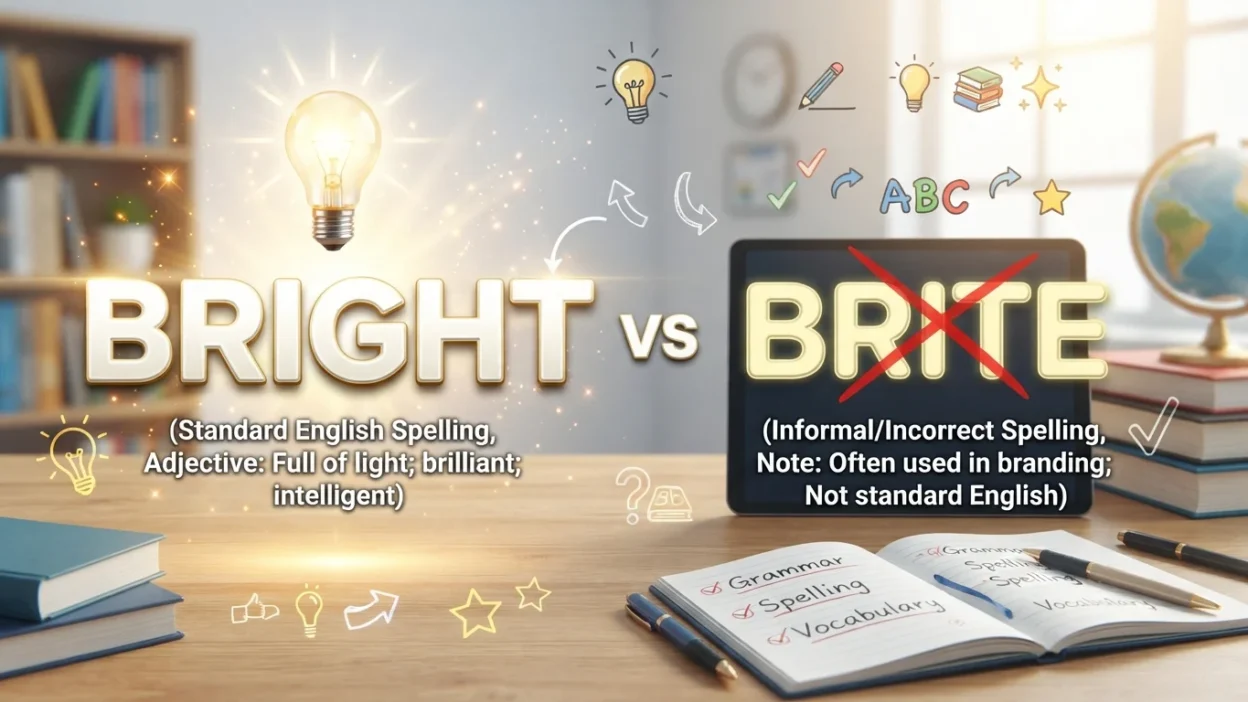
If you are confused about brite vs bright, you are not alone. These two words look and sound very similar, but they do not have the same standard usage. Bright is the correct and widely accepted English spelling when you mean full of light, intelligent, vivid, cheerful, or promising. Brite is generally a nonstandard or stylized spelling and is often found in brand names, product names, usernames, or informal writing.
Understanding the difference is useful because spelling matters in school, professional writing, emails, essays, and everyday communication. While brite may appear in advertisements or names, you should normally choose bright when writing standard English. In this guide, we will explain the meanings, differences, examples, common mistakes, and situations where each form may appear.
Quick Answer: Brite vs Bright
Bright is the standard English spelling. It can describe something full of light, colorful, intelligent, cheerful, or likely to succeed. Brite is usually a stylized or nonstandard spelling used in names, brands, and informal contexts. For normal English writing, use bright.
Why Do People Confuse Brite and Bright?
The confusion mainly comes from pronunciation.
Brite and bright are normally pronounced the same way: /braɪt/. They also look almost identical, except that bright contains the letter gh.
Because English has many words with unusual spellings, learners may wonder whether brite is simply another accepted spelling of bright.
In standard modern English, however, bright is the normal spelling.
You may still encounter brite in special contexts, especially in company names, product names, advertising, or deliberately shortened spellings.
What Does “Bright” Mean?
Bright is a common English adjective with several meanings.
It can describe something that produces or reflects a lot of light.
- The room was bright in the morning.
- She wore a bright yellow dress.
- The bright sunlight made me close my eyes.
It can also describe someone who is intelligent or quick to learn.
- Maria is a bright student.
- He is a very bright young man.
Bright can also describe a positive future or a hopeful situation.
- She has a bright future ahead of her.
- The company has a bright outlook.
Other meanings include cheerful, vivid, shiny, and intense.
Common Meanings of Bright
Bright can mean:
- Full of light
- Shining
- Vivid in color
- Intelligent
- Cheerful
- Hopeful
- Promising
What Does “Brite” Mean?
Brite is not normally the standard spelling of the adjective bright in ordinary English writing.
Instead, brite is commonly seen as a stylized spelling. Businesses and product creators may use it because it looks shorter, distinctive, or suitable for a brand name.
For example, you might encounter a business, product, website, or trademark containing Brite.
The important point is that seeing Brite in a brand name does not mean you should replace bright with brite in normal English sentences.
For example:
- Correct standard English: The room is bright.
- Usually incorrect in standard English: The room is brite.
If Brite is part of an official name, however, keep the spelling exactly as the organization or product uses it.
Brite vs Bright: Comparison Table
| Feature | Bright | Brite |
|---|---|---|
| Standard English spelling | Yes | Generally no |
| Common adjective | Yes | No, not normally |
| Means full of light | Yes | Not in standard usage |
| Means intelligent | Yes | No |
| Used for vivid colors | Yes | No |
| Used in ordinary writing | Yes | Generally avoid |
| Used in brand names | Sometimes | Commonly possible |
| Used in stylized names | Sometimes | Often |
| Pronunciation | Usually /braɪt/ | Usually /braɪt/ |
| Best choice for school/work writing | Bright | Avoid unless it is a proper name |
When Should You Use “Bright”?
Use bright whenever you are writing standard English and need the adjective with its usual meanings.
1. To Describe Light
Use bright for something that gives off or reflects a lot of light.
The stars were bright tonight.
2. To Describe Colors
Use bright for strong, vivid colors.
She bought a bright red bag.
3. To Describe Intelligence
Use bright when saying someone is intelligent or quick to understand things.
He is a bright student.
4. To Describe a Positive Future
Use bright when talking about a promising future.
The young athlete has a bright future.
5. To Describe a Cheerful Person
Bright can also describe someone who seems cheerful or lively.
Her bright personality made everyone feel welcome.
When Should You Use “Brite”?
Use Brite mainly when it is part of an established name, brand, product, title, or other intentionally stylized spelling.
For example, if a company officially spells its name Brite, changing it to Bright would make the name inaccurate.
In ordinary sentences, though, use bright.
Compare:
- The room is bright. ✓
- The room is brite. ✗
- Brite is the official name of the product. ✓
The third example is acceptable because Brite is being used as a specific name.
Brite vs Bright: 10+ Examples
Here are practical examples that show the difference.
- The sun is very bright today.
- She chose a bright blue shirt.
- He is a bright student.
- We walked into a bright room.
- The child has a bright smile.
- They believe she has a bright future.
- The stars looked bright against the dark sky.
- I need a bright light to read this book.
- His idea was bright and practical.
- The flowers have bright colors.
- The morning was sunny and bright.
- The official product name contains the word Brite.
Notice that the ordinary adjective is spelled bright, while Brite can be correct when it is intentionally used as a name.
Common Mistakes With Brite and Bright
Mistake 1: Using “Brite” in Formal Writing
Some writers use brite because it sounds the same as bright.
Incorrect:
The classroom is very brite.
Correct:
The classroom is very bright.
Mistake 2: Assuming Brite Is an Alternative Standard Spelling
Although you may see Brite online, this does not make it a standard replacement for bright.
Branding and standard spelling follow different rules.
Mistake 3: Changing a Brand Name
The opposite mistake can also happen.
If an official company or product is named Brite, changing it to Bright can make the name incorrect.
Always preserve an official name’s spelling.
Mistake 4: Thinking Pronunciation Determines Spelling
English contains many words that sound alike but have different spellings and meanings.
The fact that brite and bright can sound alike does not mean they are interchangeable in standard writing.
Memory Trick: How to Remember Bright
A simple trick is:
Bright has “right” inside it.
b + right = bright
Think:
BRIGHT = B + RIGHT
This can help you remember the standard spelling when you are writing quickly.
Another useful reminder is:
Light is bright.
If you mean something full of light, vivid, intelligent, cheerful, or promising, bright is usually the word you want.
Brite vs Bright in American and British English
There is no major American-versus-British spelling difference that makes brite the normal standard spelling of bright.
Both American English and British English use bright for the ordinary adjective.
For example:
- American English: The room is bright.
- British English: The room is bright.
Brite may appear in names, commercial branding, or other specialized contexts, but it should not generally be treated as the standard American or British spelling of bright.
Similar Words to Bright
Depending on the meaning, several words can be related to bright.
When Bright Means Full of Light
- Shining
- Radiant
- Luminous
- Brilliant
- Glowing
- Illuminated
Example:
The room was bright.
Similar:
The room was well-lit.
When Bright Means Intelligent
- Smart
- Clever
- Intelligent
- Sharp
- Quick-witted
- Brilliant
Example:
She is a bright student.
Similar:
She is a smart student.
When Bright Means Cheerful
- Cheerful
- Happy
- Joyful
- Lively
- Positive
Example:
He has a bright personality.
When Bright Means Promising
- Hopeful
- Promising
- Encouraging
- Favorable
Example:
She has a bright future.
Final Verdict: Brite or Bright?
For standard English writing, bright is the correct choice.
Use bright when you mean something full of light, vivid in color, intelligent, cheerful, or promising.
Use Brite only when it is intentionally part of a proper name, brand, product, title, or other specialized spelling.
So, if you are writing an essay, school assignment, email, article, or professional document, remember:
Choose “bright,” not “brite.”
Frequently Asked Questions
Is “brite” a correct spelling of “bright”?
Brite is generally not the standard spelling of bright in ordinary English. It can appear as a stylized spelling, especially in brand or product names.
Is bright or brite correct?
Bright is the standard English spelling. Use brite only when reproducing an official name or intentionally stylized spelling.
Do bright and brite sound the same?
Yes, they can be pronounced the same, which is one reason they are easy to confuse.
Can I use “brite” in a sentence?
You can use Brite when it is part of a specific name or brand. In normal English sentences, use bright.
Is “brite” British English?
No. Brite is not the standard British English spelling of bright. British English normally uses bright.
Is “brite” American English?
No. American English also uses bright as the standard spelling. Brite may appear in stylized commercial names.
What does bright mean?
Bright can mean full of light, vivid in color, intelligent, cheerful, or promising, depending on the context.
Why do people spell bright as brite?
The spelling brite may be used because it is shorter or visually distinctive, particularly in branding, advertising, names, and informal contexts.
Remember This
- Bright = standard English spelling.
- Brite = usually a stylized or nonstandard spelling.
- Bright can mean full of light.
- Bright can describe vivid colors.
- Bright can mean intelligent.
- Bright can describe a hopeful future.
- Use Brite when it is an official name or intentionally stylized term.
Conclusion
The difference between brite vs bright is mainly a matter of standard spelling and context. Bright is the normal English word and can describe light, colors, intelligence, cheerfulness, or a promising future. Although brite may look familiar because it appears in some names and brands, it should not normally replace bright in everyday or formal English.
When writing a sentence, essay, email, or professional document, the safest choice is simple: use bright. If you see Brite in a company, product, or other official name, keep that spelling because proper names can intentionally use nonstandard forms.

John Tyler is a dream researcher and content writer at SleepCout, sharing insightful articles about coded dreams, dream meanings, symbolism, sleep psychology, and practical guidance to help readers understand their dreams.