
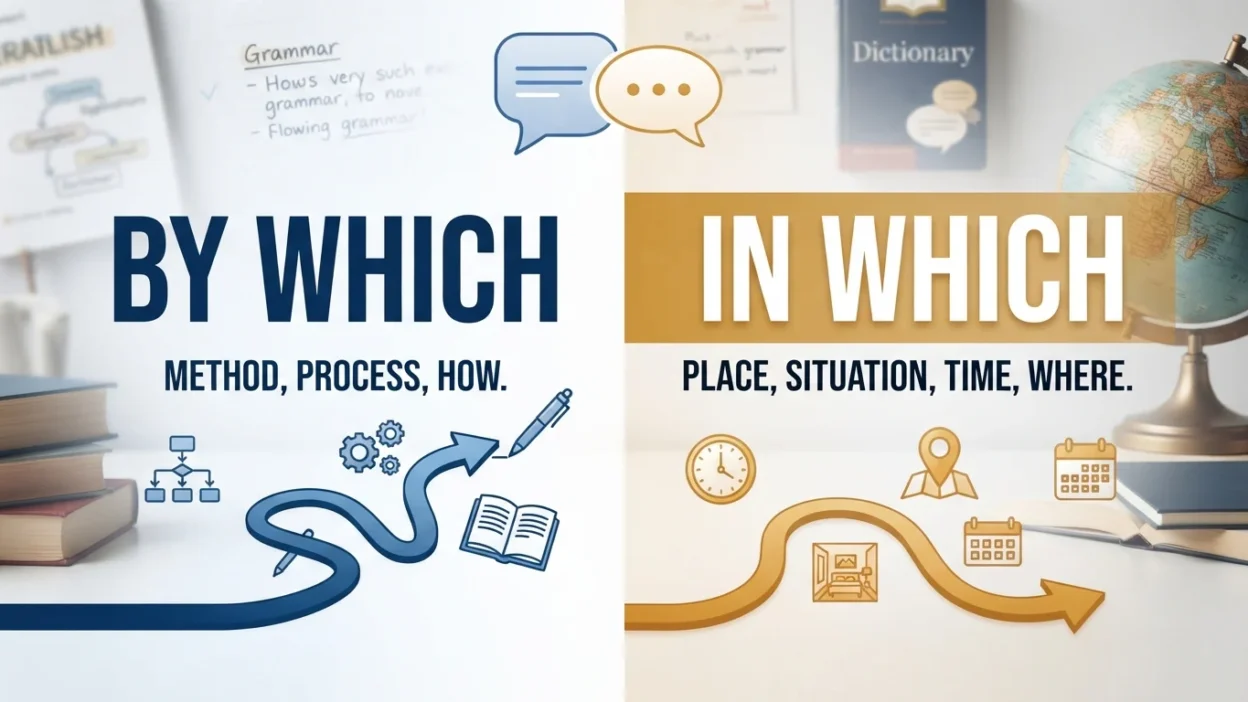
When learning English, small words can create surprisingly big problems. “By which” and “in which” are both grammatically correct, but they are used in different situations. Choosing the right phrase depends on the relationship you want to express between two parts of a sentence.
The main difference is simple: “by which” usually refers to a method, means, process, or agent, while “in which” usually refers to something happening inside a place, situation, condition, period, or context. For example, “The method by which we solved the problem” focuses on the method, while “The situation in which we found ourselves” focuses on the situation.
Quick Answer
“By which” is used to describe the method, means, process, or agent used to do something. “In which” is used when something happens within a place, situation, condition, period, or context. The correct choice depends on the meaning of the sentence, not simply on grammar.
Why Do People Confuse “By Which” and “In Which”?
People often confuse these expressions because both contain the relative pronoun “which.” They can also appear in formal sentences and are frequently followed by abstract nouns.
Compare:
- The process by which the machine works.
- The environment in which the machine operates.
Both sentences are grammatical, but by and in communicate different relationships.
A useful way to understand them is to ask:
What relationship am I describing?
If you mean how something happens or is done, use by which.
If you mean where, when, or under what circumstances something happens, use in which.
What Does “By Which” Mean?
“By which” generally means “through which,” “by the method that,” “by means of which,” or sometimes “by whom,” depending on context.
It focuses on the means, method, process, or mechanism used to achieve an action or result.
Examples
- This is the method by which we calculate the answer.
- She explained the process by which the product is made.
- The system by which payments are processed is secure.
- That is the standard by which performance is measured.
In each example, by which introduces the way something is accomplished.
“By Which” as “By Means of Which”
In formal writing, by which can often be understood as “by means of which.”
For example:
The tool by which the measurement was taken was highly accurate.
This means:
The tool by means of which the measurement was taken was highly accurate.
What Does “In Which” Mean?
“In which” generally means “inside which,” “within which,” “during which,” or “under which,” depending on the context.
It describes the place, situation, condition, environment, or period where something happens.
Examples
- This is the room in which we met.
- I remember the year in which they moved.
- She described the situation in which she found herself.
- We need an environment in which children can learn.
Here, in which identifies the setting or circumstances surrounding an action or event.
By Which vs In Which: Comparison Table
| Phrase | Main Meaning | Usually Refers To | Example |
|---|---|---|---|
| By which | By means of / through which | Method, process, mechanism | The method by which we solved it |
| In which | Within / during / under which | Place, situation, condition, time | The situation in which we met |
| By which | How something is accomplished | Means or procedure | The system by which payments are made |
| In which | Where or under what circumstances | Context or setting | The environment in which students study |
When Should You Use “By Which”?
Use by which when the noun before which represents a method, process, system, mechanism, or means.
1. To Describe a Method
- The method by which the data was collected was reliable.
- We discussed the technique by which the problem could be solved.
2. To Describe a Process
- The process by which plants absorb water is fascinating.
- Scientists studied the process by which the disease spreads.
3. To Describe a System
- The system by which employees are evaluated has changed.
- This is the system by which applications are approved.
4. To Explain How Something Happens
- Nobody understood the mechanism by which the device operated.
- Researchers discovered the way by which the cells communicate.
When Should You Use “In Which”?
Use in which when you are referring to a place, situation, condition, environment, or period.
1. For a Physical Place
- This is the house in which I grew up.
- The building in which they work is very old.
2. For a Situation
- It was a difficult situation in which nobody knew what to do.
- She described the circumstances in which the accident occurred.
3. For a Period of Time
- 2020 was the year in which many businesses changed.
- That was the period in which he learned the most.
4. For a Condition or Environment
- We need conditions in which plants can grow.
- Children learn best in an environment in which they feel comfortable.
10+ Examples of “By Which” and “In Which”
- The method by which the answer was obtained was simple.
- The process by which paper is recycled can be complex.
- This is the system by which the company operates.
- Scientists studied the mechanism by which the virus spreads.
- The technique by which the artist created the effect was unusual.
- This is the room in which the meeting took place.
- I remember the house in which we lived.
- That was the year in which I graduated.
- She explained the circumstances in which the decision was made.
- We need an environment in which everyone feels safe.
- The standard by which success is measured varies.
- The situation in which they found themselves was unexpected.
Notice that the first group focuses on methods, systems, processes, or standards, while the second group focuses on places, situations, time, and environments.
Common Mistakes
Mistake 1: Using “In Which” for a Method
Incorrect:
The method in which we solved the problem was effective.
Better:
The method by which we solved the problem was effective.
The sentence is about how the problem was solved, so by which is appropriate.
Mistake 2: Using “By Which” for a Place
Incorrect:
This is the room by which we had the meeting.
Better:
This is the room in which we had the meeting.
The meeting happened inside the room, so in which is appropriate.
Mistake 3: Choosing Based Only on the Noun
The noun itself does not always determine the preposition.
For example:
The situation in which she found herself was difficult.
But:
The method by which she solved the problem was clever.
Think about the relationship between the noun and the action, rather than memorizing isolated combinations.
What Is an Easy Memory Trick?
Use this simple rule:
BY = HOW
IN = WHERE / WHEN / UNDER WHAT CONDITIONS
For example:
- By which → How was it done?
- In which → Where did it happen?
- In which → When did it happen?
- In which → Under what circumstances did it happen?
Remember
By which = method or means
In which = place, time, situation, or condition
This trick works for many common sentences.
American vs British English
There is no major American-versus-British difference in the basic meanings of “by which” and “in which.” Both forms are standard in American and British English.
However, everyday speech in both varieties often uses simpler structures.
For example:
The house in which I live…
can commonly become:
The house that I live in…
Similarly:
The method by which they solved the problem…
might be expressed more naturally in conversation as:
The method they used to solve the problem…
By which and in which are especially common in formal, academic, professional, and carefully written English.
Similar Words and Expressions
Depending on the sentence, several alternatives can express similar ideas.
Alternatives to “By Which”
- by means of which
- through which
- using which
- with which
- the method that
- the way that
Example:
The process by which the machine works…
can sometimes be rewritten as:
The process through which the machine works…
Alternatives to “In Which”
- where
- within which
- during which
- under which
- in the situation that
- in the environment where
For example:
The city in which she lives…
can often become:
The city where she lives…
Final Verdict: By Which or In Which?
“By which” and “in which” are both correct, but they are not interchangeable.
Use by which when you are talking about the method, means, process, mechanism, or standard used to accomplish something.
Use in which when you are talking about a place, situation, environment, condition, or period of time in which something happens.
The fastest way to choose is to ask:
Does the sentence explain HOW something happens? → “By which.”
Does it explain WHERE, WHEN, or UNDER WHAT CONDITIONS something happens? → “In which.”
FAQs
Is “by which” grammatically correct?
Yes. “By which” is grammatically correct and commonly used in formal English to describe a method, means, process, or mechanism.
Is “in which” grammatically correct?
Yes. “In which” is grammatically correct and is used to refer to a place, situation, condition, environment, or period.
What is the main difference between “by which” and “in which”?
“By which” generally describes how something is done, while “in which” generally describes where, when, or under what circumstances something happens.
Can “by which” and “in which” be used interchangeably?
Usually, no. Changing the preposition can change the meaning or make the sentence unnatural. Choose the phrase based on the relationship you want to express.
Is “by which” formal English?
Yes. “By which” is particularly common in formal and academic writing. In casual conversation, speakers often use simpler expressions such as “the way,” “how,” or “that.”
Can I use “where” instead of “in which”?
Often, yes, especially when in which refers to a physical or figurative place.
For example:
The house in which I live.
can become:
The house where I live.
Is “in which” better than “where”?
Neither is automatically better. “In which” can sound more formal, while “where” is often more natural in everyday English. The best choice depends on the sentence and writing style.
Remember This
BY WHICH = HOW
IN WHICH = WHERE, WHEN, or UNDER WHAT CONDITIONS
- The method by which it works.
- The room in which it happens.
- The year in which it happened.
- The process by which it was created.
- The situation in which they found themselves.
Once you identify whether you are describing a method or a setting/context, choosing the correct phrase becomes much easier.
Conclusion
The difference between “by which” and “in which” is mainly about the relationship expressed by the preposition. By which connects an action with the method, means, process, or mechanism used to perform it. In which connects an action or event with the place, situation, time, environment, or condition in which it occurs.
When you are unsure, do not simply memorize the phrase that sounds right. Ask yourself whether the sentence answers “How?” or “Where, when, or under what circumstances?” If it answers how, by which is usually the right choice. If it identifies a setting or context, in which is generally appropriate.

John Tyler is a dream researcher and content writer at SleepCout, sharing insightful articles about coded dreams, dream meanings, symbolism, sleep psychology, and practical guidance to help readers understand their dreams.