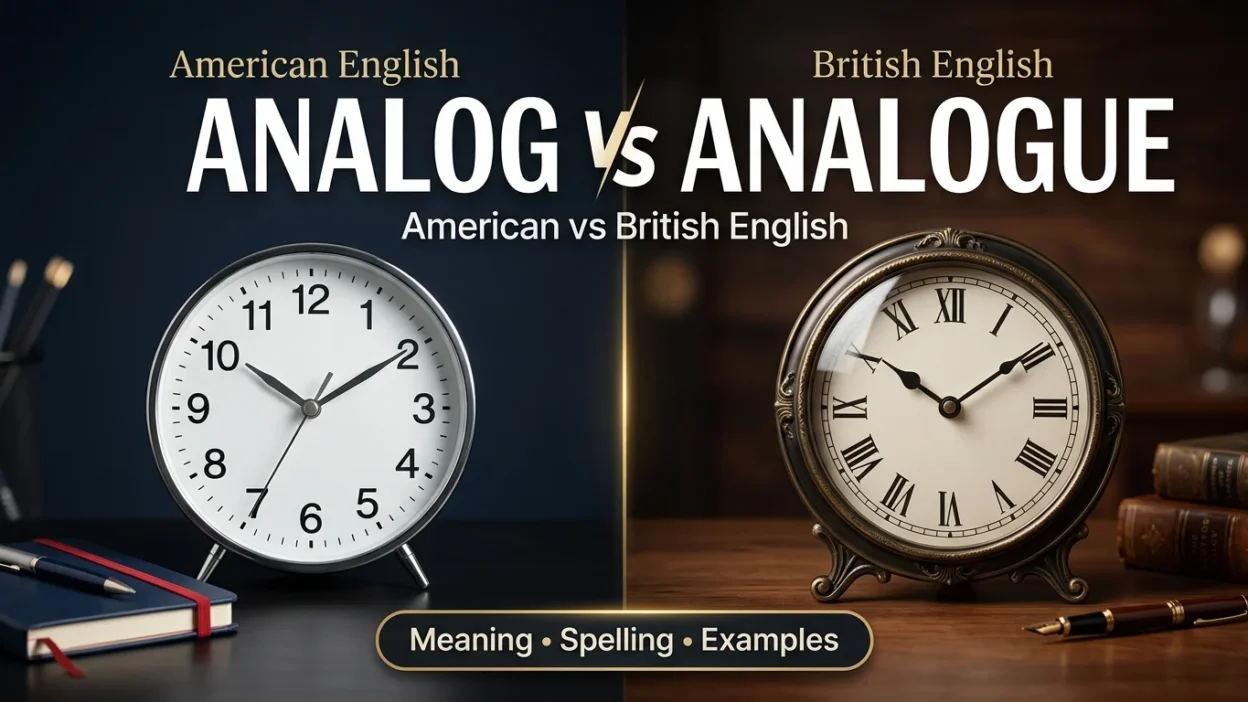
The words analog and analogue have the same meaning, but their spelling depends on the variety of English and the context in which they are used. Both describe something that represents information through continuously changing physical quantities or something that is comparable to another thing. However, analog is more common in American English, while analogue is traditionally preferred in British English, especially in general writing.
Choosing between analog and analogue can be confusing because both spellings are correct, and you may encounter them in technology, science, education, and everyday communication. For example, you might see an analog clock in an American textbook and an analogue clock in a British one. The difference is usually spelling, not meaning. Understanding regional preferences and common expressions will help you choose the right form for your audience.
Quick Answer: Analog vs Analogue
Analog and analogue mean the same thing. Analog is the preferred spelling in American English, particularly in technical writing. Analogue is traditionally preferred in British English and is also used in other varieties of English. Both refer to something continuous or something that corresponds to another thing. Choose the spelling that matches your audience and remain consistent throughout your writing.
Why Do People Confuse Analog and Analogue?
People confuse these words because they have the same pronunciation and meaning in most contexts. The only noticeable difference is the final spelling: analog ends in -g, while analogue ends in -gue.
Several factors contribute to this confusion:
- Regional spelling differences: American English generally favors analog, while British English traditionally favors analogue.
- Technology and science: Technical terms such as analog signal and analogue signal appear in different publications.
- Similar pronunciation: Both words are generally pronounced the same way.
- Different writing styles: A company, university, or technical publication may follow a specific spelling convention.
The key point is that neither spelling is inherently wrong. The appropriate choice depends on your regional variety of English, your subject, and the style guide you follow.
What Does Analog Mean?
Analog is an adjective or noun that describes something based on continuous variation or something that corresponds to another thing.
In American English, analog is the standard spelling in most contexts.
Examples of Analog
- Analog clock: A clock that displays time using hands moving around a dial.
- Analog signal: A signal that varies continuously to represent information.
- Analog technology: Technology that represents information through continuously varying physical quantities.
- Analog comparison: A comparison between two things that share similar features.
Example Sentences
- My grandfather still uses an analog clock.
- The engineer tested the analog signal.
- Analog photography uses film to capture images.
- The teacher explained the concept using an analog example.
- This device converts digital information into an analog signal.
In these sentences, analog describes a type of clock, signal, technology, or comparison.
What Does Analogue Mean?
Analogue has the same basic meaning as analog. It is the traditional British English spelling and is common in British-oriented publications and other varieties of English.
It can describe something that works through continuous variation or something that serves as a counterpart to another thing.
Examples of Analogue
- Analogue clock: A clock with hands that indicate the time.
- Analogue signal: A continuously varying signal that carries information.
- Analogue photography: Photography using film rather than digital image capture.
- Analogue of a substance: Something that is similar to another substance in structure or function.
Example Sentences
- She bought an analogue clock for her bedroom.
- The technician measured the analogue signal.
- Some photographers prefer analogue photography.
- The researcher identified an analogue of the original compound.
- This model provides an analogue of the real-world process.
In British English, analogue is a natural choice for general and technical writing, although particular organizations and technical standards may use analog.
Analog vs Analogue: Comparison Table
| Feature | Analog | Analogue |
|---|---|---|
| Meaning | Continuous or corresponding to something else | Continuous or corresponding to something else |
| American English | Preferred spelling | Less common |
| British English | Used, especially in technical contexts | Traditional preferred spelling |
| Pronunciation | Usually /ˈænəlɔːɡ/ | Usually /ˈænəlɔːɡ/ |
| Part of speech | Noun or adjective | Noun or adjective |
| Example | Analog clock | Analogue clock |
| Correctness | Correct | Correct |
The main difference is spelling, not meaning. Neither word is universally more correct than the other.
When Should You Use Analog or Analogue?
Choose the spelling according to your audience and the conventions of your writing.
Use Analog in American English
Choose analog when writing primarily for an American audience.
Examples:
- The analog clock stopped working.
- The technician repaired an analog audio system.
- The sensor produces an analog output.
- The device converts digital data into an analog signal.
This spelling is especially common in American technical and scientific writing.
Use Analogue in British English
Choose analogue when following traditional British English spelling conventions.
Examples:
- The analogue clock hangs above the fireplace.
- The engineer studied analogue electronics.
- The radio receives an analogue signal.
- The book offers an analogue of modern society.
The same principle often applies to related forms, such as analogue-to-digital converter, although established technical terminology and standards may specify a particular spelling.
Follow Your Style Guide
If you are writing for a school, university, company, or scientific journal, check its preferred spelling. Technical publications sometimes follow international standards or established terminology rather than general regional preferences.
Consistency matters more than switching between the two forms.
12 Examples of Analog vs Analogue in Sentences
These examples show how both spellings work in practical contexts.
- Analog: I prefer an analog clock because it is easy to read.
- Analogue: I prefer an analogue clock because it is easy to read.
- Analog: The engineer examined the analog signal.
- Analogue: The engineer examined the analogue signal.
- Analog: My father enjoys listening to music on analog equipment.
- Analogue: My father enjoys listening to music on analogue equipment.
- Analog: The camera uses an analog recording process.
- Analogue: The camera uses an analogue recording process.
- Analog: The scientist compared the substance with a chemical analog.
- Analogue: The scientist compared the substance with a chemical analogue.
- Analog: The textbook explains analog electronics.
- Analogue: The textbook explains analogue electronics.
The paired sentences demonstrate that the meaning generally stays the same when you change the spelling. The most suitable version depends on regional usage and the terminology of your field.
Common Mistakes to Avoid
Although both spellings are correct, writers can make several mistakes when choosing between them.
1. Thinking One Spelling Is Always Wrong
A common misconception is that analog is incorrect because analogue appears in British dictionaries, or that analogue is incorrect because American publications use analog.
Both are standard forms.
2. Mixing Spellings in the Same Document
Using analog clock in one paragraph and analogue signal in another may look inconsistent if the document follows a single regional spelling convention.
Better approach: Choose a spelling convention and apply it consistently, unless you are reproducing an official name or quotation.
3. Confusing Analog with Digital
Analog and digital often describe different ways of representing information.
An analog signal varies continuously, whereas a digital signal represents information using discrete values. The exact behavior of a digital system can be more complex, but this distinction is useful for beginners.
4. Assuming Analog Only Refers to Technology
The word can also refer to a counterpart or something comparable to another thing.
For example:
- The scientist found an analogue of the natural compound.
- The story provides an analog for a real-life problem.
5. Ignoring Technical Conventions
Some industries, standards, or product names may use one spelling regardless of the surrounding variety of English. Follow the terminology used by the relevant authority when precision matters.
Memory Trick: How to Remember Analog vs Analogue
Use this simple trick:
- Analog = American: Both are shorter and end in a simple g.
- Analogue = British tradition: Remember the extra -ue as a familiar feature of traditional British spelling.
Another helpful reminder is to associate the spelling with your audience:
- Writing for the United States? Usually choose analog.
- Writing for the United Kingdom? Usually choose analogue.
These are useful general guidelines, not absolute rules for every technical publication.
Analog vs Analogue in American and British English
The spelling difference follows a familiar pattern in English: American English often favors shorter forms, while traditional British English retains certain endings.
| Context | American English | Traditional British English |
|---|---|---|
| Clock | Analog clock | Analogue clock |
| Signal | Analog signal | Analogue signal |
| Electronics | Analog electronics | Analogue electronics |
| Photography | Analog photography | Analogue photography |
| General comparison | An analog of the original | An analogue of the original |
American English typically uses analog in general and technical contexts. British English traditionally uses analogue, although analog is also found in British technical writing.
Other English-speaking regions may use either spelling depending on local conventions, institutional preferences, and technical terminology.
Similar Words Related to Analog and Analogue
Understanding related terms can help you use these words more accurately.
1. Digital
Digital describes information represented using discrete values, commonly binary digits in computing.
Example: My phone stores photographs as digital files.
2. Equivalent
Equivalent describes something equal or corresponding in value, function, or meaning.
Example: This replacement part is equivalent to the original.
3. Corresponding
Corresponding means matching or relating to something else.
Example: Each diagram has a corresponding explanation.
4. Comparable
Comparable describes things that can reasonably be compared because they share relevant qualities.
Example: The two devices offer comparable performance.
5. Analogous
Analogous means similar in certain ways, especially in function, relationship, or structure.
Example: The human brain is sometimes compared to a computer because certain functions are analogous.
6. Counterpart
A counterpart is a person or thing that has a corresponding role or function.
Example: The British model has an American counterpart.
7. Analogy
An analogy is a comparison used to explain an idea by showing similarities between two things.
Example: The teacher used an analogy to explain how electricity flows.
Remember that these words are related in meaning but are not interchangeable in every sentence.
Final Verdict: Analog or Analogue?
Both analog and analogue are correct spellings of the same word.
Use analog when writing in American English, where it is the usual form. Use analogue when following traditional British English spelling conventions. In technical writing, check whether a particular standard, publication, or organization requires one spelling.
If you are unsure, think about your readers first. For most everyday writing, choosing the spelling that matches your audience and using it consistently is the best approach.
Frequently Asked Questions
1. Is analog or analogue correct?
Both are correct. Analog is the preferred spelling in American English, while analogue is traditionally preferred in British English. Both can function as a noun or adjective and generally have the same meaning.
2. Is analogue British English?
Yes, analogue is the traditional British English spelling. It is commonly used in expressions such as analogue clock, analogue signal, and analogue electronics. However, analog also appears in British technical contexts.
3. Is analog American English?
Yes, analog is the standard American English spelling. It is widely used in science, technology, electronics, and everyday descriptions, such as analog clock and analog signal.
4. Do analog and analogue mean the same thing?
Yes. In most contexts, the two words have the same meaning. Both can describe something based on continuous variation or something that corresponds to another thing. Their main difference is regional spelling preference.
5. How do you pronounce analog and analogue?
Both are generally pronounced the same way, approximately AN-uh-log. The final spelling does not usually change the pronunciation.
6. Is an analog clock or an analogue clock correct?
Both expressions are correct. Analog clock is standard in American English, while analogue clock is traditional in British English. Both describe a clock that typically displays time using hands on a dial.
7. Should I use analog or analogue in technical writing?
Follow the spelling used by your technical standard, publication, organization, or intended audience. American technical writing generally favors analog, while British-oriented technical writing often uses analogue. Consistency and adherence to established terminology are important.
Remember This
- Analog: The usual American English spelling.
- Analogue: The traditional British English spelling.
- Meaning: Generally identical.
- Pronunciation: Usually identical.
- Best practice: Match your audience and follow the relevant style guide.
Conclusion
The difference between analog and analogue is straightforward once you understand regional spelling conventions. Both words describe continuously varying systems or something that corresponds to another thing, and neither spelling is inherently incorrect. American English generally prefers analog, while British English traditionally favors analogue.
When choosing between them, consider who will read your writing and whether your subject follows a specific technical standard. Use the preferred spelling consistently, and you can confidently write about analog signals, analogue clocks, electronics, photography, and related topics without worrying that one form is universally wrong.

Charles Kyle is a passionate writer and dream researcher at SleepCout, dedicated to exploring coded dreams, lucid dreaming, dream symbolism, and sleep science. He creates engaging, well-researched content that helps readers understand their dreams and discover the fascinating connection between technology, imagination, and the sleeping mind.