
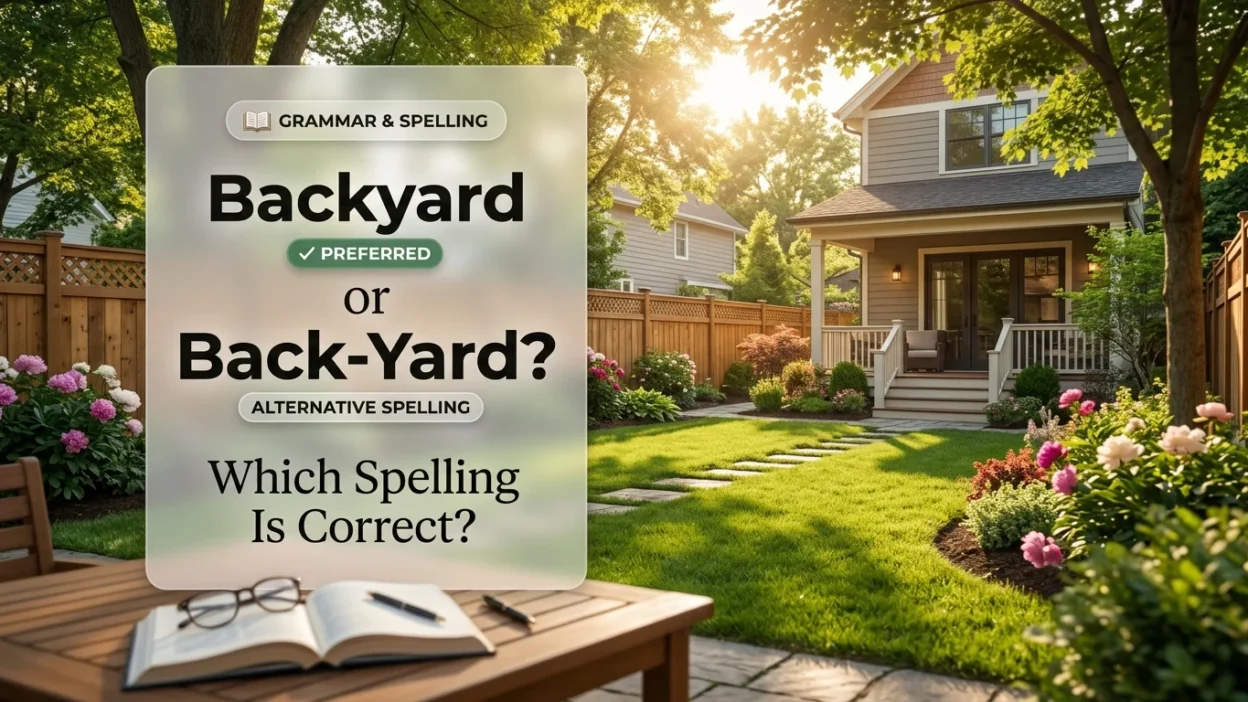
If you are wondering whether to write backyard or back-yard, the correct choice in modern English is usually backyard, written as one word. It refers to the outdoor area behind a house. For example, “The children are playing in the backyard.” The hyphenated form, “back-yard,” is uncommon in contemporary writing and is generally unnecessary.
Both forms may be understandable, but backyard is the standard spelling in American English and is also widely used in British English. if you are writing an email, completing a school assignment, or creating online content, using “backyard” is the safest choice.
Understanding the difference between compound words, hyphenated words, and open compounds can help you avoid similar spelling mistakes. This guide explains the meanings, spelling rules, examples, and common errors associated with “backyard” and “back-yard.”
Quick Answer
Backyard is the preferred spelling in modern English. It is a compound word written without a space or hyphen and usually means the area behind a house. “Back-yard” is a less common, older-style, or context-specific variant. In everyday writing, choose “backyard” for clarity and consistency.
Why Do People Confuse Backyard and Back-Yard?
People confuse these spellings because English compound words can appear in three different forms:
- Closed compound: Two words joined together, such as backyard.
- Hyphenated compound: Two words connected by a hyphen, such as back-yard.
- Open compound: Two separate words, such as back yard.
These forms can sometimes vary over time as spelling conventions change. Writers may also see older publications or particular style choices that use a hyphen.
However, when referring to the outdoor space behind a home, backyard is the most widely accepted everyday spelling.
First Word: Backyard
Backyard is a noun that refers to an outdoor area at the back of a house or other building. Depending on the property, it may contain grass, a garden, trees, a patio, or a play area.
Meaning of Backyard
A backyard is generally the part of a residential property located behind the main building.
Examples:
- We planted roses in our backyard.
- The dog sleeps in the backyard.
- Our backyard has a small swimming pool.
- They invited their friends to a backyard barbecue.
The word can also be used as an adjective in expressions such as backyard garden, backyard chickens, and backyard barbecue.
Is Backyard One Word?
Yes. In standard modern usage, backyard is written as one word.
Correct: “We have a beautiful backyard.”
Less common: “We have a beautiful back-yard.”
Incorrect for the usual spelling: “We have a beautiful back yard.” This last form may occur in some contexts, but the closed compound is generally preferred when referring to the outdoor area behind a home.
Second Word: Back-Yard
Back-yard is a hyphenated spelling of the same basic expression. It may appear in older texts or in writing that follows a particular editorial convention, but it is not the usual modern spelling.
Meaning of Back-Yard
When used to refer to the area behind a house, back-yard generally carries the same meaning as backyard. The hyphen does not normally create a different meaning.
Examples:
- The children played in the back-yard.
- We built a fence around the back-yard.
- The back-yard needs more sunlight.
These sentences are understandable, but most contemporary writers would remove the hyphen and write backyard.
Is Back-Yard Ever Correct?
It can appear as a deliberate spelling choice in historical writing, quotations, or publications that follow a specific house style. However, there is usually no reason to use it in ordinary modern English.
For schoolwork, professional writing, and general communication, backyard is the better choice.
Backyard vs. Back-Yard: Comparison Table
| Feature | Backyard | Back-yard |
|---|---|---|
| Spelling | One word | Hyphenated |
| Meaning | Area behind a house | Usually the same |
| Modern usage | Standard and common | Uncommon |
| American English | Preferred | Rare |
| British English | Widely used | Uncommon |
| Everyday writing | Recommended | Usually unnecessary |
| Example | Our backyard is large. | Our back-yard is large. |
When Should You Use Each Spelling?
When to Use Backyard
Use backyard in almost all ordinary writing when you mean the area behind a home.
Examples:
- “The children are playing in the backyard.”
- “We need to clean the backyard this weekend.”
- “She grows vegetables in her backyard.”
- “They organized a backyard party.”
It is also appropriate in compound expressions such as backyard garden, backyard wildlife, and backyard barbecue.
When to Use Back-Yard
Use back-yard only when a particular publication, historical source, or editorial style requires that spelling. You may also preserve it when quoting a text that originally uses the hyphen.
For example:
“The original document describes a ‘back-yard garden.’”
In this sentence, the hyphenated form is retained as part of the quotation rather than chosen as the standard modern spelling.
12 Examples of Backyard and Back-Yard in Sentences
Here are practical examples to help you understand how the two spellings work.
- Correct: We spend every summer evening in our backyard.
- Correct: My parents planted fruit trees in the backyard.
- Correct: The children built a small fort in their backyard.
- Correct: Our backyard is big enough for a vegetable garden.
- Correct: The dog chased a squirrel across the backyard.
- Correct: We hosted a backyard barbecue on Saturday.
- Correct: She enjoys watching birds in her backyard.
- Correct: They installed a fence around the backyard.
- Less common: The children played in the back-yard.
- Less common: We planted flowers in the back-yard.
- Less common: The back-yard was covered with snow.
- Less common: They repaired the back-yard fence.
In examples 9–12, the meaning remains clear, but backyard would generally be preferred in contemporary writing.
Common Mistakes to Avoid
1. Using a Hyphen Unnecessarily
Incorrect or less preferred: “We had a picnic in the back-yard.”
Better: “We had a picnic in the backyard.”
2. Writing It as Two Words Without a Reason
Less preferred in the usual sense: “Our back yard looks beautiful.”
Preferred: “Our backyard looks beautiful.”
The open form can appear in some writing, but the closed spelling is the standard choice for this meaning.
3. Assuming the Hyphen Changes the Meaning
The hyphenated form does not normally describe a different kind of outdoor space. The difference is primarily one of spelling convention.
4. Using Different Spellings in the Same Article
Avoid switching between backyard and back-yard without a specific reason. Consistent spelling makes your writing easier to read.
5. Confusing Backyard With Front Yard
A backyard is behind a building. A front yard is in front of it. Notice that backyard is generally one word, while front yard is conventionally written as two words.
Memory Trick: How to Remember Backyard
Use this simple trick:
Back + yard = backyard.
Think of the word as two familiar words joined into one. When you imagine the grassy or paved area behind your house, write backyard without a space or hyphen.
- Backyard barbecue
- Backyard garden
- Backyard playground
- Backyard swimming pool
If you are unsure which spelling to choose, use backyard.
American vs. British English
The spelling backyard is widely accepted in both American and British English. Unlike some words that differ between these varieties, such as color and colour, this word does not normally require a regional spelling change.
| Variety of English | Preferred spelling | Example |
|---|---|---|
| American English | Backyard | We played in the backyard. |
| British English | Backyard | The children are in the backyard. |
| Australian English | Backyard | We have a small backyard. |
| Canadian English | Backyard | They renovated their backyard. |
Although garden is often used in British English for an outdoor area around a house, backyard is also familiar and widely used. The exact meaning of garden and yard can vary with context.
Similar Words to Know
Learning related terms can help you choose the correct expression for different parts of a property.
- Front yard: The outdoor area in front of a house.
- Back garden: An outdoor garden at the rear of a house, particularly common in British English.
- Backyard garden: A garden located in the backyard.
- Side yard: The outdoor area alongside a house.
- Courtyard: An open area surrounded partly or completely by buildings or walls.
- Garden: An area used for growing plants, flowers, vegetables, or other greenery.
- Yard: An outdoor area near a building, often with grass, paving, or other landscaping.
- Patio: A paved outdoor area used for sitting, relaxing, or entertaining.
These terms are related, but they are not always interchangeable. For example, a courtyard may be enclosed by walls, while a backyard is defined primarily by its location behind a building.
Final Verdict: Backyard or Back-Yard?
Backyard is the correct and recommended spelling for everyday modern English. It is written as one word and refers to the outdoor area behind a house.
Back-yard is a less common variant that may appear in historical material or follow a particular editorial style. It generally has the same meaning, but the hyphen is unnecessary in ordinary writing.
For essays, emails, articles, captions, and professional documents, choose backyard unless you have a specific reason to preserve another spelling.
Frequently Asked Questions
1. Is backyard one word or two?
Backyard is one word. It is the standard modern spelling for the outdoor area behind a house.
2. Is back-yard grammatically correct?
The hyphenated form can appear in older texts or under particular editorial conventions. However, backyard is the preferred spelling in contemporary everyday English.
3. Is backyard or back-yard correct in American English?
Backyard is the standard choice in American English. The hyphenated version is uncommon.
4. Do British people write backyard or back-yard?
Backyard is widely used in British English, too. Back-yard is not the usual modern spelling.
5. What is the plural of backyard?
The plural is backyards. For example, “The houses on this street have spacious backyards.”
6. Is backyard a noun or an adjective?
It can be both. As a noun, it refers to an outdoor area behind a house. As an adjective, it describes something associated with that area, as in backyard chickens or backyard gardening.
7. Is back yard ever written as two words?
Yes, the open form back yard can occur in some contexts. However, backyard is generally preferred when referring to the area behind a home.
Remember This
- Backyard: The standard modern spelling.
- Back-yard: A less common hyphenated variant.
- Back yard: An alternative open form that is less usual for this meaning.
- Best choice: Use backyard in everyday, academic, and professional writing.
Conclusion
Choosing between backyard and back-yard is simple once you know the standard spelling. Although both forms may be understood, backyard is the preferred modern form for the outdoor area behind a house. It is concise, familiar, and widely accepted across different varieties of English.
When writing a school assignment, an email, a blog post, or a social media caption, use backyard unless a specific style guide or quotation requires otherwise. Remembering this one-word spelling will help you write more clearly and avoid an unnecessary hyphen.

Charles Kyle is a passionate writer and dream researcher at SleepCout, dedicated to exploring coded dreams, lucid dreaming, dream symbolism, and sleep science. He creates engaging, well-researched content that helps readers understand their dreams and discover the fascinating connection between technology, imagination, and the sleeping mind.