Have you ever wondered if to use “us” or “we” in a sentence? These two English pronouns may seem similar because both refer to a group of people that includes the speaker. However, they serve different grammatical purposes. Understanding the difference between us vs we will help you speak naturally, write correctly, and avoid common grammar mistakes.
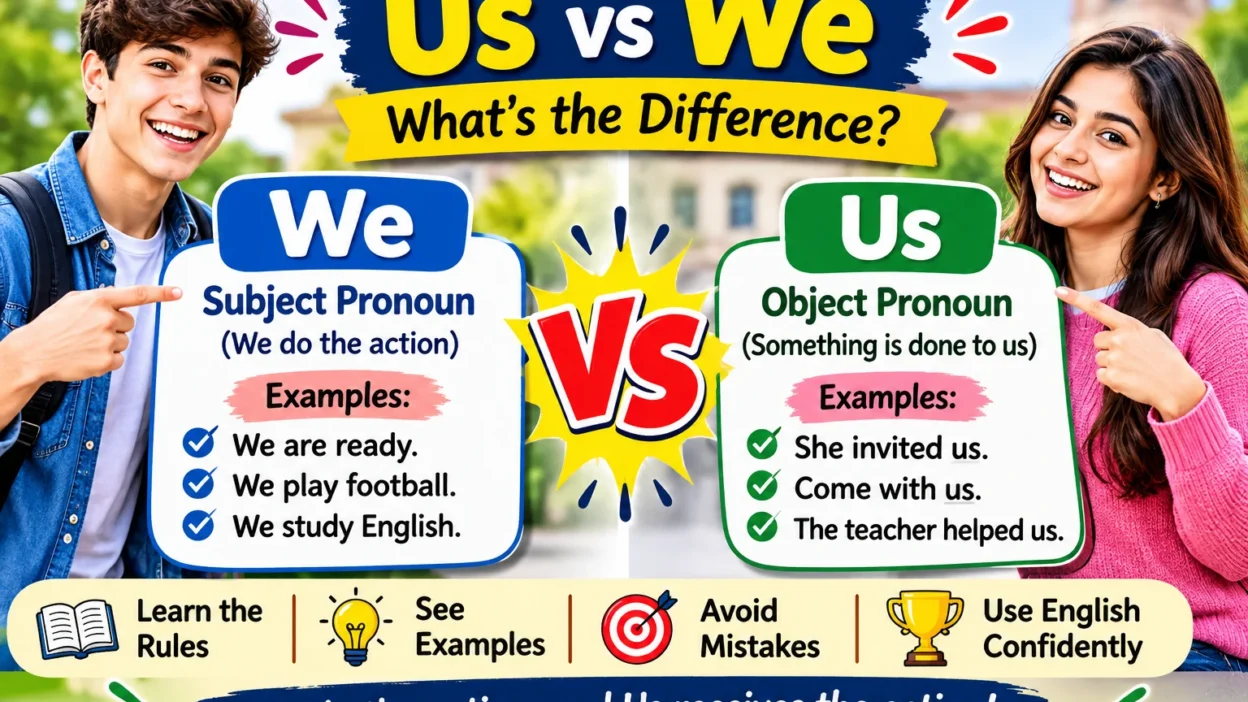
The main difference is that “we” is a subject pronoun, while “us” is an object pronoun. Use “we” when a group of people performs an action, such as “We play football.” Use “us” when the group receives an action or follows a preposition, such as “She invited us.” Although both words refer to the same group of people, they cannot always replace each other. In this guide, you will learn their meanings, grammatical rules, and differences through simple explanations, practical examples, and common mistakes. By the end, you will know exactly when to use “we” and when to choose “us.”
Quick Answer: Us vs We
“We” is used as a subject pronoun, while “us” is used as an object pronoun. Use “we” for the people performing an action: “We are studying.” Use “us” for the people receiving an action or following a preposition: “The teacher helped us.” The correct choice depends on each word’s role in the sentence.
Why Do People Confuse Us and We?
People often confuse “us” and “we” because both pronouns refer to the same group of people, including the speaker.
For example, both sentences describe the same group:
- We are going to the park.
- The teacher is taking us to the park.
The difference is not the people being discussed. It is their grammatical role in the sentence.
In the first example, “we” performs the action of going. In the second, “us” receives the action of being taken somewhere.
Another reason for confusion is everyday conversation. People sometimes use informal expressions that do not follow standard grammar rules. Learning the difference between subject and object pronouns makes it easier to choose the correct word.
What Does “We” Mean?
“We” is a first-person plural subject pronoun. It refers to the speaker and at least one other person.
Use “we” when the speaker and other people perform an action or when they are described as being in a particular state.
Grammar Rules for We
Use “we” in these situations:
1. When the group performs an action
- We play cricket every weekend.
- We study English together.
- We visited our grandparents yesterday.
2. Before a verb when it acts as the subject
- We are happy.
- We have finished our homework.
- We will arrive soon.
3. When talking about a group that includes the speaker
- We are classmates.
- We live in the same neighborhood.
- We enjoy reading books.
More Examples of We
- We need more time.
- We understand the lesson.
- We are ready for the test.
- We want to learn English.
- We traveled to Lahore last month.
Remember: If the speaker and other people are performing the action, “we” is usually the correct choice.
What Does “Us” Mean?
“Us” is a first-person plural object pronoun. It refers to the speaker and at least one other person when they receive an action or follow a preposition.
Use “us” when someone does something to the group or when the group is the object of a verb or preposition.
Grammar Rules for Us
Use “us” in these situations:
1. When the group receives an action
- She called us.
- The teacher praised us.
- They invited us to dinner.
2. After a preposition
- Come with us.
- The gift is for us.
- He sat beside us.
3. When the group is the object of a verb
- My parents helped us.
- The coach trained us.
- The manager thanked us.
More Examples of Us
- Please listen to us.
- They gave us some advice.
- Our friends visited us.
- The teacher taught us English.
- Can you help us?
Remember: If the speaker and other people receive an action or follow a preposition, “us” is usually the correct choice.
Us vs We: Comparison Table
| Feature | We | Us |
|---|---|---|
| Part of speech | Subject pronoun | Object pronoun |
| Person | First person | First person |
| Number | Plural | Plural |
| Main function | Performs an action or serves as the subject | Receives an action or serves as an object |
| Used before a verb as the subject | Yes | No |
| Used after a preposition | Generally no | Yes |
| Example | We helped our neighbors. | Our neighbors helped us. |
| Correct expression | We are ready. | Come with us. |
| Incorrect example | Us are ready. | Come with we. |
The easiest way to remember the difference is that “we” usually does something, while “us” has something done to it.
When Should You Use We or Us?
Choosing between “we” and “us” becomes easier when you identify the pronoun’s role in the sentence.
1. Use We Before the Main Verb When It Is the Subject
When the speaker and other people perform an action, use “we.”
Correct: We finished the project.
Incorrect: Us finished the project.
In the correct sentence, “we” is the subject performing the action of finishing.
2. Use Us After an Action Verb When It Is the Object
When an action affects the speaker and other people, use “us.”
Correct: The teacher congratulated us.
Incorrect: The teacher congratulated we.
The teacher performs the action, and “us” identifies the people receiving it.
3. Use Us After Prepositions
Prepositions such as with, for, to, between, beside, and among generally take object pronouns.
Examples:
- She came with us.
- This letter is for us.
- He spoke to us.
- The secret stays between us.
In standard English, you would not say “with we” or “for we” in these sentences.
4. Use We When It Is the Subject of a Clause
A clause has a subject and a verb. When the speaker and other people perform the action in a clause, use “we.”
Correct: We believe that the plan will work.
Correct: She said that we should leave early.
In the second example, “we” is the subject of the clause “we should leave early.”
5. Use Us When It Is the Object of a Clause
When the speaker and other people receive an action in a clause, use “us.”
Correct: She believes that they will help us.
Correct: He told us that the meeting was canceled.
In the second example, “us” is the object of “told.”
15 Examples of Us vs We in Sentences
These examples show how to use both pronouns in everyday English.
| No. | Sentence with We | Sentence with Us |
|---|---|---|
| 1 | We play football every Sunday. | Our coach watches us play football. |
| 2 | We are learning English. | Our teacher helps us learn English. |
| 3 | We visited the museum. | The guide welcomed us at the museum. |
| 4 | We completed the assignment. | The teacher congratulated us. |
| 5 | We are going to school. | Our father is taking us to school. |
| 6 | We enjoy reading books. | The librarian recommended books to us. |
| 7 | We need some help. | Can you help us? |
| 8 | We organized the event. | Our principal thanked us for organizing it. |
| 9 | We are ready for the exam. | The examiner gave us our papers. |
| 10 | We visited our relatives. | Our relatives welcomed us warmly. |
| 11 | We want to improve our writing. | Our teacher gave us useful advice. |
| 12 | We arrived early. | The host greeted us at the entrance. |
| 13 | We enjoy spending time together. | Our friends often join us. |
| 14 | We finished our work. | The manager praised us for our efforts. |
| 15 | We will attend the meeting. | Please save two seats for us. |
Additional Examples in Everyday Conversation
Here are a few more examples you might hear in daily life:
- We: We should leave now.
- Us: Please wait for us.
- We: We know the answer.
- Us: The teacher asked us a question.
- We: We are excited about the trip.
- Us: Come and sit with us.
Notice that the correct pronoun depends on the role it plays, not on whether the sentence is formal or informal.
Common Mistakes When Using Us and We
Even fluent English speakers sometimes encounter confusing pronoun choices. The following mistakes are especially common among learners.
Mistake 1: Using Us as a Subject
Incorrect: Us are going to the market.
Correct: We are going to the market.
Why? “We” is the subject performing the action of going.
Mistake 2: Using We as an Object
Incorrect: She invited we to her birthday party.
Correct: She invited us to her birthday party.
Why? “Us” is the object of the verb “invited.”
Mistake 3: Using We After a Preposition
Incorrect: He came with we.
Correct: He came with us.
Why? The preposition “with” takes the object pronoun “us.”
Mistake 4: Confusing Compound Subjects and Objects
Incorrect: Me and my brother went shopping.
Correct: My brother and I went shopping.
Incorrect: The teacher helped my brother and I.
Correct: The teacher helped my brother and me.
The same principle applies to “we” and “us.”
Correct: Sarah and we finished the project.
Correct: The teacher congratulated Sarah and us.
However, some of these sentences may sound unnatural in everyday conversation. You can often rewrite them to make them clearer.
For example:
- Sarah and we finished the project. → Sarah and our group finished the project.
- The teacher congratulated Sarah and us. → The teacher congratulated our group and Sarah.
Mistake 5: Choosing a Pronoun Based on What Sounds Familiar
Some speakers use “us” in expressions where standard grammar requires “we.”
For example:
Incorrect in standard English: Us students need more time.
Correct: We students need more time.
Here, “we students” is the subject of the sentence. However, the object form is correct in a sentence such as “The teacher gave us students more time.”
The best approach is to identify the grammatical role rather than relying only on how a sentence sounds.
Easy Memory Trick: How to Remember Us vs We
Use this simple memory trick:
WE = DOERS
US = RECEIVERS
Think of “we” as the people performing an action and “us” as the people receiving an action.
Examples:
- We helped our friend. (We performed the action.)
- Our friend helped us. (We received the help.)
You can also use a simple substitution test.
The Subject Test
Replace the pronoun with “they.”
- We are happy. → They are happy.
- Us are happy. → They are happy, so “we” is correct.
The Object Test
Replace the pronoun with “them.”
- The teacher helped us. → The teacher helped them.
- The teacher helped we. → The teacher helped them, so “us” is correct.
This trick works in many everyday sentences because “they” is a subject pronoun and “them” is an object pronoun.
Us vs We in American and British English
The basic grammatical rules for “we” and “us” are the same in American and British English.
Both varieties use “we” as a subject pronoun and “us” as an object pronoun.
Examples accepted in both varieties:
- We are going home.
- They invited us.
- She came with us.
- We have finished our work.
There is no general American-versus-British difference that changes when these two pronouns should be used.
You may occasionally hear informal or nonstandard constructions in conversation, but hearing a phrase does not necessarily make it appropriate for formal writing.
For schoolwork, professional communication, and standard written English, follow the usual subject-and-object rules.
Similar Words: I vs Me, They vs Them, and He vs Him
Understanding “we” and “us” becomes easier when you compare them with other English pronouns.
We vs Us
- We are studying. (Subject)
- The teacher is helping us. (Object)
I vs Me
“I” is a subject pronoun, while “me” is an object pronoun.
- I finished my homework.
- My teacher helped me.
They vs Them
“They” is a subject pronoun, while “them” is an object pronoun.
- They play basketball.
- We watched them play basketball.
He vs Him
“He” is a subject pronoun, while “him” is an object pronoun.
- He called his friend.
- His friend called him.
She vs Her
“She” is a subject pronoun, while “her” is an object pronoun.
- She reads every evening.
- I gave her a book.
These pronoun pairs follow the same general pattern. Learning one pair can help you understand the others.
Final Verdict: Which Is Correct, Us or We?
Neither “us” nor “we” is always correct. The right choice depends on the grammatical role of the pronoun.
Use “we” when the speaker and other people are the subject of a sentence or clause.
Example: We are preparing for the competition.
Use “us” when the speaker and other people are the object of a verb or preposition.
Example: The coach is preparing us for the competition.
If you are unsure, identify who performs the action and who receives it. You can also try replacing “we” with “they” or “us” with “them” to check whether the sentence follows the same pattern.
Frequently Asked Questions About Us vs We
1. What Is the Main Difference Between Us and We?
The main difference is their grammatical function. “We” is a subject pronoun used for the people performing an action, while “us” is an object pronoun used for the people receiving an action or following a preposition.
Examples: “We called them” and “They called us.”
2. Is It Correct to Say “Us and Them”?
Yes, “us and them” can be correct when the phrase functions as an object.
Example: The teacher spoke to us and them.
However, when the phrase functions as the subject, use “we and they” or, more naturally, rewrite the sentence.
Example: We and they worked together.
A clearer alternative is “Our group and their group worked together.”
3. Should I Say “We Students” or “Us Students”?
Both forms can be correct, depending on the sentence.
Use “we students” when the phrase is the subject.
Example: We students need more practice.
Use “us students” when the phrase is the object.
Example: The teacher gave us students extra time.
4. Is “Between You and We” Correct?
No. In standard English, the correct expression is “between you and us.”
Example: This matter should stay between you and us.
The preposition “between” takes object pronouns, so “us” is correct rather than “we.”
5. Can I Use We After a Preposition?
Generally, no. Standard English uses object pronouns after prepositions.
Correct: She came with us.
Incorrect: She came with we.
Other examples include “for us,” “to us,” “beside us,” and “among us.”
6. Is “We Are” or “Us Are” Correct?
“We are” is correct when referring to a group that includes the speaker.
Example: We are ready to leave.
“Us are” is incorrect in standard English when the pronoun is the subject. Use “we” because the subject pronoun performs the grammatical role required before the verb.
7. How Can I Quickly Decide Between Us and We?
Identify the pronoun’s role in the sentence.
If the pronoun is the subject, use “we.” If it is the object of a verb or preposition, use “us.”
You can also use the substitution trick: “we” works like “they,” while “us” works like “them.”
Remember This
- We = subject pronoun.
- Us = object pronoun.
- Use “we” when the group performs an action.
- Use “us” when the group receives an action.
- Use “us” after prepositions such as “with,” “for,” and “between.”
- The same rules apply in American and British English.
- When in doubt, try replacing “we” with “they” or “us” with “them.”
Conclusion
Understanding the difference between “us” and “we” is an important step toward using English correctly. Although both pronouns refer to the speaker and other people, their grammatical roles are different. “We” is used as a subject pronoun, while “us” is used as an object pronoun. Once you recognize these roles, choosing the correct word becomes much easier.
The best way to improve is through regular practice. Read example sentences, write your own, and pay attention to how native English speakers use subject and object pronouns. Remember the simple rule: we do the action, and us receives the action. With practice, you will be able to use both words confidently in everyday conversations, school assignments, and professional writing.

John Tyler is a dream researcher and content writer at SleepCout, sharing insightful articles about coded dreams, dream meanings, symbolism, sleep psychology, and practical guidance to help readers understand their dreams.