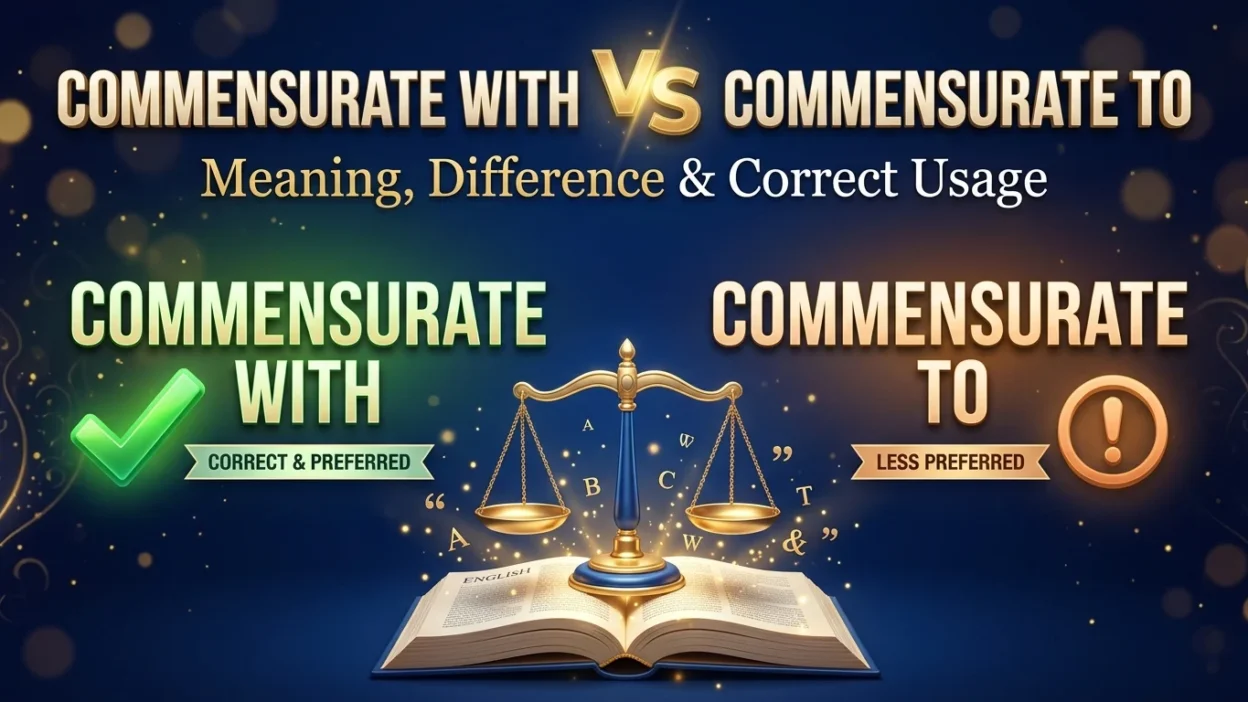
The phrases “commensurate with” and “commensurate to” look similar, but choosing the correct preposition can be confusing. Both may appear in formal writing, professional communication, and everyday discussions about salary, responsibility, experience, value, and performance. However, they are not equally natural or widely accepted in standard English.
The most commonly accepted expression is “commensurate with.” It means equal or corresponding in size, amount, degree, importance, or value to something else. For example, a salary should be commensurate with an employee’s experience. The preposition with connects two things that are appropriately matched or proportionate.
But what about “commensurate to”? Is it grammatically incorrect, or can it be used in certain contexts? Understanding the meaning of commensurate, its usual grammatical pattern, and its correct usage will help you avoid mistakes and write more naturally. Let’s explore the differences with simple explanations and practical examples.
Quick Answer
“Commensurate with” is the standard and preferred expression in modern English. It means proportionate or corresponding in size, value, amount, or degree to something. “Commensurate to” occasionally appears, but it is much less idiomatic. For clear, natural, and professional writing, choose “commensurate with.”
Why Do People Confuse Commensurate With and Commensurate To?
People often confuse these expressions because both with and to can show relationships between two things.
For example:
- Equal to something
- Proportionate to something
- Corresponding with something
- Appropriate for something
Since commensurate describes a relationship of proportion or correspondence, writers may naturally assume that either preposition works.
Another reason is that English has several similar expressions:
- Equal to
- Proportionate to
- Corresponding with
- Consistent with
- Commensurate with
However, prepositions do not always follow the same patterns, even when words have similar meanings.
The safest choice is to remember that commensurate is conventionally followed by with.
1. What Does Commensurate With Mean?
Commensurate with means equal or proportionate to something in size, amount, value, degree, or importance.
It is used when two things are appropriately matched or have a suitable relationship.
Examples of Commensurate With
- Her salary is commensurate with her experience.
- The punishment should be commensurate with the seriousness of the crime.
- His responsibilities are commensurate with his position.
- The reward was commensurate with their hard work.
- The benefits should be commensurate with the risks involved.
Simple Explanation
Imagine someone has ten years of professional experience. If that person’s salary reflects their qualifications and experience, you can say:
“Her salary is commensurate with her experience.”
In simple words, the salary matches the level of experience.
Common Sentence Patterns
- Salary commensurate with experience
- Responsibilities commensurate with position
- Compensation commensurate with qualifications
- Punishment commensurate with the offense
- Rewards commensurate with performance
2. What Does Commensurate To Mean?
Commensurate to is a less common and generally less idiomatic alternative to commensurate with.
Some writers use it because commensurate expresses a relationship of proportion, similar to the phrase proportionate to. However, standard modern English generally favors commensurate with.
For example:
Less preferred: Her salary is commensurate to her experience.
Preferred: Her salary is commensurate with her experience.
The second sentence sounds more natural and follows established usage.
Should You Use Commensurate To?
It is better to avoid commensurate to in formal writing, academic work, business communication, and professional documents.
Instead, use:
- Commensurate with the responsibility
- Commensurate with the value
- Commensurate with the level of experience
- Commensurate with the amount of work
If you want to use to, choose a more suitable alternative, such as proportionate to or equal to.
Commensurate With vs Commensurate To: Comparison Table
| Feature | Commensurate With | Commensurate To |
|---|---|---|
| Meaning | Proportionate or corresponding | Intended to express proportion |
| Usage | Standard and preferred | Less common |
| Grammar | Conventional construction | Generally less idiomatic |
| Formal writing | Recommended | Best avoided |
| Professional English | Natural | Awkward to many readers |
| Example | Salary commensurate with experience | Salary commensurate to experience |
| Recommendation | Use it | Prefer an alternative |
When to Use Commensurate With vs Commensurate To
When to Use Commensurate With
Use commensurate with when you want to show that one thing matches or corresponds appropriately to another.
It is especially useful in:
1. Workplace communication
- Compensation should be commensurate with experience.
- Your salary will be commensurate with your qualifications.
2. Education
- The difficulty of the examination should be commensurate with the students’ academic level.
- The course requirements are commensurate with the expected learning outcomes.
3. Business and finance
- The investment risk should be commensurate with the expected return.
- The company’s expenses should be commensurate with its revenue.
4. Legal and professional writing
- The penalty must be commensurate with the seriousness of the offense.
- The level of responsibility should be commensurate with the employee’s position.
When to Use Commensurate To
In most situations, avoid this construction.
If you want to express the same idea using to, consider these alternatives:
- Proportionate to
- Equal to
- Equivalent to
- Corresponding to
For example:
- Incorrect or less idiomatic: The reward is commensurate to the effort.
- Better: The reward is commensurate with the effort.
- Alternative: The reward is proportionate to the effort.
10+ Examples of Commensurate With vs Commensurate To
Here are practical examples to help you understand the correct usage.
| No. | Sentence | Usage |
|---|---|---|
| 1 | Her salary is commensurate with her experience. | Preferred |
| 2 | The reward should be commensurate with the effort. | Preferred |
| 3 | His responsibilities are commensurate with his position. | Preferred |
| 4 | The punishment must be commensurate with the crime. | Preferred |
| 5 | The benefits are commensurate with the risks. | Preferred |
| 6 | Compensation should be commensurate with qualifications. | Preferred |
| 7 | The workload is commensurate with the employee’s role. | Preferred |
| 8 | The investment should be commensurate with the expected return. | Preferred |
| 9 | The price is commensurate with the product’s quality. | Preferred |
| 10 | Her achievements are commensurate with her abilities. | Preferred |
| 11 | The resources provided are commensurate with the project’s needs. | Preferred |
| 12 | The level of authority is commensurate with the responsibility. | Preferred |
Additional Examples Using Commensurate To
These examples illustrate the less-preferred construction:
- Her salary is commensurate to her experience.
- The reward is commensurate to the effort.
- His responsibilities are commensurate to his position.
In each case, replacing to with with produces the more natural standard expression.
Common Mistakes to Avoid
Even experienced English speakers sometimes make mistakes with commensurate.
Here are some common problems.
1. Using to instead of with
- Less preferred: The salary is commensurate to his experience.
- Correct: The salary is commensurate with his experience.
2. Confusing commensurate with proportionate
Both words express a relationship of appropriate degree or amount, but their usual prepositions differ.
- Commensurate with the effort.
- Proportionate to the effort.
3. Using commensurate when you simply mean equal
Commensurate is more formal and usually emphasizes an appropriate relationship in degree, value, or amount.
Instead of saying:
“The two objects are commensurate.”
You might write:
“The two objects are equal in size.”
Choose the expression that communicates your meaning most clearly.
4. Forgetting the word’s formal tone
Commensurate is common in professional, academic, legal, and business contexts. In casual conversation, simpler words such as matching, equal, or proportionate may sound more natural.
Memory Trick: How to Remember the Correct Preposition
Here is an easy way to remember the difference:
Commensurate = With
Think of two things that go together or match with each other.
For example:
- Experience goes with salary.
- Responsibility goes with authority.
- Effort goes with reward.
Remember this simple sentence:
“A suitable salary should be commensurate with experience.”
You can also remember the related expression:
- Commensurate with
- Proportionate to
This comparison makes it easier to remember which preposition belongs with each word.
American vs British English
There is no significant American-English versus British-English difference in the standard use of commensurate with.
Both varieties generally use the same construction.
| English Variety | Preferred Expression | Example |
|---|---|---|
| American English | Commensurate with | Salary commensurate with experience |
| British English | Commensurate with | Salary commensurate with experience |
Whether you are writing for an American or British audience, commensurate with is the safest and most natural choice.
Similar Words to Commensurate
Several English words have meanings similar to commensurate. Learning their usual prepositions can help you improve your vocabulary.
| Word or Phrase | Meaning | Example |
|---|---|---|
| Proportionate to | Appropriate in size or amount | The response should be proportionate to the problem. |
| Equal to | The same in amount or value | The result is equal to our expectations. |
| Equivalent to | Having the same value or meaning | One dollar is equivalent to approximately a certain amount in another currency. |
| Corresponding to | Matching or relating to something | The figures correspond to the original report. |
| Consistent with | In agreement with something | His explanation is consistent with the evidence. |
| In line with | In agreement with or suitable for | The decision is in line with company policy. |
These alternatives can make your writing clearer and help you avoid repeating the same expression.
Final Verdict: Commensurate With or Commensurate To?
The correct and preferred expression in standard modern English is commensurate with.
Use it when describing something that is proportionate, appropriate, or corresponding in size, amount, value, or degree to another thing.
Although commensurate to occasionally appears in writing, it is less idiomatic and is generally best avoided.
For professional emails, academic assignments, business documents, and everyday formal writing, remember this simple rule:
Use commensurate with, not commensurate to.
Frequently Asked Questions (FAQs)
1. Is it commensurate with or commensurate to?
Commensurate with is the standard and preferred expression. It means proportionate or corresponding in value, amount, size, or degree to something. Commensurate to is less common and generally considered less idiomatic.
2. What does commensurate with mean?
Commensurate with means equal or appropriate in proportion, size, value, amount, or degree to something else.
Example: “His salary is commensurate with his experience.”
3. Is commensurate to grammatically correct?
Although commensurate to appears occasionally, it is not the usual construction in standard modern English. Most writers and editors prefer commensurate with.
4. Can I say salary commensurate with experience?
Yes. “Salary commensurate with experience” is a widely used expression in job advertisements and professional communication. It means the salary will reflect the candidate’s level of experience.
5. What is another word for commensurate with?
Depending on the context, alternatives include proportionate to, equivalent to, corresponding to, matching, and consistent with.
For example: “The reward is proportionate to the effort.”
6. Is commensurate with formal or informal?
Commensurate with is a formal expression. It is particularly common in business, academic, legal, and professional writing. In casual conversation, simpler alternatives such as matching or appropriate for may be easier to understand.
7. Does commensurate with have the same meaning in American and British English?
Yes. American and British English generally use commensurate with in the same way. There is no important regional difference in its standard grammatical construction.
Remember This
- Commensurate with is the correct and preferred expression.
- It means proportionate, suitable, or corresponding in degree or amount.
- Commensurate to is less idiomatic and generally best avoided.
- Use proportionate to when you want a natural alternative with to.
- Remember: Salary is commensurate with experience.
Conclusion
Understanding the difference between commensurate with and commensurate to makes your English more accurate and natural. Although both expressions may be used to communicate a relationship of proportion, commensurate with is the established construction in standard modern English. It is suitable for discussing salaries, responsibilities, rewards, risks, qualifications, and performance.
Whenever you are unsure which preposition to use, choose commensurate with. It is the safer option for professional communication, academic writing, and everyday formal English. Remembering this simple rule will help you avoid a common grammatical mistake and express your ideas more clearly.

John Tyler is a dream researcher and content writer at SleepCout, sharing insightful articles about coded dreams, dream meanings, symbolism, sleep psychology, and practical guidance to help readers understand their dreams.