The simple present tense is one of the most important parts of English grammar. It helps us talk about daily routines, habits, facts, general truths, and things that happen regularly. if you are a beginner, an English language learner, or someone improving everyday communication, understanding this tense will help you make clear and grammatically correct sentences.
Learning the simple present tense is easier than it may seem. You mainly need to understand how to use the base form of a verb, when to add -s or -es, and how to make negative sentences and questions. In this guide, you will learn the rules with easy explanations, sentence patterns, practical examples, and common mistakes to avoid. By the end, you will be able to use the simple present tense confidently in speaking and writing.
Quick Answer: What Is the Simple Present Tense?
The simple present tense is a verb tense used to describe habits, daily routines, general facts, permanent situations, and repeated actions. It uses the base form of a verb, but we usually add -s or -es with he, she, and it. For example: “She reads every day.”
Why Do People Find the Simple Present Tense Confusing?
Many English learners confuse the simple present tense because its verb forms change depending on the subject.
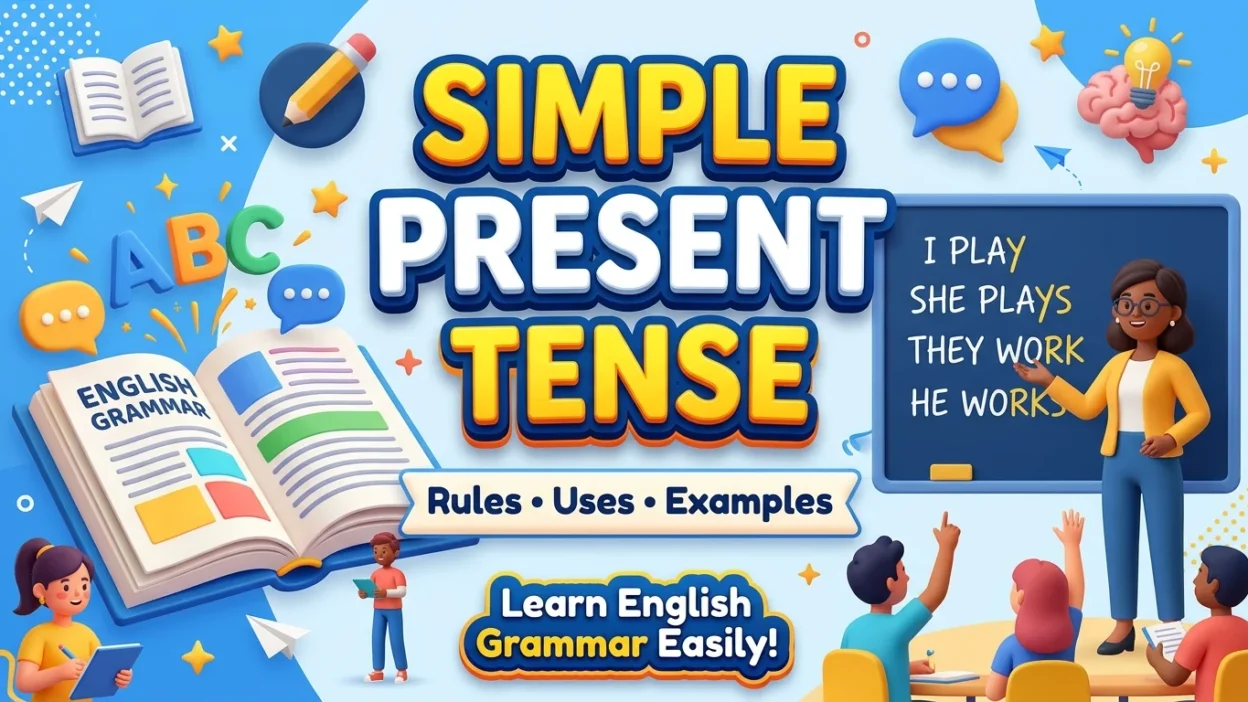
For example:
- I play football.
- They play football.
- She plays football.
The first two sentences use the base form of the verb, while the third adds -s.
Another common source of confusion is using helping verbs such as do and does. These words are necessary when making most negative sentences and questions.
For example:
- He does not like coffee.
- Does he like coffee?
Understanding these small differences makes the tense much easier to use.
What Is the Simple Present Tense?
The simple present tense describes actions that happen regularly, facts that are generally true, and situations that exist in the present.
It does not necessarily mean that an action is happening at this exact moment.
For example:
- I work in a bank.
- She speaks English.
- Water boils at 100°C at standard atmospheric pressure.
- We visit our grandparents every Sunday.
Main Uses of the Simple Present Tense
We use this tense in several situations.
1. Daily routines and habits
It describes activities that we do regularly.
- I wake up at 6 a.m.
- He brushes his teeth every morning.
- They go to school by bus.
2. General truths and facts
It expresses facts that are generally accepted as true.
- The Earth revolves around the Sun.
- Birds have wings.
- Ice melts when heated.
3. Permanent or long-term situations
It describes situations that are generally stable.
- She lives in London.
- My father works in a hospital.
- They own a small business.
4. Likes, dislikes, and feelings
It describes preferences, emotions, and mental states.
- I love chocolate.
- He dislikes loud music.
- She understands the lesson.
5. Timetables and scheduled events
It can describe fixed schedules, such as transport and class times.
- The train leaves at 8 p.m.
- The school opens at 7:30 a.m.
- The meeting starts tomorrow.
Simple Present Tense Sentence Structure
The simple present tense follows different sentence patterns depending on whether the sentence is positive, negative, or interrogative.
1. Affirmative Sentences
An affirmative sentence gives positive information.
Structure:
Subject + base verb (add -s/-es with he, she, it) + object.
Examples:
- I drink milk.
- She cooks dinner.
- He plays cricket.
- They speak English.
2. Negative Sentences
A negative sentence expresses that something does not happen or is not true.
Structure:
Subject + do not/does not + base verb + object.
Examples:
- I do not eat meat.
- She does not drive a car.
- He does not play tennis.
- They do not watch television.
Remember that after does not, always use the base form of the verb.
Correct: She does not work here.
Incorrect: She does not works here.
3. Interrogative Sentences
An interrogative sentence asks a question.
Structure:
Do/Does + subject + base verb + object + ?
Examples:
- Do you speak English?
- Does she like coffee?
- Does he work here?
- Do they play football?
4. Negative Interrogative Sentences
These sentences ask questions in a negative form.
Structure:
Do/Does + subject + not + base verb + object + ?
Examples:
- Do you not understand?
- Does she not like tea?
- Do they not attend school?
Contracted forms are also common:
- Don’t you understand?
- Doesn’t she like tea?
What Is the Second Form of the Simple Present Tense?
The simple present tense does not have a second verb form as part of its basic structure. It uses the base form of the verb, with -s or -es added for third-person singular subjects.
For example:
| Subject | Verb | Sentence |
|---|---|---|
| I | Work | I work daily. |
| You | Work | You work daily. |
| We | Work | We work daily. |
| They | Work | They work daily. |
| He | Works | He works daily. |
| She | Works | She works daily. |
| It | Works | It works well. |
Simple Present Tense Comparison Table
The following table shows how the simple present tense changes in different sentence types.
| Sentence type | Structure | Example |
|---|---|---|
| Affirmative | Subject + verb | She writes letters. |
| Negative | Subject + do/does not + verb | She does not write letters. |
| Question | Do/Does + subject + verb? | Does she write letters? |
| Negative question | Do/Does + subject + not + verb? | Does she not write letters? |
When Should You Use the Simple Present Tense?
Use the simple present tense when describing something that is regular, factual, or generally true.
Here are some useful situations.
Use it for daily activities:
- I exercise every morning.
- My mother prepares breakfast.
- He walks to work.
Use it for general facts:
- Plants need sunlight.
- The Sun rises in the east.
- Fish live in water.
Use it for personal preferences:
- I prefer tea to coffee.
- She loves reading books.
- We enjoy playing games.
Use it for instructions and directions:
- First, you open the box.
- Then, you add some water.
- Finally, you mix everything together.
Use it for fixed schedules:
- The bus arrives at 9 a.m.
- The movie begins at 6 p.m.
- Our English class starts on Monday.
20 Simple Present Tense Examples
Here are 20 easy examples to help you understand how this tense works in everyday English.
- I wake up early every morning.
- She reads a book before sleeping.
- He plays cricket with his friends.
- They go to school together.
- We drink tea after dinner.
- My brother works in a bank.
- The baby sleeps peacefully.
- Birds fly in the sky.
- My father drives a car.
- I speak English with my teacher.
- She teaches mathematics.
- He washes his clothes every Sunday.
- They visit their grandparents regularly.
- The Earth moves around the Sun.
- My dog barks at strangers.
- We watch movies on weekends.
- Water freezes at 0°C under standard atmospheric pressure.
- The shop opens at 9 a.m.
- He does not eat spicy food.
- Do you play football?
What Are the Common Mistakes in the Simple Present Tense?
English learners often make small grammatical mistakes when using this tense. Here are some common errors and their correct forms.
1. Forgetting -s or -es
Incorrect: She play tennis.
Correct: She plays tennis.
Use -s or -es with he, she, and it in affirmative sentences.
2. Adding -s After Does
Incorrect: He does not likes coffee.
Correct: He does not like coffee.
The verb returns to its base form after does.
3. Using Do Instead of Does
Incorrect: Do she speak English?
Correct: Does she speak English?
Use does with he, she, and it.
4. Confusing Simple Present with Present Continuous
Incorrect: I am go to school every day.
Correct: I go to school every day.
Use the simple present for regular habits, not the present continuous.
5. Forgetting the Correct Form of Be
Incorrect: She are happy.
Correct: She is happy.
The verb be has special forms in the present tense: am, is, and are.
Easy Memory Trick for the Simple Present Tense
Remember this simple rule:
I, You, We, They = Base Verb
He, She, It = Verb + S/ES
For example:
- I eat rice.
- You eat rice.
- We eat rice.
- They eat rice.
- He eats rice.
- She eats rice.
- It eats food.
For questions and negative sentences, remember:
- Do = I, you, we, they.
- Does = He, she, it.
This simple trick can help you avoid many common grammar mistakes.
Simple Present Tense in American vs British English
The simple present tense follows almost the same grammatical rules in American and British English.
Both varieties use the same subject-verb agreement rules, including adding -s or -es with third-person singular subjects.
For example:
- American English: She works in a hospital.
- British English: She works in a hospital.
The main differences are often vocabulary and pronunciation rather than tense structure.
| Meaning | American English | British English |
|---|---|---|
| Apartment | Apartment | Flat |
| Vacation | Vacation | Holiday |
| Elevator | Elevator | Lift |
| Truck | Truck | Lorry |
| Store | Store | Shop |
Both varieties use the simple present tense in the same way.
Similar English Grammar Topics
If you are learning the simple present tense, these related grammar topics can also improve your understanding.
- Present Continuous Tense: Describes actions happening now or around the present time.
- Simple Past Tense: Describes completed actions in the past.
- Simple Future Tense: Describes actions expected to happen in the future.
- Present Perfect Tense: Connects past actions or experiences with the present.
- Present Perfect Continuous Tense: Describes actions that started in the past and continue or have a present connection.
Understanding the differences between these tenses will help you choose the correct verb form in everyday communication.
Final Verdict: Why Is the Simple Present Tense Important?
The simple present tense is essential for communicating clearly in English. It helps you describe everyday routines, habits, facts, preferences, and scheduled events.
The most important rule is to use the base form of the verb with I, you, we, and they, and add -s or -es with he, she, and it in affirmative sentences.
Once you understand these patterns, making positive sentences, negative sentences, and questions becomes much easier.
Frequently Asked Questions
1. What is the simple present tense in English?
The simple present tense is used to describe habits, routines, general truths, facts, and regular activities. For example, “She goes to school every day.”
2. What are the 10 examples of simple present tense?
Here are 10 examples:
- I drink water.
- She sings beautifully.
- He plays cricket.
- They work together.
- We study English.
- My mother cooks dinner.
- The Sun rises in the east.
- Birds build nests.
- He drives carefully.
- She teaches children.
3. What are the four rules of the simple present tense?
The four basic rules are:
- Use the base verb with I, you, we, and they.
- Add -s or -es with he, she, and it in affirmative sentences.
- Use do not or does not for negative sentences.
- Use do or does to make questions.
4. When do we use the simple present tense?
We use it for daily routines, habits, general facts, permanent situations, likes, dislikes, and fixed schedules.
5. What is the formula for the simple present tense?
The main formulas are:
- Affirmative: Subject + verb + object.
- Negative: Subject + do/does not + base verb + object.
- Interrogative: Do/Does + subject + base verb + object?
6. What is the difference between simple present and present continuous?
The simple present describes regular habits and general facts, while the present continuous describes actions happening now or around the present time.
Examples:
- Simple present: I read books every day.
- Present continuous: I am reading a book now.
7. Does the simple present tense always describe the present moment?
No. It often describes habits, repeated actions, facts, and long-term situations rather than something happening at the exact moment of speaking.
Remember This
- The simple present tense describes habits, routines, facts, and regular actions.
- Use the base verb with I, you, we, and they.
- Add -s or -es with he, she, and it in affirmative sentences.
- Use do and does to make questions.
- Use do not and does not to make negative sentences.
- Always use the base form of the verb after does.
Conclusion
The simple present tense is a foundation of English grammar. It allows you to talk about your everyday life, describe general facts, express preferences, and explain things that happen regularly. Learning its sentence structures and verb rules will make your English communication more accurate and natural.
The best way to master this tense is through regular practice. Start by writing sentences about your daily routine, asking simple questions, and correcting common mistakes. With consistent practice, you will become more confident using the simple present tense in both speaking and writing.

Charles Kyle is a passionate writer and dream researcher at SleepCout, dedicated to exploring coded dreams, lucid dreaming, dream symbolism, and sleep science. He creates engaging, well-researched content that helps readers understand their dreams and discover the fascinating connection between technology, imagination, and the sleeping mind.