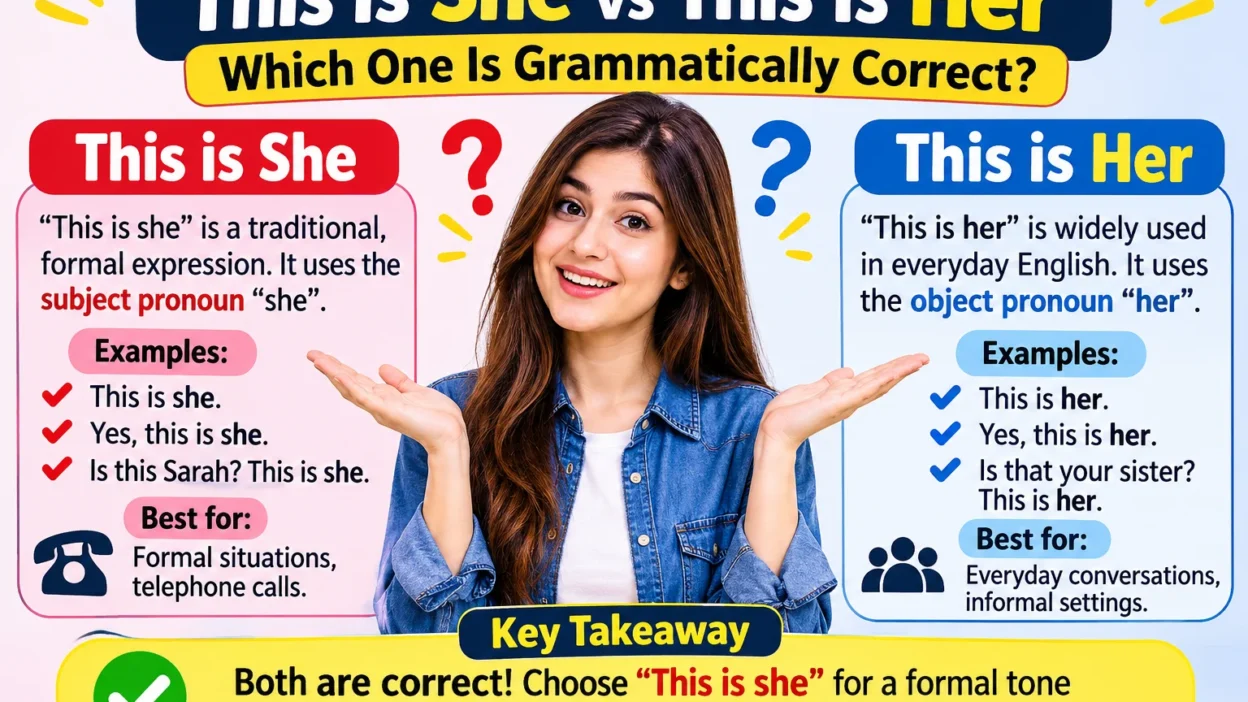
Have you ever wondered if to say “This is she” or “This is her” when answering a phone call or introducing yourself? Both expressions are commonly heard in English, but they follow different grammatical patterns. Understanding the difference can help you speak and write more confidently.
The confusion usually comes from the difference between traditional formal grammar and everyday conversational English. In particular, English speakers often use object pronouns after the verb be, even though traditional grammar sometimes recommends subject pronouns in certain situations. Both expressions have a place in English, but the context and level of formality matter.
if you are an English learner, student, or fluent speaker looking to improve your grammar, this guide explains the meanings, grammatical rules, differences, and practical examples of “this is she” and “this is her.”
Quick Answer
“This is she” is traditionally considered grammatically correct in formal English, especially when identifying yourself on the telephone. “This is her” is widely used in everyday conversational English and sounds more natural to many modern speakers. Both are understood, but the choice depends on context, style, and formality.
Why Do People Confuse This Is She vs This Is Her?
People confuse these expressions because they use two different types of pronouns: subject pronouns and object pronouns.
- She is a subject pronoun used when someone performs an action or serves as the subject.
- Her is an object pronoun used when someone receives an action or follows certain prepositions.
The confusion becomes clearer when these pronouns appear after linking verbs such as is, am, and are.
Traditional grammar treats the verb be differently from ordinary action verbs. It allows a subject pronoun in formal identification sentences, such as:
- This is she.
- It is I.
- That was he.
However, everyday English frequently uses object pronouns in these situations:
- This is her.
- It’s me.
- That was him.
Both patterns are familiar to English speakers, although their levels of formality differ.
1. First Word: This Is She
“This is she” is a traditional, formal expression used to identify a female person.
The word she is a subject pronoun. In traditional grammatical analysis, it follows the linking verb is as a subject complement (also called a predicate nominative).
Meaning of This Is She
It means that the female person being identified is the speaker or the person being referred to.
For example:
- Caller: May I speak to Sarah?
- Sarah: This is she.
Here, Sarah confirms that she is the person the caller wants to speak with.
When Is This Is She Used?
You can use this expression in:
- Formal telephone conversations.
- Professional communication.
- Traditional written English.
- Situations where a more formal grammatical style is preferred.
Examples of This Is She
- Is this Sarah speaking? Yes, this is she.
- May I speak to the manager? This is she.
- Are you the new teacher? Yes, this is she.
- Is Emily available? This is she.
- Did you apply for the position? Yes, this is she.
Important: Although this expression is traditionally grammatical, it may sound stiff or old-fashioned in casual modern conversations.
2. Second Word: This Is Her
“This is her” is a common expression in modern conversational English. It uses her, an object pronoun, to identify a female person.
Although traditional grammar may prefer this is she in formal identification, this is her is widely accepted in everyday speech.
Meaning of This Is Her
It means that the female person being identified is the person someone is talking about or looking for.
For example:
- Caller: Is this Anna?
- Anna: Yes, this is her.
The speaker confirms her identity using a natural conversational expression.
When Is This Is Her Used?
Use this expression in:
- Everyday conversations.
- Informal telephone calls.
- Friendly introductions.
- Casual workplace conversations.
- Situations where natural, conversational English is preferred.
Examples of This Is Her
- Is that your sister? Yes, this is her.
- May I speak to Emma? This is her.
- Are you the person I called? Yes, this is her.
- Is Jessica the new employee? Yes, this is her.
- Do you recognize the woman in the picture? This is her.
In everyday English, this expression sounds natural and is easily understood.
This Is She vs This Is Her: Comparison Table
| Feature | This Is She | This Is Her |
|---|---|---|
| Pronoun | She | Her |
| Pronoun type | Subject pronoun | Object pronoun |
| Grammar tradition | Traditional formal usage | Modern conversational usage |
| Tone | Formal | Informal or neutral |
| Common situation | Formal identification | Everyday identification |
| Telephone usage | Traditional | Very common |
| Meaning | Identifying a female person | Identifying a female person |
| Naturalness | Can sound formal | Often sounds conversational |
When to Use This Is She vs This Is Her
Choosing between these expressions depends on your communication style and the situation.
Use This Is She in Formal Situations
Choose this is she when you want to follow traditional formal grammar.
Examples:
- This is she speaking. How may I help you?
- Yes, this is she. Thank you for calling.
- If you are looking for the department head, this is she.
This expression is particularly associated with traditional telephone etiquette.
Use This Is Her in Everyday Conversations
Choose this is her when speaking naturally in informal or neutral situations.
Examples:
- Is this Maria? Yes, this is her.
- Who is the new student? This is her.
- Are you the person from the interview? Yes, this is her.
This form is common in contemporary spoken English.
10+ Examples of This Is She and This Is Her
Here are practical examples to help you understand the difference.
| No. | This Is She | This Is Her |
|---|---|---|
| 1 | This is she speaking. | This is her speaking. |
| 2 | Yes, this is she. | Yes, this is her. |
| 3 | The caller asked for Jane, and this is she. | The caller asked for Jane, and this is her. |
| 4 | If you need the director, this is she. | If you need the director, this is her. |
| 5 | This is she, the person you contacted. | This is her, the person you contacted. |
| 6 | The woman you called is here; this is she. | The woman you called is here; this is her. |
| 7 | Is this the doctor? Yes, this is she. | Is this the doctor? Yes, this is her. |
| 8 | The person responsible for the project is she. | The person responsible for the project is her. |
| 9 | The speaker on the phone is she. | The speaker on the phone is her. |
| 10 | This is she, returning your call. | This is her, returning your call. |
Note: The examples with this is her reflect common conversational usage. Some speakers may prefer a different construction in formal writing.
Common Mistakes to Avoid
English learners sometimes misunderstand the difference between subject and object pronouns.
Here are some common mistakes.
Mistake 1: Thinking Her Is Always Incorrect
Incorrect assumption: You should never use her after is.
Better understanding: This is her is a common and natural expression in modern English.
Mistake 2: Using She After Every Form of Is
Incorrect: I spoke to she yesterday.
Correct: I spoke to her yesterday.
The verb spoke to requires an object pronoun.
Mistake 3: Thinking Both Expressions Have Different Meanings
Both expressions can identify the same female person.
The main difference is their grammatical tradition and conversational style, not their basic meaning.
Mistake 4: Confusing She and Her
Remember:
- She is a subject pronoun.
- Her is an object pronoun or possessive determiner.
Examples:
- She is my friend.
- I called her.
- Her book is interesting.
Memory Trick: How to Remember the Difference
Use this simple trick:
- She = Subject: Think of someone performing an action.
- Her = Object: Think of someone receiving an action or being referred to in everyday speech.
For formal identification, remember the traditional expression:
This is she.
For natural everyday conversation, remember:
This is her.
You do not need to avoid either expression. Just understand the context in which each is commonly used.
American vs British English
The expressions this is she and this is her are understood in both American and British English.
| Feature | American English | British English |
|---|---|---|
| This is she | Traditional and formal | Traditional and formal |
| This is her | Common in conversation | Common in conversation |
| Telephone usage | Both are understood | Both are understood |
| Everyday speech | Often favors her | Often favors her |
There is no major difference in their basic meaning between American and British English.
In both varieties, this is her is a familiar conversational construction, while this is she can sound more formal or traditional.
Similar Words and Expressions
Understanding related pronoun expressions can make English grammar easier.
1. It Is I vs It Is Me
- It is I: Traditional formal usage.
- It is me: Common everyday English.
Example: Who is there? It’s me!
2. That Is He vs That Is Him
- That is he: Traditional formal construction.
- That is him: Common conversational construction.
Example: Is that your brother? Yes, that’s him.
3. This Is They vs This Is Them
- This is they: A traditional-style construction that sounds unusual in everyday English.
- This is them: Common conversational usage.
Example: Those are the people we invited. This is them.
4. She vs Her
- She is working today.
- I called her yesterday.
The first sentence uses a subject pronoun, while the second uses an object pronoun.
Final Verdict: This Is She or This Is Her?
Both “this is she” and “this is her” can be used to identify a female person.
However, they differ in grammatical style:
- This is she: Traditionally preferred in formal English.
- This is her: Common and natural in modern everyday conversation.
If you are writing in a highly formal or traditional style, choose this is she. If you are having a normal conversation or answering a casual phone call, this is her is perfectly natural.
Frequently Asked Questions (FAQs)
1. Is It Correct to Say This Is She?
Yes. This is she is traditionally correct in formal English. It is commonly associated with telephone conversations when someone confirms their identity.
2. Is This Is Her Grammatically Correct?
Yes. This is her is widely used and accepted in modern conversational English. Although traditional grammar may favor this is she, the alternative is natural in everyday speech.
3. Which Is More Formal: This Is She or This Is Her?
This is she is generally more formal and traditional. This is her is more conversational and commonly used in everyday communication.
4. Should I Say This Is She When Answering the Phone?
You can. It is a traditional and grammatically formal way to confirm your identity. However, saying this is her is also common in modern telephone conversations.
5. Why Do We Say This Is She Instead of This Is Her?
Traditional grammar treats she as a subject complement after the linking verb is. This follows the formal grammatical pattern used in expressions such as It is I.
6. Can I Use This Is Her in Professional Conversations?
Yes. This is her is widely understood and can sound perfectly natural in professional conversations. However, this is she may suit particularly formal or traditional communication.
7. Do This Is She and This Is Her Mean the Same Thing?
Yes. Both expressions can identify the same female person. Their main difference is their grammatical style and level of formality.
Remember This
- This is she = Traditional formal English.
- This is her = Common modern conversational English.
- Both expressions identify a female person.
- Choose the expression that suits your situation.
- Do not assume that this is her is always grammatically wrong.
Conclusion
Understanding the difference between this is she and this is her is easier when you recognize the difference between traditional grammar and modern conversational English. Both expressions are used to identify a female person, but they create slightly different impressions. The first sounds more formal and traditional, while the second is more natural in everyday conversations.
If you want to follow traditional formal grammar, use this is she. If you want to sound natural when speaking with friends, colleagues, or family members, this is her is a perfectly suitable choice. Learning when to use each expression will help you communicate more confidently and accurately in English.

John Tyler is a dream researcher and content writer at SleepCout, sharing insightful articles about coded dreams, dream meanings, symbolism, sleep psychology, and practical guidance to help readers understand their dreams.