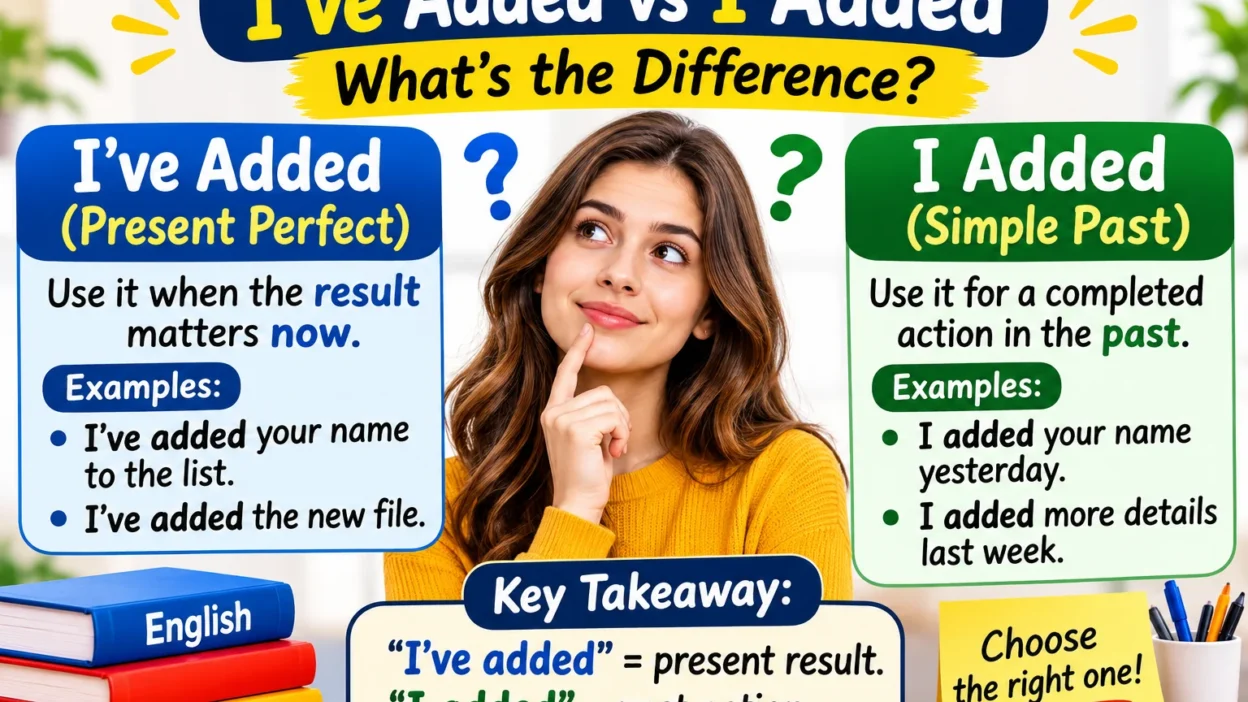
Have you ever wondered if to say “I’ve added” or “I added”? Both expressions are grammatically correct, but they are used in different situations. Understanding the difference can help you speak and write English more naturally, especially when discussing completed actions, updates, messages, documents, or changes.
The main difference is the tense and the connection to the present. “I’ve added” is the present perfect tense. It describes an action that happened in the past but has a connection to the present or a result that matters now. “I added” is the simple past tense. It describes an action that was completed at a specific or understood time in the past. For example, you might say, “I’ve added your name to the list” when informing someone about a current update. However, “I added your name yesterday” focuses on when the action happened. Knowing when to use each expression makes your English clearer and more accurate.
Quick Answer
“I’ve added” and “I added” both describe a completed action, but they have different uses. “I’ve added” (present perfect) emphasizes a present result or connection, while “I added” (simple past) focuses on a completed past action, often with a specific past time. Both are correct in everyday English.
Why Do People Confuse I’ve Added and I Added?
People often confuse these expressions because both communicate that something has been included, inserted, or put somewhere.
For example:
- I’ve added your email address to the contact list.
- I added your email address to the contact list.
Both sentences are correct. The difference is not the action itself but how the speaker presents it.
There are three main reasons for this confusion:
- Similar meanings: Both expressions describe an action that has already happened.
- Different tenses: One uses the present perfect, while the other uses the simple past.
- Time expressions: Certain time expressions work naturally with one tense but not the other.
The easiest way to understand the difference is to look at the relationship between the action and the present moment.
First Word: What Does “I’ve Added” Mean?
“I’ve added” is the contracted form of “I have added.” It uses the present perfect tense.
The structure is:
Subject + have/has + past participle
In this expression:
- I = subject
- Have = helping verb
- Added = past participle of add
We use “I’ve added” when a past action has a present connection or when its result is important now.
When to Use “I’ve Added”
1. To communicate a recent update
Use it when you want to tell someone that something has been added and the result is relevant now.
Example: I’ve added the new information to the report.
2. To emphasize the present result
Use it when the action is complete and its current outcome matters.
Example: I’ve added your name to the guest list.
3. To report a completed task
Use it when informing someone that you have finished adding something.
Example: I’ve added all the necessary details.
4. To describe an experience or achievement
Use it when talking about something you have done without specifying an exact past time.
Example: I’ve added several new skills to my professional profile.
More Examples of “I’ve Added”
- I’ve added your phone number to my contacts.
- I’ve added another paragraph to the introduction.
- I’ve added the missing information.
- I’ve added some examples to the lesson.
- I’ve added your suggestions to the document.
In these examples, the focus is on the completed action and its relevance now.
Second Word: What Does “I Added” Mean?
“I added” is the simple past tense of the verb “add.”
The structure is:
Subject + past-tense verb
Here:
- I = subject
- Added = simple past form of add
We use “I added” when talking about an action that started and finished in the past.
It is particularly useful when the time of the action is mentioned, understood, or important to the conversation.
When to Use “I Added”
1. To describe an action at a specific past time
Example: I added your name to the list yesterday.
2. To explain something that happened earlier
Example: I added the final paragraph before submitting the assignment.
3. To describe a completed past action
Example: I added three new chapters to the book last month.
4. To tell someone about a past decision
Example: I added more examples because the original explanation was unclear.
More Examples of “I Added”
- I added your email address this morning.
- I added the missing details last night.
- I added some sugar to the tea.
- I added a new section to the presentation yesterday.
- I added the final changes before the meeting.
These sentences focus on actions completed in the past.
I’ve Added vs I Added: Comparison Table
| Feature | I’ve Added | I Added |
|---|---|---|
| Full form | I have added | I added |
| Tense | Present perfect | Simple past |
| Main focus | Present result or connection | Completed past action |
| Time reference | Unspecified or connected to now | Past time |
| Recent updates | Very common | Also possible |
| With yesterday | Generally incorrect | Correct |
| With last week | Generally incorrect | Correct |
| Example | I’ve added your name. | I added your name yesterday. |
Remember: The choice depends on if you want to emphasize the present result or the past event.
When Should You Use Each Expression?
Choosing between these expressions becomes easier when you understand the situation.
Use “I’ve Added” When the Result Matters Now
Use the present perfect when you want to communicate that something is now included or available.
Examples:
- I’ve added the new file to the folder.
- I’ve added your comments to the document.
- I’ve added the requested information.
In these situations, the listener is usually interested in the current result.
Use “I Added” When the Past Time Matters
Use the simple past when you want to explain when something happened or describe a completed past event.
Examples:
- I added the file yesterday.
- I added your comments before the deadline.
- I added the information last week.
Here, the focus is on the past action.
Can Both Expressions Work in the Same Situation?
Yes! Sometimes both expressions are appropriate, depending on what you want to emphasize.
For example:
- I’ve added the new members to the group.
- I added the new members to the group yesterday.
The first sentence emphasizes the current result. The second identifies when the action happened.
15 Examples of I’ve Added vs I Added in Sentences
Here are 15 practical examples to help you understand the difference.
| No. | I’ve Added (Present Perfect) | I Added (Simple Past) |
|---|---|---|
| 1 | I’ve added your name to the list. | I added your name yesterday. |
| 2 | I’ve added more information. | I added more information last night. |
| 3 | I’ve added the new file. | I added the new file this morning. |
| 4 | I’ve added your suggestions. | I added your suggestions before the meeting. |
| 5 | I’ve added another example. | I added another example yesterday. |
| 6 | I’ve added your email address. | I added your email address last week. |
| 7 | I’ve added some new features. | I added some new features last month. |
| 8 | I’ve added the missing paragraph. | I added the missing paragraph earlier. |
| 9 | I’ve added your number to my phone. | I added your number to my phone yesterday. |
| 10 | I’ve added more details to the report. | I added more details to the report last night. |
| 11 | I’ve added the final section. | I added the final section before submitting it. |
| 12 | I’ve added a new chapter. | I added a new chapter last week. |
| 13 | I’ve added the correct address. | I added the correct address this morning. |
| 14 | I’ve added the latest updates. | I added the latest updates yesterday. |
| 15 | I’ve added everything you requested. | I added everything you requested before the deadline. |
Tip: The present perfect connects a past action to the present, while the simple past places the action in a completed past period.
Common Mistakes to Avoid
English learners sometimes use these expressions incorrectly. Here are some common mistakes and their corrections.
Mistake 1: Using Present Perfect With a Finished Past Time
Incorrect:
I’ve added your name yesterday.
Correct:
I added your name yesterday.
Why? Yesterday is a finished past-time expression, so the simple past is normally required.
Mistake 2: Forgetting the Helping Verb
Incorrect:
I’ve add your information.
Correct:
I’ve added your information.
Why? The present perfect requires have/has followed by the past participle.
Mistake 3: Using the Wrong Verb Form
Incorrect:
I have add the new details.
Correct:
I have added the new details.
Why? The past participle of add is added.
Mistake 4: Thinking One Expression Is Always Better
Both expressions are correct. The choice depends on the context and the time reference.
For example:
- I’ve added the document to the folder.
- I added the document to the folder yesterday.
Neither sentence is wrong.
Memory Trick: How to Remember the Difference
Here is a simple trick to remember the difference:
- I’ve added = Result now.
- I added = Action in the past.
Think of these two situations:
Situation 1: Someone asks if you have updated a document.
You reply: “I’ve added the missing information.”
The current result is important.
Situation 2: Someone asks when you updated the document.
You reply: “I added the missing information yesterday.”
The past time is important.
This simple trick can help you choose the correct expression in everyday conversations and writing.
American vs British English: Is There Any Difference?
There is no meaningful difference between American and British English in the use of “I’ve added” and “I added.”
Both varieties use the present perfect and simple past in similar ways.
However, there can be slight differences in how frequently speakers use these tenses in certain situations.
For example:
- British English: I’ve already added your details.
- American English: I already added your details.
Both sentences are natural.
British English speakers may favor the present perfect in some contexts where American English speakers commonly use the simple past, particularly with words such as already.
However, this is a tendency, not a strict rule. Both expressions are understood in both varieties of English.
Similar Words and Expressions
Understanding related expressions can help you improve your grammar and vocabulary.
| Expression | Meaning | Example |
|---|---|---|
| I’ve included | Something is now part of something else | I’ve included your name. |
| I included | Something was included in the past | I included your name yesterday. |
| I’ve inserted | Something has been put into a particular place | I’ve inserted the image. |
| I inserted | Something was put in during the past | I inserted the image earlier. |
| I’ve updated | Something has been brought up to date | I’ve updated the file. |
| I updated | Something was updated in the past | I updated the file last week. |
| I’ve attached | Something has been included as an attachment | I’ve attached the document. |
| I attached | Something was attached in the past | I attached the document yesterday. |
These expressions follow similar tense patterns and can help you communicate more accurately.
Final Verdict: I’ve Added or I Added?
Both “I’ve added” and “I added” are grammatically correct, but they are not always interchangeable.
Use “I’ve added” when you want to emphasize a completed action that has a connection to the present or whose result matters now.
Use “I added” when you want to describe a completed action in the past, especially when mentioning a specific past time such as yesterday, last week, or this morning.
The most important thing is to consider the context rather than choosing one expression every time.
Frequently Asked Questions (FAQs)
1. Is “I’ve added” grammatically correct?
Yes. “I’ve added” is grammatically correct. It is the contraction of “I have added” and uses the present perfect tense to describe a past action connected to the present.
Example: I’ve added your details to the document.
2. Is “I added” correct English?
Yes. “I added” is correct English. It uses the simple past tense to describe an action that was completed in the past.
Example: I added your details yesterday.
3. What is the difference between “I’ve added” and “I added”?
“I’ve added” emphasizes a present result or connection, while “I added” focuses on a completed past action. The first uses the present perfect tense, and the second uses the simple past tense.
4. Can I say “I’ve added it yesterday”?
No, this is generally incorrect in standard English because yesterday refers to a finished past time.
The correct sentence is:
“I added it yesterday.”
5. Should I say “I’ve added you to the group” or “I added you to the group”?
Both are correct.
- “I’ve added you to the group” emphasizes that you are now a member.
- “I added you to the group yesterday” explains when the action happened.
6. Is “I’ve already added” correct?
Yes. “I’ve already added” is correct and commonly used when informing someone that an action has been completed.
Example: I’ve already added your email address to the list.
7. Can I use “I added” without mentioning a specific time?
Yes. You do not always need to mention a specific past time when using the simple past.
Example: I added a new section to the report.
The past time can be understood from the surrounding conversation.
Remember This
- “I’ve added” = Present perfect tense.
- “I added” = Simple past tense.
- Use “I’ve added” when the present result matters.
- Use “I added” when discussing a completed past action.
- Avoid using the present perfect with finished past-time expressions such as yesterday and last week.
The key is simple: Focus on the present result with “I’ve added” and the past action with “I added.”
Conclusion
Understanding the difference between “I’ve added” and “I added” is important for using English tenses correctly. Although both expressions describe completed actions, they communicate different time relationships. “I’ve added” connects a past action to the present, while “I added” describes an action completed in the past.
With regular practice and attention to time expressions, you can use both forms confidently. Remember to consider if you are emphasizing the current result or explaining a past event. This small grammar distinction can make your everyday conversations, emails, and professional writing more natural and accurate.

John Tyler is a dream researcher and content writer at SleepCout, sharing insightful articles about coded dreams, dream meanings, symbolism, sleep psychology, and practical guidance to help readers understand their dreams.