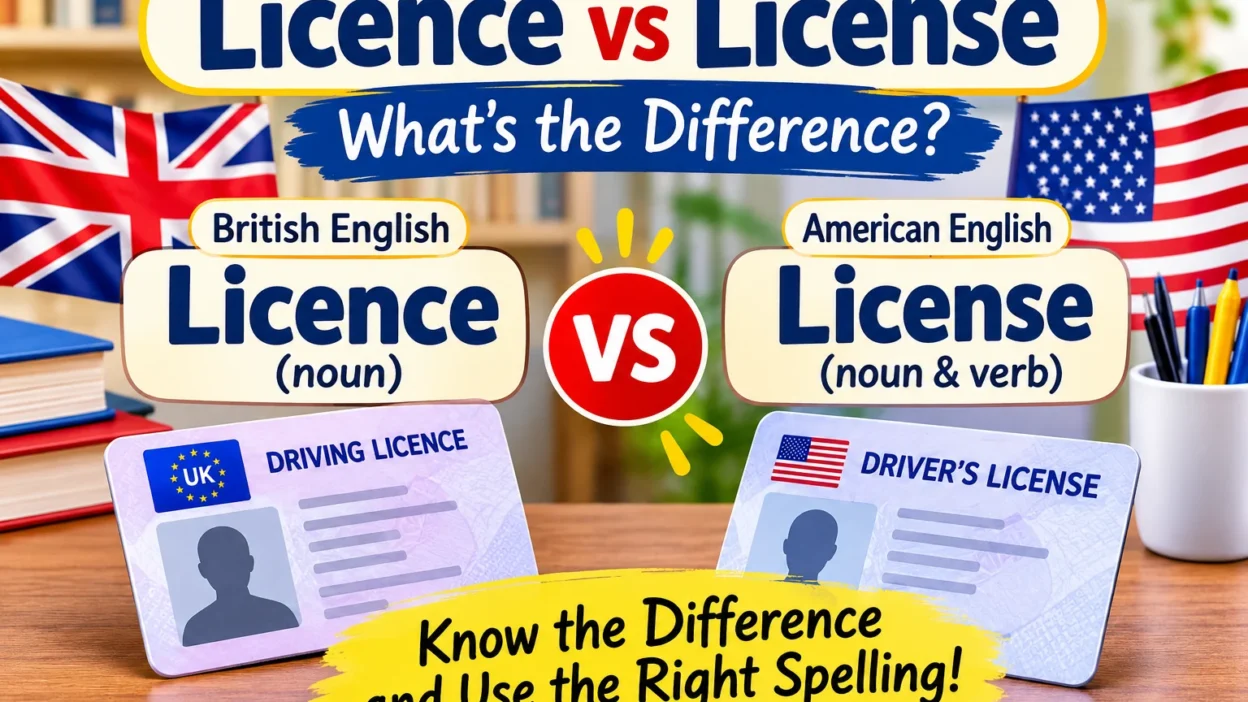
Have you ever wondered if to write licence or license? Both spellings are correct, but the right choice depends on if you are using American or British English. Although the words look almost identical and have the same pronunciation, they follow different spelling conventions. Understanding the difference will help you write more accurately and avoid common spelling mistakes.
The main distinction is that license is used in both American English and British English as a verb. However, American English uses license as both a noun and a verb, while British English traditionally uses licence as a noun and license as a verb. This spelling difference also appears in other varieties of English, including Canadian and Australian English, although local style guides may vary.
Quick Answer: Licence vs License
Licence is the British English spelling of the noun, meaning official permission to do something. License is the American English spelling for both the noun and verb. In British English, license is used as a verb meaning to give official permission. Both words have the same pronunciation.
Why Do People Confuse Licence and License?
People often confuse licence and license because they have the same pronunciation, similar meanings, and almost identical spellings.
The difference is mainly related to regional spelling conventions and grammatical functions.
Here are three reasons for the confusion:
- Similar pronunciation: Both words sound exactly the same in standard English pronunciation.
- Different regional rules: American and British English follow different spelling conventions for the noun.
- Same general meaning: Both forms relate to official permission, authorization, or legal approval.
For example:
- British English: She has a driving licence.
- American English: She has a driving license.
Both sentences are correct.
1. Licence: Meaning and Examples
Licence (noun) is the British English spelling for an official document or permission that allows someone to do something.
It is commonly used when talking about driving, business activities, professional qualifications, and legal permissions.
Meaning of Licence
Licence means official permission granted by an authority to perform a particular activity.
Examples:
- I renewed my driving licence last week.
- You need a licence to operate this business.
- She applied for a marriage licence.
- The restaurant has a licence to sell alcohol.
- His professional licence expires next month.
- You must carry your fishing licence.
- The company received a licence to use the software.
- He lost his licence after breaking traffic laws.
Important: In British English, licence is a noun. Do not use it as a verb in standard British spelling.
2. License: Meaning and Examples
License can be a noun or a verb, depending on the variety of English being used.
In American English, it is the standard spelling for both grammatical functions. In British English, it is used as a verb.
Meaning of License as a Noun
In American English, license means official permission or a document that gives someone the right to do something.
Examples:
- I need to renew my driver’s license.
- She received a business license.
- He applied for a fishing license.
- The company has a license to sell its products.
- You must show your license before entering.
Meaning of License as a Verb
License means to officially give someone permission or legal authority to do something.
Examples:
- The government will license the new company.
- The agency licenses professional drivers.
- The authority licensed the restaurant last year.
- This organization can license qualified teachers.
- The company is licensed to operate in several countries.
Important: In British English, license is the verb spelling. In American English, it is used for both nouns and verbs.
Licence vs License: Comparison Table
| Feature | Licence | License |
|---|---|---|
| American English noun | No | Yes |
| American English verb | No | Yes |
| British English noun | Yes | No |
| British English verb | No | Yes |
| Pronunciation | Same | Same |
| Meaning | Official permission (noun) | Official permission or to authorize |
| Example | Driving licence | Driving license |
When to Use Licence vs License
Choosing between these spellings is easy once you know your audience and the grammatical role of the word.
Use Licence When:
Use licence as a noun when writing in British English.
Examples:
- She has a valid driving licence.
- I need a licence to open this shop.
- His television licence has expired.
Use License When:
Use license in American English for both nouns and verbs.
Examples:
- I renewed my driver’s license.
- The state will license the new business.
- She has a professional license.
Also use license as a verb in British English.
Examples:
- The government will license the company.
- The authority licenses qualified professionals.
12 Examples of Licence vs License in Sentences
Here are practical examples to help you understand the difference.
- British English: My driving licence expires next month.
- American English: My driver’s license expires next month.
- British English: You need a licence to sell alcohol.
- American English: You need a license to sell alcohol.
- British English: The government will license the business.
- American English: The government will license the business.
- British English: She applied for a professional licence.
- American English: She applied for a professional license.
- British English: The authority licensed the company.
- American English: The authority licensed the company.
- British English: He forgot to bring his fishing licence.
- American English: He forgot to bring his fishing license.
Notice that the spelling changes when the word is a noun in British and American English. However, the verb spelling remains license in both varieties.
Common Mistakes When Using Licence and License
Even experienced English writers sometimes mix up these words. Here are some common mistakes to avoid.
Mistake 1: Using licence as a verb in British English
- Incorrect: The government will licence the company.
- Correct: The government will license the company.
Mistake 2: Using licence as a noun in American English
- Incorrect: I need a driving licence.
- Correct: I need a driver’s license.
Mistake 3: Thinking the words have different pronunciations
Both words are pronounced the same way. Their difference is spelling and grammatical usage, not pronunciation.
Mistake 4: Mixing American and British spelling
- Inconsistent: I renewed my driving licence, and the state will licence my business.
- Consistent British English: I renewed my driving licence, and the state will license my business.
Always follow one spelling convention throughout your writing.
Memory Trick: How to Remember Licence vs License
A simple memory trick can help you remember the difference.
Think of C for Certificate:
- Licence = British English noun.
- License = American English noun and verb, and British English verb.
Remember this simple rule:
British English: C for the noun, S for the verb.
American English: S for both.
This trick makes it easier to choose the correct spelling when writing.
American English vs British English
The difference between licence and license is an example of how American and British English use different spelling conventions.
American English
American English uses license for both nouns and verbs.
Examples:
- I have a valid driver’s license.
- The government licenses the company.
- She needs a business license.
British English
British English traditionally uses licence as a noun and license as a verb.
Examples:
- I have a valid driving licence.
- The government licenses the company.
- She needs a business licence.
What About Australian and Canadian English?
Australian English generally follows the British distinction:
- Noun: licence
- Verb: license
Canadian English commonly uses licence as a noun and license as a verb, although individual style guides and institutional preferences should be followed.
Similar Words: Other British and American Spelling Differences
The licence vs license difference is not the only spelling variation between British and American English.
Here are some other examples:
| British English | American English |
|---|---|
| Defence | Defense |
| Offence | Offense |
| Pretence | Pretense |
| Practice (noun and verb) | Practice (noun and verb) |
| Colour | Color |
| Centre | Center |
| Travelling | Traveling |
| Organise | Organize |
Notice that defence and offence follow a similar noun spelling pattern in British English, while American English uses defense and offense.
Frequently Asked Questions (FAQs)
1. Is licence or license correct?
Both are correct. Licence is the British English spelling of the noun, while license is the American English spelling for both the noun and verb. British English also uses license as a verb.
2. Is licence British or American English?
Licence is traditionally the British English spelling used for a noun. For example: “She has a valid driving licence.”
3. Is license American or British English?
License is used in American English as both a noun and a verb. It is also the standard verb spelling in British English.
4. Is driving licence or driving license correct?
Both are correct, depending on the English variety. British English uses driving licence, while American English uses driver’s license.
5. Is license a noun or a verb?
License can be both a noun and a verb in American English. In British English, it is generally used as a verb, while licence is used as the noun.
6. Do licence and license sound the same?
Yes. Both words have the same pronunciation. The difference is their spelling and grammatical usage.
7. Is it licensed or licenced?
The correct standard spelling is licensed in both British and American English. The verb is spelled license, so its past-tense form is licensed.
Remember This
The easiest way to remember the difference is:
- Licence: British English noun.
- License: American English noun and verb.
- License: British English verb.
Both words have the same pronunciation and are related to official permission or authorization.
Conclusion
The difference between licence and license depends mainly on the type of English you are using. British English uses licence as a noun and license as a verb. American English uses license for both grammatical functions. Although their spellings differ, their pronunciation and general meaning remain the same.
To avoid mistakes, remember the simple C-for-noun and S-for-verb rule in British English. If you are writing for an American audience, use license in every situation. Following these conventions will make your writing clearer, more consistent, and grammatically accurate.

Charles Kyle is a passionate writer and dream researcher at SleepCout, dedicated to exploring coded dreams, lucid dreaming, dream symbolism, and sleep science. He creates engaging, well-researched content that helps readers understand their dreams and discover the fascinating connection between technology, imagination, and the sleeping mind.