
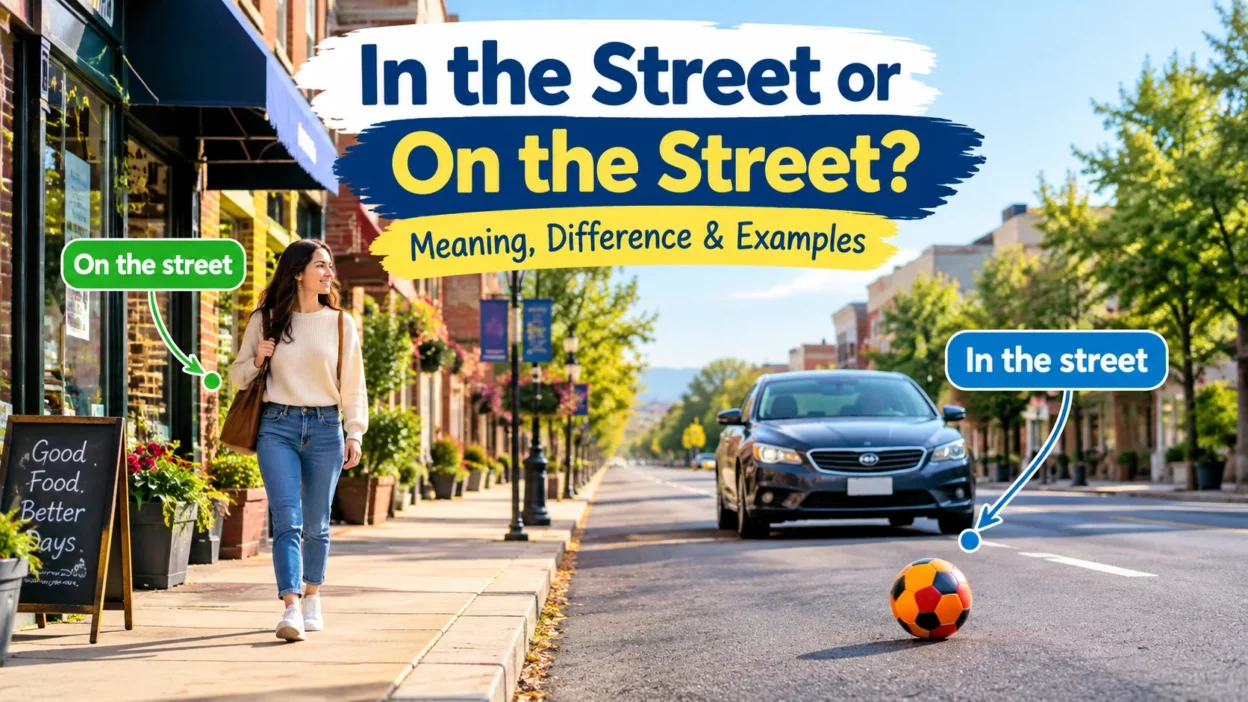
If you are unsure if to say “in the street” or “on the street,” both expressions are grammatically correct, but they are used in different situations. “On the street” is generally more common when talking about being located along or beside a street, while “in the street” often emphasizes being physically within the street or roadway itself.
For example, you can say, “There is a restaurant on the street,” when describing its location along a street. However, “The children were playing in the street” suggests that the children were actually in the roadway. Understanding this small difference can make your English sound more natural and precise. The choice depends mainly on whether you mean a location along a street or inside the street area.
Quick Answer
“On the street” is more common for locations, addresses, or being along a street. “In the street” usually means physically within the roadway or street area. For example, “She lives on Green Street” is natural, while “The children are playing in the street” means they are playing on the roadway.
Why Do People Confuse “In the Street” and “On the Street”?
The confusion comes from the fact that both in and on can describe location.
In English, however, prepositions often depend on how we imagine a place.
- On the street → along, beside, or located on a particular street.
- In the street → physically within the street or roadway.
- On the street can also describe someone who is outside rather than inside a building.
- In the street often draws attention to the physical space of the street itself.
Compare:
The bakery is on the street.
This means the bakery is located along that street.
The ball is in the street.
This suggests the ball has rolled into the roadway.
What Does “In” Mean in “In the Street”?
In generally indicates that something is inside or within an area.
So, “in the street” can mean physically located within the street space.
Examples
- A car stopped in the street.
- The children were playing in the street.
- There was a large hole in the street.
- Someone left a bicycle in the street.
The expression often focuses on the physical street area, particularly the roadway.
What Does “On” Mean in “On the Street”?
On is commonly used for something located along a surface, route, or named street.
Examples
- I live on this street.
- There is a pharmacy on the street.
- We met a friend on the street.
- The hotel is on Main Street.
Here, on usually identifies the street as a location or route rather than saying something is physically inside the roadway.
In the Street vs On the Street: Comparison Table
| Expression | Main Meaning | Common Use | Example |
|---|---|---|---|
| In the street | Within the physical street/roadway area | Objects, people, activities | The children are playing in the street. |
| On the street | Along or located at a street | Locations, addresses, people | The shop is on the street. |
| On the street | Outside or in public | General situations | I met him on the street. |
| In the street | Actually within the roadway | Physical position | There is a car in the street. |
When Should You Use “In the Street”?
Use “in the street” when you want to emphasize that someone or something is physically within the street area.
1. For people physically in the roadway
The children were playing in the street.
2. For objects lying in the roadway
There is a large branch in the street.
3. For vehicles positioned in the road
A truck was parked in the street.
4. For something happening within the street
A parade was taking place in the street.
The expression can suggest that the street itself is the space where something is happening.
When Should You Use “On the Street”?
Use “on the street” when referring to a location along a street or someone’s presence in a public street environment.
1. For locations
The bank is on the street near the station.
2. For named streets
She lives on King Street.
3. For people outside
I saw him on the street yesterday.
4. For businesses
There is a new café on our street.
5. For public situations
We found a lot of people on the street.
10+ Examples of “In the Street” and “On the Street”
Examples With “In the Street”
- The children were playing in the street.
- A dog was running in the street.
- There was a fallen tree in the street.
- The car stopped in the street.
- Someone dropped a wallet in the street.
- Water was flowing in the street.
- A cyclist fell in the street.
- The workers found a damaged pipe in the street.
Examples With “On the Street”
- I live on this street.
- There is a supermarket on the street.
- We met our teacher on the street.
- The hotel is on Oxford Street.
- She saw her friend on the street.
- There are several restaurants on this street.
- He spends a lot of time on the street.
Common Mistakes
Mistake 1: Using “in” for a street address
❌ I live in Green Street.
✅ I live on Green Street.
When referring to a named street as an address, on is normally used.
Mistake 2: Using “on” when something is actually in the roadway
❌ There is a huge pothole on the street.
This sentence can be understood, but if you want to emphasize its physical position within the roadway, in the street may be more precise.
✅ There is a huge pothole in the street.
Mistake 3: Assuming one preposition always works
English prepositions are strongly influenced by context.
Instead of memorizing only one expression, ask:
Am I talking about a location along the street, or something physically within the street?
Memory Trick
Remember:
ON = along the street
IN = inside the street area
Think of a row of shops:
Shops are on the street.
Now imagine a ball rolling into the roadway:
The ball is in the street.
A simple formula is:
Address/location → ON
Physical roadway → IN
American vs British English
Both American English and British English use “in the street” and “on the street.”
The basic distinction remains similar.
For example:
- I live on this street.
- There is a car in the street.
- The children are playing in the street.
- I saw her on the street.
There can be differences in how speakers describe particular situations, but the central distinction between being located along a street and being physically within the street area is useful in both varieties.
Similar Words and Expressions
Several related expressions can also cause confusion.
On the road
Usually refers to traveling or being on a road.
We have been on the road for three hours.
In the road
Often emphasizes physical position within the roadway.
A fallen tree is in the road.
On the sidewalk
Refers to being on the pedestrian path beside a road.
She was walking on the sidewalk.
By the street
Means near or beside a street.
There is a small house by the street.
Along the street
Means following the length or direction of a street.
There are several shops along the street.
Final Verdict
Both “in the street” and “on the street” are correct, but they communicate slightly different ideas.
Use “on the street” for a street as a location, especially with addresses, businesses, homes, and people being out in public.
Use “in the street” when you want to emphasize that someone or something is physically within the street or roadway.
The most useful distinction is:
“I live on the street.”
“The children are playing in the street.”
FAQs
Is “in the street” grammatically correct?
Yes. “In the street” is grammatically correct and usually describes someone or something physically within the street or roadway.
Is “on the street” grammatically correct?
Yes. “On the street” is very common and can describe a location along a street, being outside in public, or living at a particular street address.
Do you say “I live in the street” or “I live on the street”?
Normally, say “I live on the street.” For example: “I live on Park Street.”
Do you say “playing in the street” or “playing on the street”?
“Playing in the street” is very common when you mean playing within the roadway or street area.
Is it “on Main Street” or “in Main Street”?
Use “on Main Street” when referring to the named street as a location.
The store is on Main Street.
What is the difference between “in the street” and “on the street”?
“In the street” emphasizes being within the physical street area, while “on the street” commonly refers to a location along the street or being outside in public.
Which is more common: “in the street” or “on the street”?
Neither is universally correct in every situation. “On the street” is especially common for locations and addresses, while “in the street” is natural when emphasizing something physically within the roadway.
Remember This
- On the street = along or located at a street.
- In the street = physically within the street area.
- On Main Street = correct for a named street.
- In the street = useful for things physically in the roadway.
- On the street can also mean outside or in a public place.
Conclusion
The difference between “in the street” and “on the street” is mainly about how you view the street in the sentence. On the street commonly identifies a location, address, or someone’s presence outside. In the street focuses more on being physically within the street or roadway.
When choosing between them, consider the meaning you want to express. If you are giving an address, describing a shop’s location, or saying where someone lives, on is usually the natural choice. If something is physically occupying the roadway, in often gives the clearer meaning.

John Tyler is a dream researcher and content writer at SleepCout, sharing insightful articles about coded dreams, dream meanings, symbolism, sleep psychology, and practical guidance to help readers understand their dreams.