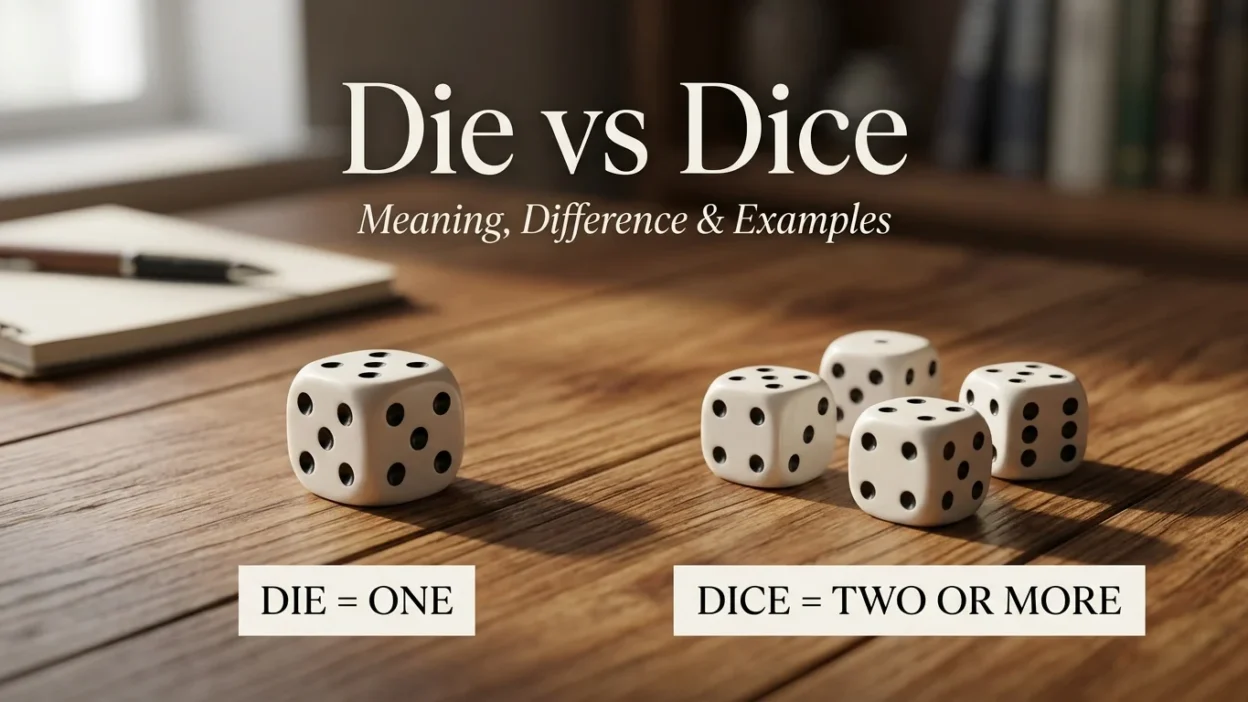
If you are talking about games, you may wonder if you should say die or dice. The basic difference is simple: die is the singular form, while dice is traditionally the plural form. You use one die when referring to a single cube with numbered sides, and two dice when referring to two or more. For example, “I rolled one die” is correct, while “I rolled two dice” is correct. Although dice is increasingly used as a singular noun in informal modern English, die remains the standard singular form in careful or formal writing.
These words can be confusing because die also has other meanings. As a verb, die means to stop living, while as a noun it can refer to a tool used for cutting, shaping, or stamping materials. In this article, we will focus mainly on die vs dice when talking about games and gambling.
Quick Answer: Die vs Dice
Die is traditionally the singular form of dice, so you say “one die” and “two dice.” A die is one small numbered cube used in games, while dice means two or more of these objects. In informal English, dice is sometimes used for both singular and plural, but die is preferred in formal writing.
Why Do People Confuse Die and Dice?
People often confuse die and dice because the words refer to the same type of object and are frequently used together in games.
The main difficulty is remembering which word is singular and which is plural:
- One die = one game cube
- Two dice = two game cubes
- Three dice = three game cubes
Another reason for the confusion is that dice is commonly used as a general term for these gaming objects. In everyday speech, you may hear someone say “a dice,” especially in informal contexts.
However, if you want to follow the traditional grammatical distinction, use die for one and dice for more than one.
Die: Meaning and Usage
Die is the traditional singular noun for one of the small objects used in games.
A typical die has six sides, numbered from 1 to 6, although dice can have different numbers of sides.
Examples of “die”
- I rolled one die.
- The die landed on six.
- Pick up the die and roll it again.
- This game requires one die.
- The die fell off the table.
In these examples, die refers to a single gaming object.
Other meanings of “die”
The word die has meanings unrelated to games.
As a verb, die means to stop living:
- Plants can die without water.
- The old tree began to die.
As a noun, die can also refer to a tool used to cut, shape, or form material.
So the meaning of die depends on the context.
Dice: Meaning and Usage
Dice is traditionally the plural form of die when referring to gaming objects.
Use dice when you are talking about two or more game cubes.
Examples of “dice”
- I rolled two dice.
- The dice landed on the floor.
- She bought a new set of dice.
- We need three dice for this game.
- The player rolled the dice.
The plural form does not normally become dies when talking about gaming cubes. The traditional plural is dice.
Die vs Dice: Comparison Table
| Word | Traditional Number | Meaning | Example |
|---|---|---|---|
| die | Singular | One gaming cube | I rolled one die. |
| dice | Plural | Two or more gaming cubes | I rolled two dice. |
| die | Verb | To stop living | Plants die without water. |
| die | Noun | A tool for shaping or cutting | The machine uses a metal die. |
When Should You Use Die or Dice?
The choice depends mainly on the number of objects you are describing.
Use “die” for one
When you are talking about a single gaming cube, use die in traditional standard English.
Correct:
I rolled one die.
Not traditionally preferred:
I rolled one dice.
Use “dice” for two or more
When you are talking about multiple gaming cubes, use dice.
Correct:
She rolled two dice.
Correct:
We need four dice.
What about “a dice”?
You may encounter a dice in informal English, especially in modern gaming communities. This usage reflects the increasing tendency to treat dice as both singular and plural.
Still, if you are writing an academic assignment, educational material, formal article, or other careful English, a die is the safer traditional choice.
Die vs Dice: 10+ Examples
Here are practical examples to make the difference easier to remember.
- I rolled one die and got a five.
- She rolled two dice at the same time.
- The die landed on the number three.
- The players threw the dice across the table.
- This board game requires one die.
- The game comes with two dice.
- He picked up the die and rolled it again.
- The dice were scattered across the table.
- We need another die for this game.
- The children rolled the dice to decide who would go first.
- One die is missing from the set.
- The player shook the dice before rolling them.
Notice the pattern
The easiest pattern is:
1 = die
2 or more = dice
For example:
- one die
- two dice
- three dice
- four dice
Common Mistakes with Die and Dice
Mistake 1: “I rolled one dice.”
In traditional standard English, this should be:
I rolled one die.
Mistake 2: “I rolled two dies.”
When referring to gaming cubes, the traditional plural is not dies.
Use:
I rolled two dice.
Mistake 3: “There is three dice.”
Because dice is traditionally plural, use a plural verb when referring to multiple dice:
There are three dice on the table.
Mistake 4: Thinking “die” only means death
Die has several meanings.
It can mean:
- to stop living
- one gaming cube
- a tool used to shape or cut material
The context tells you which meaning is intended.
Mistake 5: Assuming “dice” is always wrong for one object
Modern English is changing. Dice is increasingly used as a singular noun in informal contexts. Therefore, you may see phrases such as “a dice.”
However, die remains the traditional singular form and is the best choice when you want to be precise or formal.
Memory Trick: Die = One, Dice = More
A simple way to remember the difference is:
One die, many dice.
Think of the -ce in dice as a signal that you are talking about a group.
You can also memorize this short sentence:
One die rolls; two dice roll.
If you remember that sentence, you will usually choose the correct word.
American vs British English
The traditional distinction between die and dice is understood in both American and British English.
In both varieties, die is traditionally the singular form and dice is the plural form when referring to gaming objects.
However, dice is widely used informally as both a singular and plural noun in modern English. This usage is especially common in casual speech and gaming contexts.
For formal writing, the clearest choice remains:
- one die
- two dice
The difference is therefore more about traditional versus modern usage than a major American-British vocabulary difference.
Similar Words and Related Terms
Several words are connected with die and dice.
Roll
Roll means to throw a die or dice so that they move across a surface.
Roll the dice and see what number you get.
Toss
Toss can also mean to throw dice.
He tossed the dice onto the table.
Game piece
A game piece is an object used as part of a board game. It is not necessarily a die.
Move your game piece three spaces.
Number
A number is one of the values shown on a die.
The die landed on the number four.
Pair of dice
A pair of dice means two dice considered together.
He rolled a pair of dice.
Final Verdict: Die or Dice?
The traditional rule is straightforward:
Die = one
Dice = two or more
So you should write:
- one die
- two dice
- three dice
- a pair of dice
If you are writing formally, die is the preferred singular form. Although dice is increasingly used as a singular noun in informal modern English, using die for one gaming cube avoids ambiguity and follows the traditional distinction.
Remember that die also has unrelated meanings, including the verb meaning “to stop living” and a noun referring to a tool used for shaping or cutting materials.
FAQs About Die vs Dice
Is “die” singular or plural?
Die is traditionally the singular form when referring to one gaming cube. For example, “I rolled one die.”
Is “dice” singular or plural?
Traditionally, dice is the plural of die. For example, “I rolled two dice.” In modern informal English, however, dice can also be used as a singular noun.
Is it correct to say “one dice”?
In traditional standard English, one die is preferred. One dice is common in informal usage but does not follow the traditional singular-plural distinction.
Is “two dies” correct?
Not when you mean gaming cubes. The traditional plural of die in this sense is dice, so say two dice.
What is the plural of die?
The plural is dice when die means a gaming cube. However, dies can be the plural of another meaning of die, such as a tool used for shaping or cutting material.
Can “dice” be singular?
Yes. In modern informal English, dice is sometimes treated as both singular and plural. However, die remains the traditional singular form and is preferred in formal or careful writing.
Which is correct: “a die” or “a dice”?
A die is the traditional and formally preferred expression for one gaming cube. In casual modern English, you may also encounter a dice.
How do you remember die vs dice?
Use the simple rule: one die, two or more dice. This is the easiest way to remember the traditional distinction.
Remember This
One die, two dice.
Die = one gaming cube
Dice = two or more gaming cubes
And remember that die can have other meanings depending on the context.
Conclusion
The difference between die and dice is mainly a matter of number. In traditional English, die refers to one gaming cube, while dice refers to two or more. This distinction is simple once you connect die with singular and dice with plural.
Modern English sometimes uses dice as both singular and plural, particularly in informal speech. Nevertheless, one die and two dice remain the clearest and most traditional forms. If you are writing for school, work, or a formal audience, following this distinction is a reliable choice.

Alice Allison is the Administrator at SleepCout, ensuring smooth operations while supporting a platform dedicated to coded dreams, dream interpretation, and insightful content that inspires curiosity, creativity, and imagination.