
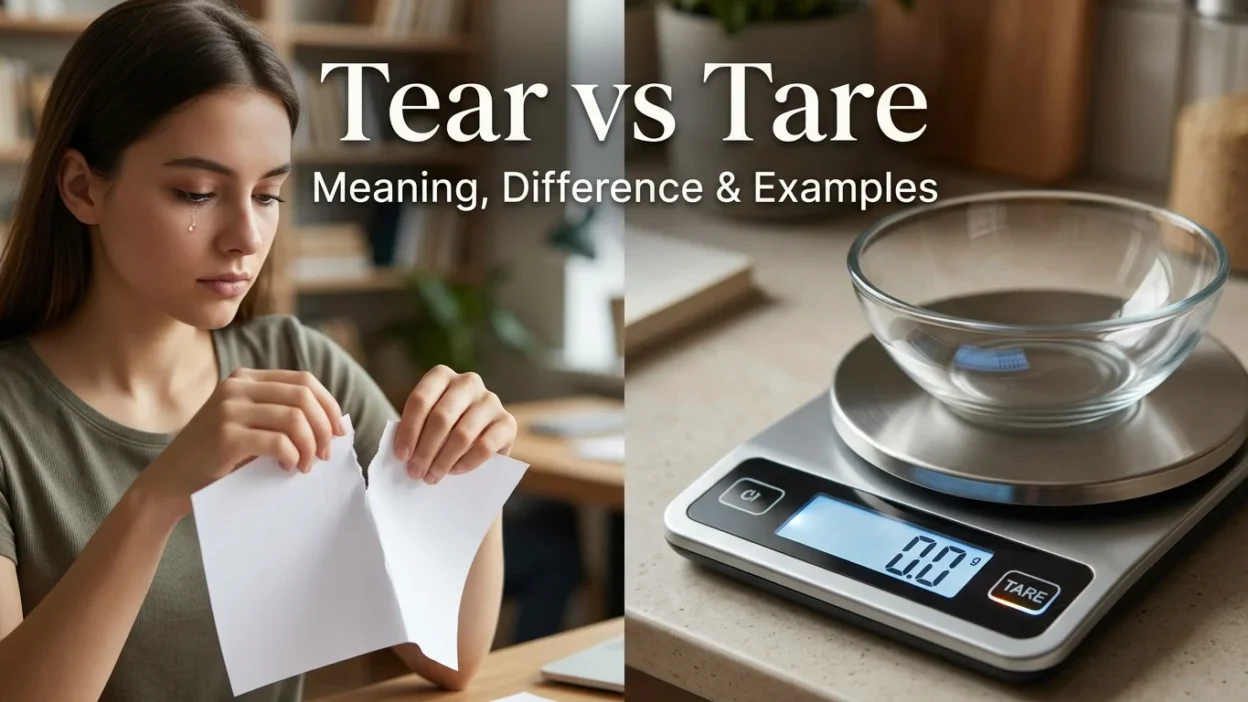
If you are unsure if to write tear or tare, you are not alone. These two words are pronounced differently in most contexts and have completely different meanings. Tear can refer to ripping something apart, a drop of liquid from the eye, or the act of moving quickly. Tare, on the other hand, is mainly used in weighing and packaging to describe the weight of a container or packaging.
The confusion often comes from their similar spelling. However, once you connect each word with its meaning and pronunciation, the difference becomes easy to remember. In this guide, you will learn what tear and tare mean, how to use them correctly, how they differ in American and British English, and how to avoid common mistakes.
Quick Answer
Tear usually means to rip or damage something by pulling it apart, or a drop of fluid from the eye. Tare refers to the weight of an empty container or packaging, especially when weighing goods. Remember: tear is about ripping or crying; tare is about weighing.
Why Do People Confuse Tear and Tare?
Tear and tare look and sound similar in some contexts, but they are different words with different meanings.
The main reason for confusion is their spelling. Both contain the letters t, a, and r, but their vowel arrangement is different.
Compare:
- Tear → to rip, or a drop from the eye
- Tare → the weight of a container or packaging
The pronunciation also changes depending on the meaning of tear.
For example:
- Tear meaning “rip” → sounds like TAIR
- Tear meaning “drop from the eye” → sounds like TEER
- Tare → usually sounds like TAIR
What Does “Tear” Mean?
Tear has several meanings, and it can function as both a verb and a noun.
Tear as a Verb
As a verb, tear means to pull, rip, or separate something by force.
Examples:
- Be careful not to tear the paper.
- She tore her dress on the fence.
- Please don’t tear the envelope.
- The children tore the wrapping paper apart.
The past tense of tear is tore, and the past participle is torn.
Tear → tore → torn
Tear as a Noun
Tear can also mean a drop of liquid that comes from the eye.
Examples:
- A tear rolled down her cheek.
- He wiped away a tear.
- She had tears in her eyes.
- One tear fell onto the page.
In this meaning, tear is pronounced differently from the verb meaning “rip.”
Tear as a Verb Meaning “Move Quickly”
Tear can also mean to move very quickly, often in an uncontrolled or energetic way.
Examples:
- The children tore through the house.
- The car tore down the highway.
- He tore out of the room.
What Does “Tare” Mean?
Tare is a specialized word most commonly used in weighing, shipping, packaging, and commerce.
It refers to the weight of an empty container or packaging.
For example, suppose a box containing products weighs 12 kilograms, while the empty box weighs 2 kilograms.
- Gross weight = 12 kg
- Tare weight = 2 kg
- Net weight = 10 kg
The tare weight is the weight of the container itself, not the contents.
Tare on a Scale
You may also see tare as a button or function on a digital scale.
When you place an empty container on the scale and press Tare, the scale resets the displayed weight to zero. You can then add the material without counting the container’s weight.
For example:
Place the bowl on the scale and press tare before adding flour.
Tear vs Tare: Comparison Table
| Word | Main Meaning | Part of Speech | Example |
|---|---|---|---|
| Tear | To rip or pull apart | Verb | Don’t tear the paper. |
| Tear | A drop from the eye | Noun | A tear rolled down her cheek. |
| Tear | To move very quickly | Verb | The car tore down the road. |
| Tare | Weight of an empty container | Noun | The tare weight is 2 kg. |
| Tare | Reset a scale to account for container weight | Verb | Tare the scale before weighing. |
When Should You Use “Tear” or “Tare”?
Use tear when you are talking about:
- ripping paper
- damaging fabric
- pulling something apart
- crying or tears from the eyes
- moving very quickly
Examples:
Don’t tear the page.
A tear fell from her eye.
Use tare when you are talking about:
- weighing goods
- containers
- packaging
- scales
- net weight and gross weight
- subtracting container weight
Example:
The tare weight of the container is 500 grams.
A simple rule is:
Tear = rip or cry
Tare = container weight or scale adjustment
10+ Examples of Tear and Tare
Examples With “Tear”
- Please don’t tear the paper.
- She accidentally tore her shirt.
- He tore the letter into pieces.
- The child began to tear the wrapping paper.
- A tear rolled down her cheek.
- She tried not to shed a tear.
- There were tears in his eyes.
- The dog tore the cushion apart.
- The runner tore down the track.
- The storm tore branches from the trees.
Examples With “Tare”
- Check the tare weight of the package.
- The empty container has a tare weight of 300 grams.
- Press the tare button before adding the ingredients.
- The scale automatically calculates the tare.
- The label shows the gross, net, and tare weights.
Common Mistakes With Tear and Tare
Mistake 1: Using “tare” for ripping
Incorrect:
Please tare the paper.
Correct:
Please tear the paper.
Mistake 2: Using “tear” for container weight
Incorrect:
The tear weight is 2 kilograms.
Correct:
The tare weight is 2 kilograms.
Mistake 3: Confusing “tear” with “tears”
Remember that tear can mean a drop from the eye.
She wiped away a tear.
The plural is:
She wiped away her tears.
Mistake 4: Forgetting that “tear” has different pronunciations
The spelling stays the same, but the pronunciation changes according to the meaning.
- tear = rip → rhymes with bear
- tear = drop from the eye → rhymes with near
- tare → usually rhymes with bear
Memory Trick: How Can You Remember Tear vs Tare?
Use this simple memory trick:
Tear = Tear something apart or shed a tear.
Think of:
Tear = rip or cry
For tare, think about a scale.
Tare = container weight
You can also remember:
TARE → TARE the scale
If you are dealing with a weighing scale or the weight of packaging, tare is probably the word you need.
American vs British English
The basic meanings of tear and tare are the same in American and British English.
Tear is widely used in both varieties for ripping, crying, and moving quickly.
Tare is also used in both varieties for the weight of packaging or containers and for the process of accounting for that weight when weighing something.
The pronunciation of tare is generally the same as the “rip” meaning of tear.
So this is not primarily an American-versus-British spelling difference. The important distinction is meaning and pronunciation.
Similar Words
Several words are related to tear and tare, but they should not be confused with them.
Rip
Rip means to tear something quickly or forcefully.
He ripped the paper in half.
Ripped
Ripped is the past tense and past participle of rip.
My jacket is ripped.
Torn
Torn is the past participle of tear.
My shirt is torn.
Cry
Cry can mean producing tears because of sadness, pain, happiness, or another strong emotion.
The baby began to cry.
Gross Weight
Gross weight is the total weight of an item, including its container or packaging.
Net Weight
Net weight is the weight of the actual contents without the packaging.
Tare Weight
Tare weight is the weight of the empty container or packaging.
Final Verdict: Tear or Tare?
The correct word depends entirely on what you mean.
Use tear when you mean rip, pull apart, a drop from the eye, or move very quickly.
Use tare when you mean the weight of an empty container or the process of adjusting a scale to exclude the container’s weight.
The easiest distinction is:
Tear = rip or cry.
Tare = weighing and containers.
Once you connect tare with a scale and tear with ripping or crying, the difference becomes much easier to remember.
Frequently Asked Questions
Is it “tear weight” or “tare weight”?
The correct expression is tare weight. It refers to the weight of an empty container or packaging.
Is “tear” and “tare” the same word?
No. Tear and tare are different words with different meanings. Tear can mean rip or a drop from the eye, while tare relates mainly to container weight and weighing.
How do you pronounce “tear” and “tare”?
When tear means “rip,” it is usually pronounced like tare. When tear means a drop from the eye, it has a different pronunciation, like the vowel sound in near.
What does “tare” mean on a weighing scale?
Tare allows a scale to exclude the weight of a container. For example, you can place an empty bowl on the scale, press the tare function, and then weigh the ingredients without including the bowl.
What is the past tense of “tear”?
The past tense of tear meaning “rip” is tore.
Present: I tear the paper.
Past: I tore the paper.
Past participle: I have torn the paper.
Can “tear” be a noun?
Yes. Tear can be a noun meaning a drop of liquid from the eye.
A tear rolled down her cheek.
Is “tare” used only for weighing?
Tare is most commonly associated with weighing and the weight of containers or packaging. It is especially common in technical, commercial, shipping, and measurement contexts.
Remember This
- Tear = rip something
- Tear = a drop from the eye
- Tear = move very quickly
- Tare = weight of an empty container
- Tare = adjust a scale to exclude container weight
- Tore = past tense of tear
- Torn = past participle of tear
Easy memory rule: Tear is for ripping or crying; tare is for scales and containers.
Conclusion
Although tear and tare look similar, they have very different uses. Tear is the everyday word you need when talking about ripping something, a drop from someone’s eye, or rapid movement. It also changes form to tore and torn when used as a verb.
Tare is mainly used in weighing and packaging. It describes the weight of an empty container or the adjustment that removes the container’s weight from a measurement. If you remember tear = rip or cry and tare = weighing, you can easily choose the correct word in most situations.

John Tyler is a dream researcher and content writer at SleepCout, sharing insightful articles about coded dreams, dream meanings, symbolism, sleep psychology, and practical guidance to help readers understand their dreams.