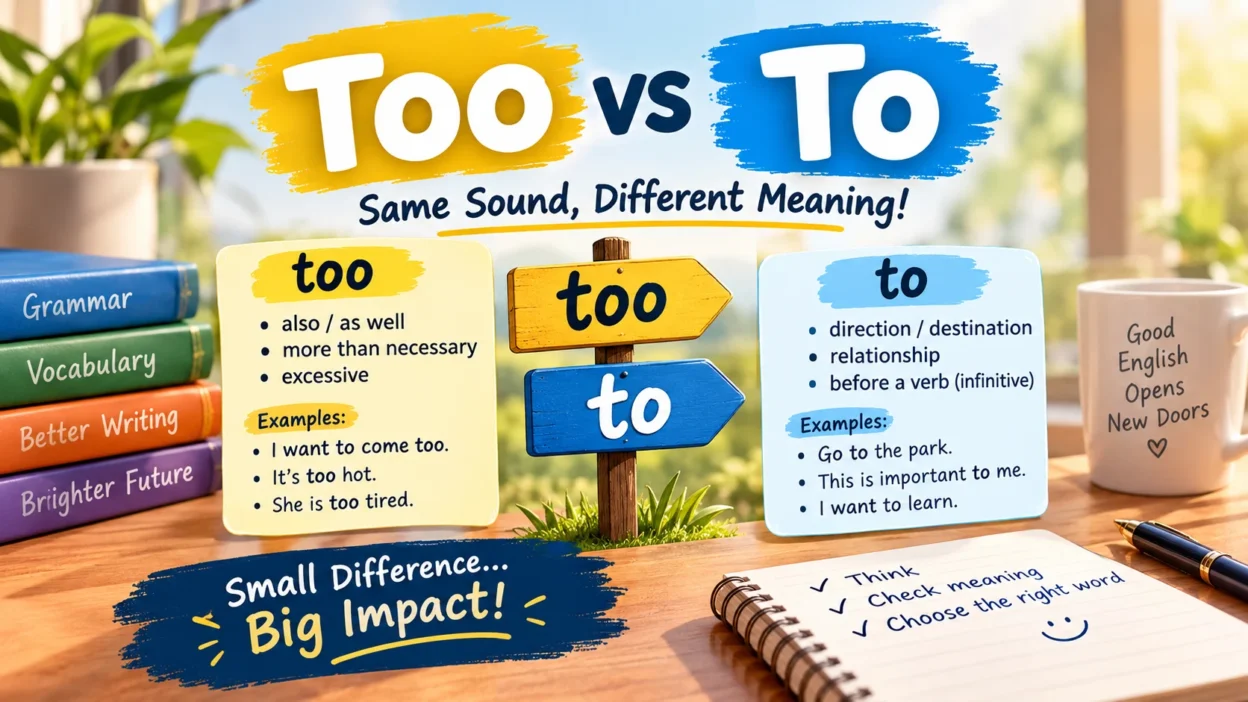
Too and to may sound the same, but they have different meanings and uses. To is usually a preposition or part of an infinitive verb, while too usually means also, as well, or more than enough. Learning the difference helps you avoid one of the most common English writing mistakes.
Many learners confuse these words because they are homophones—words with the same pronunciation but different spellings and meanings. The good news is that once you understand a few simple rules and examples, choosing between to and too becomes much easier.
Quick Answer
To is used for direction, relationships, or before a verb, as in “I want to learn.” Too means “also” or “more than necessary,” as in “I want to learn too” or “It is too difficult.” Remember: too often relates to addition or excess.
Why Do People Confuse Too and To?
The main reason is simple: too and to are pronounced the same way in most English accents.
However, pronunciation does not tell you which spelling to use. You need to look at the word’s role and meaning in the sentence.
For example:
- I am going to school.
- I am going too fast.
In the first sentence, to shows direction. In the second, too means excessively.
What Does “To” Mean?
To is one of the most common words in English. It is mainly used as a preposition or as part of an infinitive verb.
1. To Shows Direction or Destination
Use to when someone or something is moving toward a place, person, or thing.
Examples:
- We are going to the park.
- She walked to school.
- I sent the email to my teacher.
- They traveled to London.
2. To Shows a Relationship
To can connect people, things, or ideas.
Examples:
- This answer is important to me.
- He is married to Sarah.
- The solution to the problem was simple.
- Please speak to the manager.
3. To Comes Before an Infinitive Verb
An infinitive usually follows the pattern to + base verb.
Examples:
- I want to learn English.
- She decided to leave early.
- We need to study.
- They hope to travel soon.
In these examples, to is part of the verb structure.
What Does “Too” Mean?
Too is usually an adverb. It commonly has two main meanings: also and more than necessary or desirable.
1. Too Means “Also” or “As Well”
Use too when you want to add similar information.
Examples:
- I like coffee, too.
- She wants to come, too.
- Can I join too?
- They were invited too.
When too means also, it often appears at the end of a sentence.
2. Too Means “More Than Necessary”
Use too when something is excessive.
Examples:
- The coffee is too hot.
- This bag is too heavy.
- You are driving too fast.
- The question is too difficult.
In these sentences, too means more than is wanted, needed, or acceptable.
Too vs To: Comparison Table
| Word | Main Meaning | Common Use | Example |
|---|---|---|---|
| To | Direction, connection, or part of an infinitive | Before a noun, pronoun, or verb | I want to sleep. |
| Too | Also; more than necessary | Addition or excess | I want to sleep too. |
| Too much | More than needed | Excessive quantity | There is too much noise. |
| Too many | More than needed | Excessive number | There are too many people. |
When Should You Use “To”?
Use to when you are talking about:
Direction
- Go to the office.
- Walk to the door.
- Drive to the airport.
A Recipient
- Give the book to Maria.
- Send the message to your friend.
- Explain it to me.
A Range or Limit
- The shop is open from 9 to 5.
- Count from one to ten.
- The temperature rose from 20 to 30 degrees.
An Infinitive
- I need to go.
- She wants to improve.
- We plan to visit them.
When Should You Use “Too”?
Use too when you mean also, as well, or more than enough.
Meaning “Also”
- I am happy too.
- My brother likes football too.
- She can speak Spanish too.
Meaning “Excessively”
- It is too cold outside.
- The music is too loud.
- He arrived too late.
- This box is too big.
12 Examples of Too vs To
Here are practical examples that show the difference clearly:
- I want to go to the beach.
- I want to go too.
- She is going to call her mother.
- The food is too spicy.
- Please give this letter to John.
- John wants to come too.
- We need to leave now.
- We are leaving too early.
- They traveled to another country.
- The suitcase is too heavy to carry.
- I love reading, and my sister does too.
- It is never too late to learn.
Notice that both words can appear in the same sentence:
The suitcase is too heavy to carry.
Here, too means excessively, while to introduces the verb carry.
Common Mistakes With Too and To
One of the most common mistakes is using to when you mean also.
Incorrect: I want to come to.
Correct: I want to come too.
Another common mistake is using too before an infinitive verb.
Incorrect: I want too learn English.
Correct: I want to learn English.
Also remember that too does not always mean “very.”
Too tired means excessively tired or more tired than is acceptable for a situation. Very tired simply means extremely tired.
Compare:
- I am very tired, but I can continue.
- I am too tired to continue.
The second sentence suggests that tiredness prevents the action.
A Simple Memory Trick for Too vs To
Here is an easy way to remember:
Think of the Extra “O”
Too has an extra O.
That extra letter can remind you of something extra:
- Too = also / extra
- Too = more than enough / excessive
For example:
I want one too.
The extra O can remind you that someone or something is being added.
Use to for direction or before a verb:
- Go to school.
- Want to learn.
- Talk to her.
Too vs To in American and British English
The basic rules for too and to are the same in both American and British English.
Both varieties use:
- to for direction and infinitives.
- too for “also” and “more than necessary.”
For example, these sentences are correct in both:
- I’m going to the store.
- I’m going too.
- It’s too expensive to buy.
However, the word too may sometimes sound slightly different depending on the speaker’s accent. The spelling and grammar rules remain the same.
Similar Words You May Confuse With Too and To
Two
Two is the number 2.
- I have two cats.
- She bought two books.
To
To usually shows direction, connection, or an infinitive.
- Go to the station.
- I want to eat.
Too
Too means also or excessively.
- I want one too.
- It is too expensive.
These three words—to, too, and two—are homophones in standard pronunciation, so context is important.
Common Expressions Using “Too”
Learning common phrases can help you understand how too works naturally.
Too Much
Used for an excessive amount of something.
- You are watching too much television.
- There is too much sugar in this recipe.
Too Many
Used for an excessive number of countable things.
- There are too many mistakes.
- She has too many bags.
Too Little
Used when there is not enough of something.
- We have too little time.
Too Late
Means after the appropriate or expected time.
- It is too late to change the plan.
Too Good to Be True
Means something seems so good that it may not be real or believable.
- The offer looked too good to be true.
Final Verdict: Too or To?
Choose to when you are showing direction, connection, or using an infinitive verb.
Choose too when you mean also, as well, or more than necessary.
A quick check can help:
- Can you replace the word with also? Use too.
- Does it mean excessively? Use too.
- Is it showing direction or coming before a base verb? Use to.
Frequently Asked Questions
Is it “too much” or “to much”?
The correct phrase is too much. Here, too means more than necessary or desirable.
How do I know whether to use too or to?
Use too for “also” or “excessively.” Use to for direction, connection, recipients, ranges, or before the base form of a verb.
Can “too” mean “also”?
Yes. Too can mean also or as well. For example: “I would like to come too.”
Is “I love you too” correct?
Yes. I love you too is correct when you are responding by expressing the same feeling.
Why does “too” have two O’s?
The spelling is simply part of English. As a memory aid, many learners use the extra O to remember that too often suggests addition or excess.
Is “to” always a preposition?
No. To can function as a preposition, but it is also used as an infinitive marker before a base verb, such as in “to eat” or “to learn.”
What is the difference between “too” and “very”?
Very strengthens an adjective or adverb, while too usually suggests an excessive degree or an unwanted result.
- The soup is very hot.
- The soup is too hot to eat.
Remember This
Keep these three simple rules in mind:
- To = direction or to + verb
- Too = also or excessively
- Two = the number 2
If you can remember the meaning first, choosing the correct spelling becomes much easier.
Conclusion
The difference between too and to is small in pronunciation but important in writing. To is generally used for direction, relationships, and infinitive verbs, while too means also or more than necessary.
The best way to master too vs to is through practice. Read sentences carefully, think about the meaning, and ask whether you are describing direction, an action, addition, or excess. With regular practice, this common grammar confusion will become much easier to avoid.

Adam Cody is a passionate writer at SleepCout, exploring coded dreams, dream meanings, sleep science, lucid dreaming, and symbolism through engaging, well-researched articles that inspire curiosity and self-discovery.