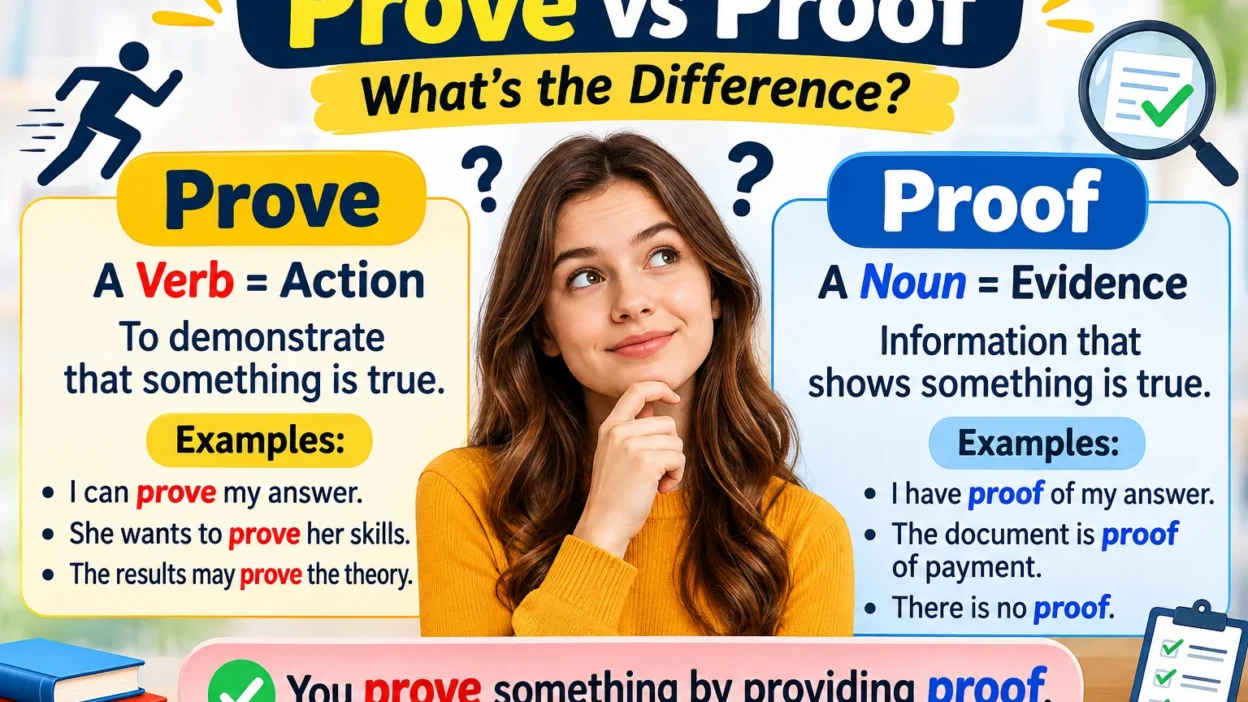
The English words prove and proof look and sound similar, but they have different meanings and grammatical functions. Both are connected to showing that something is true, correct, or real. However, knowing when to use each word can make your writing and speaking much clearer.
The main difference between prove and proof is that prove is a verb, while proof is usually a noun. You use prove when talking about the action of demonstrating that something is true. You use proof when referring to the evidence or information that shows something is true. For example, you can prove your answer by providing proof. Although these words are closely related, they cannot always replace each other in a sentence. Understanding their meanings, common expressions, and grammatical patterns will help you avoid mistakes in everyday English, academic writing, and professional communication.
Quick Answer: Prove vs Proof
Prove is a verb meaning to show that something is true, correct, or valid. Proof is a noun meaning evidence or information that demonstrates something is true. For example, “I can prove my point” uses a verb, while “I have proof” uses a noun. Remember: you prove something using proof.
Why Do People Confuse Prove and Proof?
People often confuse prove and proof because they share the same word origin and are closely connected in meaning.
Both words relate to demonstrating truth, correctness, or validity. Their similar spelling also makes them easy to mix up, especially for English learners.
However, their grammatical roles are different:
- Prove: Describes an action.
- Proof: Describes evidence or confirmation.
For example:
- She wants to prove her innocence.
- She has proof of her innocence.
Both sentences communicate a similar idea, but they use different grammatical structures.
1. What Does Prove Mean?
Prove is a verb that means to demonstrate or establish that something is true, correct, or genuine through evidence, facts, reasoning, or actions.
It describes the process of showing that a statement, belief, claim, or idea is accurate.
Examples of Prove in Sentences
- She worked hard to prove her abilities.
- The scientist hopes to prove the theory.
- Can you prove that your answer is correct?
- He wants to prove his innocence.
- This experiment may prove our hypothesis.
Common Expressions with Prove
- Prove a point: Show that your opinion or argument is correct.
- Prove someone wrong: Demonstrate that another person’s statement is incorrect.
- Prove yourself: Show your abilities or worth through actions.
- Prove useful: Turn out to be helpful.
- Prove effective: Demonstrate that something works successfully.
2. What Does Proof Mean?
Proof is usually a noun that means evidence, facts, or information that establishes if something is true or correct.
It refers to something that supports a claim, confirms a fact, or demonstrates the truth of a statement.
In mathematics and logic, proof can also mean a logical argument that establishes a conclusion.
Examples of Proof in Sentences
- Do you have proof of your identity?
- The police found proof of his involvement.
- There is no proof that the story is true.
- She provided proof of payment.
- The teacher asked for proof of the answer.
Common Expressions with Proof
- Proof of identity: A document or evidence confirming who someone is.
- Proof of payment: Evidence that a payment has been made.
- Beyond a reasonable doubt: A legal standard of proof in criminal cases.
- Proof of concept: Evidence that an idea or system can work.
- Concrete proof: Clear and convincing evidence.
Prove vs Proof: Comparison Table
| Feature | Prove | Proof |
|---|---|---|
| Part of speech | Verb | Noun |
| Meaning | To demonstrate something is true | Evidence that something is true |
| Main purpose | Describes an action | Describes evidence |
| Example | Prove your claim | Show your proof |
| Related form | Proved, proven | Proofs (plural in some contexts) |
| Common phrase | Prove someone wrong | Proof of identity |
When Should You Use Prove or Proof?
Choosing between these words becomes easier when you understand what your sentence needs.
When to Use Prove
Use prove when you want to describe the action of demonstrating that something is true.
Examples:
- I will prove that I am right.
- The results prove the theory.
- She wants to prove her skills.
- Time will prove if this decision was correct.
If you can replace the word with “demonstrate” or “establish,” you probably need prove.
When to Use Proof
Use proof when you are talking about evidence, facts, or information that supports a claim.
Examples:
- We need proof of ownership.
- There is no proof of wrongdoing.
- He showed proof of his qualifications.
- The document serves as proof of payment.
If you can replace the word with “evidence” or “confirmation,” you probably need proof.
15 Examples of Prove vs Proof in Sentences
The following examples show how these words work in everyday English.
| No. | Prove (Verb) | Proof (Noun) |
|---|---|---|
| 1 | I can prove my innocence. | I have proof of my innocence. |
| 2 | She will prove her talent. | Her performance is proof of her talent. |
| 3 | Can you prove your claim? | Do you have proof of your claim? |
| 4 | He tried to prove his point. | He provided proof of his point. |
| 5 | The test may prove the theory. | The results are proof of the theory. |
| 6 | They must prove their identity. | They need proof of identity. |
| 7 | The lawyer will prove the case. | The lawyer presented proof. |
| 8 | This may prove useful. | This is proof of its usefulness. |
| 9 | I want to prove my ability. | My work is proof of my ability. |
| 10 | Scientists aim to prove the idea. | Scientists are looking for proof. |
| 11 | She hopes to prove him wrong. | She has proof that he is wrong. |
| 12 | His actions prove his honesty. | His actions provide proof of honesty. |
| 13 | The experiment will prove the result. | The experiment provides proof of the result. |
| 14 | You cannot prove that rumor. | There is no proof of that rumor. |
| 15 | He worked hard to prove himself. | His success is proof of his hard work. |
Common Mistakes When Using Prove and Proof
Even experienced English learners sometimes use these words incorrectly. Here are some common mistakes and their correct forms.
Mistake 1: Using Proof as a Verb
Incorrect: I will proof that I am right.
Correct: I will prove that I am right.
Why? Prove is the verb needed to describe the action.
Mistake 2: Using Prove as a Noun
Incorrect: Do you have a prove?
Correct: Do you have proof?
Why? Proof is the noun referring to evidence.
Mistake 3: Confusing Prove and Proven
Incorrect: This is a prove fact.
Correct: This is a proven fact.
Why? Proven is the past participle of prove and can work as an adjective.
Mistake 4: Using the Wrong Word in Common Expressions
Incorrect: Please provide prove of payment.
Correct: Please provide proof of payment.
Why? The expression “proof of payment” requires the noun proof.
Mistake 5: Forgetting the Verb Form
Incorrect: She prove her point yesterday.
Correct: She proved her point yesterday.
Why? The past tense of prove is proved. Its past participle can be proved or proven.
Easy Memory Trick: How to Remember Prove vs Proof
Use this simple trick to remember the difference:
- Prove = Action: You do something to demonstrate the truth.
- Proof = Evidence: You have something that demonstrates the truth.
Think of this sentence:
“To prove your answer, you need proof.”
Here, prove describes the action, while proof describes the evidence.
This simple relationship will help you choose the correct word whenever you write or speak English.
Prove vs Proof in American and British English
There is no significant difference between American and British English when it comes to the basic meanings and grammatical uses of prove and proof.
Both varieties use:
- Prove as a verb.
- Proof as a noun.
- Proved as the simple past form of prove.
- Proved and proven as past participles.
For example:
- American English: The results prove his theory.
- British English: The results prove his theory.
Both sentences are grammatically correct.
The words have the same spelling and general usage in both varieties of English.
Similar Words Related to Prove and Proof
Understanding related vocabulary can help you expand your English knowledge.
| Word | Part of Speech | Meaning |
|---|---|---|
| Prove | Verb | Demonstrate that something is true |
| Proof | Noun | Evidence supporting a statement |
| Proven | Adjective / past participle | Demonstrated to be true or effective |
| Evidence | Noun | Information supporting a claim |
| Verify | Verb | Check that something is accurate |
| Confirm | Verb | Establish that something is correct |
| Demonstrate | Verb | Show how or why something is true |
| Validation | Noun | The process of confirming validity |
| Verification | Noun | The process of checking accuracy |
| Testimony | Noun | A formal statement or account of facts |
These words are related, but they are not always interchangeable. For example, verify means to check something, while prove means to establish that it is true.
Final Verdict: Prove vs Proof
The difference between prove and proof is simple once you understand their grammatical roles.
- Prove is a verb that means to demonstrate that something is true or correct.
- Proof is a noun that means evidence or information supporting a statement.
For example:
- You must prove your claim.
- You must provide proof of your claim.
Both words are connected, but they serve different purposes in a sentence. Use prove for an action and proof for evidence.
Frequently Asked Questions (FAQs)
1. What is the main difference between prove and proof?
The main difference is their part of speech. Prove is a verb meaning to demonstrate that something is true, while proof is a noun referring to evidence that supports a claim.
2. Is prove a noun or a verb?
Prove is a verb. It describes the action of demonstrating that something is true, correct, or valid.
Example: She wants to prove her point.
3. Is proof a noun or a verb?
Proof is usually a noun. It refers to evidence or information that establishes the truth of something.
Example: We need proof before making a decision.
4. Is it correct to say “prove me wrong”?
Yes, “prove me wrong” is a grammatically correct expression. It means demonstrating through evidence or facts that someone’s statement or belief is incorrect.
Example: If you disagree, prove me wrong.
5. What is the past tense of prove?
The simple past tense of prove is proved.
Example: He proved his theory with scientific evidence.
6. What is the difference between proved and proven?
Both proved and proven are forms of the verb prove. Proved is used as the simple past form and can also be a past participle. Proven is commonly used as a past participle and as an adjective.
Examples:
- She proved her point.
- This is a proven method.
7. Can proof be used as a verb?
In ordinary English, proof is mainly a noun. However, it can also be used as a specialized verb in contexts such as printing, where it means to check or prepare a proof. For general writing, use prove when you mean demonstrate that something is true.
Remember This
PROVE
Verb = Action
To demonstrate that something is true.
Example: I can prove my answer.
PROOF
Noun = Evidence
Information that shows something is true.
Example: I have proof of my answer.
Easy rule: You prove something by providing proof.
Conclusion
Understanding the difference between prove and proof is important for clear and accurate English communication. Although these words are closely related, they have different grammatical functions. Prove is a verb used to describe the action of demonstrating something, whereas proof is a noun used to describe the evidence supporting that demonstration.
The easiest way to remember their difference is that you prove a statement by presenting proof. Practice using both words in everyday sentences, pay attention to their grammatical roles, and you will become more confident using them in conversations, academic assignments, and professional writing.

John Tyler is a dream researcher and content writer at SleepCout, sharing insightful articles about coded dreams, dream meanings, symbolism, sleep psychology, and practical guidance to help readers understand their dreams.