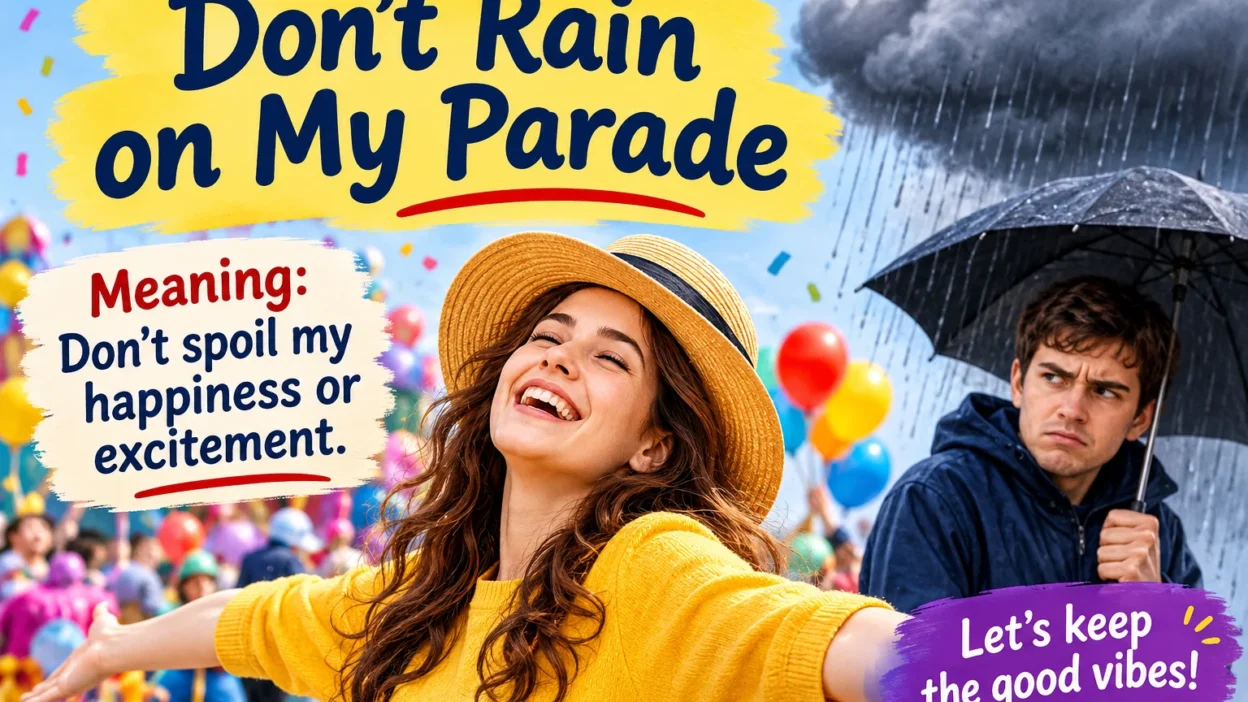
Have you ever felt excited about something, only for someone to criticize your plans or spoil your happiness? English has a colorful expression for this situation: “Don’t rain on my parade.” This popular idiom is used when someone wants another person to stop ruining their excitement, enthusiasm, or special moment. It is a friendly but sometimes firm way of saying, “Let me enjoy this without bringing me down.”
The phrase is commonly used in everyday conversations, informal discussions, and even professional settings when people want to protect their positive feelings. Understanding its meaning, usage, and examples can help you recognize it in conversations and use it naturally. if you are an English learner or a fluent speaker, learning this expression will add personality and emotion to your vocabulary.
Quick Answer: What Does “Don’t Rain on My Parade” Mean?
“Don’t rain on my parade” is an English idiom that means don’t spoil my happiness, excitement, plans, or special moment with negativity or criticism. People use it when someone says or does something that threatens to ruin their enthusiasm. It is generally informal and can sound playful or serious, depending on the situation.
Why Do People Confuse “Don’t Rain on My Parade”?
People sometimes misunderstand this expression because its literal meaning sounds like a warning about bad weather during a parade.
However, the phrase is not usually about actual rain or a real parade. It uses figurative language to describe someone ruining another person’s happiness.
The confusion often comes from three things:
- Literal meaning: Rain falling during a parade or outdoor celebration.
- Figurative meaning: Someone spoiling another person’s excitement or happiness.
- Emotional meaning: Asking someone to stop being negative and allow you to enjoy something.
For example:
“I finally got the job! Don’t rain on my parade by telling me how difficult the work will be.”
Here, the speaker is not talking about weather. They simply want to enjoy their good news without hearing negative comments.
First Word: What Does “Rain” Mean?
The word “rain” literally refers to water falling from clouds. However, in this idiom, it has a figurative meaning.
It represents something negative that interrupts happiness, excitement, or a positive experience.
Consider these examples:
- Don’t rain on my parade. I’m excited about the trip!
- His negative comments rained on our excitement.
- I don’t want anyone to rain on my happiness today.
The word “rain” creates an image of something unpleasant falling on an otherwise enjoyable occasion.
Second Word: What Does “Parade” Mean?
A “parade” is a public celebration or procession in which people march, perform, or display something special. Parades are often associated with happiness, excitement, music, and celebration.
In the idiom, “my parade” represents something that makes a person happy or excited.
It can refer to:
- A personal achievement.
- An exciting new opportunity.
- A celebration or special occasion.
- A future plan or dream.
- A positive experience.
For example:
“I’m finally going to start my own business. Please don’t rain on my parade!”
Here, the parade represents the speaker’s excitement about starting a business.
“Don’t Rain on My Parade” Meaning: Comparison Table
| Expression | Meaning | Example |
|---|---|---|
| Don’t rain on my parade | Don’t spoil my happiness | I’m excited, so don’t rain on my parade. |
| Rain on someone’s parade | Spoil someone’s excitement | His criticism rained on her parade. |
| Don’t spoil the fun | Don’t ruin an enjoyable experience | Don’t spoil the fun with complaints. |
| Bring someone down | Make someone feel less happy | Don’t bring me down today. |
| Burst someone’s bubble | Destroy someone’s excitement or expectations | I don’t want to burst your bubble. |
When to Use “Don’t Rain on My Parade”
Use this idiom when someone is making negative comments, criticizing your plans, or reducing your excitement about something positive.
Here are some common situations where it fits naturally.
1. When sharing good news
Use it when you are excited about an achievement and someone responds negatively.
Example: “I passed my driving test! Don’t rain on my parade by reminding me how expensive a car is.”
2. When discussing future plans
Use it when someone questions your plans before you have had a chance to enjoy them.
Example: “I’m planning a trip to Italy. Don’t rain on my parade by listing every possible problem.”
3. When celebrating an achievement
Use it when someone focuses on the negative instead of appreciating your success.
Example: “I got promoted! Don’t rain on my parade by saying I will have more responsibilities.”
4. When feeling optimistic
Use it when you want to maintain a positive attitude.
Example: “I know the competition will be tough, but don’t rain on my parade. I’m feeling confident!”
15 Examples of “Don’t Rain on My Parade” in Sentences
Here are 15 practical examples showing how to use this idiom in everyday English.
- I’m finally going on vacation, so don’t rain on my parade by talking about work.
- I know the project will be difficult, but don’t rain on my parade before I even start.
- She was excited about her new job, but her friend’s negative comments rained on her parade.
- Don’t rain on my parade! I’ve worked hard to achieve this goal.
- I’m getting married next month, and I don’t want anyone to rain on my parade.
- He was celebrating his promotion when his colleague rained on his parade by mentioning the extra workload.
- I know my plan isn’t perfect, but please don’t rain on my parade.
- Everyone was excited about the weekend trip until Mark rained on their parade with his complaints.
- Let me enjoy my success for a moment. Don’t rain on my parade!
- My parents supported my decision instead of raining on my parade with unnecessary criticism.
- I’m confident that our team can win. Don’t rain on my parade!
- She didn’t want her friends to rain on her parade by questioning her decision.
- We were excited about buying our first house, but the unexpected expenses rained on our parade.
- I understand your concerns, but there’s no need to rain on my parade.
- He smiled and said, “Don’t rain on my parade. Today is my day to celebrate!”
Common Mistakes When Using “Don’t Rain on My Parade”
Although this idiom is easy to understand, English learners sometimes make mistakes when using it.
1. Taking the expression literally
Incorrect understanding: Thinking the expression is only about actual rain during a parade.
Correct understanding: It usually means spoiling someone’s happiness or excitement.
2. Using the wrong preposition
Incorrect: Don’t rain in my parade.
Correct: Don’t rain on my parade.
The correct expression uses the preposition “on.”
3. Using it in overly formal situations
The idiom is conversational and informal. It may sound too casual in highly formal business writing or official documents.
4. Confusing it with being realistic
The expression does not mean that people should never offer advice or point out genuine problems.
It simply asks others not to unnecessarily spoil a positive moment.
5. Forgetting the possessive pronoun
The expression changes depending on whose happiness or excitement is being discussed:
- Don’t rain on my parade.
- Don’t rain on her parade.
- Don’t rain on his parade.
- Don’t rain on their parade.
Memory Trick: How to Remember “Don’t Rain on My Parade”
Imagine yourself enjoying a beautiful parade filled with music, colors, and celebration. Suddenly, dark clouds appear and heavy rain starts falling.
The rain ruins the celebration.
Now connect that picture to the idiom:
- Rain: Something negative.
- Parade: Your happiness or excitement.
- Don’t rain on my parade: Don’t let negativity ruin my happiness.
This simple mental picture makes the expression easier to remember.
American vs. British English: Is the Expression Different?
“Don’t rain on my parade” is understood in both American and British English.
There is no significant difference in its basic meaning or grammatical structure.
| Feature | American English | British English |
|---|---|---|
| Expression | Don’t rain on my parade | Don’t rain on my parade |
| Meaning | Don’t spoil my happiness | Don’t spoil my happiness |
| Usage | Informal conversations | Informal conversations |
| Tone | Playful or serious | Playful or serious |
The expression is also recognized in other varieties of English. Its meaning remains essentially the same regardless of location.
Similar Words and Expressions
Several English idioms and expressions communicate a similar idea. However, their meanings are not always identical.
1. Burst someone’s bubble
Meaning: To destroy someone’s excitement or unrealistic expectations.
Example: “I hate to burst your bubble, but the concert tickets are already sold out.”
2. Bring someone down
Meaning: To make someone feel sad, disappointed, or less positive.
Example: “Don’t let negative people bring you down.”
3. Spoil someone’s fun
Meaning: To ruin someone’s enjoyment of an activity.
Example: “Stop complaining and don’t spoil everyone’s fun.”
4. Put a damper on something
Meaning: To make an enjoyable event or experience less exciting.
Example: “The unexpected rain put a damper on our outdoor party.”
5. Rain on someone’s parade
Meaning: To spoil someone’s happiness, excitement, or plans.
Example: “I don’t want to rain on your parade, but you should check the travel dates.”
6. Throw cold water on something
Meaning: To discourage an idea, plan, or proposal.
Example: “His manager threw cold water on his suggestion.”
Final Verdict: What Does “Don’t Rain on My Parade” Really Mean?
“Don’t rain on my parade” is a popular English idiom that means don’t spoil my happiness, excitement, plans, or special moment by being negative.
It is commonly used when someone wants to enjoy a positive experience without unnecessary criticism or discouragement.
Remember that the expression is figurative, not literal. It is a natural way to ask someone to respect your excitement and let you enjoy the moment.
Frequently Asked Questions (FAQs)
1. What does “don’t rain on my parade” mean in simple words?
It means don’t spoil my happiness or excitement. People use this expression when someone makes negative comments that could ruin a positive experience or special moment.
2. Is “don’t rain on my parade” an idiom?
Yes, it is a common English idiom. Its meaning is figurative because it does not refer to actual rain or a real parade. Instead, it describes someone spoiling another person’s happiness.
3. Is “don’t rain on my parade” positive or negative?
The expression is generally used to protect a positive feeling, but its tone can be slightly negative or defensive. It is often said when someone is being overly critical or discouraging.
4. What is another way to say “don’t rain on my parade”?
You can say:
- Don’t spoil my fun.
- Don’t bring me down.
- Let me enjoy this moment.
- Don’t spoil my happiness.
- Don’t burst my bubble.
These expressions have similar meanings, although they are not always interchangeable.
5. Can I use “don’t rain on my parade” in a professional setting?
Yes, but it depends on the situation. It can work in friendly workplace conversations when discussing achievements or exciting plans. However, it is usually better to use more formal language in official business communication.
6. What is the origin of “don’t rain on my parade”?
The expression is associated with the imagery of rain ruining an enjoyable outdoor celebration. It became especially famous through the song “Don’t Rain on My Parade” from the 1964 Broadway musical Funny Girl, which was later featured in the 1968 film adaptation.
7. What does “you’re raining on my parade” mean?
It means that someone is spoiling your happiness, excitement, or enthusiasm through negative comments or discouraging behavior.
For example: “I was excited about my new project, but you’re raining on my parade with all these complaints.”
Remember This
- Don’t rain on my parade means don’t spoil my happiness or excitement.
- It is an informal English idiom.
- “Rain” represents negativity or disappointment.
- “Parade” represents something enjoyable or exciting.
- It is commonly used when someone is being unnecessarily negative about another person’s plans or achievements.
Conclusion
Learning the expression “don’t rain on my parade” helps you understand how English speakers communicate emotions, excitement, and frustration in everyday conversations. It is a useful idiom for situations where someone wants to protect their happiness from unnecessary negativity or criticism. Its meaning is simple: let people enjoy their special moments without bringing them down.
The next time someone criticizes your exciting plans or focuses only on the negative, you can naturally say, “Don’t rain on my parade!” Remember that this expression is informal, friendly in many situations, and sometimes a little assertive. Use it when you want to keep your enthusiasm alive and enjoy the moment.

Charles Kyle is a passionate writer and dream researcher at SleepCout, dedicated to exploring coded dreams, lucid dreaming, dream symbolism, and sleep science. He creates engaging, well-researched content that helps readers understand their dreams and discover the fascinating connection between technology, imagination, and the sleeping mind.